Have you ever heard someone say, "Use your inside voice," or "Please speak up so we can hear you"? Those reminders happen because speaking is not only about what you say. It is also about how you say it. A strong speaker knows how to make words clear, easy to hear, and right for the moment. The same person may talk one way during lunch with friends and another way when sharing ideas with the class.
When you speak clearly, people can understand your message. When you choose the right volume and the right tone of voice, people are more likely to listen. Good speakers think about their audience, or the people who are listening, and their purpose, or the reason they are speaking. Are they telling a story, asking a question, giving directions, or speaking to show respect? The answers help them decide how to use their voices.
Clear speaking means saying words in a way that listeners can easily hear and understand. It includes speaking at the right speed, saying words carefully, and choosing an appropriate volume and pitch.
Volume is how loud or soft your voice is. Pitch is how high or low your voice sounds.
Clear speaking begins with pronunciation. That means saying words correctly instead of mumbling or swallowing sounds. If a student says, "I brng my buk," the listener may not understand. If the student says, "I brought my book," the message is much clearer.
Clear speaking also means not talking too fast. When people rush, words can bump together. When they speak much too slowly, listeners may lose interest. A comfortable speed helps others follow along. Clear speaking is like making a path for your listener. Each word should help guide the listener forward.
Your face and body can support clear speaking too. Looking at the person you are talking to, standing or sitting up straight, and opening your mouth enough to form words all help your message come through.
A speaker should match volume to the place and situation, as [Figure 1] shows. A voice that works well in one setting may be a poor choice in another. If you whisper on a noisy playground, no one will hear you. If you shout in a library, you will disturb others.
Volume should be soft, medium, or loud depending on what you need. Soft volume works when people are close and the setting is quiet. Medium volume often works best in a classroom conversation. Loud volume may be needed outside, across a field, or on a stage.
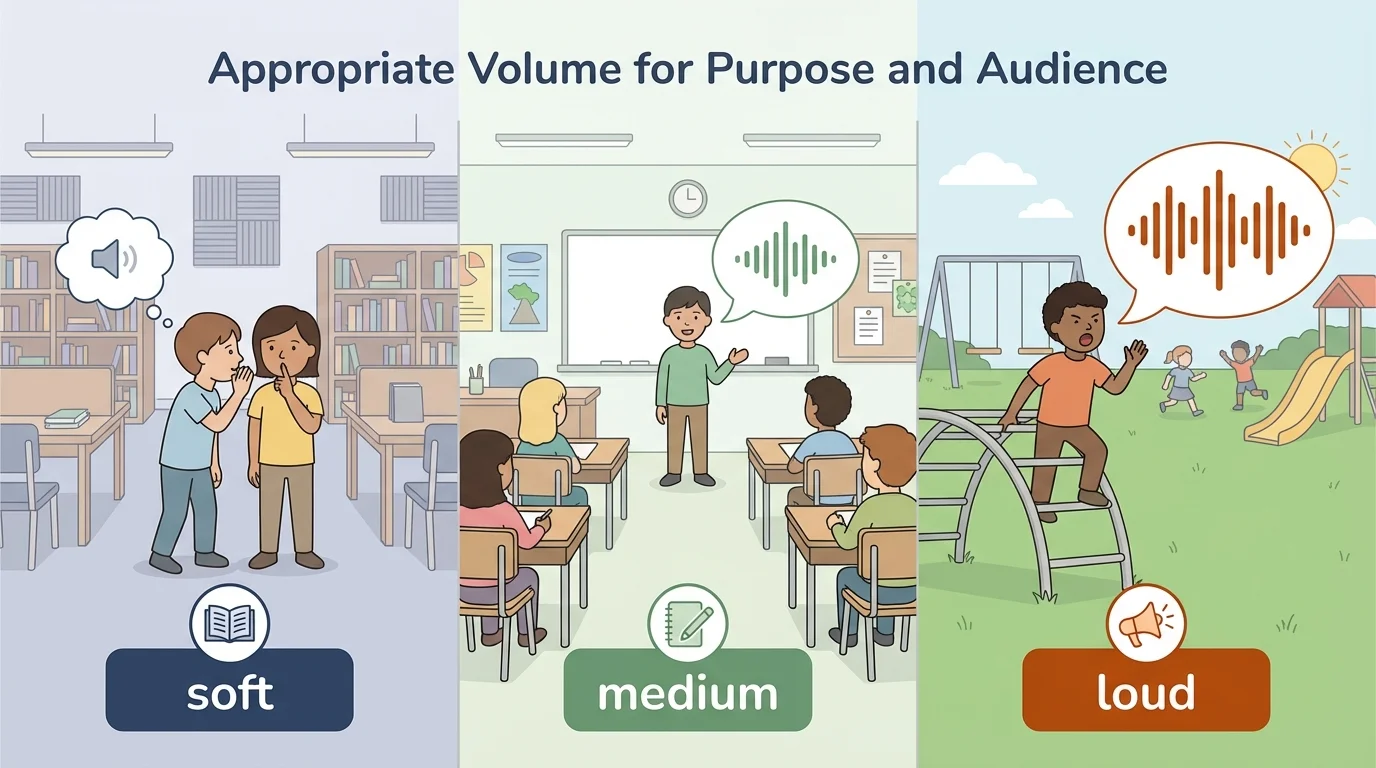
Think about these examples. If you are reading with a partner, a soft or medium voice is enough. If you are answering a question so the whole class can hear, use a stronger classroom voice. If you are calling to a teammate during recess, you may need a louder voice. The goal is not to be loud all the time. The goal is to be heard by the people who need to hear you.
Very low volume can cause problems. Listeners may miss important words and ask you to repeat yourself. Very high volume can also cause problems. It may sound rude, startling, or out of control. Good speakers adjust. They think, "How far away is my listener? How noisy is this place? How many people need to hear me?"
Choosing the right volume in different situations
Step 1: Talking to one friend during silent reading
Use a soft voice because the room is quiet and only one person needs to hear.
Step 2: Sharing an answer with the class
Use a medium-to-strong classroom voice so everyone can hear without feeling like you are shouting.
Step 3: Warning someone on the playground
Use a loud, clear voice because the area is noisy and the message may be urgent.
In each case, the best volume depends on the setting and the need.
Later, when you compare formal and informal speaking, [Figure 1] still helps. It reminds us that voice level changes with the place, not just with the words we choose.
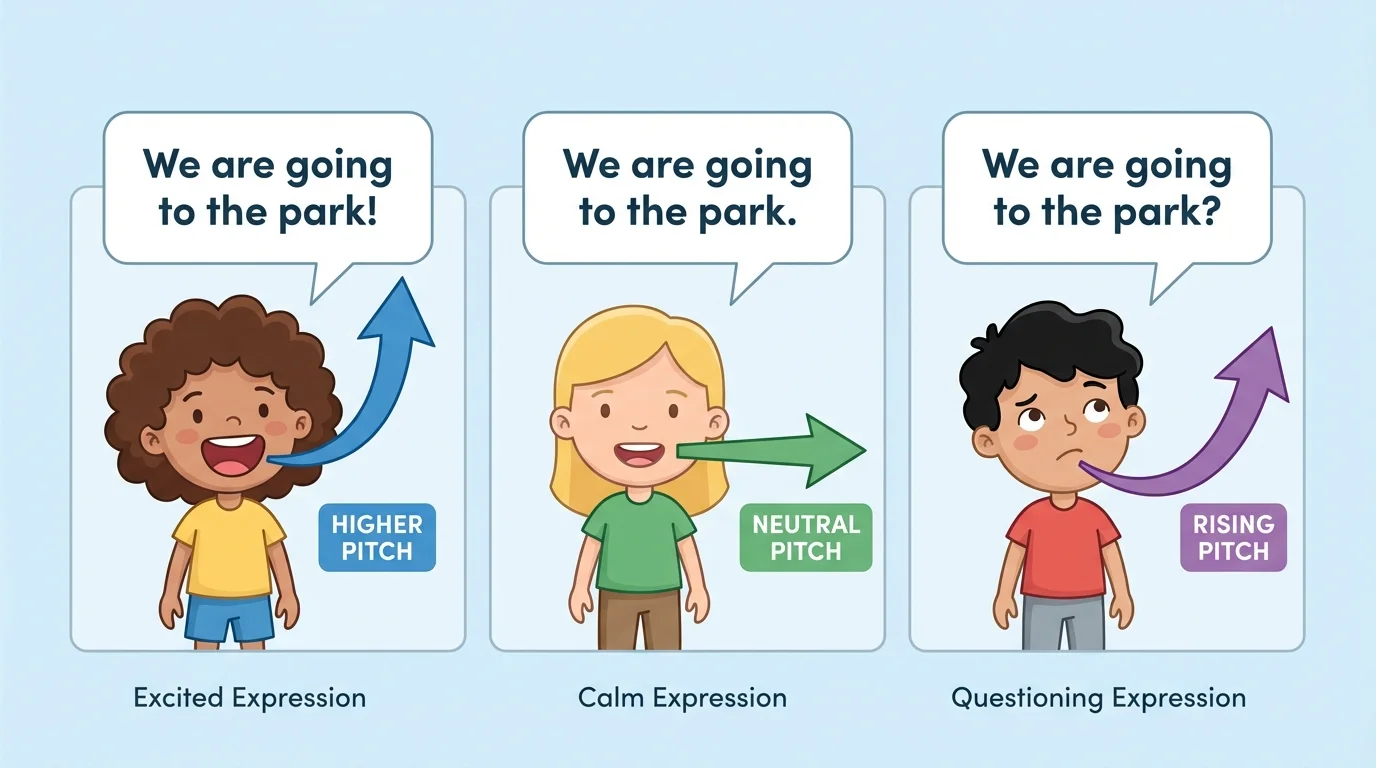
As [Figure 2] illustrates, your voice also has pitch, and pitch helps listeners understand feeling and meaning. A high pitch may sound excited, surprised, or questioning. A lower pitch may sound calm, serious, or steady. Neither is always better. What matters is whether the pitch fits the message.
If you ask, "Are we lining up now?" your voice often rises at the end. If you say, "We are lining up now," your voice may stay steadier or drop a little. Pitch changes can help your listener know whether you are asking, telling, wondering, or reacting.
Pitch also adds expression. Listen to someone read a story in a flat voice with almost no change at all. It can sound boring and confusing. Now listen to someone who changes pitch to show excitement, mystery, worry, or joy. The story becomes easier to understand because the voice carries clues.
That does not mean speaking in a silly or dramatic way all the time. It means letting your voice match your meaning. If you are giving safety instructions, your pitch should sound calm and serious. If you are cheering for a team, your pitch may rise with energy. If you are comforting a classmate, a gentle, lower pitch may feel kinder.
Your brain notices tiny changes in voices very quickly. Even before people fully think about the words, they often notice whether a voice sounds calm, worried, excited, or angry.
Pitch works together with volume. A person can speak loudly with excitement, softly with kindness, or firmly with seriousness. As you saw in [Figure 2], the same words can sound very different depending on how the voice rises or falls.
Before speaking, it helps to ask two questions: "Why am I speaking?" and "Who is listening?" Those questions lead you to the right choices. If your purpose is to tell a funny story to friends, your voice may sound relaxed and playful. If your purpose is to explain how to solve a problem in front of the class, your voice should be steadier and more careful.
The audience matters too. You might speak one way to your best friend, another way to your teacher, and another way to a younger child. The words, tone, volume, and pitch can all change. A younger child may need simple directions said slowly and kindly. A principal or guest speaker may expect respectful language and a calm speaking style.
Matching your voice to the situation
Strong speakers do not use one voice for every moment. They think about where they are, why they are speaking, and who needs to understand them. Then they adjust their words, volume, pitch, and speed.
Here are some examples. When asking a friend, "Want to play tag?" you might use an easy, cheerful voice. When asking a teacher, "May I please sharpen my pencil?" you would likely use a respectful tone and clear medium volume. When speaking to the whole class, you might say, "First, we measured the plant. Then, we wrote down the height," using a strong voice so everyone can hear each step.
As [Figure 3] demonstrates, some situations are informal speaking, and some are formal speaking. Informal speaking is casual. It often happens with friends or family. Formal speaking is more careful and respectful. It happens when the setting is serious or when you are speaking to a group, a teacher, or another adult in an important situation.
In an informal situation, you might say, "That game was awesome!" In a formal situation, you might say, "I enjoyed the game because the players worked well together." Both sentences communicate, but they fit different moments.

Formal speaking does not mean sounding stiff or unfriendly. It means choosing words and a voice that show respect. You may stand a little straighter, speak a little slower, and avoid slang. Your volume should still fit the room, and your pitch should still sound natural, but the overall style becomes more polished.
| Situation | Type of Speaking | Possible Voice Choice |
|---|---|---|
| Talking with a friend at recess | Informal | Relaxed, cheerful, medium volume |
| Answering a teacher in class | More formal | Clear, respectful, strong classroom voice |
| Presenting to the class | Formal | Steady, confident, easy to hear |
| Speaking in the library | Formal and quiet | Soft, controlled, careful |
Table 1. Examples of how speaking style changes with the situation.
When you look back at [Figure 3], you can notice that the speaker changes more than just words. The body posture, voice strength, and respectful tone all help fit the audience and purpose.
One of the best ways to become a better speaker is to listen to yourself. That does not always mean using a recording, although recordings can help. It also means paying attention while you speak. Ask yourself: "Am I speaking clearly? Can people hear me? Do I sound calm, respectful, or excited in the right way?"
Sometimes a speaker starts too quietly because of nervousness. Sometimes a speaker gets louder and faster without noticing. Good speakers make small changes while they talk. They pause, take a breath, and continue in a clearer way.
Think about conversations you have had before. If someone asked you to repeat your words, it may have been because your speech was too soft, too fast, or not clear enough. That memory can help you improve.
You can also watch your listeners. Are they leaning in because they cannot hear? Are they looking confused? Are they nodding because your message makes sense? Listeners give clues. Careful speakers notice those clues and adjust.
One common problem is mumbling. A person may move the lips very little or speak with words stuck together. The fix is to open the mouth more, slow down a bit, and say each word on purpose.
Another problem is shouting when it is not needed. Shouting can make listeners uncomfortable. Instead, use enough power to be heard, but keep your voice controlled. A speaker can be strong without being harsh.
A third problem is speaking in a flat way with almost no change in pitch. This is sometimes called speaking in a monotone. A monotone voice can make a story, explanation, or question harder to follow. To fix it, think about the feeling and meaning of the message. Let your voice rise and fall naturally.
Fixing common speaking problems
Step 1: Notice the problem
Example: "People keep saying, 'What?' after I speak."
Step 2: Identify the cause
You may be too soft, too fast, or mumbling.
Step 3: Make one change
Try slowing down, speaking a little louder, and finishing each word.
Step 4: Check the result
If listeners understand you better, keep using that change.
Improvement happens when you notice, adjust, and try again.
Some students worry that changing volume or pitch will make them sound strange. Actually, flexible voices usually sound more natural. People expect a voice to change with the place, message, and feeling.
Clear speaking is not only about being understood. It is also about treating others well. A respectful voice can help people feel safe and included. Even when you disagree, you can speak firmly without sounding mean.
Confidence helps too. If you take a breath, lift your head, and say your words clearly, people are more likely to pay attention. Confidence does not mean acting perfect. It means trusting that your ideas matter and sharing them in a way others can understand.
"Say what you mean clearly, and say it kindly."
Breathing can help control your voice. When you take a steady breath before speaking, your words often come out stronger and calmer. Good posture helps the voice travel. Looking at listeners shows that you are connected to them. All of these habits support clear oral expression.
Whether you are talking with one friend, asking a question in class, reading aloud, or giving a presentation, your voice is a tool. Use it wisely. Choose the right volume. Change your pitch to fit your meaning. Think about your purpose and your audience. When you do, your words become easier to hear, easier to understand, and more powerful.
