Have you ever told a story and noticed that people looked confused because you skipped an important part? Or maybe you explained something to a friend one way, but spoke very differently to a teacher. Good speakers do more than talk. They choose the right ideas, put them in a clear order, and use words that fit the people who are listening.
When you speak, you are sharing ideas with an audience. Your audience might be one friend, your whole class, a teacher, or another adult. The way you organize your ideas and the way you speak should match that audience. Speaking clearly helps people understand you, and speaking appropriately shows respect.
Speaking is easier to understand when ideas are arranged in a sensible way. If you jump from one thought to another, listeners may not know what happened first, what matters most, or what you want them to remember. Clear organization is like giving your listener a path to follow.
Audience means the person or group listening to a speaker. Formal language is careful, polite language used in serious or respectful situations. Informal language is relaxed, everyday language used with friends or in casual situations.
Organization also helps the speaker. When you know your order, you are less likely to forget important parts. You can focus on speaking clearly instead of trying to think of what comes next at the last second.
Before speaking, it helps to ask, "Who is listening?" This question shapes your word choice, tone, and the amount of detail you give. A audience of classmates may understand simple school examples. A principal or other adult may expect more polite words and a more careful explanation.
Your purpose matters too. Are you telling what happened? Giving directions? Sharing information? Asking for help? Different purposes call for different kinds of organization. If you are explaining how to plant a seed, sequence works well. If you are giving a report about frogs, major points work well.
You should also think about what your audience already knows. If you are talking to a friend who was with you at recess, you do not need to explain every small detail. If you are talking to a teacher who did not see what happened, you may need to include more important information.
Strong speakers often change the same message to fit different listeners. A student might say one thing at lunch with friends and express the same idea much more politely during a class presentation.
Knowing your audience helps you choose the best words. It also helps you decide whether your speech should sound casual and friendly or careful and respectful.
[Figure 1] shows two very useful ways to organize spoken ideas. One way is to put ideas in sequence, which means in order. The other way is to organize around major points, which means grouping details under the big ideas.
Both ways can be excellent. The best choice depends on what you are saying. If time order matters, sequence is best. If your speech has several important parts, major points may be easier for listeners to follow.
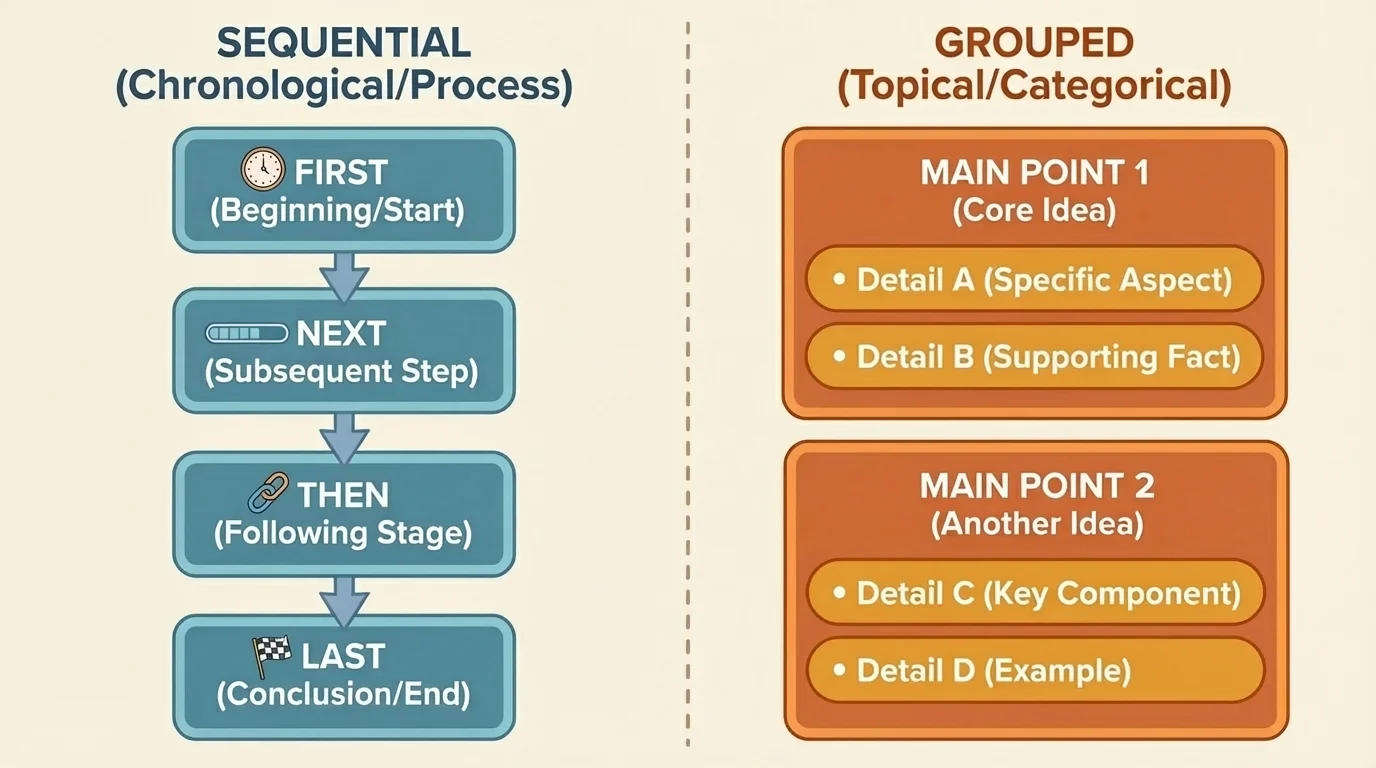
Think of sequence as walking along stepping-stones. Each step leads to the next one. Think of major points as packing items into labeled boxes. Each box holds details that belong together.
Sequential organization means arranging ideas in the order they happen or should happen. This is useful for retelling events, giving directions, explaining a process, or describing a routine.
Signal words help listeners follow the order. Words such as first, next, then, after that, and finally show sequence clearly. These words act like signs on a road.
For example, if a student explains how to wash hands, the speech might go in this order: first turn on the water, next wet your hands, then add soap, after that scrub, and finally rinse and dry. If the speaker mixes up the steps, the explanation becomes harder to follow.
Example: Speaking in sequence
A student tells how the class got ready for a field trip.
Step 1: Begin with what happened first.
"First, our teacher checked everyone's permission slips."
Step 2: Add what happened next.
"Next, we lined up by the door and counted our groups."
Step 3: Continue in order.
"Then, we walked to the bus and found our seats."
Step 4: End with the last important part.
"Finally, we arrived at the museum and met our guide."
This order helps listeners picture the events clearly.
Sequence works especially well when the listener needs to know exactly what comes before or after something else. It is a strong choice for telling stories, giving instructions, and explaining how something is done.
Sometimes a speech is not mainly about time order. Instead, it has several big ideas. In that case, you can organize around major points. A main idea is the big thought you want listeners to remember, and each major point supports that big thought.
For example, if you talk about why reading is important, you might organize your speech into three major points: reading helps you learn new things, reading builds imagination, and reading strengthens vocabulary. Under each point, you can add one or two details.
This style helps listeners because they hear the big parts clearly. They can remember the speech in chunks instead of trying to remember many small details all at once.
Many speakers use a simple structure like this: introduction, major point one, major point two, major point three, and closing. Even a short classroom talk can become clearer when ideas are grouped this way.
| Organization Type | Best Used For | Helpful Signal Words |
|---|---|---|
| Sequence | Directions, stories, events, steps | first, next, then, finally |
| Major points | Reports, explanations, opinions, presentations | one reason, another point, also, in conclusion |
Table 1. This table compares two common ways to organize spoken ideas.
As with the two-part comparison in Figure 1, choosing the right pattern helps the listener know whether to follow a timeline or listen for grouped ideas.
[Figure 2] illustrates how the same idea can be spoken in different ways depending on the situation. Formal language sounds polite, careful, and respectful. Informal language sounds relaxed and casual.
You might use informal language with a friend: "Hey, can you help me with this?" You might use formal language with a teacher or principal: "Excuse me, could you please help me with this?" Both messages ask for help, but the wording changes to fit the audience.
Formal language often includes polite expressions such as please, thank you, excuse me, and may I. Informal language may use shorter expressions, everyday words, and a more relaxed tone.
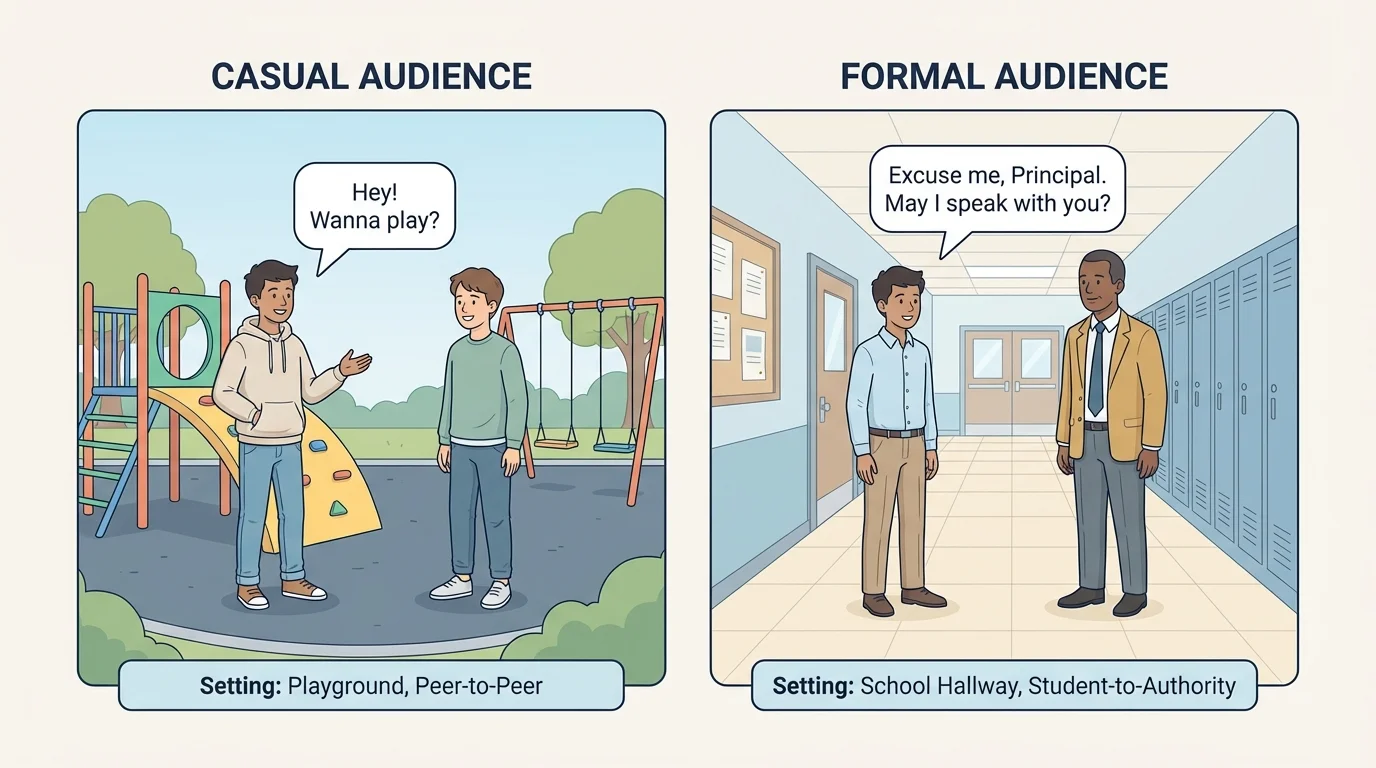
Formal language does not mean using huge, confusing words. It means speaking respectfully and clearly. Informal language does not mean being rude. It simply means the situation is more relaxed.
Matching language to the audience means choosing words that fit the listener and the setting. A classroom presentation, a conversation with the principal, and a talk with a close friend may all use different language, even when the topic is the same.
Here are some examples of how language changes:
| Situation | Informal Language | Formal Language |
|---|---|---|
| Asking to borrow a pencil | "Can I use your pencil?" | "May I borrow your pencil, please?" |
| Disagreeing | "I don't think so." | "I have a different idea." |
| Greeting | "Hi!" | "Good morning." |
Table 2. This table shows how the same kind of message can sound more informal or more formal.
Looking again at Figure 2, you can see that the audience changes not only the words but also the speaker's tone and manner.
[Figure 3] presents a clear path for building a short speaking plan. Before speaking, it is useful to pause and think through a few simple questions.
Ask yourself: Who is my audience? What is my purpose? What is my main idea? Should I organize my ideas in sequence or around major points? What details are important? How should I begin and end?
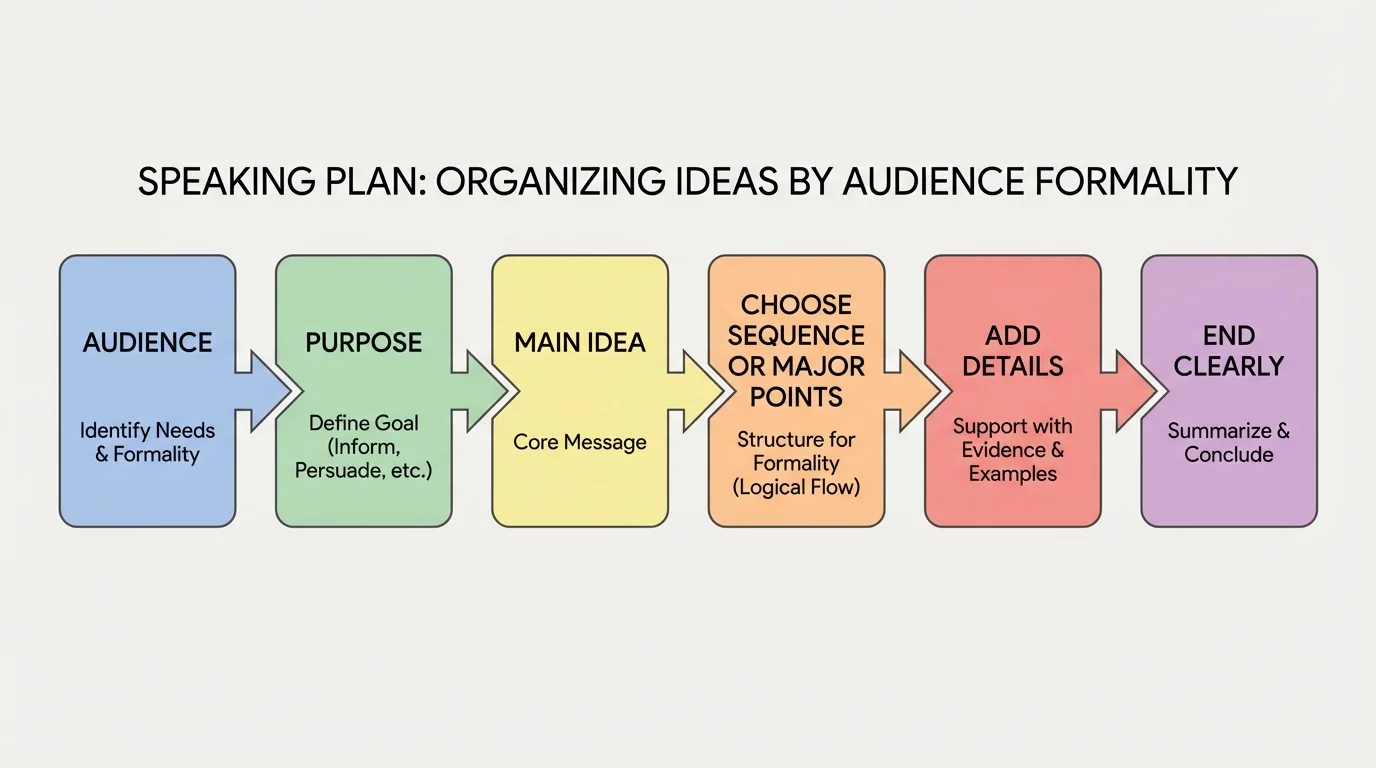
This kind of plan keeps your speech from wandering. It helps you choose only the ideas that matter. It also helps you avoid saying too much or leaving out something important.
Example: Planning a short class talk
A student wants to explain how to care for a class plant.
Step 1: Identify the audience and purpose.
The audience is the class. The purpose is to explain plant care clearly.
Step 2: Choose the best organization.
Because plant care can be explained in steps, sequence is a good choice.
Step 3: Pick the important ideas.
Water the plant, place it in sunlight, and check the soil.
Step 4: Choose fitting language.
The student uses clear school language: "First, check if the soil is dry. Next, give the plant a small amount of water."
The plan makes the speech easier for everyone to understand.
When speakers plan this way, they often sound calmer and more confident. They know where they are going, and their listeners can follow along.
Let's look at how one topic can change depending on audience. Suppose a student wants to explain why they were late to class.
To a friend, the student might say, "I got stuck tying my shoe, and then my papers fell." This is informal because the situation is casual and the friend does not need a polished explanation.
To a teacher, the student might say, "I am sorry I was late. My papers fell in the hallway, and I needed to pick them up." This version is more formal because it shows respect and gives the important reason clearly.
Now suppose the topic is a book report. For classmates, a student might organize the talk around major points such as characters, setting, and favorite part. For giving directions to play a game, that same student would probably organize ideas in sequence, beginning with what players do first.
When you speak clearly, listeners need both good ideas and good order. If either one is missing, the message becomes harder to understand.
The best speakers make choices. They do not say every thought that pops into their heads. They select the ideas that matter most for the audience and the situation.
Good communicators are also good listeners. When you listen carefully, you can notice how another speaker is organized. Are they speaking in order? Are they grouping ideas under major points? Are they using formal or informal language?
Listening can teach you what works well. For example, if a classmate gives directions and uses words like first and next, those signal words help everyone follow the explanation. If a student gives a report and says, "One reason…" and "Another important point…," that helps listeners hear the structure.
Listening also helps you respond appropriately. If someone speaks to you formally, you may answer more formally. If the situation is casual, a more informal reply may fit better.
One common mistake is organizing ideas out of order. A student might tell the ending of a story before the beginning. To fix this, the speaker can think through the events and retell them step by step.
Another mistake is adding too many tiny details. If every detail is included, the main idea may get lost. A stronger choice is to keep the most important details and leave out extras that do not help the audience understand.
A third mistake is using the wrong tone for the audience. Speaking to the principal exactly as you speak to a close friend may sound disrespectful. Speaking too stiffly with a friend may sound unnatural. Matching your language to the audience makes communication smoother.
Some speakers also forget to end clearly. A good ending reminds listeners of the last step or the final major point. It gives the speech a feeling of completion.
"Say what matters, in the order that helps, in the way your audience needs."
This idea is simple but powerful. Clear speaking is not only about words. It is also about planning, order, and respect for the listener.
Strong speakers think before they speak. They choose whether sequence or major points will work better. They pick details that support the purpose. They use words that fit the audience.
They also speak clearly, listen carefully, and notice when listeners seem confused. If needed, they can explain again with a better order or with more suitable language.
Whether you are sharing a story, explaining directions, giving a short report, or talking to an adult, organized ideas help your message make sense. Appropriate language helps your audience feel respected. Together, these skills make oral communication stronger.
