Have you ever tried to tell a friend about a book, an article, or something your teacher read aloud, and you realized you could not tell every single part? That is exactly why summary skills matter. A good reader learns how to pick out the biggest ideas and the details that truly matter. Then the reader can explain the text clearly, briefly, and correctly.
When you summarize, you do not retell everything. You choose the most important ideas. This helps you understand what you read, remember it better, and talk about it with other people. Strong readers use summary skills in reading class, science, social studies, and even everyday conversations.
Summary means a brief explanation of the most important ideas from a text. A summary includes the central idea, which is the main point, and the most important supporting details. It leaves out small or repeated details.
A central idea is what the whole text is mostly about. In a story, the central idea may be about what happens and why it matters. In an informational text, the central idea is the main information the author wants the reader to learn.
A detail is a piece of information from the text. Some details are very important because they help explain the main point. Other details may be interesting, but they are not needed in a short summary.
Think of a summary like packing for a trip. You cannot carry everything in your house. You pack the things you really need. In the same way, a summary carries the most important parts of the text and leaves out the extras.
When you read closely, you already look for who, what, where, when, why, and how. Those questions still help here. They often lead you to the most important information you need for a summary.
A summary should be shorter than the original text. It should also be written in your own words. That means you explain the ideas clearly without copying the author's exact sentences unless your teacher asks for a quote.
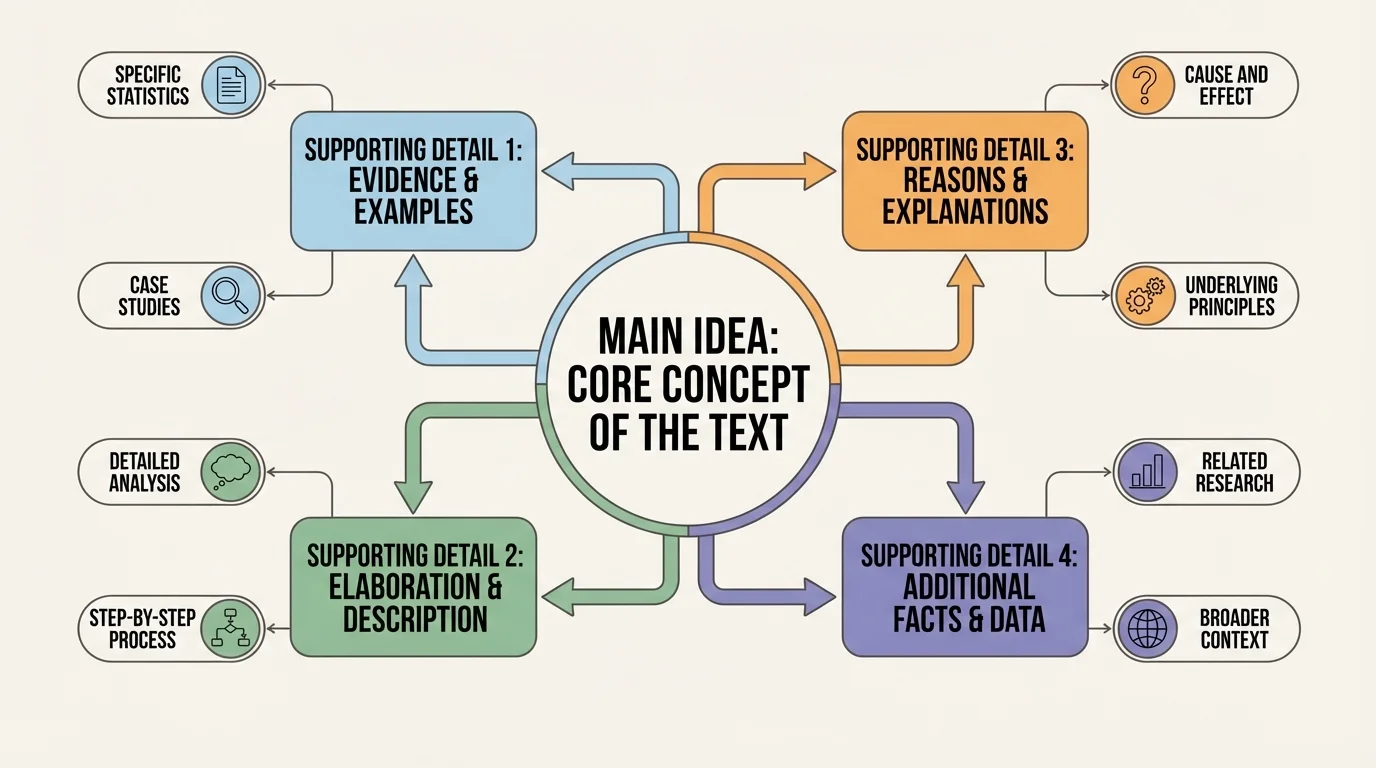
Every text has a big point, and [Figure 1] shows how that big point connects to smaller supporting details. To find the main point, ask yourself, "What is this text mostly about?" Then ask, "What does the author most want me to understand?" Those two questions often lead you to the central idea.
Sometimes the central idea is easy to find because the author says it clearly. Other times, you have to think about the whole text and put the clues together. A title, headings, repeated words, and the first or last sentences of paragraphs can all help.
For example, suppose you read a short article about bees. The article explains that bees move pollen from flower to flower, helping plants grow fruits and seeds. It also tells how some bees are disappearing and why that is a problem. The central idea is not just "bees." That is only the topic. The central idea is something more complete, such as: bees are important because they help plants reproduce.
This is an important difference. The topic is the subject, such as bees, rain forests, or volcanoes. The central idea tells what the text says about that topic.
Topic and central idea are not the same. The topic names the subject. The central idea tells the most important message or information about that subject. If the topic is "dogs," the central idea might be "dogs help people in many ways, such as guiding, guarding, and comforting them."
Readers sometimes choose a detail instead of the central idea. For example, if the bee article mentions that one kind of bee lives alone instead of in a hive, that detail may be interesting, but it is not the main point of the whole text.
As you saw earlier in [Figure 1], the central idea works like the center of a wheel. The important details connect to it and help hold it up.
Once you find the main point, the next job is to choose the details that support it. An important detail gives needed information about the central idea. It may explain, prove, describe, or give an example of the main point.
Suppose a passage says that sea turtles face dangers from plastic in the ocean. Important details might include that turtles can mistake plastic bags for food, plastic can make them sick, and cleaner beaches help protect them. Those details support the central idea.
But maybe the passage also says that one scientist wore blue boots during a beach cleanup. That fact may be true, but it does not help explain the main point. It is not important for a summary.
A helpful way to decide is to ask, "If I leave this detail out, will the reader still understand the main point?" If the answer is yes, that detail may not belong in the summary. If the answer is no, it is probably important.
Choosing important details
Read this short idea: "Lena planted a school garden. Students watered the plants, pulled weeds, and measured how tall the vegetables grew. By summer, the garden produced tomatoes, carrots, and lettuce for the cafeteria."
Step 1: Find the central idea.
The passage is mostly about students working together to grow a school garden.
Step 2: Pick details that support that idea.
Important details are that students watered the plants, pulled weeds, measured growth, and the garden produced vegetables.
Step 3: Say what to leave out.
If the passage had included a tiny fact like the color of Lena's gloves, that would not be needed in the summary.
A strong summary keeps the details that help explain the garden project and leaves out extras.
Important details are not always the longest sentences. Sometimes a short sentence can hold a very big idea. Careful readers think about meaning, not just size.
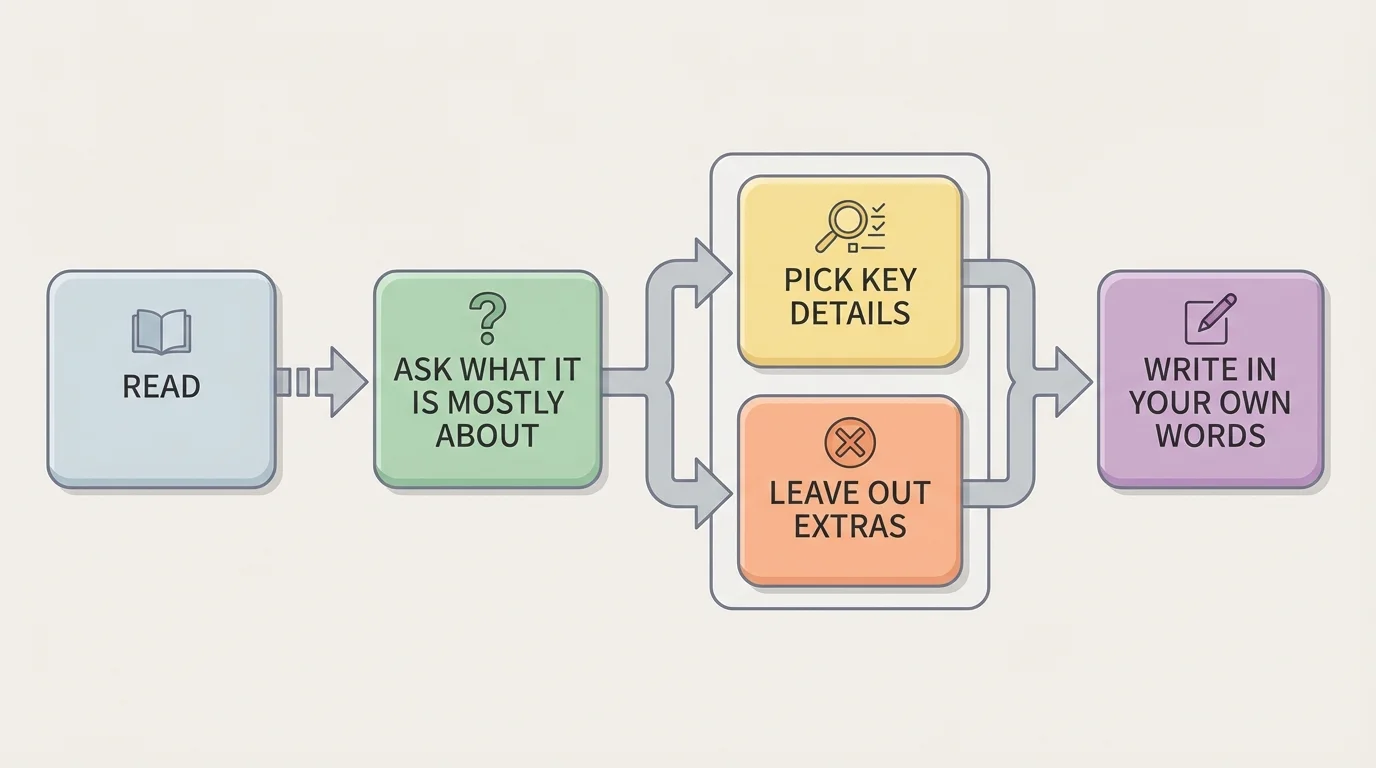
Writing a summary is easier when you follow a clear strategy, and [Figure 2] lays out that process step by step. You do not have to guess. Good readers move through the text in an organized way.
First, read the whole text carefully. If the text is long, pause after each paragraph or section and think about what it was mostly about. Next, identify the central idea. Then choose the important details that support it. After that, leave out repeated ideas, tiny facts, and your own opinions. Finally, write a short explanation in your own words.
It can help to use sentence starters in your thinking, such as "This text is mostly about..." or "The author explains that..." These starters help you focus on the main point instead of wandering into every little detail.
A good summary usually sounds smooth and connected. It is not a list of random facts. The ideas should fit together. You are showing the reader that you understand how the details connect to the central idea.
Here is a short passage: "After a heavy storm, volunteers cleaned trash from a neighborhood park. They picked up plastic bottles, branches, and broken signs. The city replaced damaged benches, and families returned to play there the next weekend." A summary could be: After a storm damaged a neighborhood park, volunteers and the city worked to clean and repair it so people could use it again.
Notice what that summary does. It keeps the big idea and the most important details. It does not list every item that was picked up. It combines the ideas into a clear sentence.
Building a summary from a short informational text
Text: "Penguins have many features that help them survive in cold places. Their thick feathers keep in heat. A layer of fat under their skin also helps them stay warm. They huddle together in groups to protect themselves from icy winds."
Step 1: Find the central idea.
The text is mostly about how penguins stay warm in cold places.
Step 2: Choose important details.
The key details are thick feathers, a layer of fat, and huddling together.
Step 3: Write the summary in your own words.
Penguins survive cold weather by using body features and group behavior to stay warm.
This summary is short, clear, and focused on the main idea.
When you use the process from [Figure 2], summary writing becomes less confusing. You read, sort, choose, and then explain.
Different texts call for different kinds of attention. The goal stays the same: include the central idea and the most important details. But the way you do that can change depending on what you are reading.
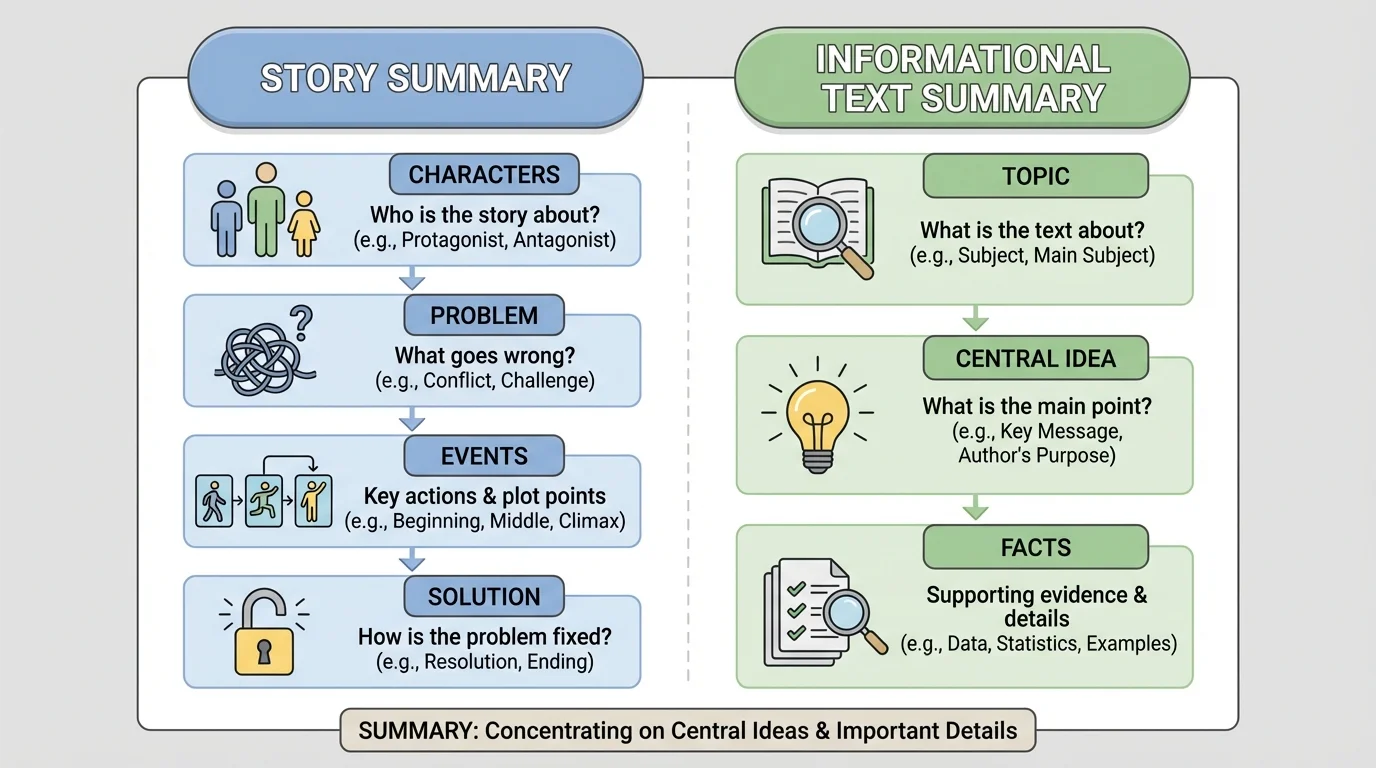
In a story, you usually pay attention to characters, setting, problem, important events, and solution. You do not need every event from beginning to end. You need the events that matter most.
For example, if a story is about a girl who is nervous about joining a spelling bee but gains confidence through practice even though she does not win first place, the summary should focus on her challenge, her hard work, and what she learns. A strong summary might say: A girl overcomes her fear of a spelling bee by practicing and learning that effort and courage matter more than winning.
In an informational text, the summary often sounds different. It focuses more on the topic, central idea, and supporting facts. If a science article explains how frogs change from tadpoles to adults, the summary should mention the stages of change and the main point that frogs go through a life cycle.
Articles, textbooks, directions, biographies, and news reports are all kinds of informational text. Some include headings, captions, and diagrams. These text features can help you locate the most important ideas, but your summary should still be written as connected sentences.
| Type of text | What to focus on in a summary |
|---|---|
| Story | Characters, problem, key events, solution, theme or lesson |
| Informational text | Topic, central idea, important facts, explanations, examples |
| Biography | Who the person is, major life events, accomplishments, importance |
| Article or report | Main issue or topic, major points, strongest supporting details |
Table 1. A comparison of what readers usually include when summarizing different types of texts.
Later, when you compare text types again, [Figure 3] still helps because it reminds you that stories and informational texts are organized in different ways.
News reporters often begin with the most important facts first. That helps readers quickly understand the central idea before learning smaller details.
No matter what kind of text you read, a summary should stay faithful to the text. It should not add made-up information or change what the author meant.
One common mistake is making the summary too long. If you include every event, every fact, and every example, you are retelling, not summarizing.
Another mistake is making the summary too short. If you write only one tiny idea, the reader may not understand the text. A summary needs enough information to explain the central idea clearly.
A third mistake is adding your opinion. For example, if you write, "I think the article was boring," that is not part of the summary. A summary tells what the text says, not whether you liked it.
Copying whole sentences is another problem. It is better to use your own words. That shows you truly understand the text. You may use some important words from the text if needed, but your full summary should sound like your own explanation.
A summary is different from a response. A summary tells the important ideas from the text. A response tells your thoughts, feelings, or opinions about the text. Both can be useful, but they are not the same thing.
Readers also sometimes mix up a topic with the full central idea. Writing "This text is about weather" is not enough if the text really explains how extreme weather can affect communities and safety.
To check your summary, ask yourself these questions: Does it include the main point? Does it include the most important details? Is it in my own words? Did I leave out unneeded parts? If you can answer yes, your summary is probably strong.
Summary skills are not only for reading class. You use them when you tell someone the most important part of a movie, explain the rules of a game, or describe what happened on a field trip.
In science, you may read a page about animal habitats and summarize the main information. In social studies, you may read about an explorer or an event and explain the key ideas. In health class, you may read safety directions and tell the important steps.
Even adults summarize all the time. Teachers summarize chapter ideas. Doctors summarize a patient visit. Coaches summarize a game plan. If people shared every detail every time, it would be hard to understand what mattered most.
Being able to summarize also helps you remember what you learn. When you stop after reading and put the big ideas into your own words, your brain organizes the information better.
Real-life summary example
A class reads a passage about saving water at home. The text explains turning off the faucet while brushing teeth, fixing leaks, and using only the water you need.
Step 1: Name the central idea.
The passage is mostly about ways people can save water at home.
Step 2: Select important details.
The important details are turning off the faucet, fixing leaks, and not wasting water.
Step 3: State the summary.
People can save water at home by avoiding waste and making smart choices, such as fixing leaks and using less running water.
This kind of summary helps students remember useful information they can apply in everyday life.
When you become a stronger summarizer, you become a stronger reader. You notice the big ideas, understand how details work, and explain learning clearly to others.
