Have you ever read a page and then realized, "Wait… I don't know what I just read"? That happens to many readers, even strong ones. Good readers are not people who understand every word right away. Good readers are people who do something when meaning gets tricky. They pay attention, look for clues, make smart guesses, stop to check their thinking, and fix mistakes. These actions are called reading strategies, and they help turn words on a page into ideas in your mind.
When you read, your eyes look at the words, but your brain does much more. Your brain notices details, connects ideas, and asks questions. It tries to make sense of what is happening in the text. This is called comprehension, which means understanding what you read. Comprehension strategies are tools that help you understand better, especially when a text is new, long, or challenging.
Reading is a little like being a detective. A detective does not just stare at clues. A detective studies them, puts them together, and checks whether the answer makes sense. Readers do the same thing. If a character slams a door, crosses their arms, and refuses to talk, a reader can figure out that the character may be upset, even if the author never says, "The character was angry."
Strong readers use strategies before, during, and after reading. Before reading, they may notice the title and pictures. During reading, they watch for important details and stop when something is confusing. After reading, they think about the big idea and the evidence that supports it. These habits help readers understand key ideas and details in many kinds of texts.
Comprehension strategies are actions readers use to understand text. Important strategies include attending, searching, predicting, checking, and self-correcting.
These strategies are useful in fiction and nonfiction. In a story, they help you understand characters, setting, and plot. In informational text, they help you find facts, notice main ideas, and connect details. In poetry, they help you notice strong word choices, feelings, and images.
[Figure 1] Attending means paying close attention to the text through clues like the title, picture, bold words, and punctuation. When readers attend, they notice the words, the way the sentences sound, and the details the author gives. They are not rushing. They are alert and ready to catch important information.
A reader who is attending might notice a heading that says How Animals Survive Winter. Right away, that heading gives a clue about the topic. The reader might also notice a labeled diagram, a caption, or a word in bold print. In a story, attending may mean noticing that the sky is dark, the wind is strong, and the dog is whining. Those details help build meaning.
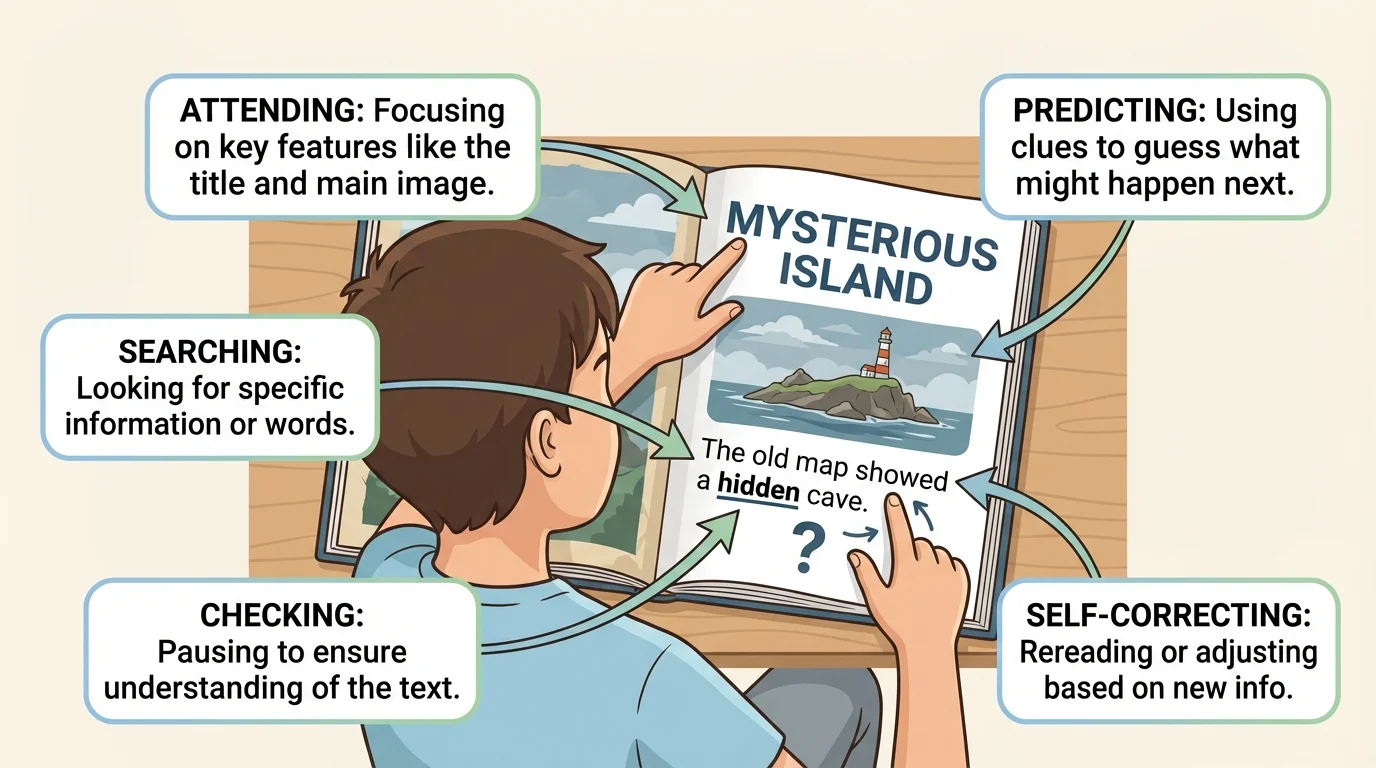
Attending also means listening to how the text sounds. If a sentence ends with a question mark, your voice should sound like a question when you read aloud. If the sentence says, "Crash!" that punctuation and word choice tell you something sudden happened. Readers who attend to punctuation, dialogue, and descriptive words understand the text more clearly.
Sometimes attending means slowing down. If the text says, "The tiny seed pushed through the soil," a careful reader notices that the seed is growing and moving upward. A fast reader who skips over that detail may miss an important step in the plant's life cycle. Later, when the text explains leaves and flowers, that missed detail can cause confusion.
Your brain can sometimes fill in missing information so quickly that you may think you read every word, even when you skipped one. That is why careful attention matters so much.
Attending helps readers collect the clues they need. Without those clues, the other strategies become much harder to use. That is why attending is often the first step when reading something new.
Searching means looking through the text to find helpful information. Sometimes you search for an answer to a question. Sometimes you search for a key detail, a signal word, or a sentence that explains a main idea. Searching is more than hunting for random words. It is looking with a purpose.
Suppose you are reading an article about frogs, and you want to know where frogs lay eggs. A searching reader looks for words such as eggs, water, pond, or spawn. In a story, if you want to know why a character is nervous, you search for clues in the character's actions, thoughts, and dialogue.
Searching can happen in different ways. A reader may scan the text with their eyes to find a certain word. A reader may reread a paragraph to locate a detail that was missed. A reader may use text features such as headings, captions, labels, or the table of contents. These tools make it easier to find key ideas and details without reading every part in the same way.
Searching is especially helpful when the text gives evidence a little at a time. For example, if a passage says, "Lena checked the clock three times, packed her bag early, and stood by the door before sunrise," a searching reader can gather those details and conclude that Lena is eager or worried about an event. The answer is built from clues in different parts of the text.
Example: Searching for evidence in a story
Step 1: Read the question.
Why does Marco think the hike will be difficult?
Step 2: Search the text for clues.
The text says Marco filled two water bottles, tightened his boots, and looked up at the steep mountain trail.
Step 3: Put the clues together.
Those details show that Marco expects a hard climb.
Searching helps the reader support an answer with details from the text.
When readers search well, they do not just say, "I think so." They can point to the words and explain, "I know this because the text says..." That makes understanding stronger and clearer.
[Figure 2] Predicting means making a smart guess about what may happen next or what a text may be about, using clues from the text and what you already know. It is not a wild guess. It is a thoughtful idea based on evidence.
Readers predict before they read and while they read. Before reading, the title The Stormy Day Race might make you think the story will involve bad weather and a competition. During reading, if clouds gather, thunder rumbles, and runners begin to hurry, you may predict that rain will interrupt the race.
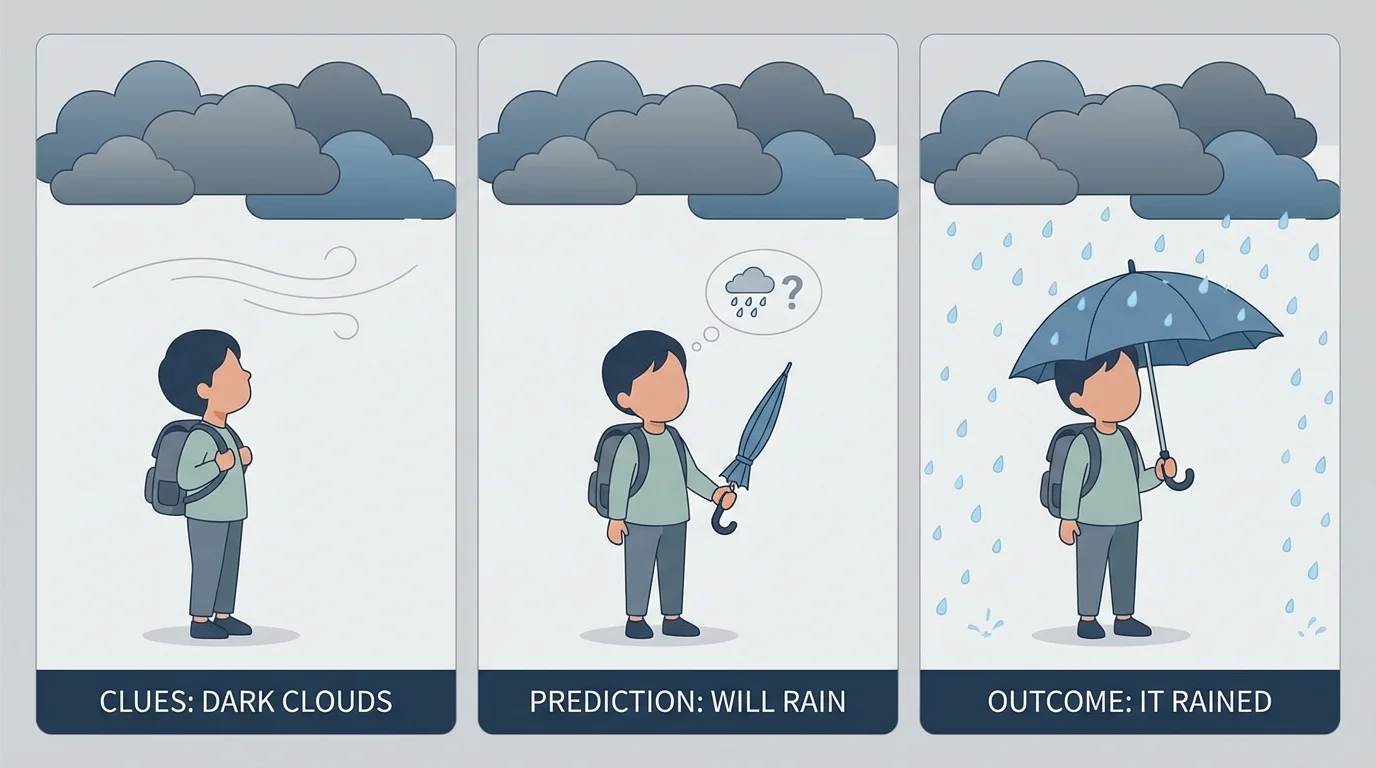
Good predictions can change. That is normal. Suppose you first predict that a lost puppy belongs to the girl in the red coat. Then the text says the puppy runs to an elderly man at the park. Now you change your prediction because you have new evidence. Changing a prediction does not mean you were a bad reader. It means you were paying attention.
Predicting keeps reading active. Your brain stays involved because you are thinking ahead. In nonfiction, predicting can help too. If a chapter heading says From Caterpillar to Butterfly, you may predict that the text will explain stages of change in order. That helps you get ready for the structure of the information.
Predictions use two kinds of clues. One clue comes from the text itself: titles, pictures, words, and details. The other clue comes from what the reader already knows. Strong predictions happen when both kinds of clues work together.
Later, when you check your prediction, you can return to the clues that helped you make it. The weather signs in a story, as seen earlier in [Figure 2], may help explain why your prediction was accurate or why you needed to change it.
Checking means stopping to ask yourself, "Does this make sense?" Good readers do not wait until the end of a whole chapter to notice confusion. They check often. They think about whether the words sound right, whether the ideas fit together, and whether they are following the meaning.
Checking can happen after one sentence, one paragraph, or one page. If a reader finishes a paragraph about penguins and cannot explain what it was mostly about, that is a sign to stop and think. Maybe the reader needs to reread, slow down, or search for the main idea.
Readers can check in simple ways. They may pause and retell what just happened. They may ask, "Who is this part about?" "What changed?" or "What new fact did I learn?" In informational text, they may ask, "What is the topic?" and "Which details support the main idea?" In a story, they may ask, "Why did the character do that?"
Checking helps readers notice confusion before it grows. For example, if a text says that a bat is a mammal, not a bird, a reader who checks understanding will stop and connect this with what the passage says about fur, live birth, and feeding babies milk. A reader who does not check might keep the wrong idea all the way to the end.
You already know that good reading is about more than saying words correctly. Understanding matters too. Checking helps make sure both word reading and meaning are working together.
When checking becomes a habit, readers become more independent. They do not always need someone else to tell them they are confused. They can notice it themselves and take action.
[Figure 3] Self-correcting means fixing your reading when something does not look right, sound right, or make sense. This is a powerful strategy because it helps readers stay in control of their own understanding.
For example, a child reads, "The rabbit hopped into the hose." But the picture and the story are about gardening, and the sentence does not make sense. The reader looks again and notices the word is rose, not hose. The reader rereads and fixes the mistake. That is self-correcting.
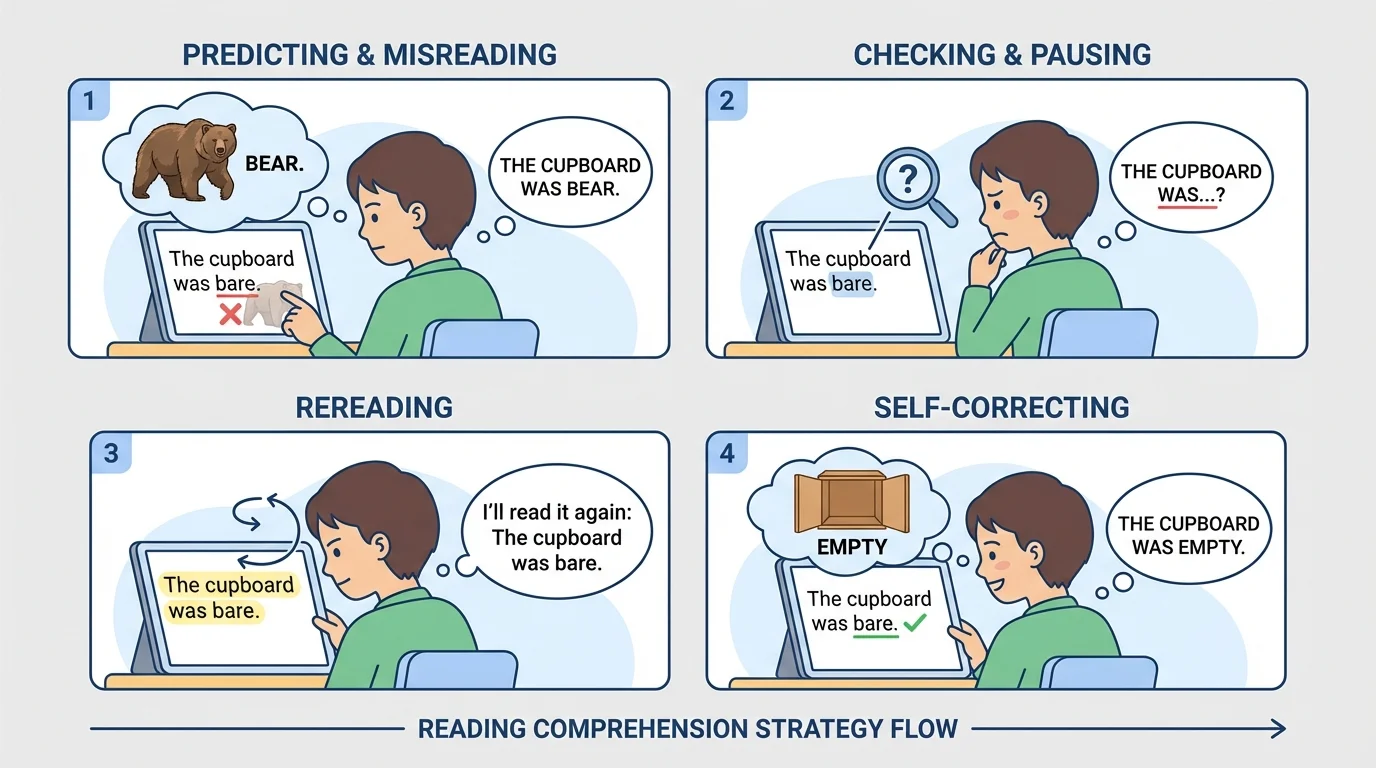
Readers self-correct for different reasons. Sometimes they misread a word. Sometimes they skip a small word like not, which can completely change the meaning. Sometimes they lose track of who is speaking in dialogue. A strong reader notices the problem and tries again.
Self-correcting may include rereading a sentence, looking at beginning or ending word parts, reading ahead for more clues, or thinking about the whole sentence. If a reader says, "The bear climbed the three," the sentence sounds strange. Looking again may show the word is tree. The reader uses meaning, letters, and sound together to fix the error.
Example: Self-correcting with meaning and letters
Step 1: Read the sentence.
"The boy placed the dish on the shelf."
Step 2: Notice the mistake.
If the reader says "fish" instead of "dish," the sentence may still sound possible, so the reader needs to check the letters carefully.
Step 3: Reread and fix it.
The word starts with d, so the correct word is dish.
Self-correcting uses more than one clue at the same time.
Later, when readers think back to the rereading steps shown in [Figure 3], they can remember that fixing an error is not failure. It is what thoughtful readers do.
These strategies are strongest when they work together. A reader may attend to the title, search for key details, predict what will happen, check whether the prediction still fits, and self-correct when a sentence becomes confusing. Reading is not usually one strategy at a time. It is a mix of thinking moves that support one another.
Think about reading a story called The Missing Lunchbox. First, you attend to the title and picture of a worried student. Then you predict that someone will search for a lost lunchbox. As you read, you search for clues about where it was last seen. You check whether each new clue makes sense. If you accidentally read hall instead of hill, you self-correct and keep going. All of this helps you understand the plot.
The same thing happens in nonfiction. If you read an article about volcanoes, you attend to headings such as How Eruptions Happen. You search for important words like magma and ash. You predict that pressure builds before an eruption. You check that the explanation makes sense from one paragraph to the next. If you misread an important word, you self-correct because the meaning depends on accuracy.
| Strategy | What the reader does | Why it helps |
|---|---|---|
| Attending | Notices words, pictures, punctuation, and details | Collects clues from the text |
| Searching | Looks for important information and evidence | Finds answers and supports ideas |
| Predicting | Makes a smart guess using clues | Keeps the mind active and ready |
| Checking | Stops to ask whether the text makes sense | Catches confusion early |
| Self-correcting | Fixes mistakes by rereading and using clues | Restores meaning and accuracy |
Table 1. The five comprehension strategies and how each one supports understanding.
Stories, poems, and informational texts are not exactly the same, so readers may use these strategies in slightly different ways. In a story, attending may focus on characters' feelings, actions, and dialogue. Searching may involve finding clues about the problem or solution. Predicting may involve what happens next in the plot.
In poetry, attending becomes very important because poems often use fewer words but stronger images. A reader may notice repeating words, rhyming sounds, or lines that create a mood. Checking matters too, because poems sometimes say things in unusual ways. If a poem says, "The moon sailed through the night," a reader checks meaning and understands that the moon is not really a boat. The poet is comparing movement in the sky to sailing.
In informational text, searching is especially useful because readers often need to locate specific facts. Headings, captions, labels, and diagrams help organize information. Predicting may help a reader prepare for what the next section will explain. Checking helps a reader connect the details to the main idea.
Readers often use these strategies so quickly that they may not even notice they are doing them. The more you read, the more naturally these thinking habits grow.
Even when texts are very different, the goal stays the same: understand key ideas and details. Whether the text is about a brave character, a rainy forest, or the life cycle of a butterfly, these strategies help readers make sense of what they read.
Readers become stronger by noticing their own thinking. If you know, "I did not understand that part," you are already taking an important step. Then you can choose a strategy that helps. You might attend more carefully, search for a clue, make a new prediction, check your understanding, or self-correct by rereading.
Fluent reading and comprehension work together. Fluency means reading smoothly, accurately, and with expression. When readers are fluent, they have more brain power left for understanding. But fluency alone is not enough. A reader can sound smooth and still miss the meaning. That is why comprehension strategies matter so much.
Over time, these strategies help readers feel confident with harder texts. They learn that confusion is not the end of reading. It is the moment to use a tool. Strong readers are not perfect readers. They are flexible readers who keep thinking all the way through the text.
