Have you ever guessed what would happen next in a story before the book told you? Strong readers do that all the time. Readers are a little like detectives. They notice clues, think carefully, and use details to understand what a text is really saying. When you read a story, poem, or play, three important things help you understand it: plot, character, and setting.
Sometimes an author tells you something directly. Other times, the author gives hints. A reader must slow down and pay attention to words, actions, and descriptions. Then the reader can figure out ideas that are not said in a simple way. This is called making an inference.
Plot is the series of events in a literary text.
Character is a person, animal, or creature in a story, poem, or play.
Setting is where and when a text takes place.
Inference is a conclusion based on clues from the text and what you already know.
When you understand these parts, reading becomes more exciting. You do not just read words. You begin to understand why a character acts a certain way, why a problem happens, or why a setting feels cheerful, spooky, calm, or dangerous.
[Figure 1] The plot is what happens in a text. It includes the events that move the story forward. The figure shows one way to think about how plot develops. A plot often has a beginning, a middle, and an ending. In the beginning, readers meet the characters and learn about the situation. In the middle, a problem or challenge often grows. In the ending, the problem may be solved, or the story may show the results of that problem.
Many stories include a problem and a solution. The problem is what goes wrong or what needs to be fixed. The solution is how the problem is solved. Some stories have more than one problem. Readers pay attention to important events because those events help explain how the story changes from start to finish.
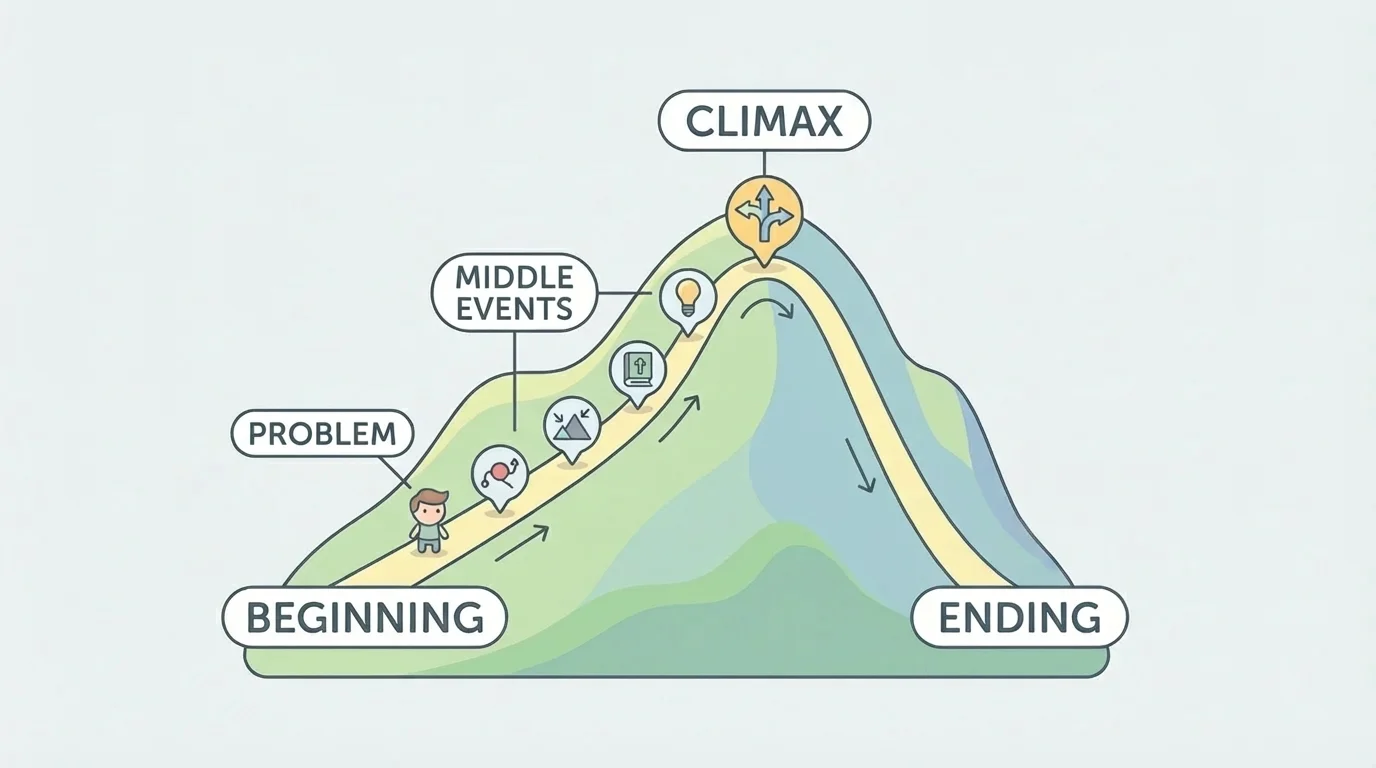
Think about a story in which a girl loses her library book. At the beginning, she checks out the book and feels excited. In the middle, she cannot find it and starts to worry. She searches her room, her backpack, and the car. At the end, she finds the book under the couch and returns it. That sequence of events is the plot.
Not every literary text has a long, complicated plot. A poem may capture only a brief moment or one small event. A play may show actions through scenes and dialogue. Even then, readers can still ask: What happens first? What happens next? What problem appears? How does it end?
Example: Finding the plot in a short story
Step 1: Notice the beginning.
Milo wants to enter the school kite contest.
Step 2: Notice the problem.
His kite rips the night before the contest.
Step 3: Notice the important middle events.
Milo feels upset, asks his grandfather for help, and learns how to patch the kite.
Step 4: Notice the ending.
Milo flies the kite in the contest and feels proud because he did not give up.
The plot is the chain of these events.
Later, when you explain a story, you should tell the events in order. That helps others understand the plot clearly. As shown in [Figure 1], plot is not just a list of random events. The events connect and build toward an important moment.
[Figure 2] A character is not only who is in the text. A character also has thoughts, feelings, choices, and traits. The figure illustrates the kinds of clues readers can use to learn about a character. These clues can come from what the character says, does, thinks, or feels. They can also come from what other characters say.
A trait is a word that describes what someone is like. A character might be brave, kind, selfish, cheerful, stubborn, honest, or nervous. Good readers do not just name a trait. They explain which details show that trait.
Suppose a story says, "Lina gave half of her lunch to a new student who forgot his food." The story may not directly say Lina is kind. But you can infer that she is kind because her action shows care for someone else.
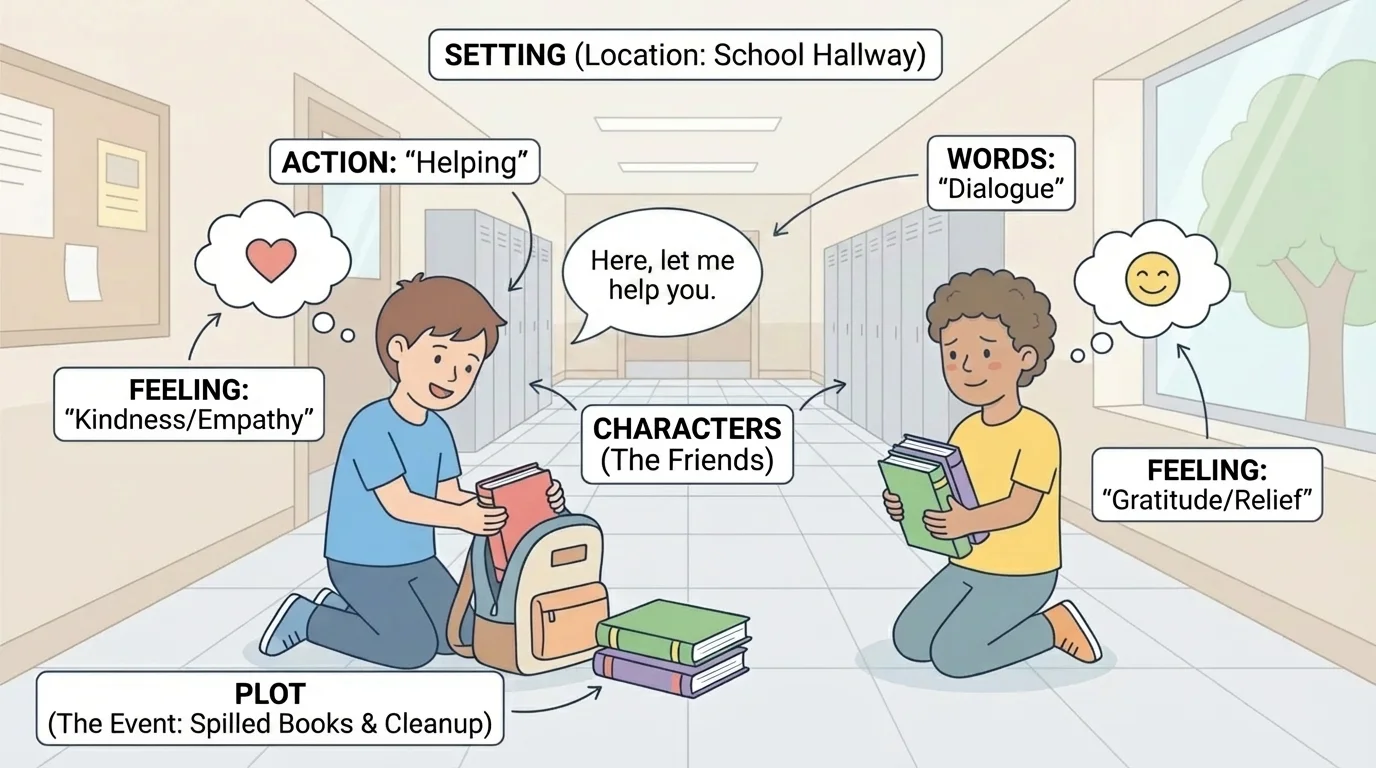
Characters can also change. At the start of a story, a character may be afraid. By the end, that same character may become brave. Readers should notice what causes the change. Did the character learn a lesson? Did a friend help? Did the problem force the character to grow?
Sometimes a character's feelings help us make inferences. If a boy keeps checking the window, tapping his foot, and asking, "Is it time yet?" you can infer that he feels impatient or excited. The author does not need to say it directly. The actions are clues.
How readers describe characters
Readers look for three main kinds of clues: words, actions, and feelings. If all three point in the same direction, an inference becomes stronger. For example, if a character says "I can do it," keeps trying after mistakes, and smiles with confidence, readers can infer that the character is determined.
Characters in poems may be described with fewer words, so every detail matters. In plays, characters are often revealed through dialogue and stage directions. That means readers listen closely to what a character says and how the character acts onstage.
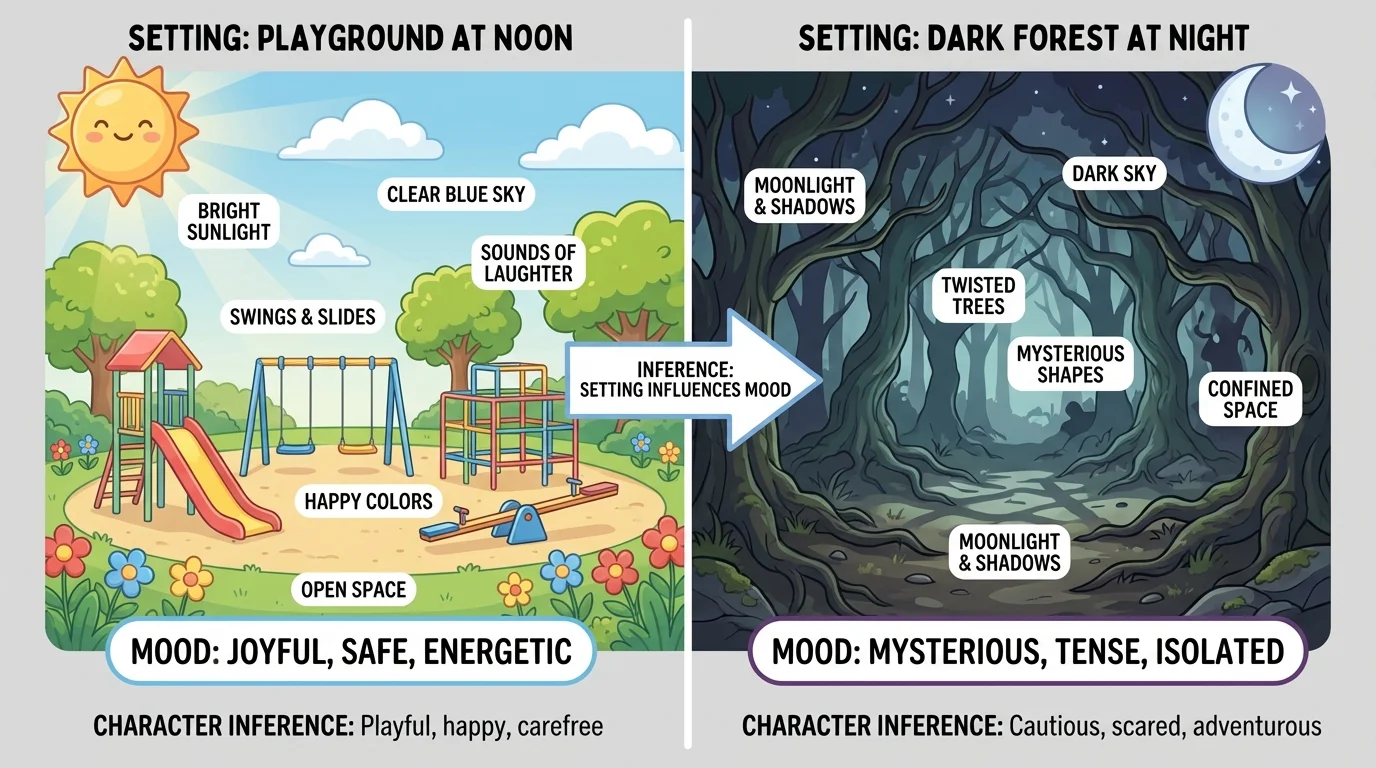
[Figure 3] The setting tells where and when a text happens. The figure shows how setting can shape events and mood. A story set on a snowy mountain will feel different from one set on a sunny beach. A story set long ago may include horses and candles, while a story set today may include buses and cell phones.
Setting includes place and time. Place could be a farm, a city, a classroom, a forest, or outer space. Time could be morning, winter, nighttime, the past, or the future. Some texts make setting very clear. Others give small hints, and the reader must infer it.
Imagine a poem about leaves crunching under boots, cold wind on cheeks, and gray skies. Even if the poet never says "autumn," you can infer that the setting is likely fall. The clues in the description help you figure it out.
Setting can affect what characters do. In a storm, characters may rush for shelter. In a quiet library, they may whisper. In a busy market, they may have trouble hearing each other. Setting can also affect the mood, which is the feeling a reader gets from the text. A bright garden may feel peaceful. A dark cave may feel tense or mysterious.
One small setting detail can change a whole story. A lost puppy in a fenced backyard creates a very different problem from a lost puppy in a crowded city.
When readers describe setting, they should name details from the text. It is stronger to say, "The setting is a winter night because the story mentions snow, ice, and early darkness," than to give a guess with no evidence. That same careful thinking appears in [Figure 3], where place and time shape the feeling of the scene.
An inference is a conclusion you draw from clues. It is not a wild guess. Readers use what the text says and combine it with what they already know from life. This helps them understand things the author only hints at.
For example, if a story says, "Marcus pulled his hood tight and blew warm air into his hands," you can infer that the weather is cold. The author may not say, "It was cold," but the clues make that idea clear.
Example: Making an inference
Text detail: "Eva stared at the stage from behind the curtain. Her hands shook, and she whispered her lines again and again."
Step 1: Find the clues.
Eva is behind the curtain, her hands shake, and she repeats her lines.
Step 2: Connect the clues to what you know.
People often shake and repeat lines when they feel nervous before performing.
Step 3: State the inference.
Eva is probably nervous about going onstage.
This inference is strong because it uses clear evidence.
Readers make inferences about plot, character, and setting all the time. They infer why a character made a choice, what may happen next, how a setting feels, or what lesson a poem might be teaching.
These three elements do not work alone. They connect. A setting can create a problem in the plot. A character's personality can affect the solution. A plot event can change a character's feelings. When readers think about all three together, they understand a text more deeply.
Suppose a play takes place during a power outage on a stormy night. The setting creates darkness and trouble. The plot may center on finding a flashlight or helping a neighbor. A brave character might take the lead, while a shy character may slowly gain confidence. In this way, setting, plot, and character all work together.
| Element | Main Question | What Readers Notice |
|---|---|---|
| Plot | What happens? | Events, problem, solution, ending |
| Character | Who is involved? | Traits, feelings, words, actions, changes |
| Setting | Where and when? | Place, time, weather, mood, surroundings |
Table 1. A comparison of the three major literary elements and the questions readers ask about each one.
When you answer questions about a text, it helps to think about which element the question is asking about. If the question asks why the hero ran away, you may need character clues and plot clues. If the question asks how the story feels spooky, you may need setting details.
Literary texts include stories such as fables, folktales, realistic fiction, and fantasy. In these texts, plot often unfolds through narration and action. Characters may be described directly or indirectly. Setting may be explained in a few words or in rich detail.
In poems, the author may use fewer words, but those words are chosen carefully. A poem may not tell a long plot. Still, readers can notice what is happening, who is speaking, and where the poem seems to take place. Poems often use strong images and feelings, so readers must pay attention to details.
In plays, much of the story appears through dialogue, scenes, and stage directions. Stage directions are notes that tell how characters move, speak, or act. If a stage direction says a character stomps across the room and slams the door, you can infer the character feels angry, even if the character never says, "I am angry."
When you read any kind of literary text, go back to the words on the page. Your ideas should come from details in the text, not only from your opinion.
This is why close reading matters. Stories, poems, and plays may look different, but readers still use the same thinking skills. They notice key ideas and details, identify important elements, and make inferences supported by evidence.
Key ideas are the most important things a text shows. Details are the smaller clues that help readers understand those ideas. Strong readers do not rush past details. They notice repeated words, strong actions, special descriptions, and dialogue.
If a poem repeats words about light, warmth, and morning, those details may help you infer that the poem has a hopeful mood. If a story repeats that a character hides, avoids eye contact, and speaks softly, those details may help you infer that the character lacks confidence.
When explaining your thinking, use words like because, so, and for example. You might say, "I think the character is generous because she shares her prize with her little brother." That answer is stronger than simply saying, "She is nice."
Example: Using evidence from a play
Dialogue: "No, I will not leave without my sister," said Ana.
Stage direction: Ana steps in front of her sister and faces the barking dog.
Step 1: Find what Ana says.
She refuses to leave without her sister.
Step 2: Find what Ana does.
She stands in front of her sister and faces danger.
Step 3: Infer a trait.
Ana is brave and protective.
The dialogue and stage direction together support the inference.
Sometimes more than one answer can make sense, but the best answer is the one supported most clearly by the text. Readers should always be ready to point to the evidence that helped them decide.
When you talk or write about literature, it is important to explain how you know. If you say, "The setting is a farm," add the clue: "because the text mentions a red barn, chickens, and corn fields." If you say, "The character changed," explain what the character was like at first and what the character was like later.
This kind of explanation helps readers become thoughtful and careful. It also helps them understand the text more deeply. Reading is not only about saying what happened. It is about understanding why it happened, how the characters respond, and what details guide your thinking.
The more you practice noticing plot, character, and setting, the more clearly you will understand literary texts. You will begin to see patterns, make stronger inferences, and support your ideas with confidence.
