Have you ever told a friend about your day, but started in the middle by mistake? Your friend might say, "Wait, what happened first?" Readers need that same kind of order. When we read, we often figure out the sequence of events: what happens first, what happens next, and what happens at the end. Knowing the order helps a story make sense.
Authors give readers clues to help them follow events. Some clues are signal words such as before, after, next, then, and finally. Other clues come from the way a text is built. When readers notice both the words and the structure, they can understand the most important events clearly.
Sequence is the order in which events happen. Signal words are words that help show that order. Narrative means a story, and chronology means time order.
Sequence matters in many kinds of reading. It matters in a funny story, in a folktale, in a chapter book, and even in a paragraph about someone's day. If you mix up the order, you may misunderstand the problem, the action, or the ending.
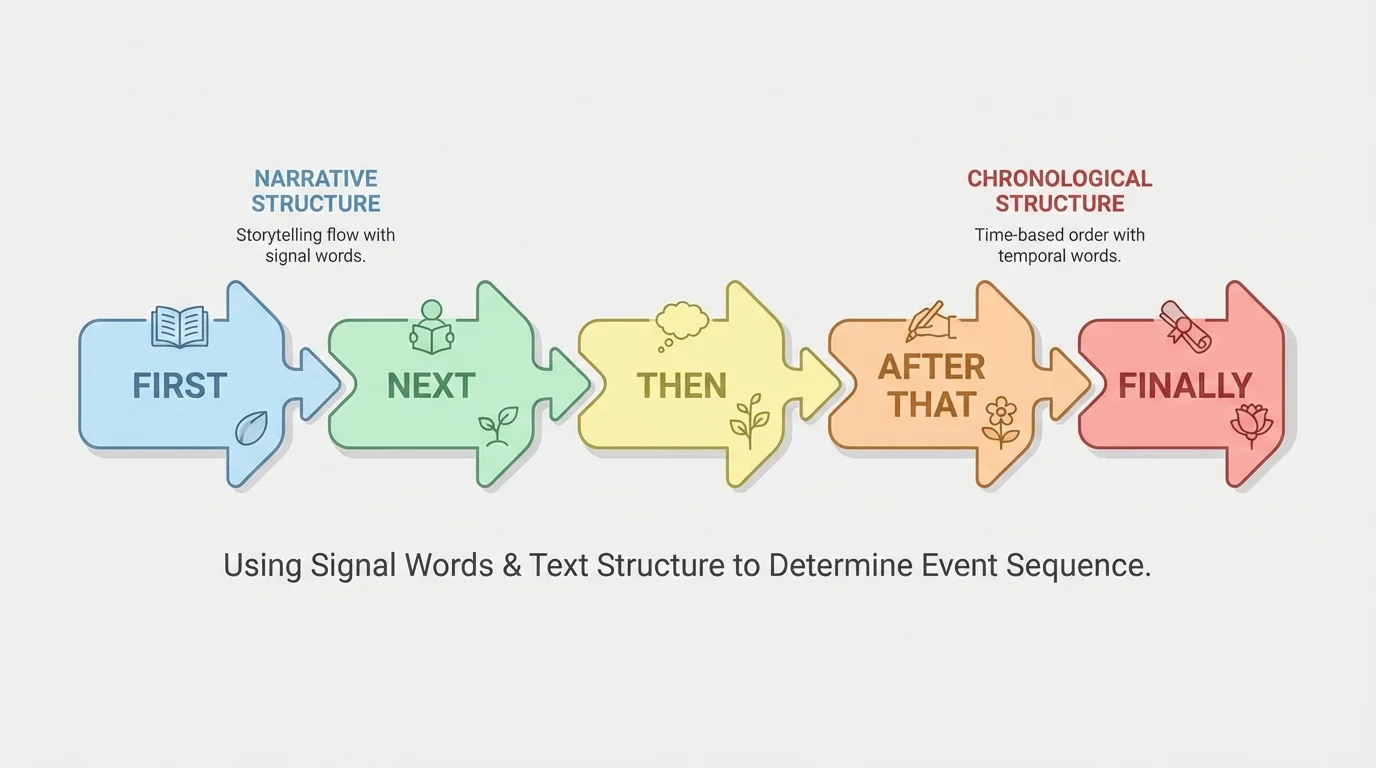
A signal word is a word or phrase that tells readers when something happens. As [Figure 1] shows, these words often work like signs on a road. They guide readers from one event to the next.
Common signal words include first, next, then, after, before, later, soon, last, and finally. Some signal words point backward in time, such as before and earlier. Others point forward, such as next and later.
Look at this example: "Mia put on her raincoat before she opened the door. Next, she stepped into the puddles. After the rain slowed, she walked to the mailbox." The signal words help us know the order. First, Mia put on her raincoat. Next, she stepped into puddles. After that, she walked to the mailbox.
Sometimes a sentence has only one signal word, but that one word is enough to help. In the sentence "After Sam finished breakfast, he brushed his teeth," the event of finishing breakfast happens first, even though it appears after the word after. Readers must think carefully about what the signal word means, not just which action is named first in the sentence.
Some signal words are tiny, but they do a big job. A single word like before can completely change the order of two events in a sentence.
Writers do not always use the exact same words. They may also use phrases like that morning, a little later, the next day, or in the end. These time clues also help readers build the sequence of events.
As [Figure 2] illustrates, a narrative is a story. Stories usually have a beginning, a middle, and an end. This structure helps readers follow what happens.
In the beginning, readers usually meet the characters and learn the setting. In the middle, a problem or important action happens. By the end, the problem may be solved, or the story may finish with a lesson or change. When readers understand these parts, they can often find the major events in the correct order.
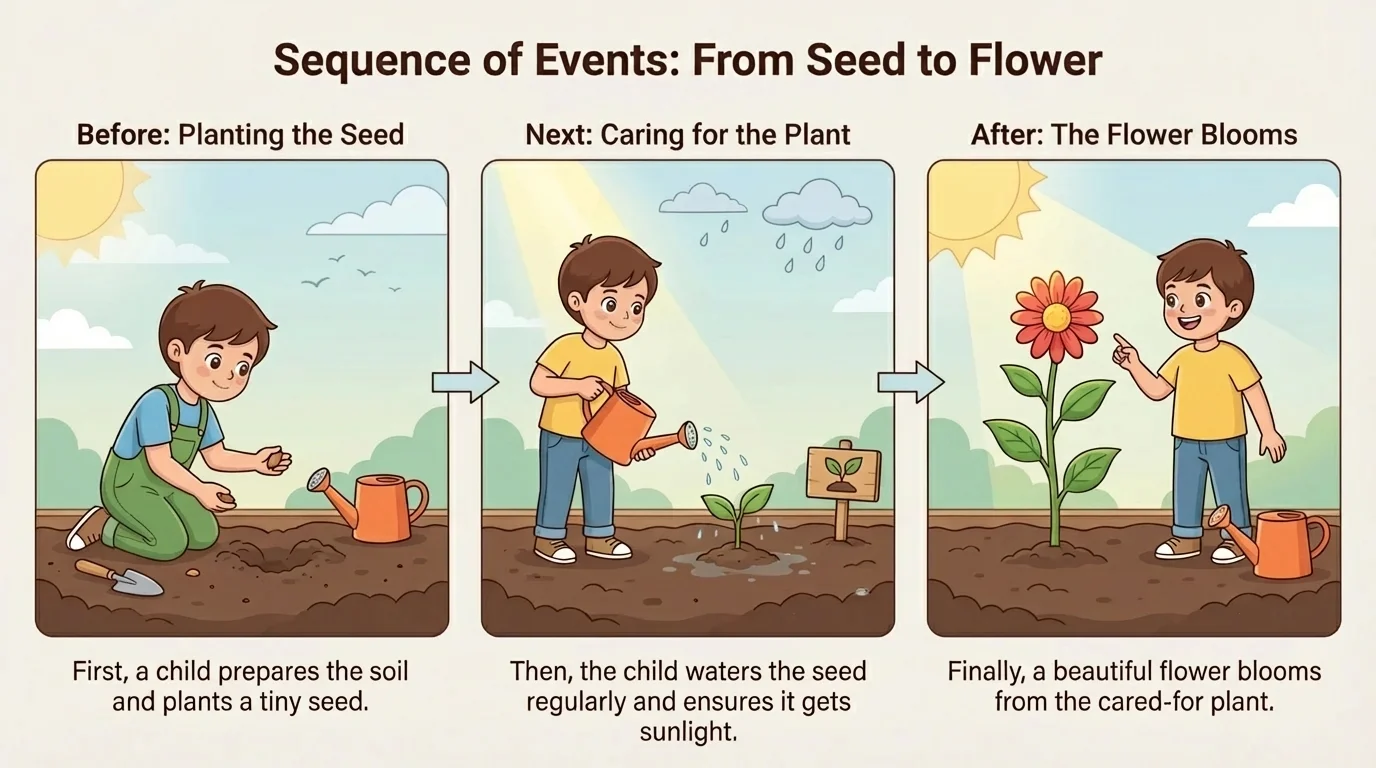
Think about this short story: "Lena found a small seed in her pocket. She planted it in a cup of soil. Every day she watered it and set it by the window. At last, a green sprout popped out." In the beginning, Lena finds the seed. In the middle, she plants and cares for it. At the end, the sprout appears. The story's narrative structure helps readers arrange the events.
Stories also have major events. These are the big moments that move the story along. In Lena's story, finding the seed, planting it, caring for it, and seeing it sprout are major events. The exact color of the cup or the shape of the window may be interesting details, but they are not the main events.
Beginning, middle, and end help readers sort events. When a reader asks, "What starts the story? What changes in the middle? How does it finish?" the answers often reveal the sequence of the biggest events.
Later, when readers think back to the story arc, they can see how a story grows step by step. The story arc is not just about parts of a story. It also helps readers notice how one event leads to the next.
As [Figure 3] shows, chronology means putting events in time order. It works like a timeline that moves from earlier events to later ones.
Many texts are written in chronological order. A text about a school morning might begin with waking up, then getting dressed, then eating breakfast, and finally leaving for school. This order matches the way the events happen in real life.
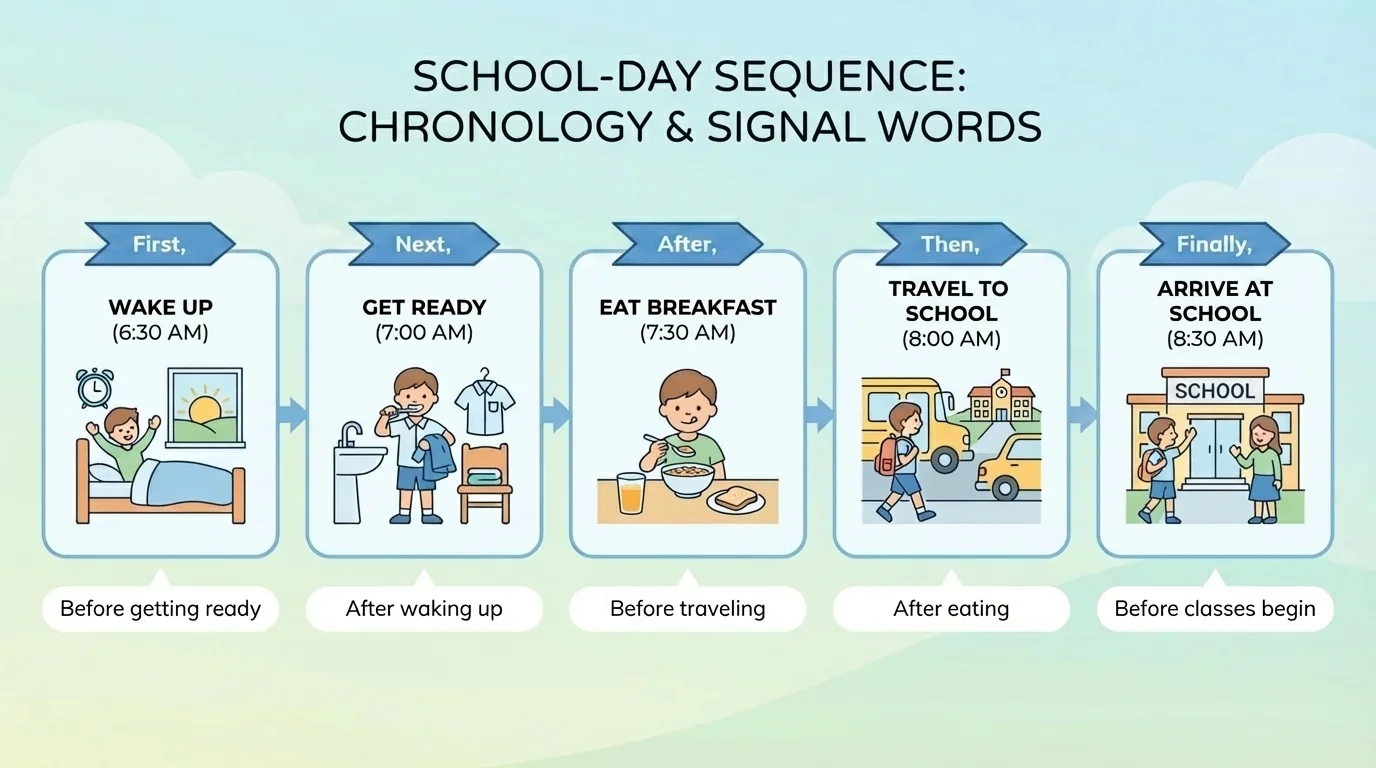
Here is an example: "First, Diego heard his alarm. Next, he made his bed. Then he ate toast. Finally, he grabbed his backpack and ran to the bus stop." This paragraph is in chronological order because the events are told from first to last.
Chronology is common in stories, but it can appear in other texts too. A paragraph about how a chick hatches, or a description of how a class prepared for a play, may also use time order. Readers should always ask, "Is the author telling these events as they happened?" If the answer is yes, the text is chronological.
You may already know how to retell a story. Retelling often means telling the important events in order. Using chronology helps make your retelling clear and accurate.
When signal words and chronology work together, sequence becomes easier to find. A timeline in your mind can help. You can almost hear the events ticking forward: first, next, then, later, finally.
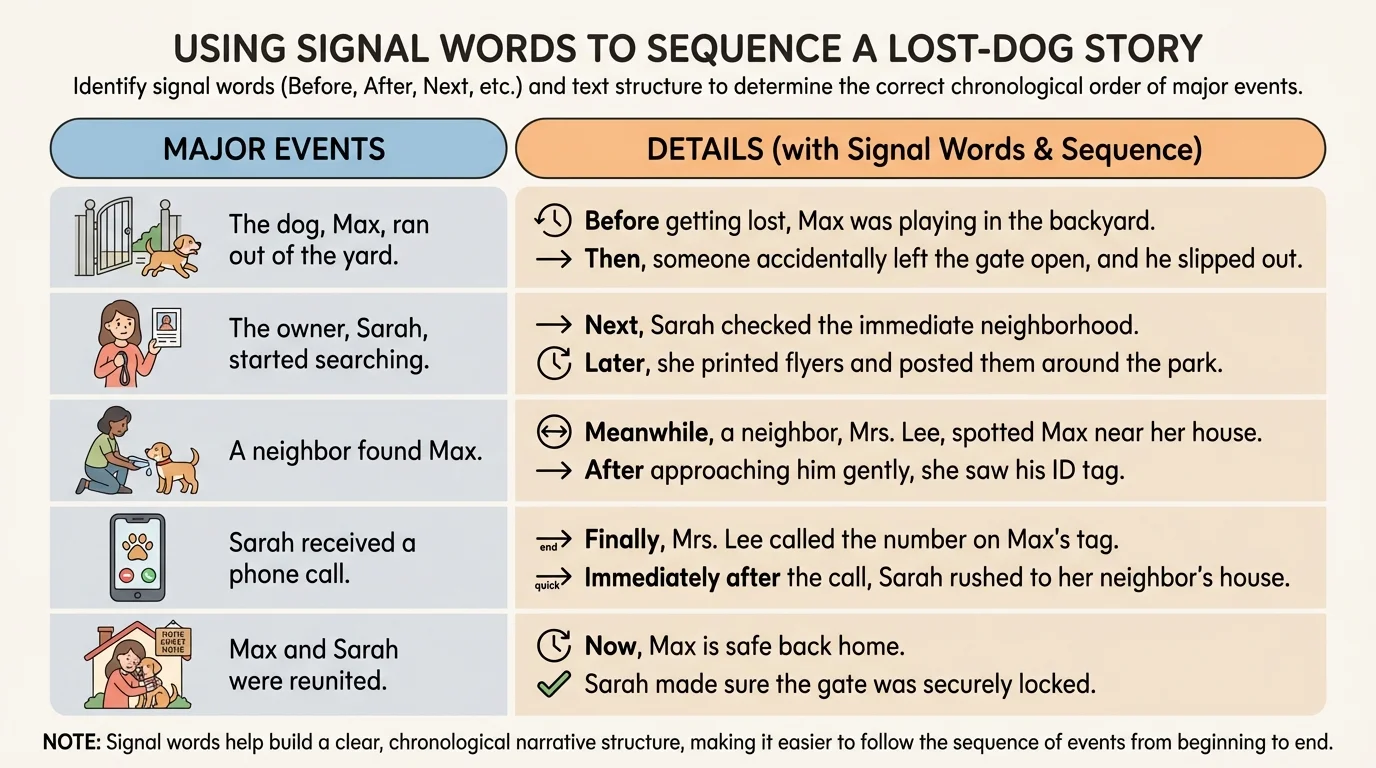
Not every sentence in a passage tells a major event. Readers must decide which actions are the biggest and most important. As [Figure 4] shows, it helps to sort big events away from small details.
A major event changes the story or moves it forward. A small detail adds description, but if you remove it, the main order of the story still makes sense. For example, in the sentence "Before dinner, Ava searched the park for her lost dog while the sun turned orange," the search for the lost dog is a major event. The orange sun is a detail.
Ask yourself these questions: What happened that changed something? What happened that led to the next part? Which events would I include if I retold the story in only a few sentences? The answers usually point to major events.
Read this passage: "Evan noticed that his kite string had snapped. He ran across the field. After a long chase, he caught the kite in a bush. His shoes were muddy and his hat was crooked." The major events are noticing the snapped string, running after the kite, and catching it. Muddy shoes and a crooked hat are details.
Remember that major events often connect like links in a chain. One event causes another. Evan notices the snapped string, so he runs. Because he runs, he reaches the kite. That cause-and-effect connection helps readers see sequence clearly.
Finding the sequence in a short passage
Passage: "Before the class visited the garden, the students drew pictures of plants. Next, they walked outside with their teacher. Then they looked for insects on the leaves. Finally, they wrote notes in their science journals."
Step 1: Circle the signal words.
The signal words are before, next, then, and finally.
Step 2: Name the events linked to those words.
The students drew pictures, walked outside, looked for insects, and wrote notes.
Step 3: Put the major events in order.
First, they drew pictures. Next, they walked outside. Then, they looked for insects. Finally, they wrote notes.
The signal words make the sequence easy to follow.
When readers return to [Figure 4], they can see why sorting major events from details is so helpful. It keeps the sequence focused on what really matters.
Strong readers do not depend on just one clue. They use signal words, narrative structure, and chronology together. If one clue is missing, another clue can still help.
Suppose a passage says, "Jordan packed his lunch. He zipped his coat. A few minutes later, he waved goodbye and stepped onto the bus." Even if the author does not say first or next, the phrase a few minutes later shows that stepping onto the bus happens after packing lunch and zipping the coat.
Sometimes readers must think about what makes sense in real life. If a story says, "After the cookies cooled, Nora took them out of the oven," a careful reader may notice that something seems wrong. Cookies usually come out of the oven before they cool. Good readers pay attention to both the words and the meaning.
Use all the clues together. Sequence is easiest to understand when readers notice time words, think about story structure, and check whether the events make sense in real life.
This is why sequence is more than memorizing signal words. It is also about understanding how events fit together in a story or passage.
Consider this example from a story: "Tariq heard scratching at the door. He opened it and found a wet kitten. After he wrapped the kitten in a towel, he called his grandmother. At last, they made a warm bed for it in a basket." The major events are hearing the scratching, finding the kitten, wrapping it in a towel, calling his grandmother, and making a warm bed.
The signal word after tells us that wrapping the kitten happens before the phone call. The phrase at last signals the ending event. The narrative structure also helps: the beginning introduces the surprise, the middle shows the care for the kitten, and the end gives the kitten a safe place.
Here is another example: "On Saturday morning, Ruby mixed flour and eggs for pancakes. Soon the kitchen smelled sweet. Later, her little brother set the table. After breakfast, the family biked to the park." The sequence is mix ingredients, smell pancakes cooking, set the table, eat breakfast, and bike to the park. Some events are directly stated, and some are understood from the meaning of the passage.
Using meaning when a signal word points backward
Sentence: "After Leo tied his shoes, he raced onto the field."
Step 1: Find the signal word.
The signal word is after.
Step 2: Ask which event must happen first.
Leo ties his shoes first.
Step 3: Name the next event.
He races onto the field second.
Even though racing is named later in the sentence, the signal word tells the order.
These examples show that readers should listen for clue words, but they should also think about how the events connect in a sensible order.
Most stories for younger readers move straight ahead in time, but sometimes an author briefly tells about something that happened earlier. This is still manageable if readers notice the clues.
For example: "Maya smiled at the blue ribbon on her wall. Yesterday, she had won it at the swim meet. Now she was packing her bag for another race." The word yesterday sends readers back to an earlier event. The word now brings readers back to the present part of the story.
When this happens, readers should ask two questions: What event is happening now? and What event happened earlier? That helps keep the full sequence straight. The order in time is: Maya won the ribbon yesterday, and now she is packing for another race.
Authors sometimes mention the past to help readers understand a character better. A quick look back can explain why a character feels proud, worried, or excited in the present moment.
Even when the author changes the order for a moment, the sequence of major events can still be found. Signal words like earlier, yesterday, long ago, and now help readers sort the timeline.
To get better at finding sequence, stop after a paragraph and quietly ask yourself, "What just happened first? What happened next?" This small habit can make a big difference.
You can also look back at the text and underline signal words. Then notice which events are important enough to retell. A reader who understands sequence does not simply repeat every sentence. A good reader chooses the biggest actions and puts them in order.
As seen earlier in [Figure 1], signal words act like arrows, but readers also need the broader structures of story and time. The beginning-middle-end pattern from [Figure 2] and the time-order path in [Figure 3] help readers build a strong picture of what happens and when it happens.
When readers use all of these clues together, they understand stories more deeply. They can retell what happened, explain the problem and solution, and keep the major events in the right order.
