Have you ever read an article about animals, weather, or space and thought, "What is this whole thing mostly about?" Good readers do more than read the words. They notice the main subject of the whole text and the specific role of each paragraph. That helps them understand books, websites, magazines, and science articles much better.
Informational texts are often built in parts. One paragraph may tell what something is. Another may explain how it works. A third may describe why it matters. If you can spot the main topic of the whole piece, you understand the big picture. If you can also tell the focus of each paragraph, you understand how the author builds that big picture, piece by piece.
This is useful in everyday reading. A student reading about recycling needs to know that the whole article is about recycling, but one paragraph may focus on sorting paper, another on saving energy, and another on reducing waste in landfills. Knowing these differences keeps a reader from mixing ideas together.
Main topic is the subject that a whole text is mostly about.
Paragraph focus is the specific part of the subject that one paragraph explains.
Detail is a fact, example, or piece of information that supports the paragraph focus.
When readers understand these three levels, they can tell whether an idea belongs to the whole text, one paragraph, or just one detail inside that paragraph.
A main topic belongs to the whole text. A paragraph focus belongs to just one paragraph. One text can have one big topic and several paragraph focuses, as [Figure 1] shows. This is like a big tree with several branches. The trunk is the whole topic, and the branches are the parts explained in different paragraphs.
For example, a text might be mostly about dogs. That is the main topic. But the first paragraph could focus on dog breeds, the second on how dogs communicate, and the third on how dogs help people. All three paragraphs connect to dogs, but each one shines a light on a different part of the subject.
Readers should ask two different questions. First: What is the whole text mostly about? Second: What is this paragraph mostly about? Those questions sound similar, but they lead to different answers.
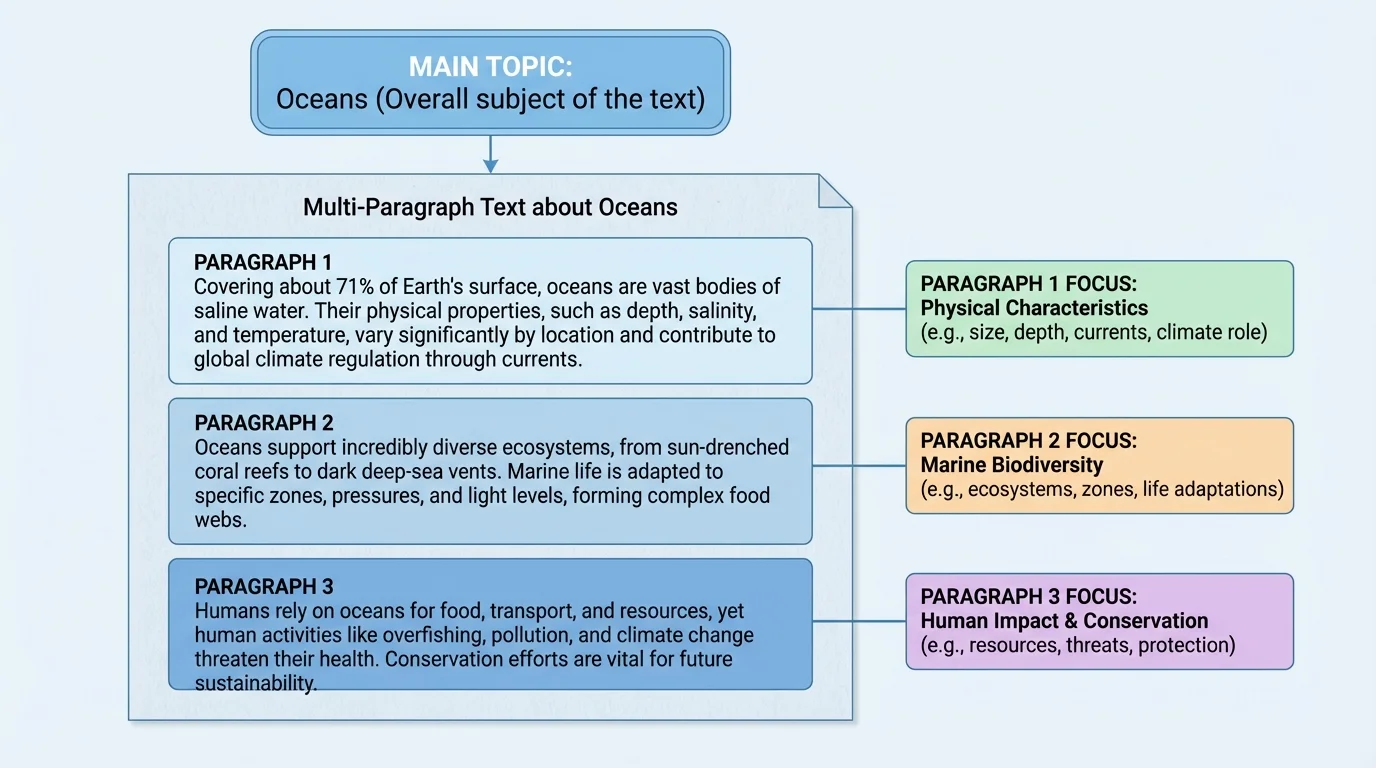
If a reader answers with something too tiny, such as one fact from only one sentence, that is probably a detail, not the main topic. If the answer is too wide, such as "animals" when the text is really about penguins, the answer is probably too broad.
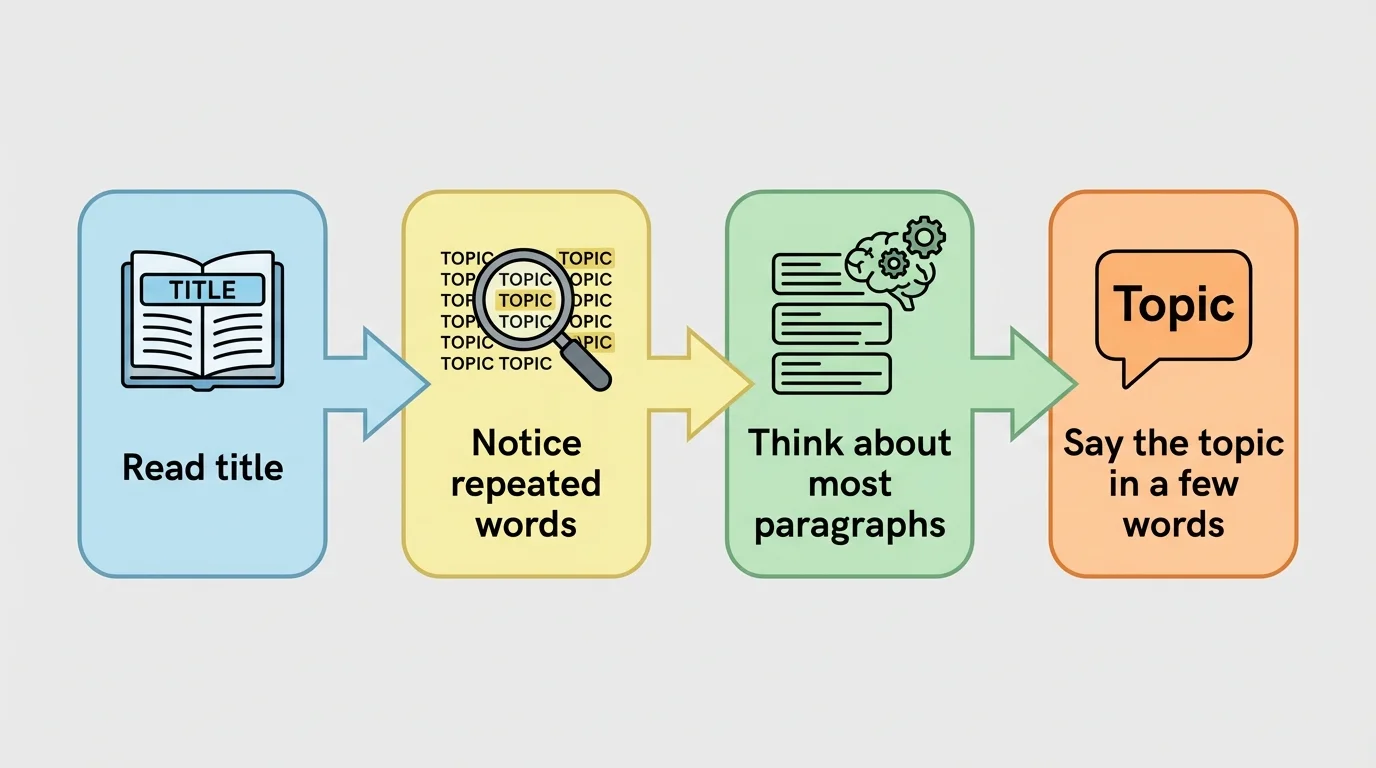
Finding the whole-text topic is easier when you look for clues in order. A smart reading plan, shown in [Figure 2], helps readers slow down and notice what matters most.
Start with the title. The title often names the subject. Then think about the headings, if the text has them. After that, notice words or ideas that repeat in more than one paragraph. Last, ask yourself what most of the paragraphs are about together.
Suppose a text is titled How Plants Survive in the Desert. One paragraph explains storing water, another describes roots, and another tells about waxy leaves. All of those paragraphs point to the same whole-text topic: desert plants and how they survive.
A good main topic is often short. It may be just a few words, such as desert plants, how volcanoes form, or ways communities recycle. It does not need to be a long sentence.
Another helpful strategy is to ask, "If I had to name this article in only a few words, what would I say?" That pushes you toward the topic instead of one small fact.
Think wide, but not too wide. The main topic should fit all or most of the paragraphs. If your answer fits only one paragraph, it is too narrow. If it is so broad that it could fit hundreds of different texts, it is too wide. Readers aim for the middle: broad enough for the whole text, but exact enough to match it closely.
This middle-sized thinking is a big part of strong reading. It helps readers avoid getting trapped by a single exciting fact and missing what the whole text is really teaching.
Each paragraph has a job to do. To find its focus, read the paragraph and ask, "What part of the topic does this paragraph explain?" A paragraph may tell causes, steps, examples, kinds, reasons, or effects. The answer should match most of the sentences in that paragraph.
Often the first sentence gives a strong clue. In many informational texts, the first sentence introduces the paragraph's focus. The other sentences then add details, facts, or examples. But not every paragraph starts that way, so readers should also look for repeated words and ideas inside the paragraph.
For example, if one paragraph in a text about frogs mentions eggs, tadpoles, and adult frogs, the paragraph focus is probably the frog life cycle. If another paragraph mentions wet skin, jumping legs, and strong eyes, that paragraph focus is probably frog body features.
The paragraph focus should usually be more exact than the whole-text topic. If the whole article is about frogs, one paragraph may focus only on where frogs live. Another may focus only on how frogs develop. The paragraph focus zooms in.
Readers already know that nonfiction texts give true information about the real world. This lesson adds a new skill: seeing how that information is organized. The whole text gives one big subject, while each paragraph handles one part of that subject.
This is why two paragraphs in the same article can be different but still belong together. They are connected because they all support the same main topic.
These words are close, so it is easy to mix them up. The main idea is what the author wants you to understand about a topic. The main topic is usually the subject in a few words. The main idea is often a fuller statement about that subject.
For example, if the topic is ants, the main idea of one paragraph might be that ants work together to gather food. The details are the small facts that support that idea, such as ants carrying crumbs, following scent trails, or helping one another.
In this lesson, the most important thing is to identify the topic of a whole multi-paragraph text and the focus of each paragraph. It is enough to remember this: the topic names the subject, and the paragraph focus tells what part of the subject that paragraph explains.
| Text part | What it tells | Example in a text about birds |
|---|---|---|
| Whole text | The big subject | Birds |
| One paragraph | A specific part of the subject | How birds build nests |
| Detail | A fact that supports the paragraph focus | Some birds use twigs and grass |
Table 1. The table compares the whole-text topic, a paragraph focus, and a supporting detail.
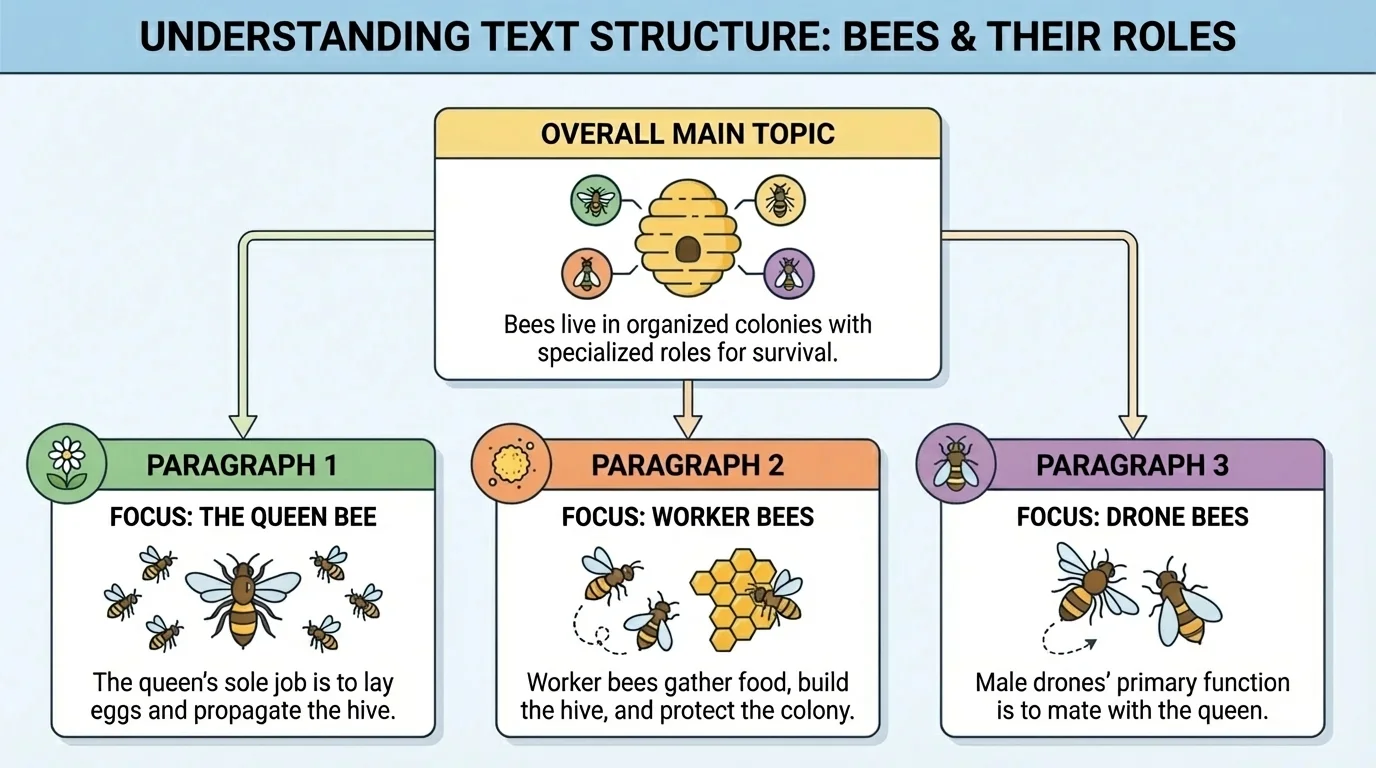
Let's look at a sample informational text. The whole text is about bees, and [Figure 3] organizes the relationship between the overall topic and the focus of each paragraph.
Paragraph 1: Bees are insects that live in groups called colonies. A colony has jobs for different bees. The queen lays eggs, worker bees gather food, and drones help the colony continue.
Paragraph 2: Bees collect nectar and pollen from flowers. As they move from flower to flower, they help plants make seeds and fruit. This process is called pollination.
Paragraph 3: Bees face dangers such as pesticides, habitat loss, and disease. People can help bees by planting flowers and avoiding harmful chemicals.
The main topic of the whole text is bees or bees and their importance. But each paragraph has its own focus. Paragraph 1 focuses on jobs in a bee colony. Paragraph 2 focuses on pollination. Paragraph 3 focuses on dangers to bees and ways people can help.
How a reader thinks through the bees text
Step 1: Read all three paragraphs and notice the repeated subject.
The repeated subject is bees.
Step 2: Ask what most paragraphs connect to.
All paragraphs teach about bees, so that is the whole-text topic.
Step 3: Check one paragraph at a time.
Paragraph 2 keeps talking about flowers, nectar, pollen, and helping plants, so its focus is pollination.
This kind of thinking helps readers stay organized instead of mixing all the details together.
Notice how the second paragraph does not tell everything about bees. It focuses on one important part. That is exactly what paragraph focus means. Later, when you read another article, you can use the same thinking we used with bees.
Now consider another multi-paragraph text.
Paragraph 1: Thunderstorms can bring lightning, strong wind, and heavy rain. They can form quickly, especially on hot days.
Paragraph 2: During a thunderstorm, people should go indoors and stay away from windows. It is also safer to avoid using plugged-in electronics.
Paragraph 3: After a storm, people should watch for flooded roads, fallen branches, and damaged power lines. Adults may need to call for help if an area is dangerous.
The main topic is thunderstorm safety or how to stay safe in thunderstorms. The paragraph focuses are different. Paragraph 1 focuses on what thunderstorms are like. Paragraph 2 focuses on what to do during a storm. Paragraph 3 focuses on what to do after a storm.
This shows that paragraph focus often changes from one paragraph to the next while still supporting one overall topic. That pattern is common in science and social studies reading.
Some informational texts use paragraphs like steps in a recipe. One paragraph introduces the topic, the next explains a part of it, and another gives examples or warnings. Spotting each paragraph's job helps readers understand the whole text more clearly.
When readers can name both the whole topic and the paragraph focus, they are much better at answering questions about what they read.
One common mistake is choosing a detail instead of a topic. If a paragraph says bees collect nectar, that fact is important, but it may not be the whole paragraph focus if the paragraph is really about pollination.
Another mistake is choosing a topic that is too broad. If a text is about sea turtles, answering "animals" is much too wide. A better answer would be "sea turtles" or "the life of sea turtles," depending on the text.
A third mistake is giving the same answer for every paragraph. In a strong informational text, paragraphs often work together by covering different parts of a subject. Readers should expect some change from paragraph to paragraph.
Here is a smart fix: after reading a paragraph, say its focus in one short phrase. Then check whether most sentences in that paragraph match your phrase. If they do, your answer is probably strong.
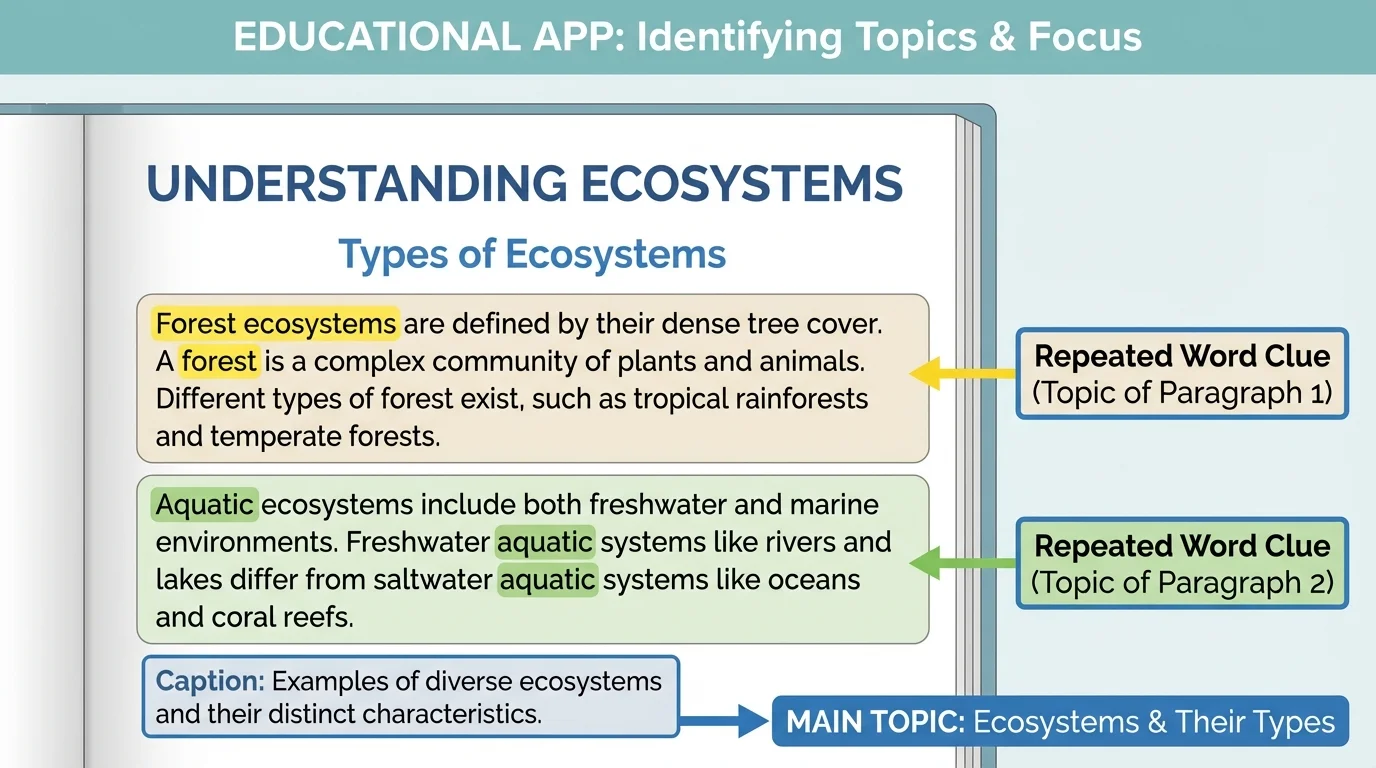
Informational texts often give readers clues right on the page. A nonfiction page, as [Figure 4] illustrates, may include a title, headings, captions, and bold words that point toward the topic and paragraph focus.
The title often gives the whole-text topic. Headings often tell what a section or group of paragraphs is about. Captions under pictures may explain one part of the topic. Repeated words are another strong clue. If the same idea appears again and again, it is probably important.
Readers should also pay attention to the first and last sentences of paragraphs. These sentences often introduce or wrap up the paragraph focus. Even when they do not, they can still provide hints.
When reading a magazine article about volcanoes, for example, the title might say Inside a Volcano. A heading might say How Eruptions Happen. From these clues, a reader can tell that the text is about volcanoes, and one part focuses especially on eruptions. These text features work together much like the clues labeled in [Figure 4].
Strong readers do not rush through paragraphs as if every sentence matters in the same way. They pause and sort ideas. They think, "This is the big subject. This paragraph explains one part. This sentence adds a detail." That habit makes long texts much easier to understand.
It also helps to reread when a paragraph feels confusing. On a second reading, the focus often becomes clearer. Readers may notice a repeated word, a topic sentence, or a detail pattern they missed the first time.
Talking about a text can help too. When students explain a paragraph in their own words, they often discover whether they truly understand its focus. If they can say the paragraph's job in a short phrase, they are usually on the right track.
"Good readers do not just collect facts. They organize ideas."
That is the heart of this skill. Reading informational text is not only about remembering facts. It is about seeing how facts fit together inside paragraphs and across the whole text.
