Some tiny words do giant jobs in reading. Words like because, although, however, and therefore may look small, but they act like road signs for your brain. They help you see whether one thing happens because of another thing, or whether two things are alike or different. When you notice these words, you understand nonfiction and other informational texts much better.
Authors do not just list facts randomly. They connect ideas in special ways. Sometimes an author explains why something happened. Sometimes an author shows how two things are alike. Sometimes an author points out important differences. These connections help the reader organize information and make sense of it.
A signal word is a clue word that helps show the relationship between ideas. If you notice signal words while reading, you can ask yourself smart questions: What caused this? What happened because of it? What things are being compared? What is different?
Cause and effect means one event makes another event happen. The cause is why something happens, and the effect is what happens.
Compare and contrast means looking at how things are alike and how they are different. Compare tells likenesses. Contrast tells differences.
Good readers do not only read the words. They also notice how the words connect. Signal words are part of the author's craft because they guide the reader through the text.
A cause is the reason something happens, and an effect is the result. In informational texts, authors often explain events in this pattern. If you can spot the clue words, you can tell which part is the reason and which part is the result.
Common cause-and-effect signal words include because, since, so, therefore, as a result, thus, and for this reason. As [Figure 1] shows, these words and phrases often point to a reason or a result.
Look at these examples:
Because the ground was icy, Maya walked slowly.
In that sentence, the ground being icy is the cause. Maya walking slowly is the effect.
The sun had not shone for days, so the garden plants drooped.
Here, the lack of sunshine is the cause. The drooping plants are the effect.
Many birds migrate south in winter. As a result, they can find warmer weather and more food.
In this example, migrating south is the cause, and finding warmer weather and more food is the effect.
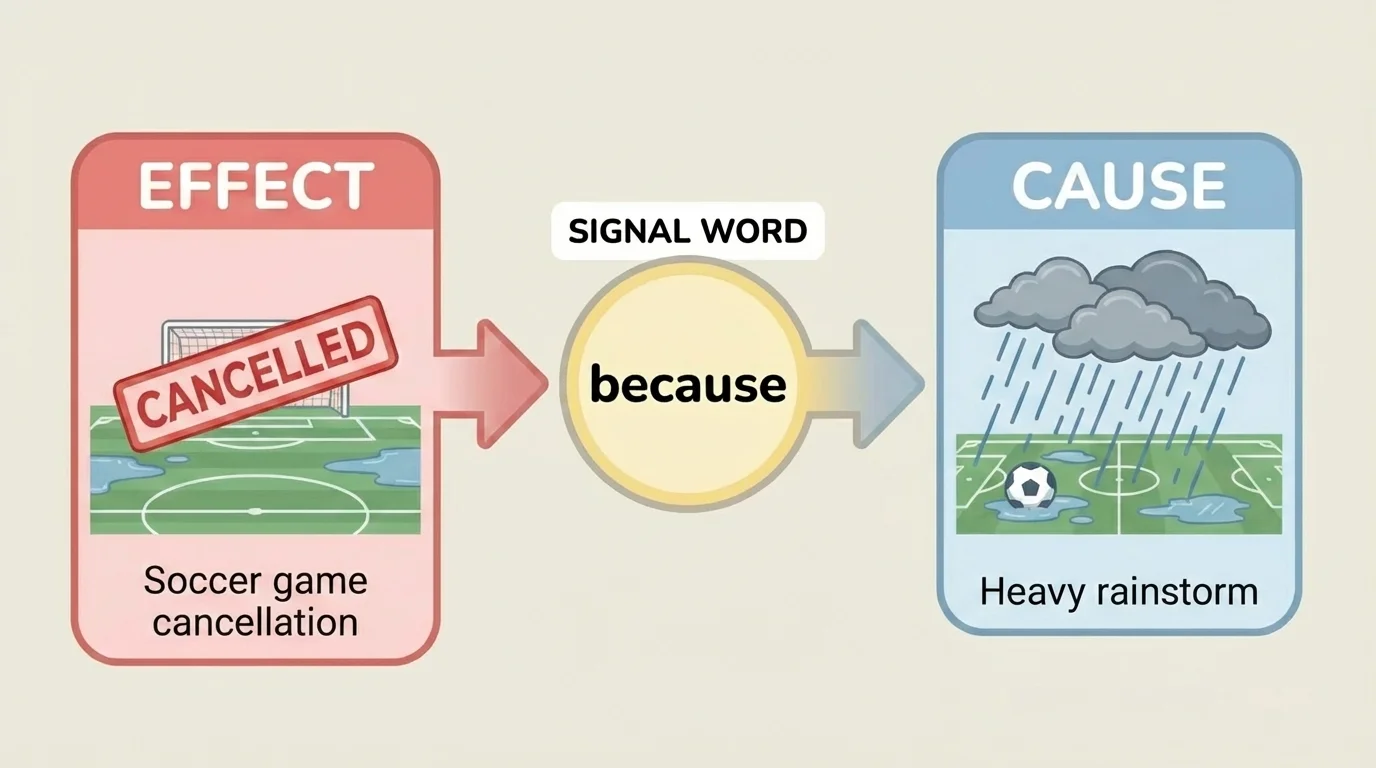
Sometimes the cause comes first. Sometimes the effect comes first. You have to read carefully.
Cause first: The class stayed indoors because it was raining.
Effect first: Because it was raining, the class stayed indoors.
Both sentences give the same idea, but the order changes. The signal word helps you find the relationship even when the order changes.
Finding cause and effect in a science sentence
Read this sentence: Plants leaned toward the window because they needed more sunlight.
Step 1: Find the signal word.
The signal word is because.
Step 2: Ask what happened.
Plants leaned toward the window.
Step 3: Ask why it happened.
They needed more sunlight.
The need for more sunlight is the cause, and leaning toward the window is the effect.
When you read science or social studies, you often see cause and effect. A volcano erupts, so ash covers the land. People recycle more, therefore less trash goes to landfills. A river floods, and as a result, roads close. The same reading skill works across subjects.
As you saw earlier in [Figure 1], arrows can help you picture the connection from reason to result. Your mind can do the same thing while reading: mentally draw an arrow from the cause to the effect.
Authors also help readers understand ideas by showing how things are alike or different. This is called compare and contrast. In many nonfiction texts, an author compares animals, weather, places, inventions, or people from history.
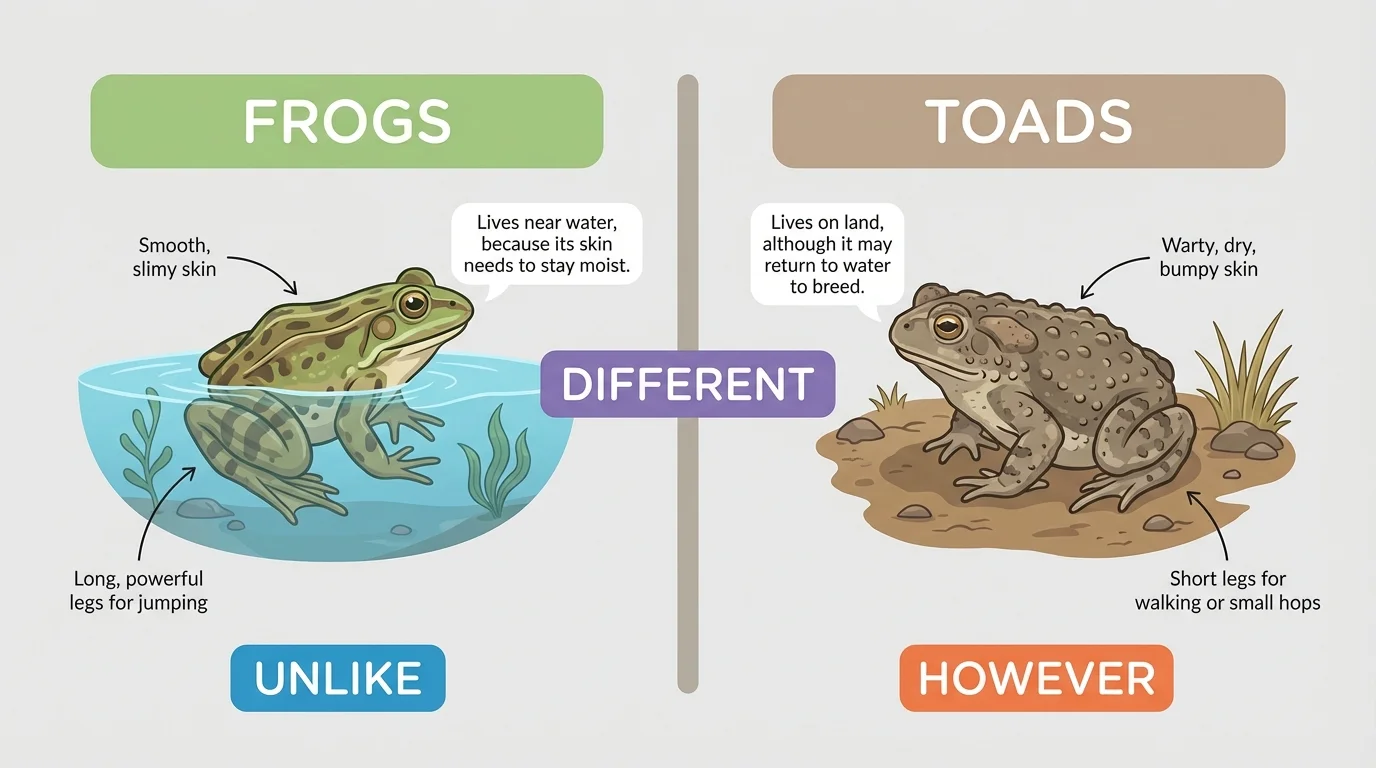
Common compare-and-contrast signal words include both, same, similar, like, also, too, however, but, although, different, unlike, and while. As [Figure 2] shows, these words can help readers notice similarities and differences side by side.
When an author wants to compare, the author may use words like both or similar.
Both dolphins and whales are mammals.
This sentence compares dolphins and whales by showing a likeness: they are both mammals.
When an author wants to contrast, the author may use words like however, unlike, or different.
Frogs live part of their lives in water; however, toads spend more time on land.
This sentence contrasts frogs and toads by showing a difference.
Here are more examples:
Compare: Maple trees and oak trees both lose their leaves in fall.
Contrast: A desert is dry, while a rainforest is wet.
Compare and contrast together: Bats and birds can both fly, but bats are mammals and birds are not.
That last sentence is especially useful because it shows both kinds of relationships. The word both shows a similarity. The word but shows a difference. One sentence can contain more than one clue.
Looking for what is being compared
When you notice a compare-or-contrast signal word, pause and ask, "What two things is the author talking about?" Then ask, "Are they alike here, or different here?" This simple habit helps you understand even harder paragraphs.
Later, when you study animals, landforms, inventions, or communities, the same strategy helps again. As shown in [Figure 2], readers can sort details into two groups: things that match and things that do not.
Some signal words are especially powerful because they can surprise the reader. Contrast signal words such as although, but, yet, and however tell you that the second idea may not match what you expected.
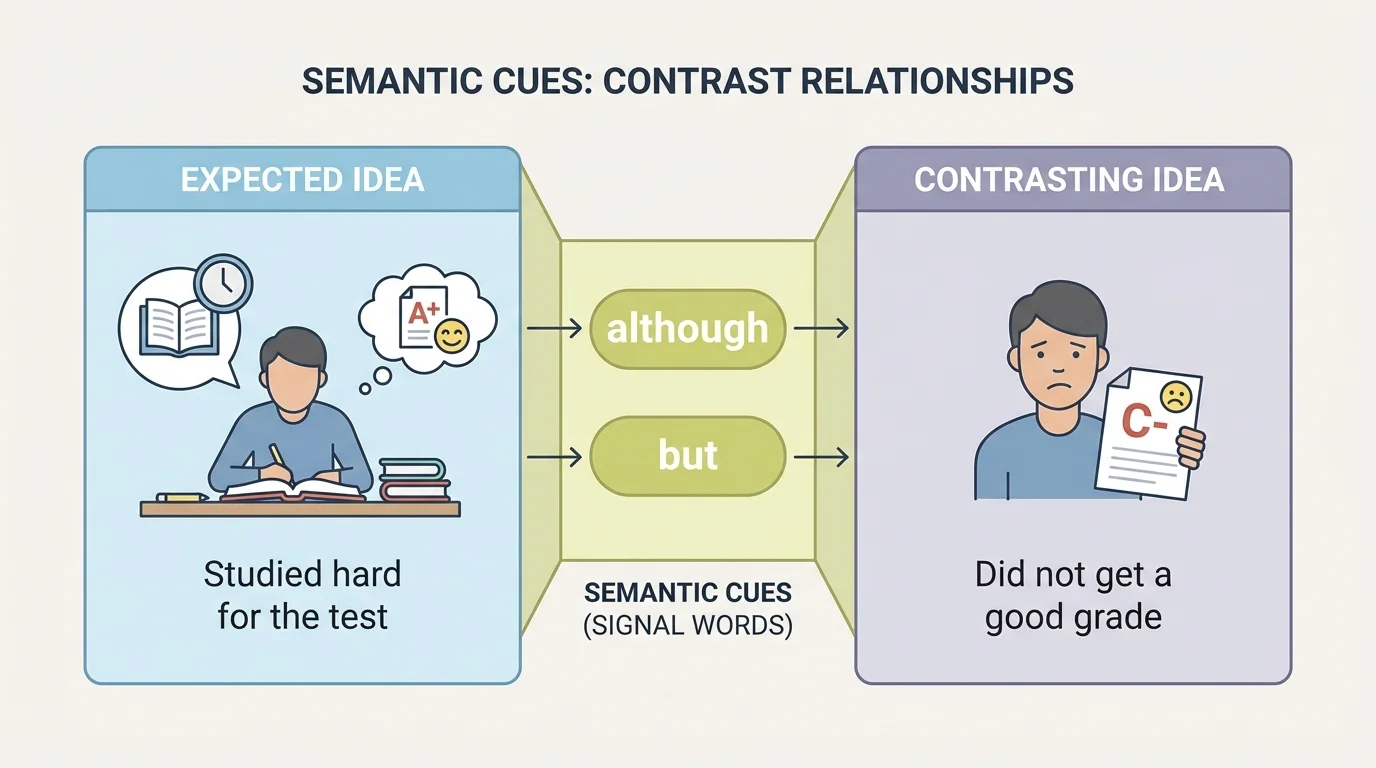
As [Figure 3] shows, contrast signal words can connect two parts of a sentence that pull in different directions.
Look at this sentence: Although Ben practiced every day, he still felt nervous before the concert.
The word although tells us that the second part may be surprising. You might expect lots of practice to make Ben feel completely calm. Instead, the sentence shows a different result.
Here is another example: The turtle is slow, but it is steady.
The word but signals a contrast. The author wants you to notice that being slow does not mean being weak or careless.
Words like while can be tricky because they sometimes show time and sometimes show contrast. In the sentence "While I was eating, the phone rang," while shows time. In the sentence "While lions live in groups, tigers usually live alone," while shows contrast. Readers must use the whole sentence to decide.
This is why signal words are called cues. They give you a clue, but you still need to think about the meaning around them. A good reader combines the signal word with the ideas nearby.
Writers of textbooks use signal words often because they help readers organize information. Even short words can make a big difference in how clearly a page explains a topic.
As shown again in [Figure 3], contrast words often connect two ideas that seem to push against each other. That push helps the reader notice an important difference.
Signal words are helpful, but sometimes you need more than one word to understand the relationship. A sentence may not include the exact word because, yet it can still show cause and effect. For example: The temperature dropped overnight. By morning, the pond had a thin layer of ice. There is no signal word here, but the meaning still shows a cause-and-effect relationship. The drop in temperature caused the ice to form.
In the same way, a paragraph may compare two things without using the word compare. Read this short paragraph: Sea turtles hatch on sandy beaches. They crawl to the ocean soon after hatching. In contrast, many young birds stay in a nest and depend on parent birds for food. The phrase in contrast signals a difference between baby sea turtles and baby birds.
Readers should pay attention to nearby details. Ask yourself:
These questions help even when the sentence is longer or the clue word is less familiar.
Reading a short paragraph for relationships
Read this paragraph: Polar bears have thick fur and a layer of fat. Because of these features, they stay warm in the Arctic. Seals also have blubber, but they live much of their lives in water.
Step 1: Find the cause-and-effect clue.
Because of these features shows that the fur and fat help cause warmth.
Step 2: Find the compare clue.
Also shows that seals share a similar feature with polar bears.
Step 3: Find the contrast clue.
But shows a difference: seals live much of their lives in water.
One short paragraph can contain more than one kind of relationship.
That is an important idea: texts often mix relationships together. An author may compare two animals and also explain why one survives better in a cold place. Readers need to stay alert for more than one kind of clue.
Informational texts are full of relationships between ideas. In science, you may read about weather, animals, plants, and matter. In social studies, you may read about communities, leaders, and historical events. In health, you may read about habits and their results. Signal words help in every subject.
Here are some examples:
| Subject | Sentence | Relationship |
|---|---|---|
| Science | Clouds became heavy with water, so it rained. | Cause and effect |
| Science | Both insects and spiders are small animals, but spiders have eight legs. | Compare and contrast |
| Social Studies | Because the town was near a river, people could travel and trade more easily. | Cause and effect |
| Social Studies | Unlike cities, rural areas usually have more open land. | Contrast |
| Health | Regular sleep helps the body rest; therefore, many people feel more focused after enough sleep. | Cause and effect |
Table 1. Examples of signal words and idea relationships in different school subjects.
When readers understand these patterns, they remember information better. Facts do not stay as separate pieces. Instead, they connect into a clear picture.
One common mistake is thinking that every clue word means the same thing. For example, then usually shows order in time, not cause and effect. In "Lena finished breakfast, then she brushed her teeth," the word then shows sequence. It does not prove that breakfast caused tooth brushing.
Another common mistake is stopping at the signal word and not reading the rest of the sentence carefully. The word gives a hint, but the whole sentence gives the meaning. If you only spot although but do not read both parts of the sentence, you may miss the contrast.
A third mistake is mixing up cause and effect. In the sentence "Because the power went out, the room became dark," the power going out is the cause. The dark room is the effect. Asking "What made this happen?" can help you keep them straight.
When you learned to find the main idea and details, you practiced noticing what information matters most. Signal words help with that same job because they show how the important details fit together.
Strong readers slow down when they see clue words. They think about the relationship, not just the fact. That habit makes difficult nonfiction much easier to understand.
When you read about storms, habitats, inventions, or communities, look for words like because, so, both, however, and although. These semantic cues point you toward the author's meaning. They help you see reasons, results, likenesses, and differences.
