Have you ever read a sentence and come across a word that felt like a locked door? Good readers do not always run for a dictionary right away. Instead, they look for clues. Sometimes a nearby word means almost the same thing. Sometimes a nearby word means the opposite. Those word relationships can unlock meaning fast.
When you read, you are not just saying words. You are building meaning. If you come to a word you do not know, you can often figure it out by noticing how it connects to other words in the sentence or paragraph. Two very helpful kinds of word relationships are synonyms and antonyms.
Readers use these relationships in stories, science books, articles, directions, and even conversations. If a character is described as fearful and the next sentence says she was afraid, the second word helps explain the first. If a text says the desert is dry, not wet, the opposite word also gives a clue.
Synonyms are words that have the same or nearly the same meaning.
Antonyms are words that have opposite meanings.
Context clue means a hint in the words or sentences around an unfamiliar word.
These ideas matter because books often contain words you have heard before but never studied closely. Word relationships help you stay focused on reading instead of getting stuck on every unfamiliar word.
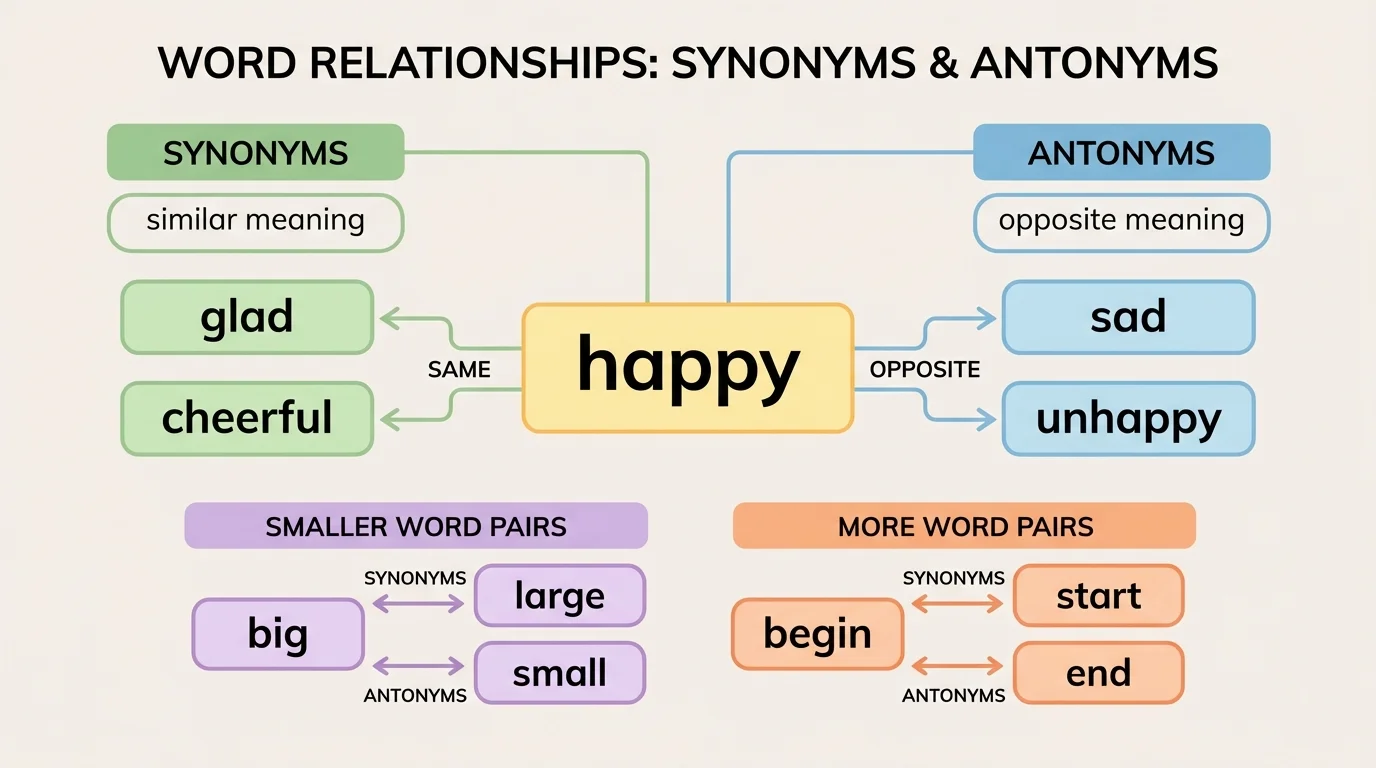
Word relationships can be pictured like a map, as shown in [Figure 1]. A word can have neighbors that are close in meaning and neighbors that are opposites. Seeing both kinds of relationships helps you understand a word more clearly.
For example, big has synonyms such as large and huge. It has antonyms such as small and tiny. The word begin has synonyms like start. Its antonym is end. The word quiet has synonyms like silent or calm. Its antonym might be noisy or loud.
Sometimes the sentence gives you one of these clue words right away. If you can spot the relationship, you can often understand the unfamiliar word without stopping your reading.
Think about the word rapid. If a sentence says, "The river moved rapidly, very quickly, after the storm," the synonym quickly helps you know that rapidly means fast. If a sentence says, "The turtle was not rapid; it was slow," the antonym slow gives the clue.
A synonym clue gives another word or phrase with a similar meaning. Sometimes it comes right after the unfamiliar word. Sometimes it comes before it. Writers may separate the clue with commas, dashes, or parentheses, but the clue can also appear in a regular sentence.
Read this sentence: "Mina felt delighted, or very happy, when her team won." The phrase very happy is a synonym clue. It helps you understand that delighted means very pleased or joyful.
Here is another example: "The puppy was tiny. It was so small that it fit inside a basket." The word small is a synonym clue for tiny.
Using a synonym clue
Sentence: "The path was narrow, or not wide, so only one person could walk on it at a time."
Step 1: Find the unfamiliar word.
The word is narrow.
Step 2: Look for a nearby word or phrase that means almost the same thing.
The clue phrase is not wide.
Step 3: Put the meaning back into the sentence.
The path was narrow, so it was not wide from side to side.
The synonym clue helps the reader understand the word quickly.
Synonym clues are especially useful in nonfiction. A science book might say, "A habitat is a creature's home." A social studies book might explain, "A settlement, or community where people live, grew near the river." In each case, a more familiar phrase helps explain the new word.
An antonym clue gives the opposite meaning. If you know one side of the pair, you can figure out the other side. Words such as but, however, unlike, instead of, and not often signal an opposite idea.
Read this sentence: "The soup was not bland; it was spicy and full of flavor." If spicy is the opposite of bland, then bland must mean not spicy or not strongly flavored.
Another sentence might say, "Unlike his messy desk, her desk was neat." The opposite word messy helps you understand that neat means tidy and organized.
Using an antonym clue
Sentence: "The cave looked ancient, not new at all."
Step 1: Notice the signal for an opposite idea.
The phrase not new shows an antonym clue.
Step 2: Think of the opposite of new.
The opposite is old.
Step 3: Choose the best meaning.
Ancient means very old.
The opposite idea narrows the meaning and makes the word clearer.
Antonym clues are powerful because they do more than name an opposite. They help you set limits around a word's meaning. If something is not cheerful but gloomy, you know it has a sad feeling. If a road is not smooth but rough, you know it has bumps.
Synonyms are often close in meaning, but they are not always exactly the same. That is why readers must pay attention to shades of meaning. A shade of meaning is a small difference between related words.
For example, walk, march, stroll, and tiptoe all describe movement on your feet, but they do not mean exactly the same thing. A stroll is relaxed. A march is strong and steady. Tiptoe means walking very quietly.
The same idea works with feelings. Glad, happy, cheerful, and delighted are related, but delighted often shows a stronger feeling than glad. Good readers choose the meaning that fits the sentence best, not just any close word.
| Word | Related Word | How the Meaning Changes |
|---|---|---|
| happy | delighted | stronger feeling of joy |
| cold | freezing | much colder |
| look | stare | look for a longer time |
| walk | tiptoe | walk softly and quietly |
Table 1. Examples of related words that have small but important differences in meaning.
Antonyms can also have shades of meaning. The opposite of warm might be cool, cold, or freezing, depending on the sentence. Readers think carefully about which opposite fits best.
Many authors choose precise synonyms on purpose. They do not just want to say that a character walked. They may want you to picture the character marching, wandering, or tiptoeing.
This is one reason why vocabulary matters in reading. The more relationships you know between words, the more exact your understanding becomes.
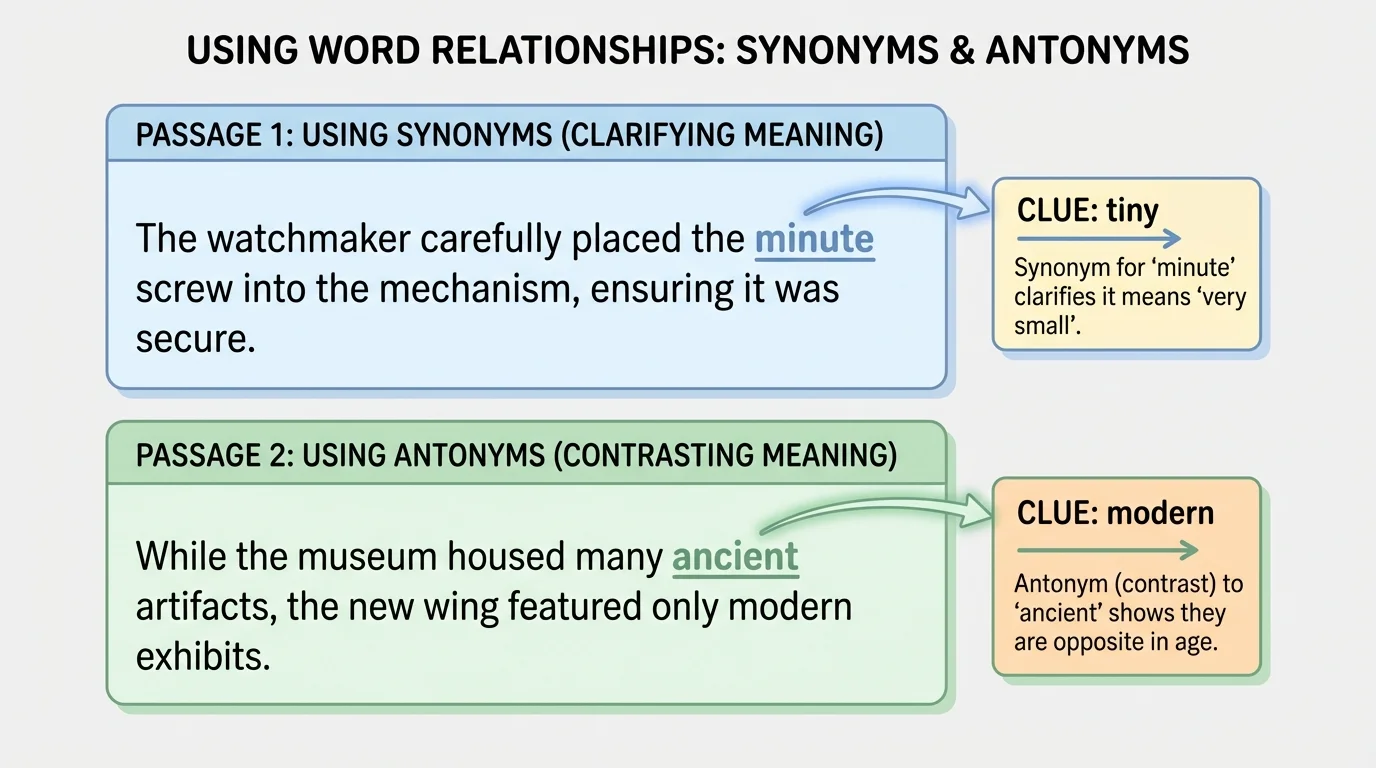
Strong readers look around the unknown word for clue words before and after it, as shown in [Figure 2]. A synonym clue may come later in the sentence, and an antonym clue may appear after a word like but or unlike.
Suppose you read: "The insect was minute, so tiny that it looked like a speck of dust." Even if you do not know minute, the clue so tiny explains it. Now read: "The castle seemed ancient, but the new glass doors looked modern." The word modern helps show that ancient means very old.
Writers do not always place clue words neatly right next to the unfamiliar word. Sometimes you must read the whole sentence or even the next sentence. That is why readers stay alert to the ideas around the word, not just the word itself.
Context clues and word relationships work best together. If a sentence says, "The kitten was timid and hid behind the chair instead of running out to greet us," the clue about hiding helps you understand that timid means shy or fearful.
Later in a story, you might see the same kind of clue again. You can use this strategy whenever an unfamiliar word appears in a paragraph.
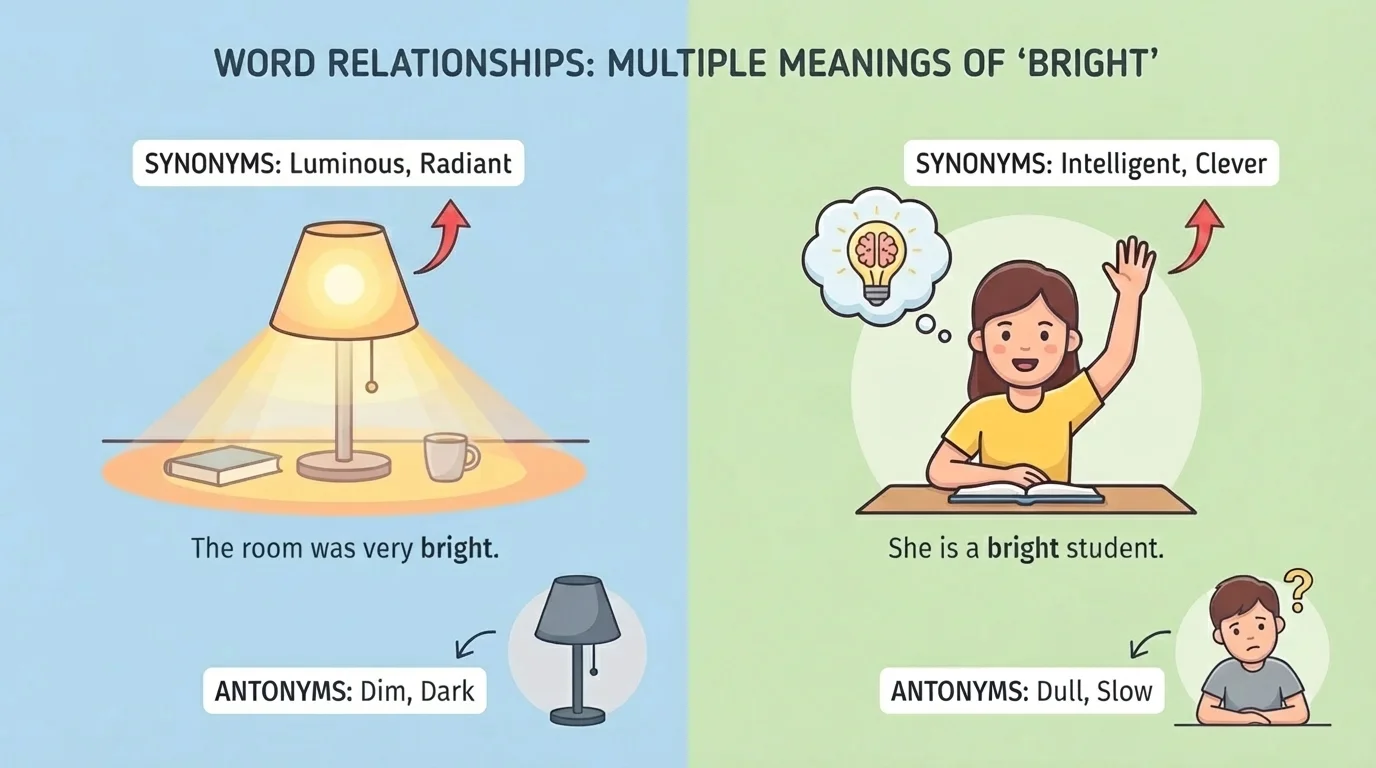
Some words have more than one meaning, and the sentence decides which meaning fits, as shown in [Figure 3]. In these cases, synonyms and antonyms help you choose the correct meaning.
Take the word bright. In one sentence, "The bright sun lit the field," bright means full of light. In another sentence, "Mila is a bright student who solves hard problems," bright means smart. The nearby words tell you which meaning belongs.
The word bark can mean the sound a dog makes or the outside covering of a tree. If you read, "The dog's bark woke the baby," the context points to sound. If you read, "The rough bark on the tree felt scratchy," the context points to the tree covering.
Synonyms help here too. In "The room was bright, or full of light," the clue is direct. In "The bright child was clever," the word clever acts like a synonym clue. Antonyms can help as well. "The room was not dim; it was bright" shows the meaning clearly through opposites.
When a word has many meanings, never guess from the word alone. Read the whole sentence and look for relationships with other words.
Sometimes you can use word relationships along with prefixes or known base words. A prefix is a word part added to the beginning of a word. For example, in unhappy, the prefix un- means not. If you know happy, then unhappy means not happy. That idea also connects to antonyms.
Another example is redo. The prefix re- means again. If you know do, then redo means do again. Word parts do not replace synonym and antonym clues, but they work together with them.
You may already know that readers use context clues to figure out meanings. Synonyms and antonyms are two special kinds of context clues. They are tools inside the larger strategy of using context.
If a sentence says, "After the mistake, she had to redo the work instead of leaving it finished," the phrase about doing the work again helps match the prefix clue. The more clues agree, the more confident you can be.
When you find an unfamiliar word, do not panic. Use a simple strategy.
First, read the whole sentence. Next, look for nearby words that mean almost the same thing. Then, look for opposite words or signal words such as but, not, and unlike. After that, think about the topic of the sentence. Finally, decide on a meaning and check whether it makes sense.
A word-detective example
Sentence: "The ground was moist, not dry, after the rain."
Step 1: Read the whole sentence.
The sentence talks about the ground after rain.
Step 2: Find a word relationship clue.
The clue is not dry, which is an antonym clue.
Step 3: Choose a meaning that fits.
Moist means a little wet.
The clue and the topic both support the same meaning.
This strategy works in many kinds of reading. In stories, it helps you understand characters and events. In nonfiction, it helps you learn new facts and subject words.
You use this skill more often than you may realize. In a recipe, the word combine might be explained by the direction to mix ingredients together. In a game, the word defeat might be understood because it is the opposite of win. In science, the word fragile may be clear if the text says an object is easily broken. In social studies, the word ancient may be clarified by words like old and long ago.
Even conversations use these relationships. If someone says, "I was exhausted, really tired, after the hike," the synonym explains the word. If someone says, "The water was shallow, not deep," the antonym explains it.
As your reading grows, you will meet harder words. But you will also grow stronger at finding clues. Every time you compare words, notice opposites, and test meanings in context, your vocabulary becomes more powerful.
"Words are connected, and those connections help readers unlock meaning."
Writers choose words carefully, and readers can study those choices. A smart reader notices when an author explains a word with a similar word, sharpens meaning with an opposite word, or uses context to show which meaning fits best. That is how reading becomes both easier and richer.
