Some books tell stories about characters and adventures. Other texts explain how volcanoes erupt, why communities grow, or how to build a model bridge. Those texts are called informational texts, and they are everywhere: in science books, history articles, directions for games, museum signs, and even manuals for using technology. Learning to read them well is like gaining a new superpower. It helps you understand the real world.
By the end of the year, strong readers can read and understand informational texts in the grades 4–5 text complexity band. Some texts in that band are easier, and some are more challenging. When a text is harder, readers may use scaffolding such as rereading, discussing with a teacher, looking at diagrams, or stopping to explain ideas aloud. The goal is not just to say the words. The goal is to understand the ideas.
An informational text gives facts, explains ideas, describes processes, or teaches steps. It may answer questions like: What happened? Why did it happen? How does it work? What should I do first? A story usually follows characters and a plot, but an informational text is usually organized around a topic.
When you read an informational text, you often look for the main idea, the most important point the author wants you to understand. Then you gather the key details, the facts, examples, and explanations that support that main idea. Good readers also notice how the text is organized. Some texts are arranged by sequence, some by cause and effect, some by compare and contrast, and some by problem and solution.
Informational text is writing that gives real information about a topic. It may explain history, science, directions, or other factual ideas.
Text structure is the way a text is organized, such as sequence, cause and effect, compare and contrast, or problem and solution.
If you read a paragraph about the water cycle, the main idea may be that water moves through a repeating process. The key details may explain evaporation, condensation, and precipitation. If you read an article about a famous explorer, the main idea may be that the explorer changed trade and travel, while the details explain where the explorer went and what happened afterward.
Informational texts often include special parts called text features. These features are not just decorations. They help readers find information faster and understand it better. A page with labels, captions, and headings, as shown in [Figure 1], guides your eyes and tells you where to focus first.
Some common text features are headings, subheadings, captions, bold print, glossaries, diagrams, maps, charts, tables, sidebars, and indexes. A heading tells the topic of a section. A caption explains a picture. A glossary defines special words. A chart or table organizes facts so they are easy to compare.
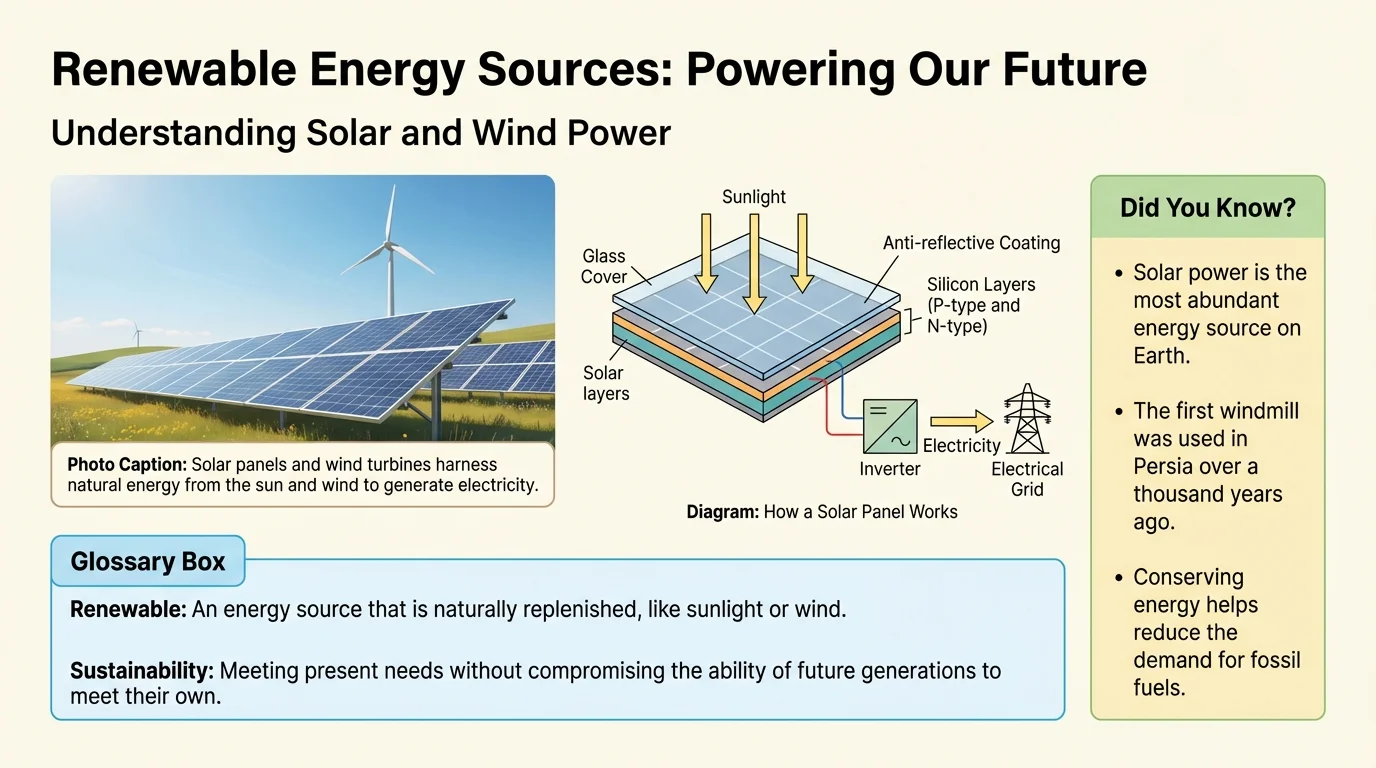
Suppose you are reading about animal habitats. The heading might say Desert Animals. A photo caption could explain how a camel stores fat in its hump. A diagram label might point to wide feet that help the camel walk on sand. If you skip those features, you may miss important information.
Smart readers use text features before, during, and after reading. Before reading, they preview headings and pictures to predict what the text will teach. During reading, they pause to study labels and captions. After reading, they return to charts, maps, or diagrams to check their understanding. Later, when you compare sources, the careful use of features in [Figure 1] helps you locate details quickly.
Many adults use informational reading every day without noticing it. Recipes, bus schedules, weather maps, and medicine labels are all informational texts.
Text features also help with harder texts. If a paragraph uses a difficult word like erosion, a nearby diagram or caption may make the meaning clearer. That is one reason strong readers do not read only the lines of print. They read the whole page.
One of the most important reading skills is figuring out what matters most. The main idea is the big point. Key details are the facts that support it. Sometimes the author states the main idea clearly in the first sentence. Other times, you have to think about all the details and decide what they have in common.
Read this short example: Bees visit flowers to collect nectar. As bees move from flower to flower, pollen sticks to their bodies. This helps plants make seeds. Many fruits and vegetables grow because pollinators do this work. The main idea is that bees help plants reproduce. The details explain nectar, pollen, and seed-making.
Finding the main idea in a short science paragraph
Paragraph: Frogs begin life as eggs in water. They hatch into tadpoles with tails and gills. As they grow, they develop legs and lungs. Adult frogs can live on land and in water.
Step 1: Notice what the sentences are mostly about.
Every sentence is about the stages in a frog's life.
Step 2: Look for details that repeat or connect.
The details describe eggs, tadpoles, growth, and adult frogs.
Step 3: State the main idea in your own words.
The main idea is that frogs change as they grow from eggs into adults.
Sometimes readers confuse a detail with the main idea. For example, tadpoles have tails is true, but it is only one detail. The paragraph is really about frog growth and change. Good readers keep asking, "What is this whole section mostly teaching me?"
It also helps to notice signal words. Words like first, next, and finally suggest sequence. Words like because, therefore, and as a result suggest cause and effect. These clues help readers connect details to the main idea.
History and social studies texts often explain events, people, places, and changes over time. A timeline, as shown in [Figure 2], helps readers put events in order and see how one event can lead to another.
When reading history, ask questions such as: Who was involved? What happened first? What changed over time? Why did this event matter? History texts often include dates, maps, quotations, and descriptions of causes and effects. Social studies texts may explain communities, governments, economics, or geography.
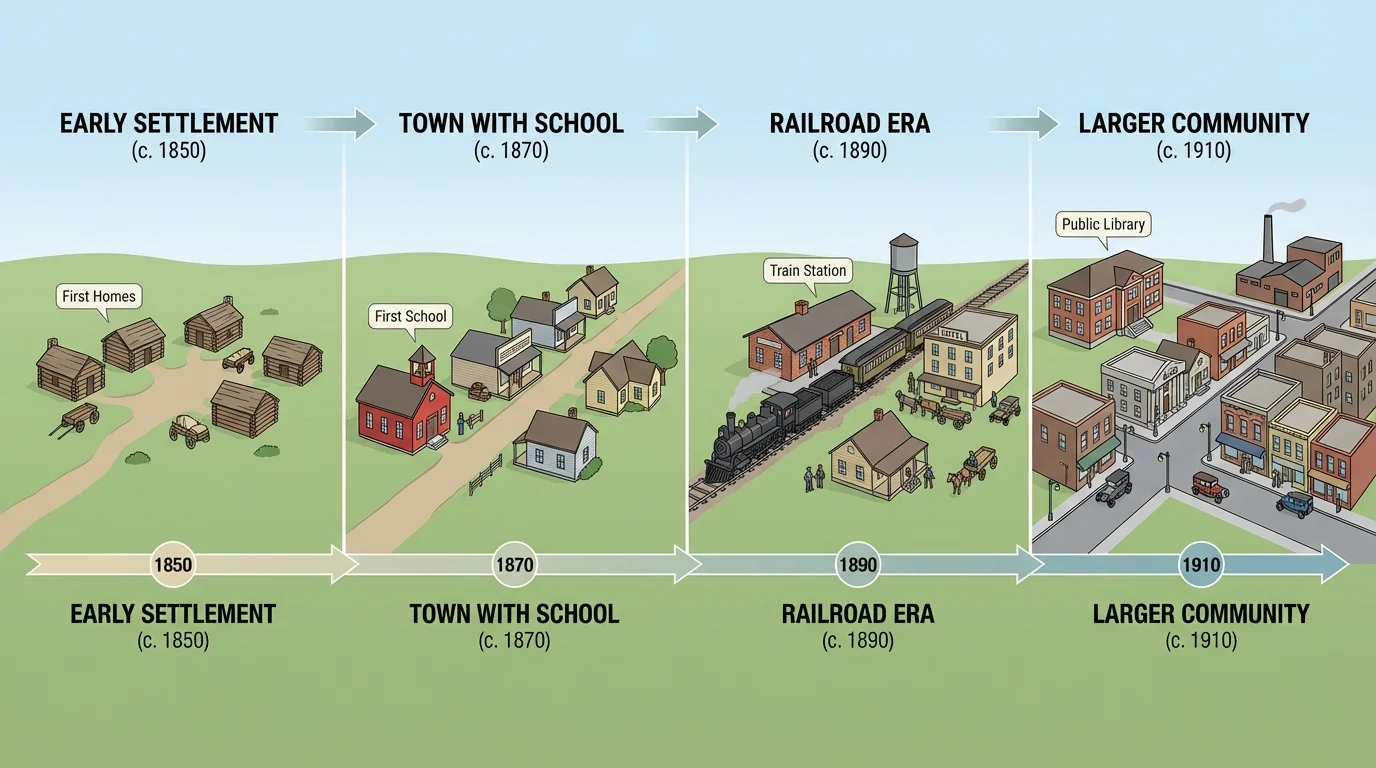
For example, a text about a town might say settlers first built homes near a river. Later, a school was built. After that, a railroad came through, making trade easier. The main idea may be that transportation and community buildings helped the town grow. The details are the river, school, and railroad.
History readers also work with primary sources and secondary sources. A primary source is something from the time being studied, such as a letter, photograph, diary, speech, or artifact. A secondary source is written later and explains or analyzes the past, such as a textbook article or biography.
Using sources carefully
A primary source gives a direct window into the past, but it may show only one person's view. A secondary source can explain many facts together, but it depends on evidence from the past. Strong readers ask what kind of source they are reading and what information it can provide.
If you read a soldier's letter from long ago, you are reading a primary source. If you read an encyclopedia article about that war, you are reading a secondary source. Both matter, but they do different jobs. As with the events arranged in [Figure 2], history becomes clearer when you keep track of sequence and evidence.
Science texts explain the natural world. They may describe animal behavior, weather, rocks, plants, space, energy, or experiments. Science reading often includes special vocabulary, close observation, and careful attention to diagrams. A labeled process diagram, as seen in [Figure 3], can add information that the paragraph gives only briefly.
Science texts often answer questions like: What is it? How does it work? What causes it? What evidence supports this idea? They may describe a process in steps, such as how a seed becomes a plant or how clouds form before rain. In science, words matter a lot. A small difference between observe and infer can change meaning.
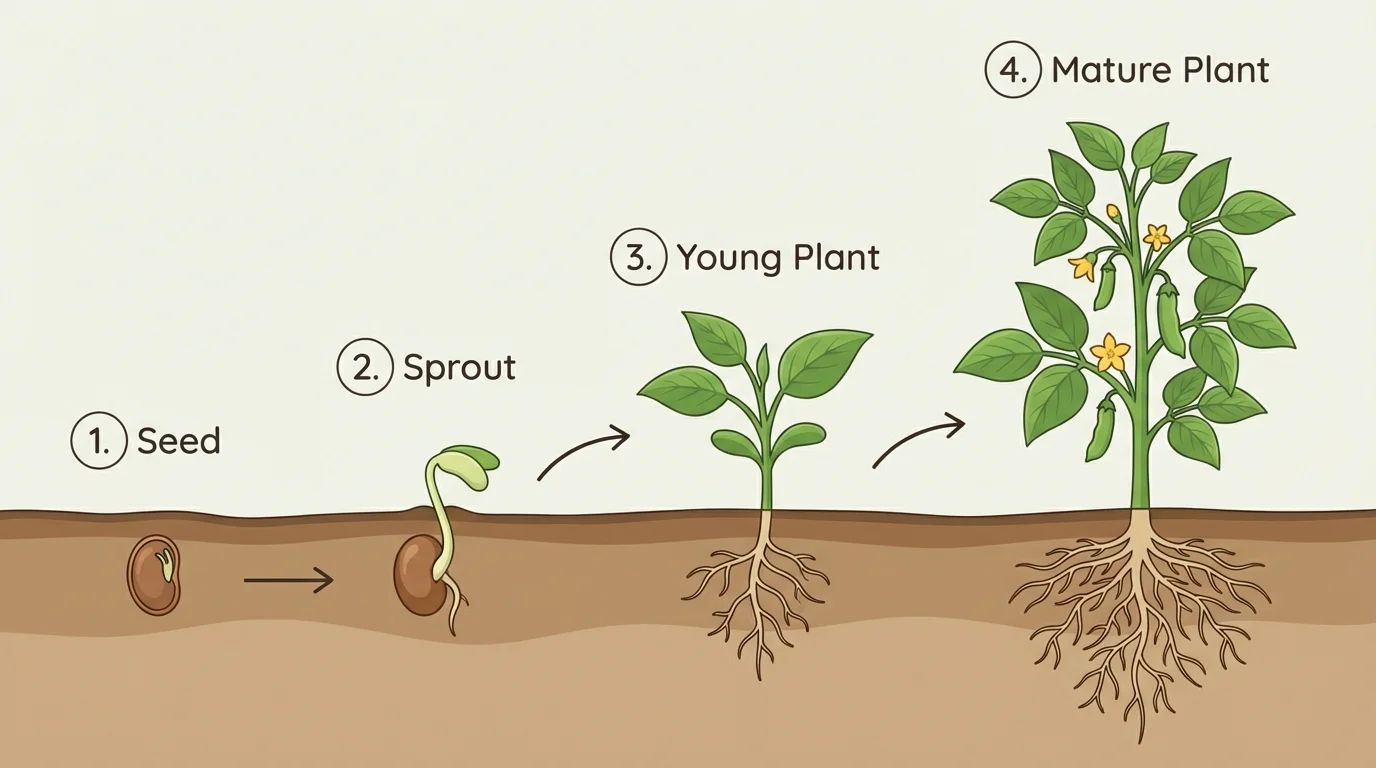
Suppose a text says: Plants need sunlight, water, air, and nutrients to grow. A diagram may label roots, stems, and leaves and show what each part does. The words and the diagram work together. If you read only one and ignore the other, your understanding may be incomplete.
Science readers also look for cause and effect. For example, if a plant does not get enough sunlight, it may grow weakly. If the temperature drops below freezing, water can turn to ice. These relationships help explain why things happen. Later, when you revisit the stages in [Figure 3], you can connect each stage to the conditions the plant needs.
When you read science, slow down at unfamiliar words. Read the sentence again, check nearby labels, and look for examples. Understanding a hard word often unlocks the whole idea.
Science texts can also include data in charts or tables.
| Plant Part | Job |
|---|---|
| Roots | Take in water and nutrients |
| Stem | Supports the plant and moves water |
| Leaves | Use sunlight to help make food |
Table 1. A simple chart showing how different plant parts help a plant live and grow.
Tables help readers compare ideas quickly. If a paragraph explains the same facts in sentences, the table can make the information easier to scan and remember.
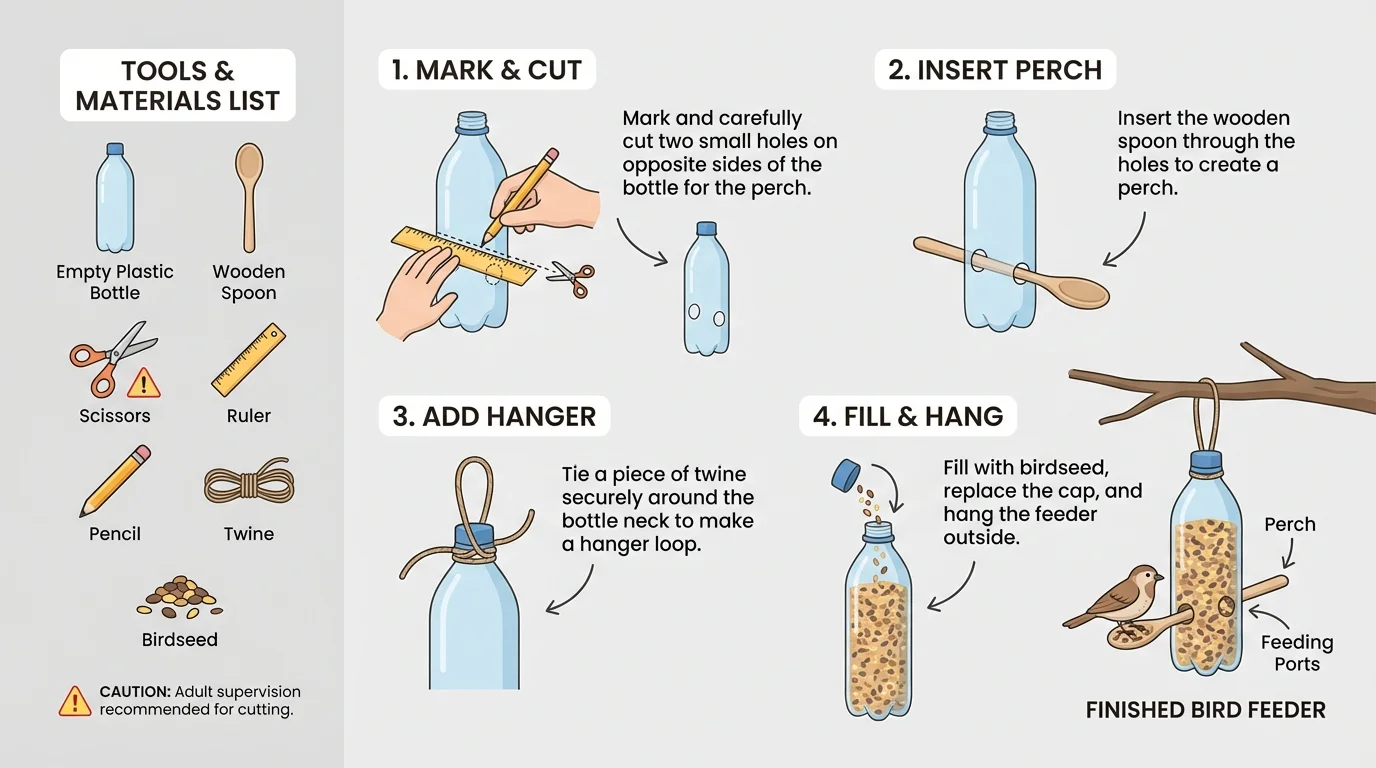
Technical texts tell how to do something or how something works. They include recipes, directions, manuals, safety rules, and instructions for building or using tools. In these texts, order is very important. A page of directions, like the one in [Figure 4], must usually be followed step by step.
Technical texts often have numbered steps, materials lists, warning symbols, labels, and precise verbs such as attach, insert, tighten, or measure. These words are exact because they must help the reader perform a task correctly and safely.
Think about directions for planting seeds. If the instructions say to place seeds 1 inch deep, water lightly, and keep the pot in sunlight, the order and exact wording matter. Planting too deep or forgetting sunlight may lead to poor results. Technical reading is not just about understanding facts. It is about following information accurately.
Warnings are especially important in technical texts. A recipe may warn that a pan is hot. A science activity may say to wear goggles. A toy manual may say that small parts are not safe for young children. When readers notice symbols and caution notes, they are using the text responsibly. The careful order seen in [Figure 4] reminds readers that skipping a step can change the outcome.
Reading a short set of directions
Directions: 1. Pour soil into a cup. 2. Place one bean seed into the soil. 3. Cover the seed lightly. 4. Water the soil. 5. Put the cup near a sunny window.
Step 1: Notice the sequence.
The numbers show the order of actions.
Step 2: Find the exact actions.
The action words are pour, place, cover, water, and put.
Step 3: Identify why precision matters.
If you water before adding the seed, or put the cup in a dark place, the directions are not followed correctly.
Technical texts can seem short, but they often require slow, careful reading. Missing one small detail can cause confusion.
Not every informational text feels easy the first time. Some texts use longer sentences, denser vocabulary, or more complicated ideas. When that happens, readers use strategies instead of giving up.
One strategy is chunking, which means breaking the text into smaller parts. Read one paragraph, stop, and say what it was mostly about. Then read the next paragraph. Another strategy is rereading. The first read may help you know the topic. The second read may help you understand the details.
Scaffolding means support that helps a reader understand a harder text. Examples include reading with a partner, using a glossary, discussing ideas aloud, or listening as a teacher models how to think through confusing parts.
Context clues also help. If you do not know a word, look at the words and sentences around it. A sentence may define the word, give an example, or show a contrast. Text features help here too. A diagram, caption, or bold word in a glossary may explain what the sentence alone does not.
Another powerful strategy is asking questions while reading. You might ask: What is this section mostly about? What does this word mean here? How does this detail connect to the paragraph before it? Why did the author include this chart? Strong readers are active thinkers, not passive word-callers.
Even expert readers reread difficult nonfiction. Needing a second read is not a sign of weakness. It is a sign that the text contains important ideas worth slowing down for.
Talking about a text can be a kind of support too. If you explain a paragraph in your own words, you may discover whether you really understand it. Teachers often model this by thinking aloud: "This heading tells me the next section is about causes. Now I will look for what made this happen."
Sometimes one text is not enough. You may read two articles about the same animal, two accounts of the same historical event, or a paragraph and a chart on the same science topic. Comparing texts helps you build a fuller understanding.
When you compare, look for information that is the same and information that is different. One article about whales may focus on body parts, while another focuses on migration. Both can be correct, but each gives a different angle on the topic. A timeline from one source might explain sequence, while a diary entry from the same period adds feelings or personal experience.
Comparing texts also helps you check ideas. If two sources agree, that may strengthen your understanding. If they differ, you can ask why. Are they describing different parts of the topic? Is one a primary source and the other a secondary source? Is one more detailed? Strong readers know that understanding grows when sources are connected thoughtfully.
Reading proficiency grows through habits. Preview the page. Notice headings. Read carefully. Stop and think. Reread when needed. Use text features. Pay attention to important words. Ask what the author most wants you to learn.
Stamina matters too. Some informational texts are longer or packed with more facts than stories. At first, a dense science article may feel tiring. Over time, as you practice, your brain gets better at holding ideas together, remembering details, and noticing structure.
It also helps to keep track of understanding. If your eyes move across the page but your mind is somewhere else, pause. Go back. Fix the confusion early. Good readers monitor their comprehension. They know when a section makes sense and when it does not.
"The more that you read, the more things you will know. The more that you learn, the more places you'll go."
— Dr. Seuss
Informational reading opens doors. It helps you understand the past, explore science, follow directions, and learn how the world works. Each time you use headings, captions, timelines, diagrams, and careful thinking, you become a stronger reader.
