Have you ever read a science book and seen a word that seemed tricky at first, but then the next sentence helped you figure it out? Strong readers do that all the time. They act like detectives. They notice hints in the text, think about the topic, and use what they already know. This matters in every subject. A social studies article, a science explanation, and even a math book can all contain words that need careful thinking.
Informational texts are written to teach facts, ideas, and explanations. When you read them, you will meet many kinds of words. Some words are useful in lots of subjects. Other words belong mostly to one subject area. Learning how to determine the meaning of these words helps you understand the whole text more clearly.
When readers know what important words mean, the text makes more sense. If you do not understand a key word, the whole paragraph can become confusing. For example, if a science text says, "Plants absorb water through their roots," the word "absorb" is important. If you know it means "to take in," the sentence becomes much clearer.
Understanding word meaning is not just about memorizing definitions. It is about using clues. Sometimes the author explains the word right away. Sometimes an example gives the meaning. Sometimes the subject itself helps. If you are reading about volcanoes, the word "magma" probably has something to do with melted rock under Earth's surface. Good readers keep asking, "What would make sense here?"
General academic words are words used in many subjects. They help readers talk about ideas, actions, and relationships. Words like compare, describe, and result are general academic words.
Domain-specific words are words mostly used in one subject or topic. Words like evaporation in science, legislature in social studies, or numerator in math are domain-specific words.
Knowing which kind of word you are reading can help you choose the best strategy for understanding it.
As [Figure 1] shows, general academic words can appear in many different books and lessons. These words are especially important in school because teachers use them often in directions and explanations. They can be compared with another group of words that belong more closely to one subject. Words such as analyze, explain, identify, and process may appear in science, reading, social studies, and math.
Domain-specific words are more closely tied to a particular topic. In a lesson about weather, you might read forecast, precipitation, or meteorologist. In a lesson about government, you might read citizen, election, or constitution. These words carry special meaning in that field.
One big difference is this: a general academic word helps you talk about learning across subjects, while a domain-specific word teaches you the special language of one subject. Both are important. If you know only the topic words but not the academic words, directions may confuse you. If you know only the academic words but not the topic words, the facts may stay unclear.
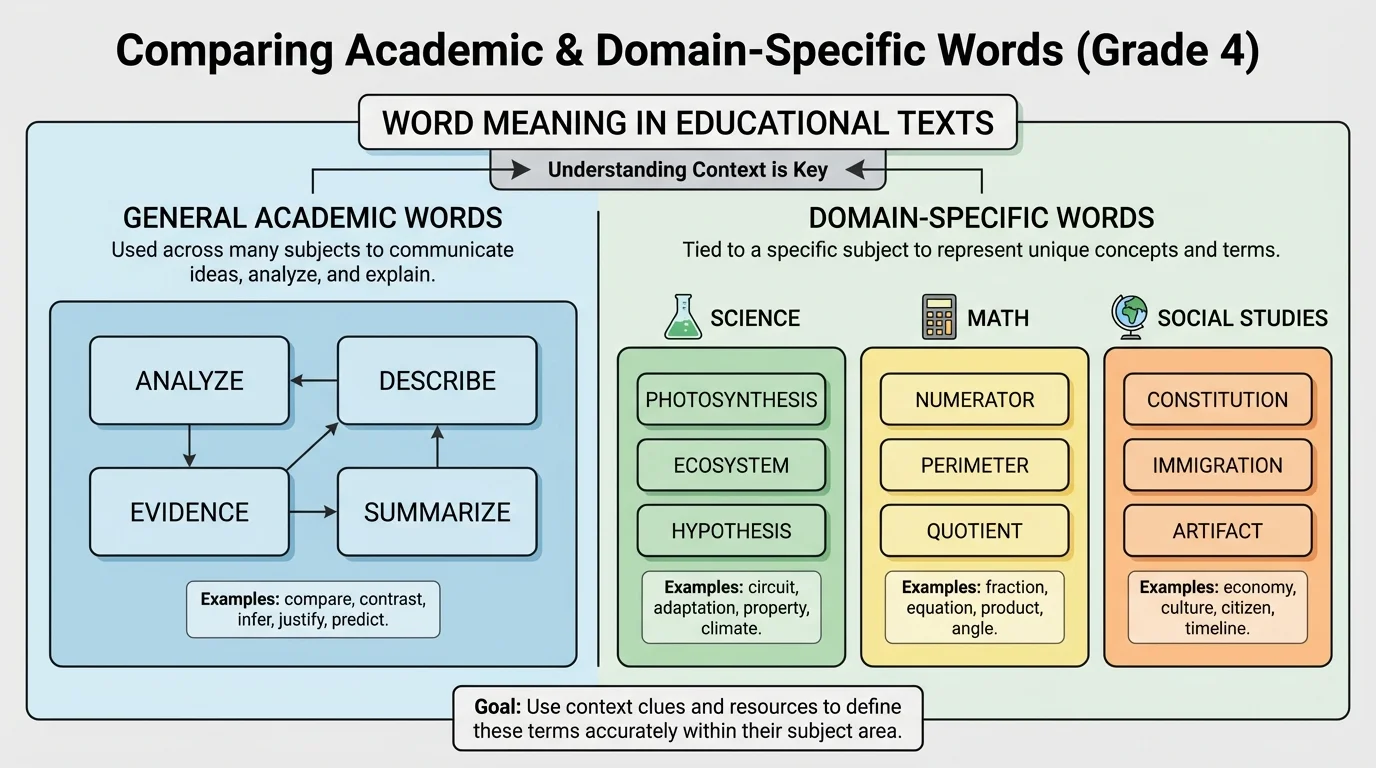
Think about the word observe. It is a general academic word because you can observe an experiment in science, observe details in a picture, or observe how people lived in history. Now think about the word photosynthesis. That word belongs mostly to science, so it is domain-specific.
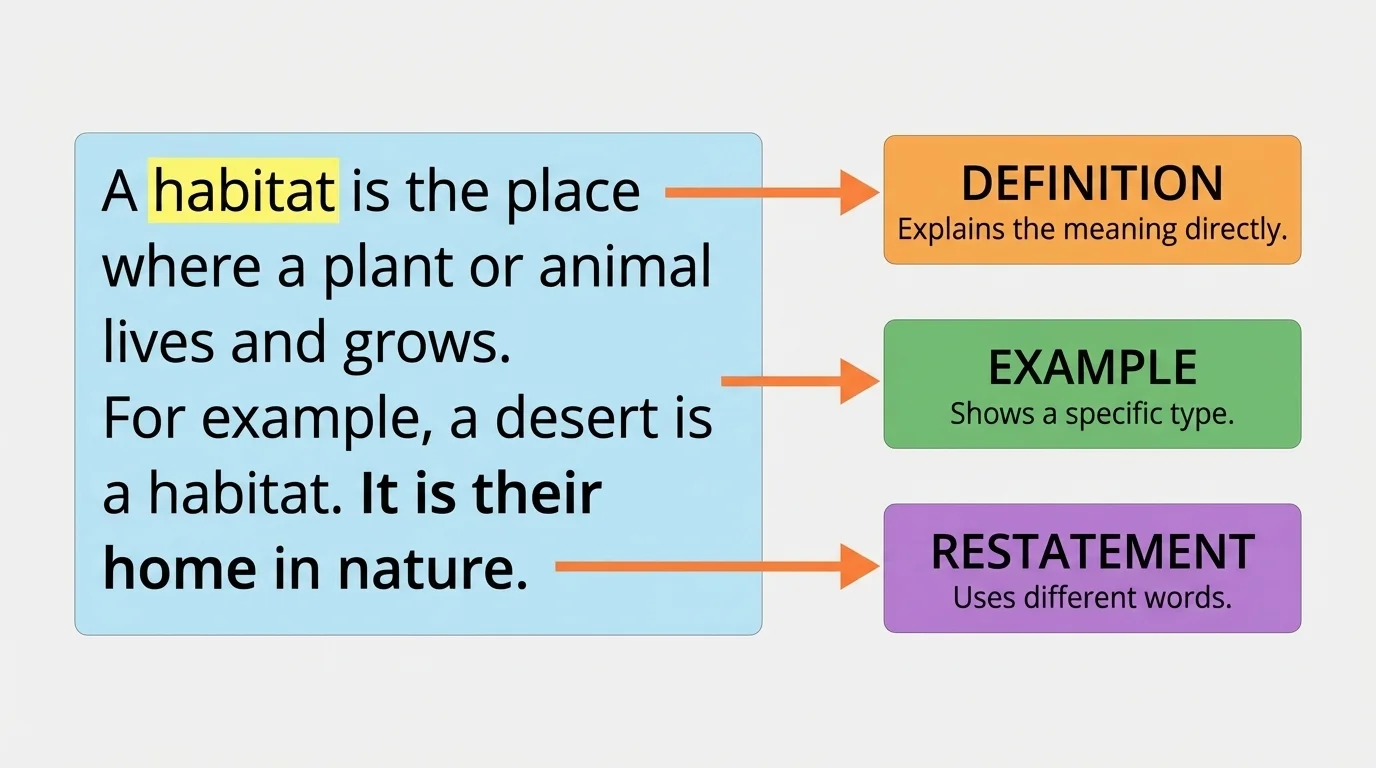
One of the best reading tools is the context clue. Context clues are hints in the words and sentences around an unfamiliar word. As [Figure 2] illustrates, a word's neighbors in a paragraph often give away its meaning. Readers look before the word, after the word, and sometimes at the whole paragraph.
Authors often include a definition right in the sentence. For example: "A habitat, the natural home of a plant or animal, provides food and shelter." The phrase "the natural home of a plant or animal" defines habitat. You can figure out the word without using a dictionary.
Sometimes authors use examples. Read this sentence: "Nocturnal animals, such as owls and bats, are active at night." The examples of owls and bats help you understand that nocturnal means active at night.
Sometimes the author restates the idea in simpler words. For example: "The surface was rough and uneven. It was not smooth at all." The second sentence helps explain what uneven means.
Readers also notice contrast clues. If a text says, "Unlike solid rock, magma is melted material under Earth's surface," the word unlike signals a difference. Since solid rock is not melted, you can infer that magma is melted rock.
Later, when you meet another unfamiliar word, remember the clue patterns from [Figure 2]: definition, example, restatement, and contrast. These patterns appear again and again in informational texts.
Finding meaning with context clues
Read this sentence: "The desert is an arid place with very little rainfall, so few plants can grow there."
Step 1: Notice the unfamiliar word
The word arid may be unfamiliar.
Step 2: Look for clues nearby
The sentence says the desert has "very little rainfall."
Step 3: Connect the clue to the word
A place with very little rainfall is very dry.
Step 4: State the meaning
Arid means dry.
That is exactly how readers solve word meaning while reading. They do not stop at every hard word. They search for clues first.
Informational texts do more than use sentences. They also use helpful parts such as headings, bold words, captions, labels, sidebars, and glossaries. As [Figure 3] shows, these text features guide readers toward word meaning even before they finish the paragraph.
A heading tells the topic of a section. If the heading says The Water Cycle, then a word like condensation probably connects to water and changes in state. A caption under a picture can explain an unfamiliar term. A labeled diagram can show what a word refers to. A glossary usually gives short definitions for important topic words.
Bold print is another clue. When authors put a word in bold, they are often telling you, "This word matters." You should pay close attention to how the text explains it. Sometimes the sentence right after the bold word gives the meaning.
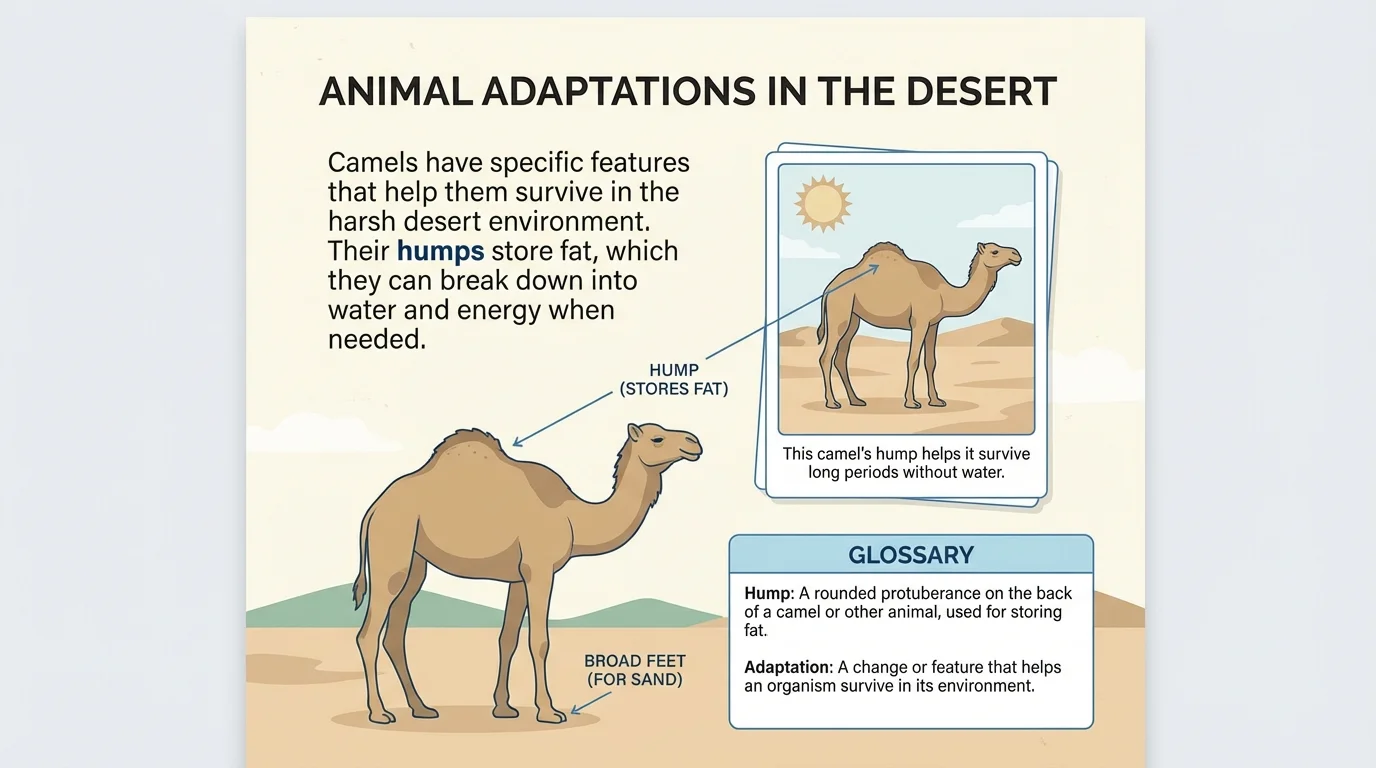
If you are reading a page about the human body and see a labeled picture of the lungs, that picture helps you understand words like oxygen and respiration. Text features do not replace reading. They work together with the sentences.
When readers return to information shown in [Figure 3], they often understand that the page itself gives many hints: the title names the topic, the labels point to exact parts, and the glossary confirms meaning.
Remember that informational texts are organized to teach. Fiction tells a story, but informational texts often use headings, charts, diagrams, and captions to help explain real facts and ideas.
That organization is useful because it helps readers make smart guesses about unfamiliar vocabulary.
Another strong strategy is studying prefixes, suffixes, and the base word. Some words are like building blocks. If you know the parts, you can unlock the whole meaning.
A prefix is a word part added to the beginning of a word. For example, un- often means "not." So unhappy means "not happy." A suffix is a word part added to the end of a word. The suffix -ful means "full of," so helpful means "full of help" or "giving help." As [Figure 4] illustrates, the base word is the main part of the word that holds the core meaning.
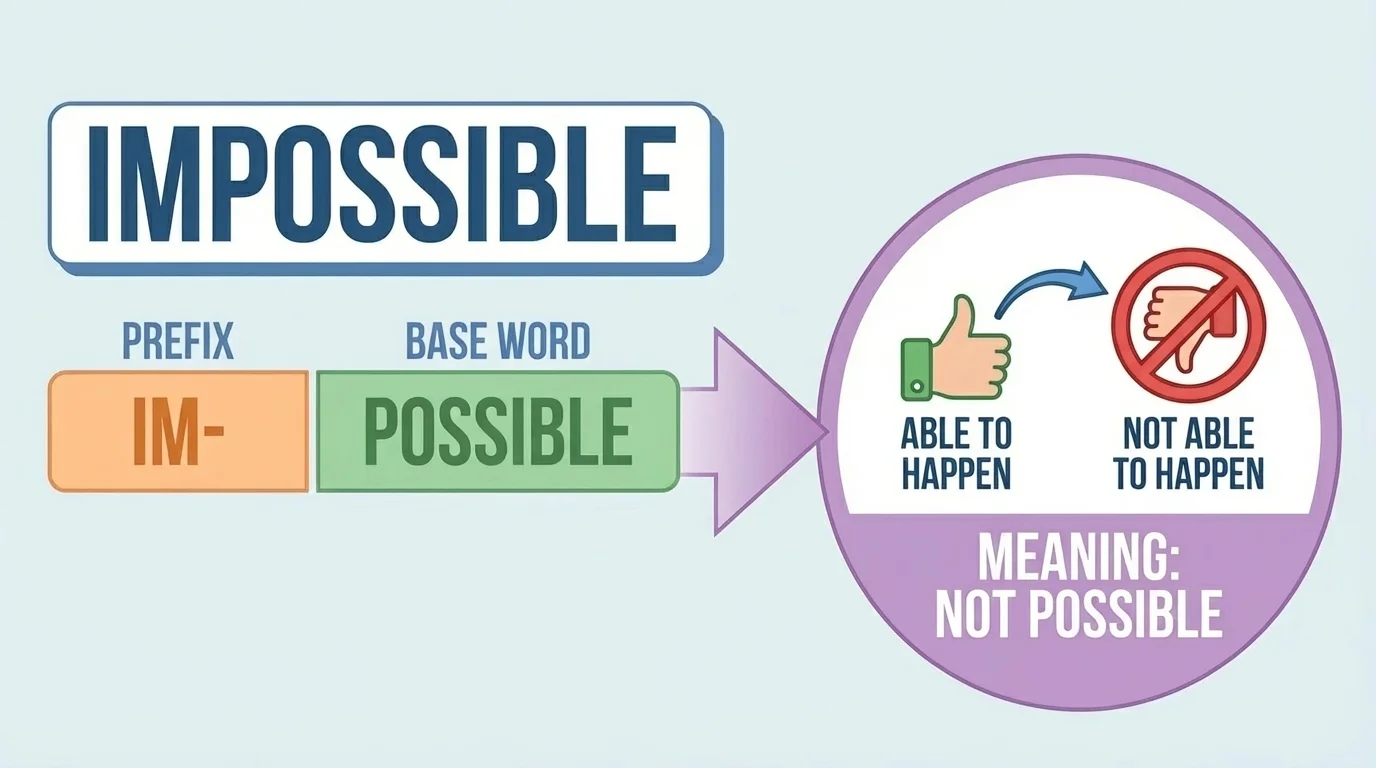
Look at the word preview. The prefix pre- means "before." The base word is view, which means "look at" or "see." So a preview is something you see before the main event. In reading, this can help you figure out words you have never seen before.
Here are a few common word parts that help in grade 4 reading:
| Word Part | Meaning | Example |
|---|---|---|
| re- | again | replay means play again |
| un- | not | unsafe means not safe |
| pre- | before | preheat means heat before |
| -less | without | hopeless means without hope |
| -er | person or thing that does something | teacher means one who teaches |
Table 1. Common word parts that help readers determine meaning.
When you meet a new word, break it apart if possible. That strategy, like the one shown in [Figure 4], can reveal a meaning that was hidden at first.
Readers need to be flexible because subjects use words in different ways. In science, the word process might describe a series of steps in nature, such as how a caterpillar becomes a butterfly. In social studies, process might describe how a bill becomes a law. In both cases, the word means a series of actions or steps.
Science texts often contain domain-specific words that name parts, systems, or changes. Words like evaporation, energy, organism, and erosion tell you about scientific ideas. If you read carefully, the text often explains what these terms mean with examples, diagrams, or definitions.
Social studies texts also use special vocabulary. Words like region, economy, colony, and migration belong to history or geography topics. A map, timeline, or description of events often helps explain them.
Reading vocabulary in science and social studies
Science sentence: "Erosion slowly wears away rock and soil as wind and water move them."
Step 1: Notice what happens
The sentence says wind and water move rock and soil.
Step 2: Infer the meaning
If rock and soil are being worn away, erosion means the wearing away of land by natural forces.
Social studies sentence: "Migration happens when people move from one place to another to live."
Step 3: Find the direct clue
The sentence explains that people move from one place to another to live.
Step 4: State the meaning
Migration means movement from one place to another to live.
Even in math, vocabulary matters. A word like estimate is a general academic and math word. A word like denominator is domain-specific to math. To understand a problem, you must know what the words are asking you to do.
Some words have more than one meaning. The correct meaning depends on the topic and the sentence. For example, the word table can mean a piece of furniture, but in informational text it can also mean a chart that organizes information in rows and columns. The word volume can mean how loud a sound is, or it can mean the amount of space something takes up.
This is why readers must think about context and subject area together. In a science text, cell may mean a tiny part of a living thing. In other contexts, cell might mean a small room or one unit of a battery. The surrounding sentences tell you which meaning fits.
Choosing the correct meaning
When a word has multiple meanings, ask three questions: What is the topic? What clues are around the word? Which meaning makes sense in this sentence? The best meaning is the one that matches all three.
Suppose a text says, "The branches extended toward the sunlight." Here, extended means reached out. But in a sentence about time, "The teacher extended the deadline," it means made longer. The word stays the same, but the meaning changes with context.
Skilled readers do not give up when a word is unfamiliar. They slow down, reread, and ask questions. They look for definitions, examples, and signal words. They notice text features. They break words into parts. They test a possible meaning by rereading the sentence to see whether it makes sense.
It also helps to connect new words to words you already know. If you know that transport means carry from one place to another, then transportation is the system of carrying people or things. Knowledge grows this way, one word building on another.
Many long school words become easier when you spot a familiar part inside them. For example, in submarine, the part marine relates to the sea, which helps explain why a submarine travels underwater.
Sometimes readers should use a glossary or dictionary, especially when the text does not give enough clues. But strong readers usually try the text first. That way, they stay active and thoughtful while reading.
The more informational texts you read, the more these word-solving strategies become automatic. Soon you start noticing patterns. A bold word may signal an important idea. A caption may explain it. A prefix may unlock part of it. The next sentence may confirm it. That is how readers grow stronger in every subject.
