Have you ever known a friend was upset before that friend actually said, "I am upset"? Maybe the friend crossed their arms, stared at the floor, and answered with one-word replies. Reading can work the same way. Sometimes an author tells you something directly, and sometimes the author leaves clues for you to figure it out. Skilled readers know how to do both.
When readers understand a story well, they do more than move their eyes across the page. They pay attention to important words, events, and details. They notice who is speaking, what happens, where the story takes place, and how the characters respond. Then they use these details to explain their thinking.
A good explanation is not just an opinion. It is based on the text. If someone asks, "How do you know?" a strong reader can point to a sentence, an action, or an example from the story. This is called using evidence.
Explicit information is information the author states directly. You can point to the exact words in the text.
Inference is an idea a reader figures out by using clues from the text and what the reader already knows.
Evidence is the details and examples from the text that support an answer or explanation.
Readers use these skills in stories, folktales, poems, dramas, and novels. They help readers understand not only what happened, but also why it happened and what it means.
Sometimes the author gives the answer right away. [Figure 1] shows how highlighted sentences can answer basic questions. In that case, you should use the exact information from the story. When a text states something clearly, your job is to find it, restate it, and support your answer with the correct details.
Suppose a story says: "Mia pulled on her boots, grabbed her umbrella, and rushed out into the pouring rain so she would not miss the bus." If someone asks, "What is the weather like?" the answer is explicit: it is raining. You know because the text says "pouring rain" and mentions an umbrella.
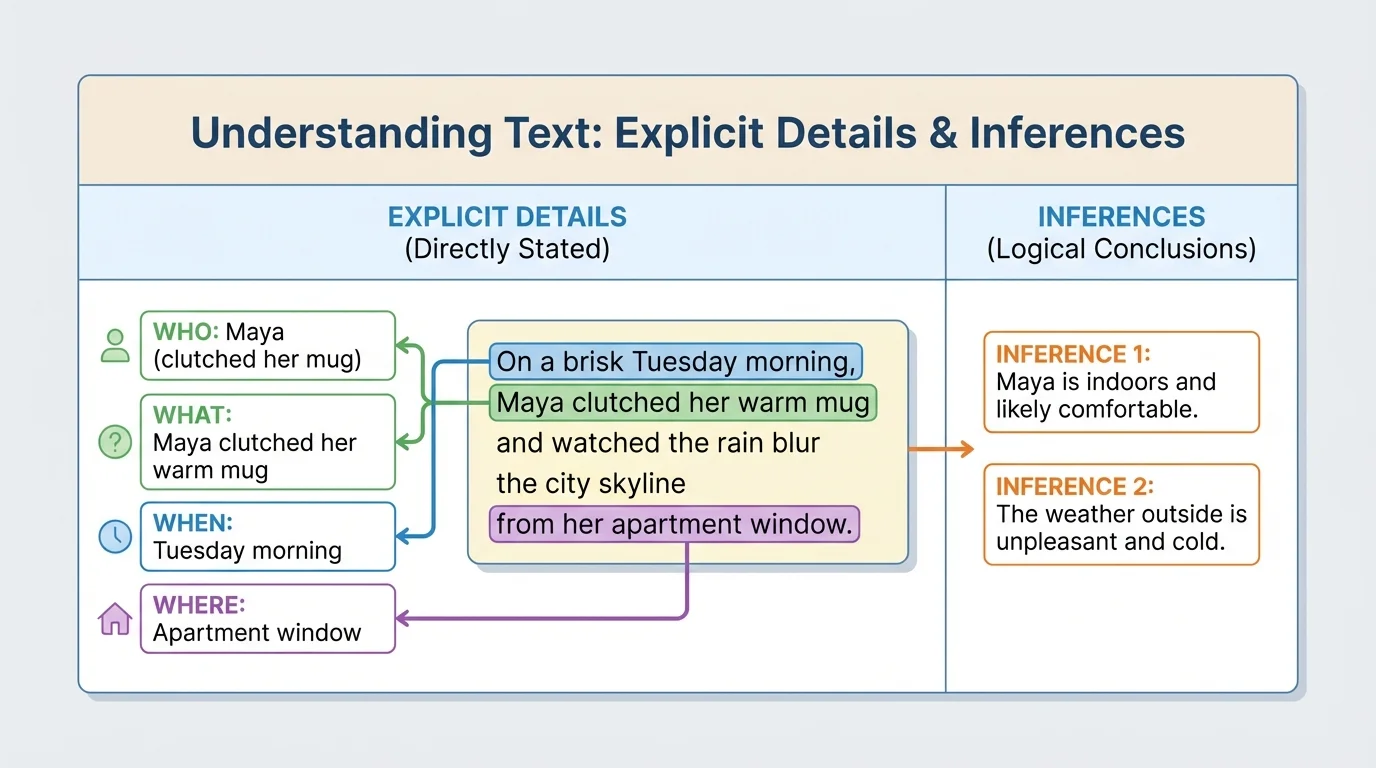
Explicit information often answers questions like these:
To explain explicit meaning, it helps to use sentence starters such as these:
Notice that these starters keep your answer close to the text. They remind you to use the author's words and examples instead of making something up.
Example of explaining explicit meaning
Text: "After school, Leo fed the dog, watered the tomato plants, and swept the porch before his grandmother came home."
Step 1: Read the question carefully.
Question: What chores does Leo do?
Step 2: Find the exact words that answer the question.
The text says Leo fed the dog, watered the tomato plants, and swept the porch.
Step 3: Turn the detail into a clear answer.
Leo does three chores: he feeds the dog, waters the tomato plants, and sweeps the porch.
This answer is strong because it uses details stated directly in the text.
When information is explicit, you do not need to guess. Your job is to read carefully and choose the right details.
[Figure 2] shows how readers combine clues from a text with what they already know. Not every important idea is said directly. Sometimes readers must make an inference by combining clues from the story with their own thinking. An inference is not a wild guess. It is a smart conclusion based on evidence.
Suppose a story says: "Jada stared at the spelling test in her hands. Her cheeks felt hot. She folded the paper quickly and slid it into her backpack before anyone else could see it." The author never says, "Jada felt embarrassed." But many readers can infer that she probably feels embarrassed or disappointed. The clues are that her cheeks feel hot and she hides the paper.
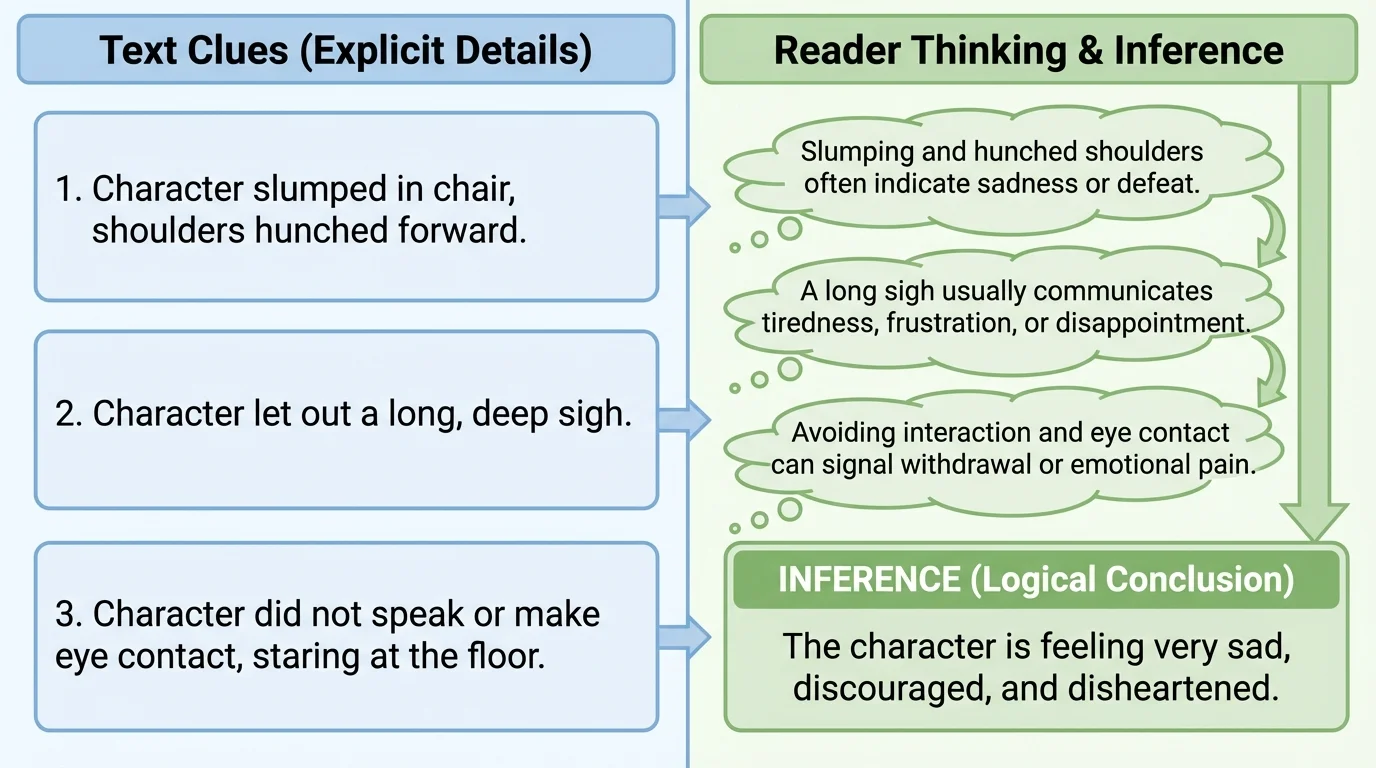
To make an inference, ask yourself:
Here is a simple way to think about it:
\(\textrm{Text clues} + \textrm{background knowledge} = \textrm{inference}\)
If a character slams a door, refuses to answer, and stomps upstairs, you may infer that the character is angry. You are not making that up. You are using actions as clues.
Inference means reading between the lines. Good readers pay attention to what the author shows through actions, dialogue, and description. Then they connect those clues to what they know about the world. This helps them understand feelings, motives, and ideas that are not directly stated.
Some inferences are about feelings. Others are about causes, problems, relationships, or lessons. For example, if a story says a boy keeps checking dark clouds, hurrying home, and covering his bike with a tarp, you can infer that he expects a storm.
[Figure 3] shows several places in a literary text where evidence can be found. You might use a character's words, a character's actions, the narrator's description, or an important event. The best evidence matches the question you are answering.
If the question is about how a character feels, look for dialogue, facial expressions, body language, and choices. If the question is about the setting, look for words that describe time and place. If the question is about the theme or lesson, look for repeated ideas and important events that teach something.
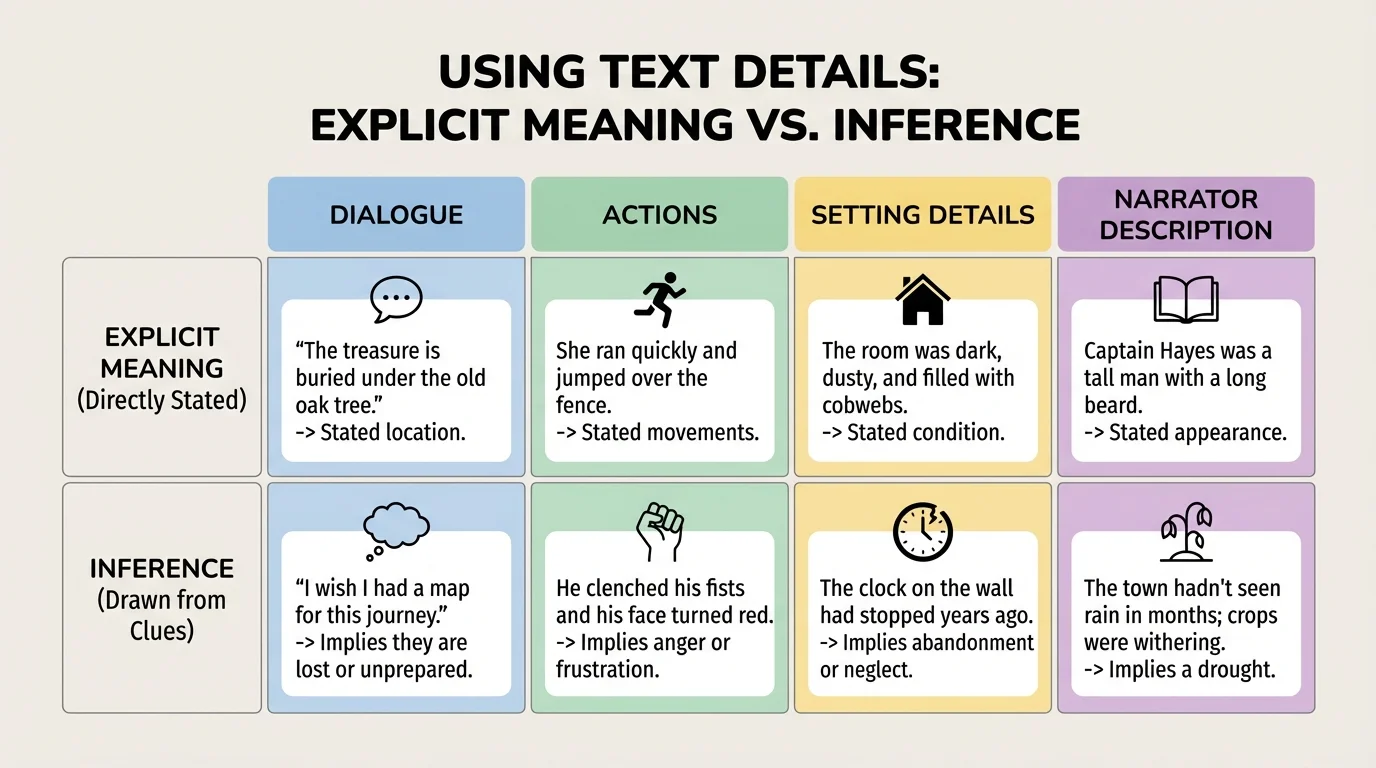
Here are common kinds of evidence readers use:
| Type of evidence | What to look for | How it helps |
|---|---|---|
| Dialogue | What characters say | Shows feelings, thoughts, or relationships |
| Actions | What characters do | Shows motives, emotions, and change |
| Description | Words about people or places | Shows setting, mood, and traits |
| Events | Important things that happen | Shows problem, solution, and lesson |
Table 1. Types of textual evidence and how each type helps a reader explain ideas.
Strong readers choose specific evidence. Saying "because of the story" is too vague. Saying "because the text says he hid the paper in his backpack" is much stronger.
Writers of stories often reveal a lot without explaining everything directly. That is why details matter so much. A tiny action, such as a pause before answering, can tell you something important.
Authors often use the rule "show, don't tell." Instead of writing "the character was nervous," they may show shaky hands, a quiet voice, or quick breathing. Readers then infer the feeling from those clues.
Later, when you explain your thinking, go back to the story and quote or paraphrase the best parts. The chart in [Figure 3] helps remind you that evidence can come from more than one place.
In literary texts, readers often study characters, setting, plot, conflict, and theme. To understand these well, you need both explicit information and inferences. A story may tell you where it takes place, but you may have to infer how the setting affects the character.
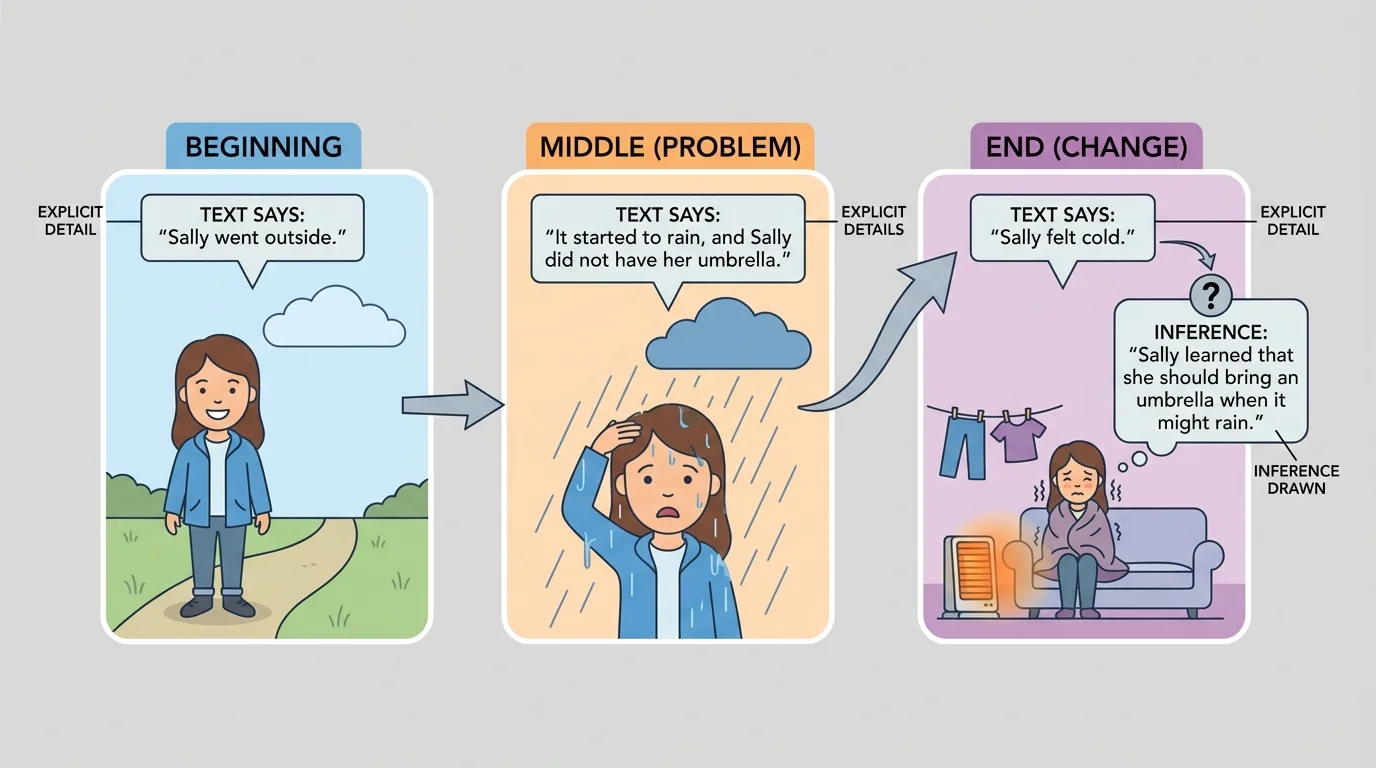
[Figure 4] shows how readers can track character change across a story. Characters are especially important. Readers should notice what a character says, thinks, does, and how the character changes over time. Tracking those changes across the beginning, middle, and end of a story helps you understand the character more fully.
For example, in the beginning of a story, a character might avoid helping others. In the middle, the character faces a problem that cannot be solved alone. By the end, the character may choose teamwork. From those details, readers can infer that the character has grown.
The setting can also give clues. A cold, empty house may create a lonely mood. A loud, bright carnival may create excitement. The author may not say "the mood is lonely," but the details help you infer it.
Plot events are another source of evidence. If the same kind choice happens again and again, readers may infer that kindness is an important idea in the story. If a character ignores warnings and then faces trouble, readers may infer a lesson about listening or responsibility.
Literary example with inference and evidence
Text: "Noah practiced his lines every afternoon. On the night of the play, he stood behind the curtain, whispering the first sentence again and again while rubbing his palms on his jeans."
Step 1: Identify the question.
Question: How is Noah probably feeling before the play?
Step 2: Find clues.
Noah whispers his line again and again, and he rubs his palms on his jeans.
Step 3: Use the clues to infer.
These actions suggest that Noah is nervous.
Step 4: Write a complete answer with evidence.
Noah is probably feeling nervous before the play because he keeps whispering his first line and rubs his palms on his jeans.
This answer includes an inference and supports it with details from the text.
The character-change map in [Figure 4] also reminds readers to look across the whole story, not just one line, when explaining how a character grows.
Strong readers ask questions while they read. These questions help them notice important details and decide whether they are finding explicit information or making an inference.
Questions for explicit information include:
Questions for inferences include:
These questions slow your thinking down in a good way. Instead of rushing, you stop and search for proof. That makes your understanding deeper and your answers stronger.
When you answer reading questions, always go back to the text. Your memory of the story helps, but the text itself is your best source for exact details and accurate evidence.
Sometimes you may need more than one detail. A single clue can help, but two or three details often make an answer much stronger. This is especially true when you are explaining a theme, a relationship, or a character trait.
One common mistake is giving an answer with no evidence. For example, if a student says, "The character is brave," the next question should be, "What in the story shows that?" A better answer would be, "The character is brave because she crossed the rickety bridge to rescue her brother's dog."
Another mistake is confusing an inference with a guess. A guess has no proof. An inference is supported by clues. If a reader says, "I think the family will move to another state," but the story gives no clues about moving, that is only a guess.
A third mistake is choosing weak evidence. If the question is about sadness, a detail about what the character ate for breakfast probably will not help. Pick the evidence that matches the question.
Readers also sometimes copy a sentence from the story without explaining it. Using the text is important, but you should also explain what the detail means. Your own words show your understanding.
Strong answers do two jobs. First, they give an idea or answer. Second, they support that idea with details or examples from the text. When needed, they also explain how the evidence supports the answer.
If you are unsure whether your answer is strong, test it with these questions: Did I answer the question? Did I use the text? Did I explain my thinking clearly?
Let's look at one more short passage: "Elena stood at the edge of the pool, gripping the towel with both hands. She watched the other swimmers dive in. When the coach nodded to her, she took a deep breath and stepped forward."
If the question is, "What is Elena doing?" the answer is mostly explicit: she is standing at the edge of the pool, watching the others, and getting ready to go in. If the question is, "How does Elena probably feel?" you need an inference. Because she grips the towel, watches others first, and takes a deep breath, she probably feels nervous but determined.
This is what skilled readers do. You notice what the story says clearly. You also notice the clues that help you understand more than what is directly stated. Then you explain your thinking with details and examples from the text.
Whether you are reading a realistic story, a fantasy tale, or a poem, these skills help you become a more careful and thoughtful reader. They also help you become a stronger writer, because you learn how authors use details to build meaning.
