A single word can make a character seem brave, weak, magical, or mysterious. If a writer says a job was hard, that tells us one thing. But if the writer says it was Herculean, suddenly the job feels enormous. Strong readers notice those word choices and ask, "What does this word mean here?" That question helps unlock the whole text.
When you read, you do more than sound out words. You build meaning. Sometimes a word has a meaning you already know. Sometimes it has a special meaning in that sentence. Sometimes it is part of a phrase that means more than the words say by themselves.
For example, if a story says, "Lena carried a mountain of laundry upstairs," the phrase does not mean there was a real mountain in the house. It means there was a very large pile. Readers must think about how the words are used in the text, not only about their plain dictionary meanings.
Authors choose words carefully. They may want to show that a task is huge, a character is clever, or a moment feels dangerous. If you can determine what words and phrases mean in context, you understand the story more deeply.
Context is the words, sentences, and ideas around a word that help explain its meaning. An allusion is a brief reference to a famous person, place, story, or event that the writer expects readers to recognize.
Good readers are like detectives. They collect clues from the sentence, the paragraph, and even the whole story. Then they test an idea: "Does this meaning make sense here?"
A context clue is a hint in the text that helps you understand a word or phrase, as [Figure 1] shows with several common clue types. Writers often help readers without stopping to define every tricky word directly.
One clue type is a definition clue. The text explains the word right away. In the sentence "The cave was gloomy, or very dark and sad-looking," the words "very dark and sad-looking" define gloomy.
Another clue type is a synonym clue. A synonym is a word with a similar meaning. In "The puppy was tiny, small enough to fit in Mia's backpack," the phrase "small enough" helps explain tiny.
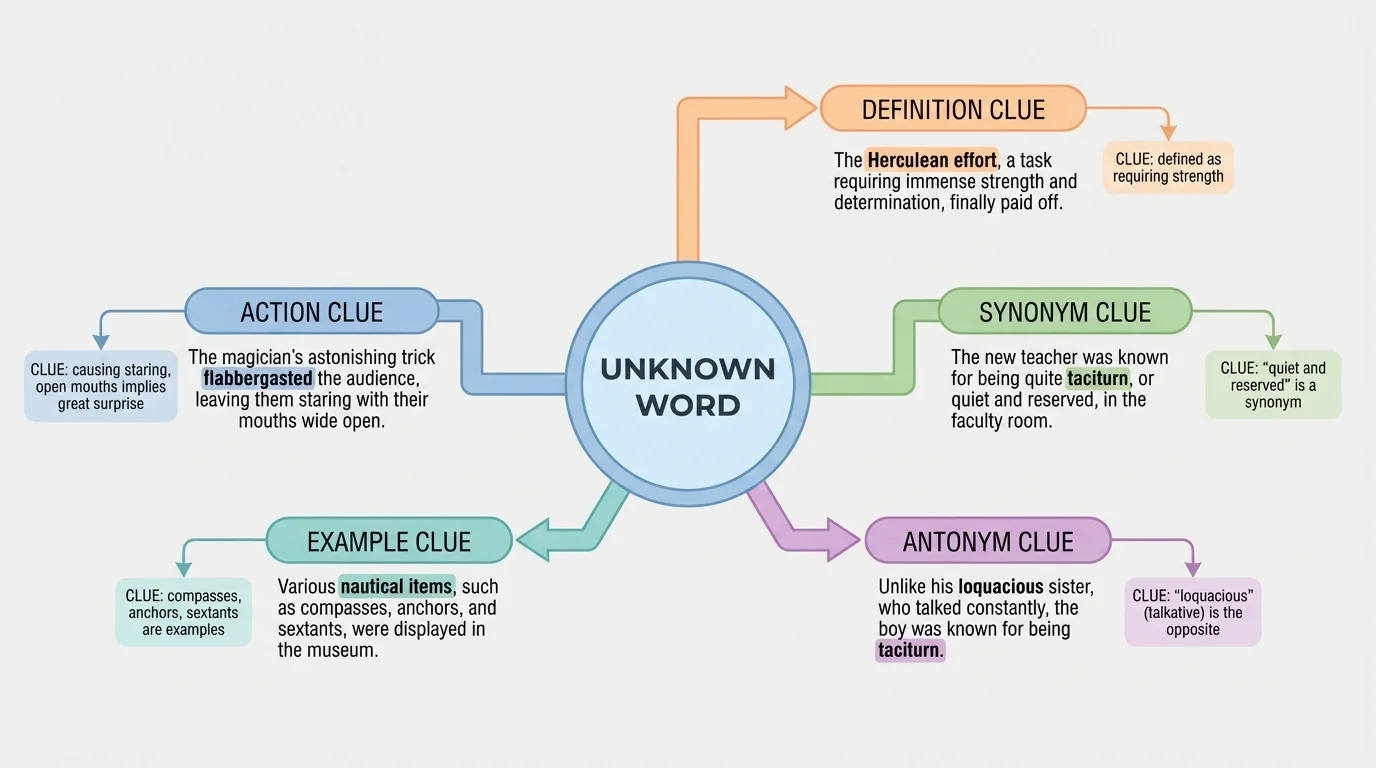
A third clue type is an antonym clue. An antonym is a word with the opposite meaning. In "Unlike his noisy brother, Ben was quiet and calm," the word noisy helps us understand quiet.
Readers also use example clues. In "Many mythology stories include gods, monsters, and heroes such as Zeus, Medusa, and Hercules," the examples show what mythology stories are like.
There are also action clues and feeling clues. If a sentence says, "Nora staggered across the finish line, gasping and reaching for support," you can infer that staggered means moved unsteadily. The action tells you.
As you keep reading, the same word may appear again. That is another reason context matters. A clue in one sentence and a clue later in the paragraph can work together, just as [Figure 1] organizes different kinds of hints that readers combine.
Sometimes you are figuring out the meaning of one word. Sometimes you are figuring out a whole phrase. A phrase may be literal, which means exactly what it says, or figurative, which means something more imaginative.
If a text says, "The sun slipped behind the hills," the sun did not literally slip like a person. The writer uses figurative language to create a smooth, gentle picture. Readers must notice when a phrase is not meant to be taken exactly.
This matters when authors describe people and events. "Jordan has a heart of stone" does not mean Jordan's heart is made of rock. It means Jordan seems unemotional or unkind. The phrase gives a stronger picture than simply saying, "Jordan is cold."
Literal and suggested meaning
A word has a literal meaning, its direct meaning, but in a story it can also carry a suggested meaning. Suggested meaning includes feelings, images, and ideas connected to the word. When a writer calls a storm "angry," the storm is not literally feeling anger, but the word helps readers sense power and danger.
Writers often choose phrases that make readers feel something quickly. That is one reason understanding how words are used in a text is so important.
An allusion is a short reference to something many readers may know already. The writer does not explain the whole story. Instead, the writer gives a small hint and trusts the reader to connect it to a larger idea.
If a character is called "a real detective," that may remind readers of stories about clever investigators. If someone says, "That test was my Everest," it alludes to Mount Everest and suggests that the test felt like a huge challenge.
Allusions can come from history, fairy tales, books, religion, or mythology. Mythology allusions are especially common because old myths are full of memorable heroes, monsters, and lessons. Those stories have shaped many modern words and phrases.
Some words people use every day began as names in very old stories. Over time, the names became part of regular language because they captured an idea so well.
When readers spot an allusion, they should ask two questions: "What is being referenced?" and "What idea does that reference add here?" Those questions help reveal both meaning and the author's purpose.
Many modern English words come from Greek and Roman myths, and [Figure 2] compares several of the most common examples. You do not need to know every myth in detail, but knowing a few important characters can help you understand many texts.
One well-known example is Herculean. Hercules was famous for great strength and difficult tasks. Today, if a book says, "Cleaning the whole park was a Herculean job," it means the job was extremely hard and required great effort.
Another example is Achilles' heel. In myth, Achilles was nearly impossible to defeat, but he had one weak spot: his heel. Now an Achilles' heel means a person's weakness or vulnerable point. In a story, "Pride was the villain's Achilles' heel" means pride was the weakness that could bring the villain down.
A third example is the Midas touch. King Midas was connected to the idea that things he touched turned to gold. Today, if someone has the Midas touch, people mean that the person seems to succeed at making things profitable or successful. "Every garden project Mrs. Cruz starts blooms beautifully; she has the Midas touch" suggests unusual success.
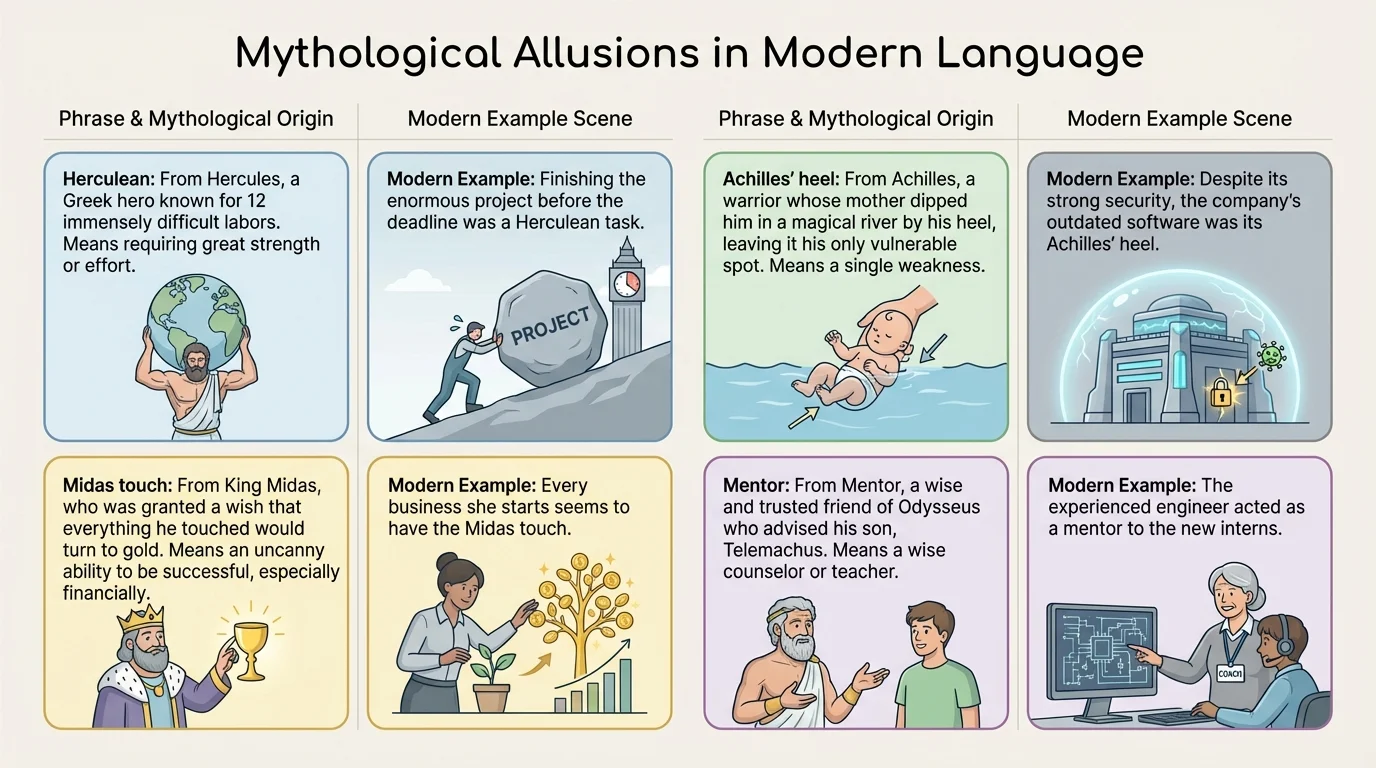
A fourth example is mentor. In ancient stories, Mentor was a wise guide. Today, a mentor is a trusted person who gives advice and helps someone learn. A coach, teacher, older student, or family member can be a mentor.
Notice that these allusions do not retell the entire myth. One word or short phrase brings along a bundle of meaning. That makes writing more powerful and more efficient.
| Mythology term | Meaning in modern text | Example in a sentence |
|---|---|---|
| Herculean | Very difficult; requiring great strength or effort | The class faced a Herculean task when they cleaned the storm-damaged playground. |
| Achilles' heel | A weak point | His fear of speaking was his Achilles' heel during the debate. |
| Midas touch | A special ability to succeed | My aunt seems to have the Midas touch with small businesses. |
| mentor | A wise and helpful guide | The new player's mentor showed her how the team worked. |
Table 1. Common mythology allusions and their modern meanings.
Later, when you meet one of these terms in a story, article, or poem, you should look at the sentence around it. Even if you know the general allusion, context still helps you decide the exact meaning and tone in that text. For instance, [Figure 2] shows that Herculean and Midas touch both come from myths, but they suggest very different ideas.
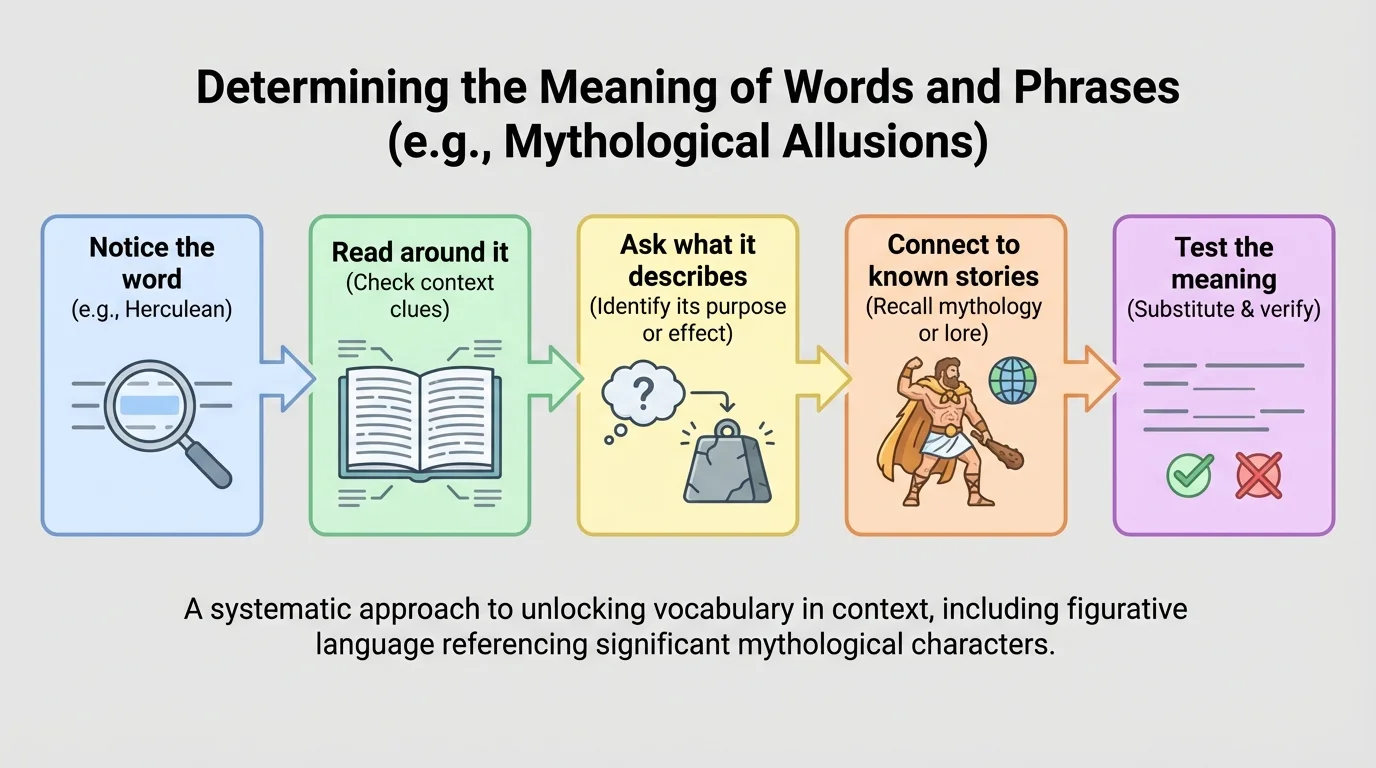
When you find an unfamiliar word or phrase, it helps to follow a clear process, and [Figure 3] lays out one useful reading path. Strong readers do these steps quickly in their minds, but it is helpful to practice them slowly at first.
First, notice the word or phrase and admit that it may be important. If it seems unusual, vivid, or repeated, pause.
Second, read the words before and after it. Search for definition clues, examples, actions, or feelings.
Third, ask what the word is describing. Is it a person, a place, a problem, or a mood?
Fourth, think about any background knowledge you have. Does the word sound like a myth, famous name, or familiar expression?
Fifth, test a possible meaning in the sentence. If the sentence still makes sense, your idea is probably close.
If your first guess does not fit, keep reading. The next sentence may provide a better clue. Readers do not have to be perfect immediately. Meaning often becomes clearer over several lines.
Example: figuring out an allusion in context
Read this sentence: "After three hours of pulling weeds, hauling soil, and planting trees, the volunteers finished their Herculean morning."
Step 1: Look at the nearby clues.
The sentence mentions "three hours," "pulling weeds," "hauling soil," and "planting trees." Those actions sound tiring and difficult.
Step 2: Connect the allusion.
The word Herculean reminds us of Hercules, a hero known for strength and hard tasks.
Step 3: Test the meaning.
If we replace Herculean with "requiring great effort," the sentence makes sense.
So Herculean means the morning's work required great effort.
That process works even when you know only a little about the myth. The text does much of the work for you.
Now consider how meaning changes from sentence to sentence. The phrase must be understood in its own setting.
Sentence one: "Tia was our team's mentor, calmly teaching us how to pass, defend, and trust one another." The actions "teaching us" and "trust one another" help show that a mentor is a guide.
Sentence two: "The old bridge looked sturdy, but one cracked support beam was its Achilles' heel." Here the bridge is being compared to a person with one weak spot. The phrase means the bridge's weakness.
Sentence three: "Dad joked that Maya had the Midas touch after her three lemonade stands sold out before noon." Selling out quickly gives a clue that the phrase means having a special way of succeeding.
Sentence four: "By the final lap, Eli staggered like a sleepwalker, but he refused to stop." Even if you had never seen the word before, the image of someone exhausted and unsteady helps you infer its meaning.
Comparing meanings in different contexts
Look at the word bright.
Step 1: In "The bright flashlight cut through the cave," bright means full of light.
Step 2: In "Sana had a bright idea for the science fair," bright means clever or smart.
Step 3: In "The room was bright with cheerful colors," bright suggests vivid color and a happy feeling.
The same word can carry different meanings depending on context.
This is why readers should avoid grabbing the first meaning they know. They should ask, "Which meaning fits this text best?"
Authors use mythology allusions for more than decoration. An allusion can quickly build a picture in the reader's mind. Calling a task Herculean feels stronger than just calling it difficult. Calling a weakness an Achilles' heel feels more dramatic than just saying "problem."
Allusions also shape tone, the feeling or attitude in a piece of writing. A mythological allusion can make a scene sound grand, serious, playful, or dramatic. In adventure stories, these allusions often make events feel larger than life.
They can also help describe characters. If a writer says a principal was "a mentor to every nervous sixth grader," that tells us about the principal's role and kindness in just a few words. If a writer says a greedy merchant wanted "the Midas touch," that may hint at ambition or love of wealth.
Writers trust readers to notice these layers. That is part of craft and structure: how an author builds meaning through careful choices of language. The meanings displayed earlier in [Figure 2] show that one myth-based term can add description, mood, and character information all at once.
"The right word may be effective, but no word was ever as effective as a rightly timed pause."
— Mark Twain
Just as pauses matter, word choice matters. A well-chosen allusion can do a lot of work in a small space.
You do not learn word meaning in one day. You build it over time by reading, noticing, and thinking. Each time you meet a strong word or phrase, ask what it adds to the text.
It helps to pay attention to repeated patterns. If you keep seeing names from myths, you begin to connect them to ideas. Hercules connects to strength and great effort. Achilles connects to weakness. Midas connects to gold and success. Mentor connects to wise guidance.
As readers grow, they collect these connections like tools in a toolbox. Then, when they meet a new sentence, they are ready to use context clues, background knowledge, and careful thinking. The process in [Figure 3] remains useful not only for mythology allusions, but for many unfamiliar words and phrases in literature.
You already know how to ask questions while reading and how to reread confusing parts. Those habits are important here too. Determining meaning is not separate from comprehension; it is one of the ways comprehension happens.
The more closely you read, the more you notice that authors rarely choose words by accident. Their words create pictures, reveal traits, and hint at deeper ideas. Understanding those choices makes reading richer and more exciting.
