Have you ever read a story and then seen it acted out or shown in pictures, only to think, "That is exactly how I pictured it," or "Wait, that is not how I imagined it at all"? This is an important reading skill. Good readers do more than understand words on a page. They also compare the written version of a story or drama with what they see and hear in a visual or oral version.
A story can live in more than one form. You might read it in a book, hear it read aloud, watch it performed on stage, or see it turned into a video. Even when the main story stays the same, each version may show it a little differently. Learning to notice those choices helps you understand the author's ideas more deeply.
When you compare versions of the same text, you become a stronger thinker. You learn to ask questions such as: Which details came directly from the text? Which details were added by the artist or performer? Which feelings are stronger when I hear the lines spoken instead of reading them silently?
This skill matters because authors, illustrators, actors, and directors all make choices. The author chooses words. The illustrator chooses colors, shapes, and what to include in a picture. An actor chooses facial expressions, movement, and voice. A director chooses how a scene looks and sounds. Comparing these choices helps you see how meaning is created.
Text is the written story or drama. Visual presentation is a version you can see, such as an illustration, picture book image, video, or stage performance. Oral presentation is a version you hear, such as a read-aloud, audio recording, or spoken performance. Description means details in the text that tell what characters, settings, or events are like. Directions are instructions in a drama that tell how a character moves, speaks, or acts.
Some texts are adaptations, which means they are changed into another form. A written story might become an animated adaptation. A play script might become a performed scene. The new version should still connect to the original text, but it may not match every single detail.
In a story, the author often gives details about the setting, the characters, and the action. A visual presentation should reflect many of those details, as [Figure 1] shows with a setting description and matching picture. If the text says a girl wore a red raincoat and stood by a crooked fence on a windy day, a picture that includes the red coat, the fence, and blowing leaves clearly connects to the text.
Sometimes a picture includes details that are not written directly in the text. That does not always mean the picture is wrong. Illustrators often add small details to help readers understand the scene. For example, the text might say, "Ben hurried into the kitchen." A picture may show a tipped chair, an open backpack, and one untied shoe. Those extra details help show that Ben is rushing, even if the words did not list each item.
As you compare a story and an image, pay attention to setting, character appearance, important objects, and mood. Ask yourself whether the image reflects the text's exact words or whether it gives one possible interpretation of them.
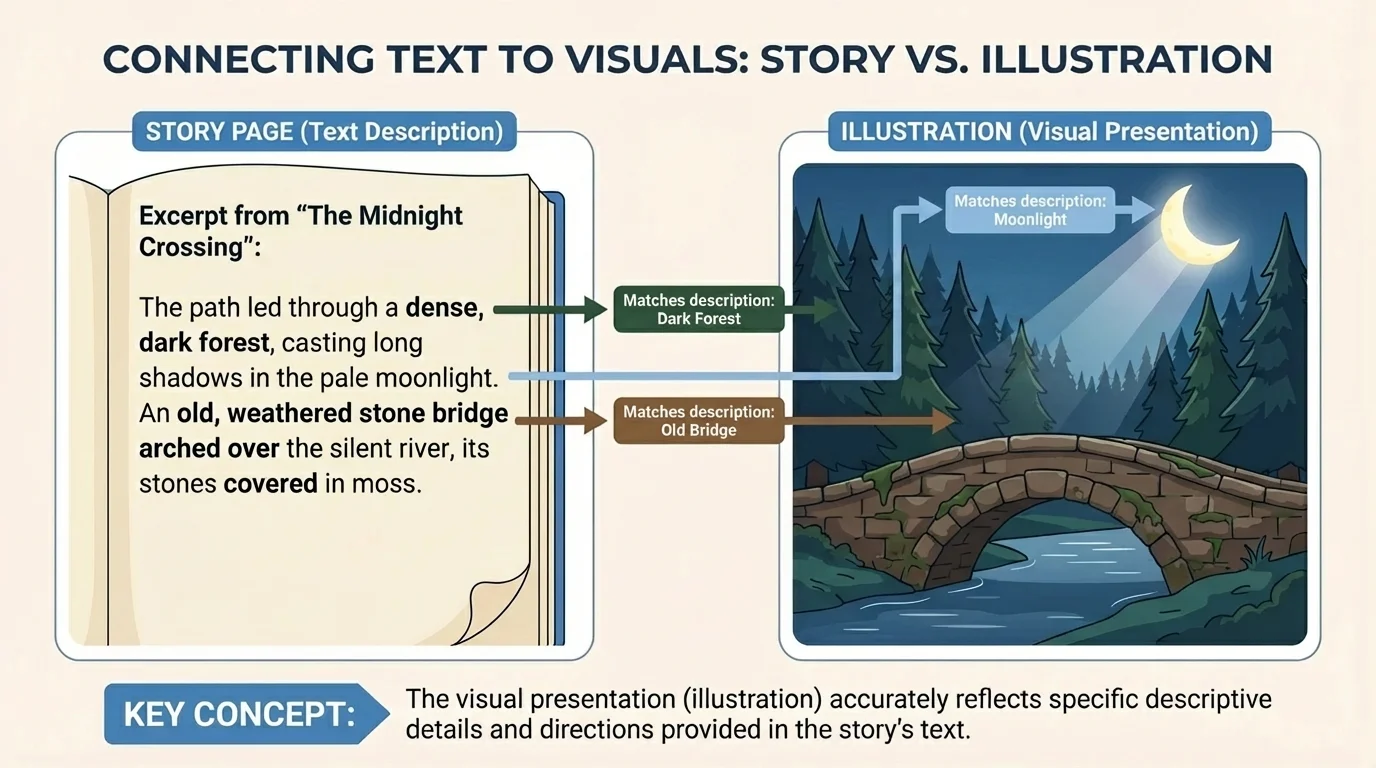
Suppose a story says, "The barn stood alone at the edge of the field, painted white long ago but now faded by rain and sun." A matching picture should probably show a barn in a field, away from other buildings, with old, worn paint. If the picture shows a bright red barn in the middle of a busy town, it does not reflect the description very well.
Pictures can also help show mood. If the text describes a stormy night, dark colors, slanted rain, and bent trees can match that feeling. Later, when you compare another version of the same scene, you can return to the kind of text-to-image matching seen in [Figure 1] and ask which details stay true to the author's words.
Illustrators sometimes read a text many times before drawing it. They look for clues about clothing, weather, place, and emotion so their pictures connect closely to the author's descriptions.
Not every story has pictures, but when it does, the pictures are worth studying carefully. They are not just decorations. They can add meaning, highlight important details, and help readers notice parts of the text they may have missed.
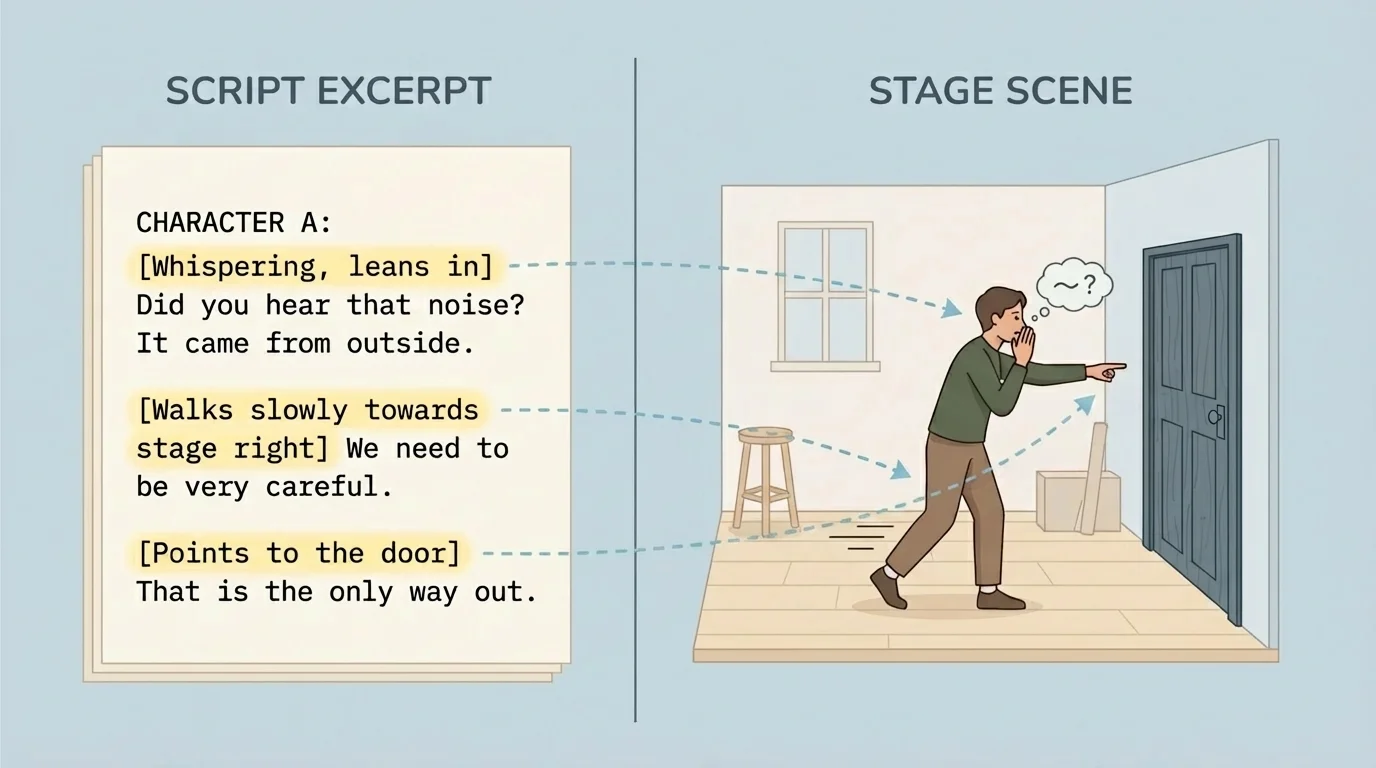
A drama is written to be performed. It includes dialogue, which is what the characters say, and often includes stage directions. Stage directions tell actors where to move, how to speak, or what action to take, and a performance turns those written directions into something you can see and hear.
For example, a script might say: "Maya tiptoes to the window and whispers, 'Someone is outside.'" In a performance, you should be able to notice that Maya moves quietly, goes to the window, and speaks in a soft voice. Those actions and sounds reflect the directions in the text, as [Figure 2] illustrates.
When you watch or listen to a drama, pay attention to voice, expression, movement, and timing. If the script says a character shouts angrily but the actor speaks softly and smiles, the performance does not fully match the text. If the actor pounds a fist, raises the voice, and uses a sharp expression, the performance better reflects the direction.
Oral presentations matter too. If someone reads a story aloud, the reader's voice can show feelings that are only hinted at in the text. A slow, quiet voice may make a sad moment feel heavier. A quick, excited voice may make an adventurous moment feel lively. Listening carefully helps you decide whether the speaker's choices match the mood and meaning of the words.
Later, when you compare different performed versions, think again about the text-to-performance connection shown in [Figure 2]. The strongest performances do not just deliver the lines. They use voice and action to bring the directions and descriptions to life.
You already know that stories have characters, setting, plot, and theme. When you compare versions, you use that same knowledge. You simply look at how each version presents those parts.
Sometimes a drama leaves some things open to interpretation. A script may say a character is nervous, but one actor might show that by pacing, while another actor might show it by wringing hands or speaking too quickly. Both choices may fit the text.
When one text appears in different forms, some parts usually stay the same while others change, as [Figure 3] helps organize. The main characters often remain the same. The important problem and the major events usually remain the same too. But the exact look, sound, and pace may differ.
For example, the written text may describe a castle as "high on a cliff above the sea." One illustration might show a gray stone castle in bright sunlight. Another might show the same castle under dark clouds. Both may fit the words, but each creates a different feeling.
In an oral version, the same line of dialogue can sound brave, worried, funny, or serious depending on how it is spoken. That means the words stay the same, but the performance can change the tone. Tone is the feeling or attitude created by the words and the way they are presented.
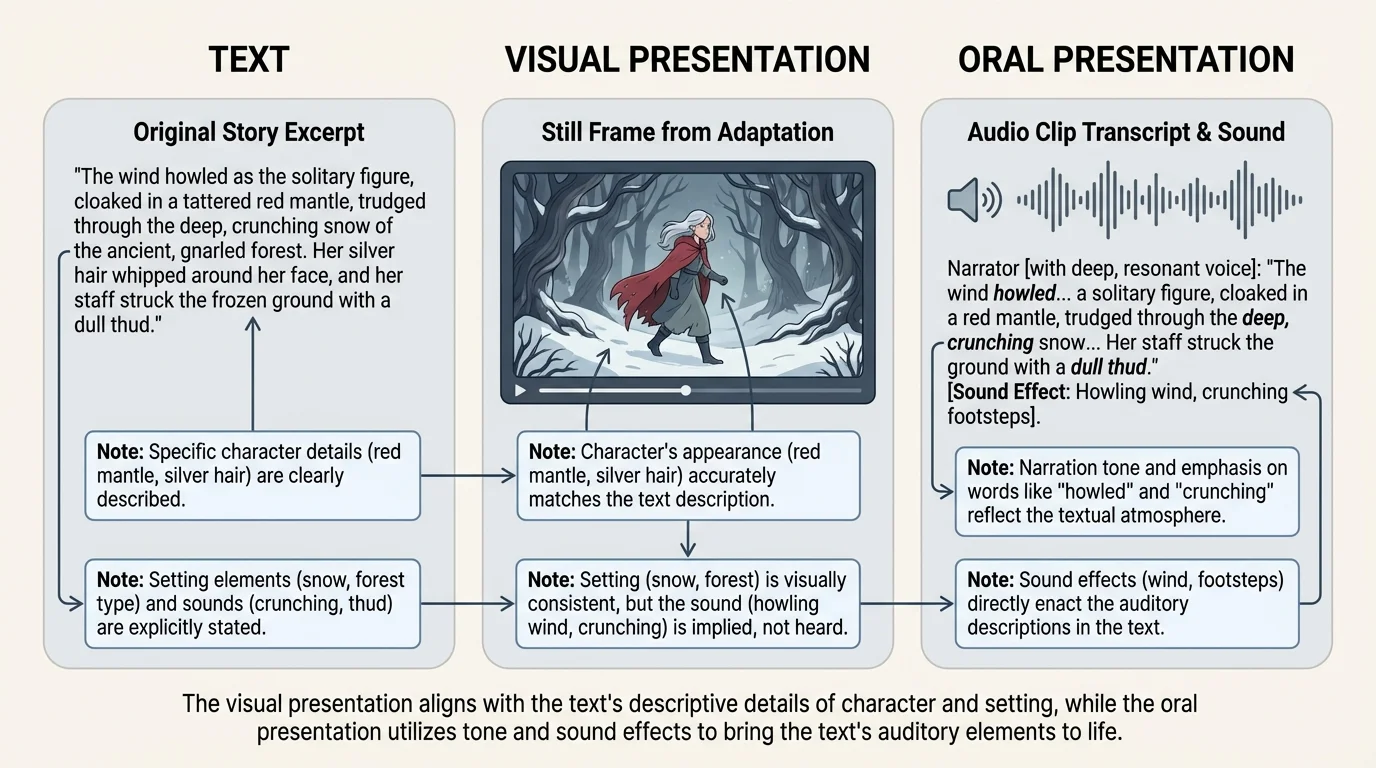
Sometimes details are shortened or left out. A video version may not include every sentence from a written story. A picture may focus on one part of a paragraph and not show every object mentioned. A performed drama may combine actions to keep the scene moving. These are changes in presentation, not always changes in the core story.
The comparison pattern in [Figure 3] is useful whenever you ask, "What matches exactly?" and "What has been changed or added?" Strong readers notice both.
| Part of the text | What to look for in a visual version | What to look for in an oral version |
|---|---|---|
| Character description | Clothing, face, size, posture | Voice, emotion, attitude |
| Setting description | Place, weather, colors, objects | Background sounds, spoken clues |
| Action | Movement, sequence of events | Pacing, stress on words, sound effects |
| Directions in drama | Actor movement, gestures | Volume, pauses, expression |
Table 1. Ways to compare parts of a written text with visual and oral presentations.
Comparing versions becomes easier when you use a clear process. First, read or listen to the original text carefully. Next, watch or hear the other version. Then look for exact connections between the two.
A careful comparison uses evidence from both versions. It is not enough to say, "I liked the video better." A strong explanation tells what in the text matches the picture, performance, or reading aloud. It also points out what is different and explains whether the change still fits the original text.
Here is a simple way to do it. Notice the important description or direction in the text. Then ask how the visual or oral version shows it. Finally, decide whether the version reflects the text closely, partly, or not very well.
You can ask yourself questions like these:
This kind of thinking works for short scenes, picture books, read-alouds, and plays. It works when the versions are very similar, and it also works when they are quite different.
Let us look at a few examples. In each one, the goal is to connect the written text to what is shown or heard.
Example 1: Story description and illustration
Text: "Lena held her lantern high as she crossed the narrow bridge above the rushing stream."
Step 1: Find the key details in the text.
The important details are Lena, a lantern, a narrow bridge, and a rushing stream below.
Step 2: Check the illustration.
If the picture shows Lena on a small bridge with water moving quickly underneath and a lantern in her hand, it reflects the text well.
Step 3: Notice any differences.
If the picture shows a wide stone bridge instead of a narrow bridge, that part does not exactly match the description.
A strong response would explain both the match and the difference.
Now consider a different kind of text. In a drama, the written page often tells actors how to behave as well as what to say.
Example 2: Script and performance
Script: "Jamal backs away from the box and says in a shaky voice, 'I do not want to open it.'"
Step 1: Identify the directions.
Jamal should move backward, and his voice should sound shaky.
Step 2: Watch or listen to the performance.
If the actor steps back, widens the eyes, and speaks unsteadily, the performance reflects the script.
Step 3: Decide how closely it matches.
If the actor laughs and grabs the box eagerly, the performance changes the meaning and does not follow the direction well.
This example shows how movement and voice matter in a drama.
A third example can combine reading and listening. This often happens when someone reads a story aloud to a class.
Example 3: Written story and oral reading
Text: "Grandfather spoke so softly that Nora had to lean closer to hear the secret."
Step 1: Notice the clue in the text.
The words "so softly" tell how the line should sound.
Step 2: Listen to the oral presentation.
If the reader lowers the voice and slows down slightly, the reading matches the text.
Step 3: Think about the effect.
The soft voice helps listeners feel that the moment is quiet and important.
This shows that oral presentations can reflect descriptions even when there are no pictures.
These examples all have one thing in common: they use details as evidence. The best comparisons are specific, not general.
Sometimes students notice the obvious parts first, such as what a character is wearing. That is a good start, but there is more to compare. Watch facial expressions. Listen for pauses. Notice whether music or sound effects change the mood. Look at lighting, color, and background details in a visual version.
For example, a cheerful text might be shown with bright colors and open spaces, while a mysterious scene might use shadows and quiet background music. Even though those choices are not always written word for word, they can still reflect the mood of the original text.
Readers and viewers should also listen for emphasis. If a speaker stresses one word strongly, that can change how the line feels. "I never said that" can sound very different depending on which word gets the strongest stress.
"Pay attention to the details. They often carry the meaning."
Being careful does not mean rushing to judge a version as right or wrong. Sometimes there is more than one good way to present the same text. Your job is to notice how the version connects to the author's descriptions and directions.
When you talk or write about two versions, use evidence from both. A strong statement might sound like this: "The illustration reflects the text because the author says the yard was covered in snow, and the picture shows snow on the ground, roof, and fence."
Another strong statement might be: "The actor's voice matches the script because the direction says to whisper, and the actor speaks quietly while leaning close to the other character."
Notice how these explanations include exact details. They do not only say whether the version is good. They explain why.
Evidence makes your comparison strong. When you support your idea with details from the text and the presentation, your explanation becomes clear and convincing. Evidence can be a description, a line of dialogue, a stage direction, something visible in an image, or something heard in a performance.
You can also explain partial matches. For example: "The movie scene reflects the stormy weather from the text, but it changes the time of day because the text says evening and the scene looks like morning." This kind of answer shows close attention.
One challenge is focusing only on what you personally enjoyed. It is fine to have an opinion, but comparison requires evidence. Instead of saying, "The performance was better," explain what matched the text and what changed.
Another challenge is missing small but important details. A character's expression, a pause before a line, or one object in the background can matter. Slow down and look or listen carefully.
A third challenge is thinking there is only one correct visual or oral version. In truth, many choices can fit the same text. If the text says a room is old and quiet, there are many ways to show that. What matters is whether the version reflects the meaning of the description or direction.
Professional actors often study stage directions closely, but they also make choices about movement and tone. That is one reason two performances of the same play can feel different while still following the script.
When you meet a difference, ask whether it changes the meaning a little or a lot. A different shirt color may not matter much if the text never named the color. But changing a frightened voice into a cheerful one can change the whole scene.
When you connect a written text to a picture, a performance, or a reading aloud, you are doing the work of a thoughtful reader. You are paying attention to words, images, sounds, and actions all at once. That kind of careful thinking helps you understand literature more deeply.
Stories and dramas become richer when you notice how each version presents the same moment. A written description paints a picture with words. An illustration paints it with color and shape. A performer paints it with voice and movement. Each version offers clues, and your job is to connect them.
The more you practice this skill, the more you will notice. You will catch details that others miss. You will understand why one version feels tense, funny, gentle, or exciting. And you will be able to explain exactly where a visual or oral presentation reflects the descriptions and directions in the text.
