Have you ever listened to someone tell a great story and noticed that everyone stayed interested from start to finish? That usually does not happen by accident. Good speakers make choices. They decide what to say first, what details matter most, and how to speak so listeners can understand every part. When you report on a topic, tell a story, or share something that happened to you, you are not just saying words. You are guiding your audience through your ideas.
Speaking is a skill people use every day. You use it when you explain game rules, talk about a book, share news with your family, or present to your class. A strong speaker sounds organized, gives enough detail, and speaks clearly. That helps the audience learn, imagine, and remember.
When ideas are mixed up, listeners can get lost. They may not understand what happened, why it happened, or why it matters. Organized speaking helps your audience follow your thinking. It also helps you feel more confident, because you already know the path your words will take.
A good oral presentation usually has a clear main idea. The main idea is the most important point you want listeners to understand. If you are reporting on dolphins, your main idea might be that dolphins are intelligent animals that communicate and work together. If you are telling a story, your main idea might be a lesson such as teamwork or courage. If you are recounting an experience, your main idea might be what happened and what you learned.
Organized speaking means putting ideas in a clear order so listeners can follow them easily. Relevant details are details that match the topic and help explain the main idea. Pace is the speed at which someone speaks.
Listeners understand more when a speaker stays on topic. If you begin talking about your soccer game and then suddenly switch to your breakfast, your audience may wonder how the ideas connect. Strong speakers choose details that belong together.
There are several ways to speak in front of others, and each one has a slightly different purpose. One kind is a report. A report gives information about a topic or text. It is meant to teach or explain. Another kind is a story. A story is told to entertain, share a message, or help people imagine events. A third kind is a recount, which is a retelling of something that really happened.
Even though these types are different, they all need order. A report often moves from an introduction to facts and then to a closing. A story often moves from the beginning of events to a problem and then to a resolution. A recount often follows the order in which things happened.
For example, if you report on a book about the rainforest, you might first name the book, then explain the important ideas, and finally tell why the book is useful or interesting. If you tell a story about a lost puppy, you might begin with the puppy disappearing, describe the search, and end with the reunion. If you recount a field trip, you might tell where you went, what you did first, what happened next, and what you learned.
Strong speaking starts before you open your mouth. Planning helps you know what to say and what to leave out. A speaking plan does not need to be long or complicated. It can be a few key points in order.
First, think about your audience. Are you talking to one partner, a small group, or the whole class? Next, think about your purpose. Are you trying to inform, entertain, or explain an experience? Then choose your most important points. These points should support the main idea instead of pulling away from it.
A simple plan can include three parts: the topic, the important details, and the ending. If your topic is sea turtles, your important details might be where they live, what they eat, and why they need protection. Your ending might remind listeners why sea turtles are important animals.
A useful speaking plan begins by naming the topic or event, continues with facts or details in a sensible order, and ends by wrapping up the message. This kind of plan works for informal sharing and for more formal class presentations.
Planning also helps you decide which words will make your speaking more vivid. Instead of saying, "The day was nice," you could say, "The day was bright, breezy, and cool." Descriptive details help listeners picture what you mean.
A clear structure makes speaking easier to follow, as [Figure 1] shows. Most strong oral presentations have a beginning, a middle, and an end. In the beginning, you introduce the topic or event. In the middle, you explain the important parts. At the end, you finish with a closing idea that helps listeners remember your message.
The beginning should quickly tell the audience what they are about to hear. In a report, that may mean naming the topic. In a story, it may mean introducing the setting and characters. In a recount, it may mean telling when and where the experience happened.
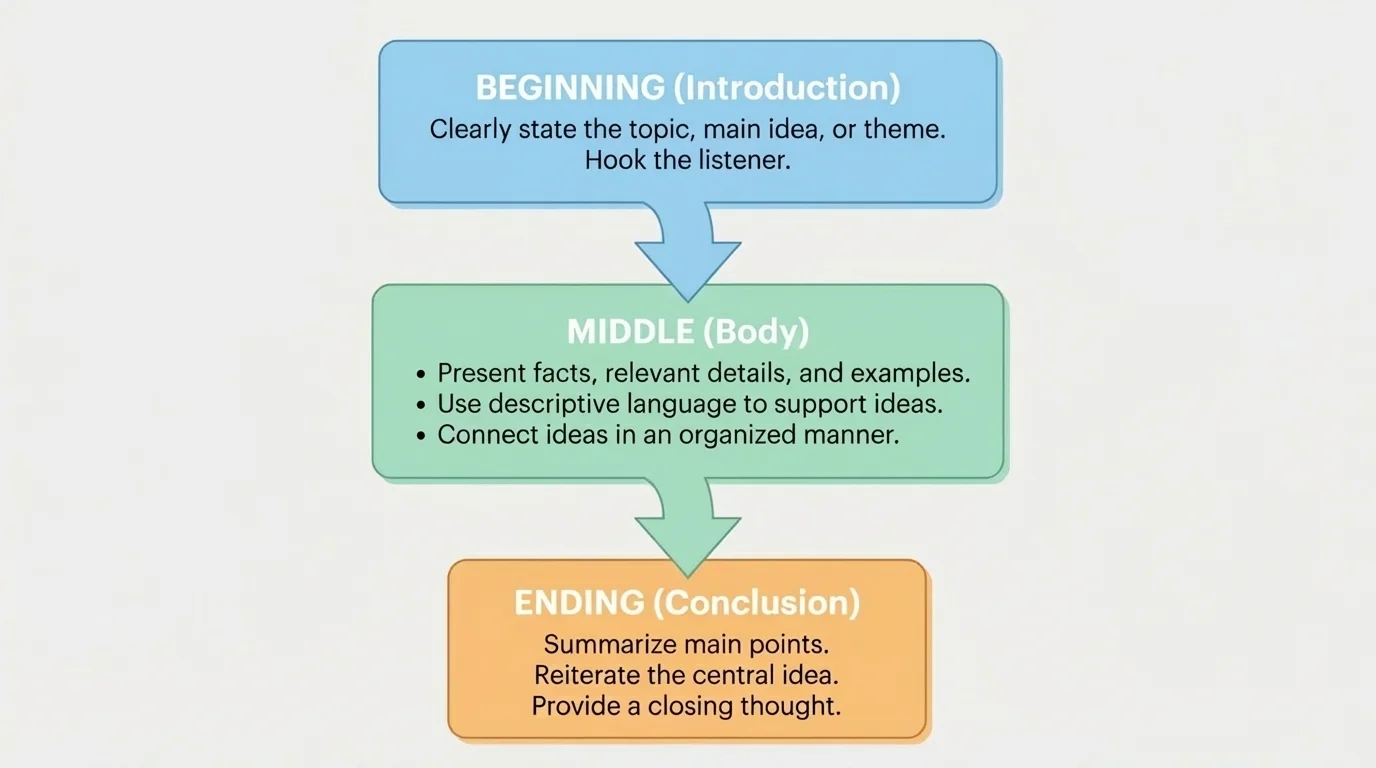
The middle is where you develop your ideas. This is the longest part, because it includes facts, events, examples, and descriptions. The middle should stay focused. If you are speaking about a book, include the most important parts of the text, not every tiny detail. If you are recounting an experience, tell the events that matter most.
The end should not feel sudden. It should leave the audience with a final thought. You might restate the main idea, tell what you learned, or explain why the topic matters. A good ending sounds complete.
Transitions help ideas connect. Words and phrases such as first, next, later, for example, because, and finally guide listeners from one part to another. As in [Figure 1], each part has a job, and transitions help the audience move smoothly through those parts.
When you speak, your ideas become stronger if you support them with facts and details. A fact is something true that can be checked. A descriptive detail is a word or phrase that helps listeners picture, hear, or understand something more clearly.
If you are giving a report, facts are especially important. Suppose your topic is bees. Instead of saying only, "Bees are helpful," you could explain, "Bees help pollinate flowers and crops, which helps plants grow." That makes your statement clearer and stronger.
If you are telling a story or recounting an experience, descriptive details bring the events to life. Instead of saying, "We went outside," you could say, "We hurried outside into the chilly morning air while the grass sparkled with dew." That detail helps the audience imagine the scene.
Example: turning weak speaking into strong speaking
Step 1: Start with a weak sentence.
"Our class went to a museum, and it was fun."
Step 2: Add facts.
"Our class went to the science museum, where we learned about space, weather, and dinosaur fossils."
Step 3: Add descriptive details.
"Our class went to the science museum, where we learned about space, weather, and dinosaur fossils. The giant skeleton in the entry hall stretched above us, and the storm exhibit made the room flash like lightning."
The stronger version helps the audience understand what happened and picture it clearly.
Relevant details are important. If you are speaking about the museum, details about your favorite sandwich probably do not belong unless they connect to your point. Good speakers choose details that support the topic.
What you say matters, but how you say it matters too, as [Figure 2] illustrates. Clear speaking means your words are easy to hear and understand. An understandable pace means you do not rush so fast that listeners miss your ideas, and you do not speak so slowly that your message loses energy.
Volume is important. If you speak too softly, some listeners will not hear you. If you shout, it may sound harsh. A strong speaking voice is clear and steady. Pronunciation also matters. When you say words carefully, your audience does not have to guess what you mean.
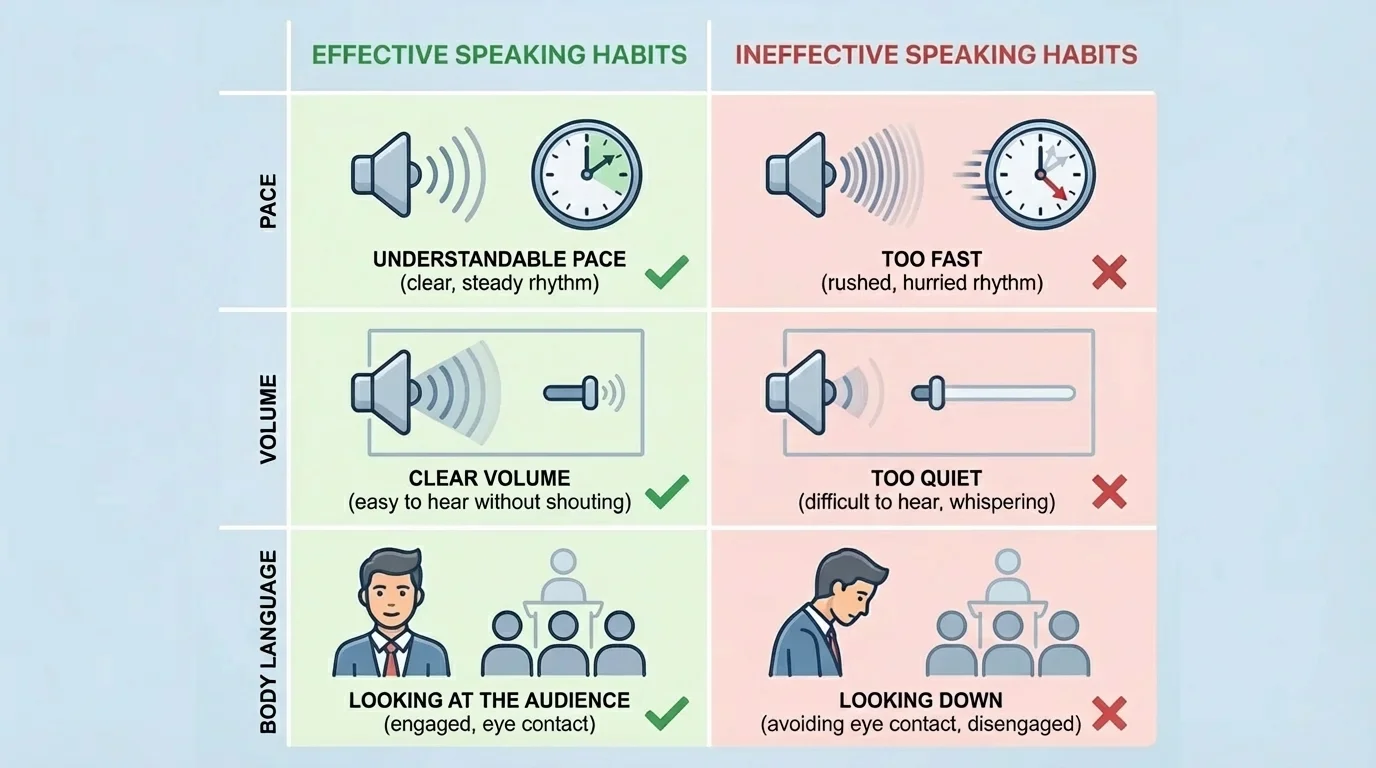
Pacing is a skill. Some students speak quickly when they are nervous. Others pause too long because they are trying to remember what comes next. Planning helps with pacing because you already know your order. Taking a short breath between ideas can make your speaking sound calm and natural.
Expression adds life to your voice. If every sentence sounds exactly the same, your speaking may sound flat. If your voice changes naturally to match the meaning, listeners stay more interested. Eye contact also helps. Looking at the audience, rather than only at your notes, shows confidence and helps you connect with listeners.
Later, when you practice for a class presentation, think again about the habits in [Figure 2]. A clear voice, careful pronunciation, and steady pace help your audience understand even the best-organized ideas.
Professional storytellers, news reporters, and teachers all practice pacing. Even people who speak for a living usually rehearse so their words sound clear and natural.
If you make a small mistake while speaking, you do not need to panic. Good speakers often pause, correct themselves, and continue. Staying calm helps the audience stay focused on your message.
The same topic can be shared in different ways depending on the setting, as [Figure 3] shows. Informal presentations are more relaxed. These might happen when you share with a partner, talk in a small group, or explain something during class discussion. Formal presentations are more planned. These often happen when you present to the class or speak in front of a larger audience.
In an informal setting, your plan may be simple and short. You may speak more naturally and answer questions right away. In a formal setting, you usually need a stronger opening, a clearer order, and more careful speaking. You may also need to stand where everyone can see you and keep your attention on the whole audience, not just one friend.
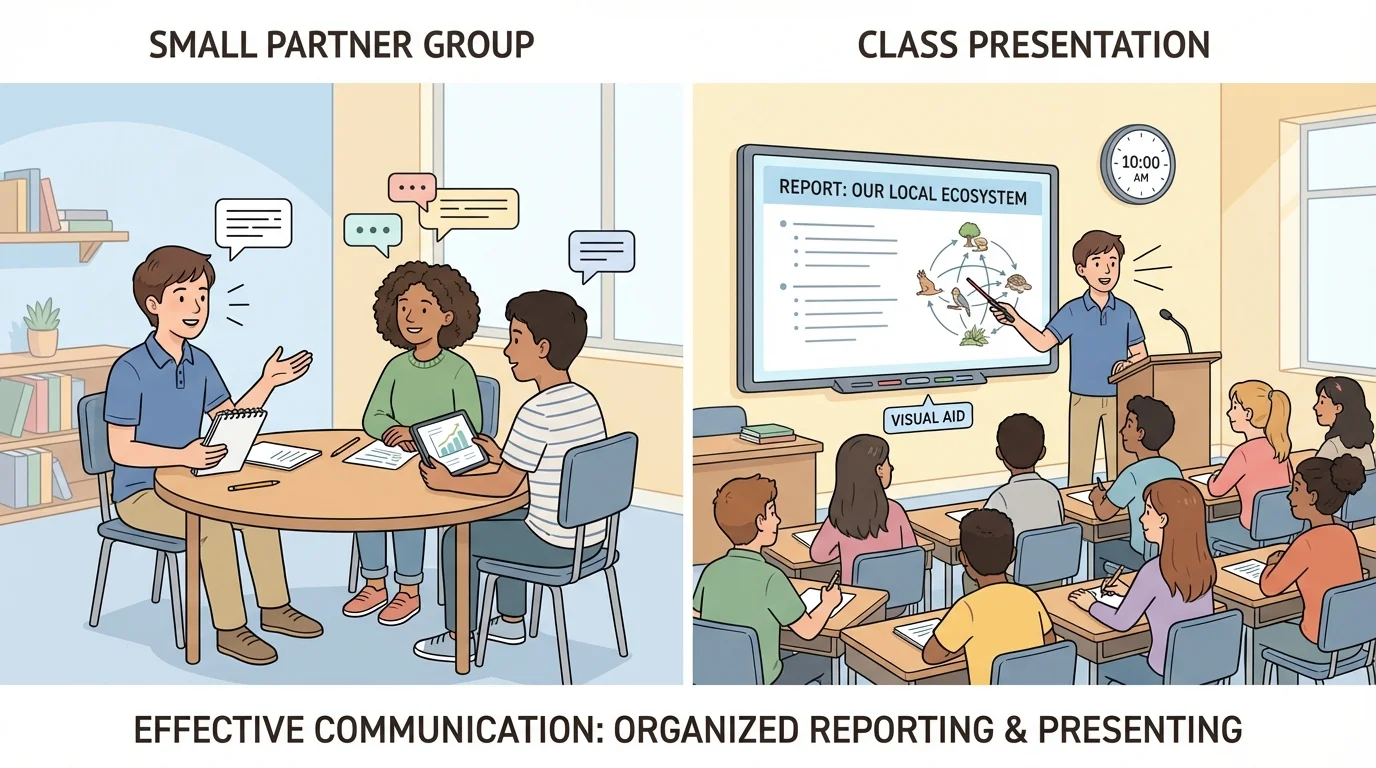
Both kinds of speaking still need organization. Whether you are explaining a game rule to one classmate or giving a report to the whole class, your listener needs to know what the topic is, what details matter, and when you are finished.
As you can see again in [Figure 3], the setting changes some parts of speaking, but it does not change the need for a clear plan. Organized ideas, relevant details, and understandable pacing matter in both situations.
Here is an example of a short report: "Today I am reporting on red pandas. Red pandas live in mountain forests in Asia. They use their long tails for balance and warmth. Even though they are called pandas, they are different from giant pandas. Red pandas need safe forests to survive." This report has a topic, facts, and a clear ending.
Here is an example of a short story: "Mila heard scratching at the window during the storm. When she opened the curtain, she saw a soaked kitten on the porch. She wrapped it in a towel, gave it warm milk, and waited with it until the storm ended. By morning, the kitten was purring in her lap." This story follows events in order and includes descriptive details.
Here is an example of a recount: "Last Saturday, my family hiked to a waterfall trail. At first the path was muddy and slippery, but the air smelled fresh after the rain. When we reached the top, we heard the water crashing over the rocks before we could even see it. I learned that the hardest part of a hike can lead to the best view." This recount shares a real experience in order and ends with a reflection.
"Say what matters most, and say it so others can follow."
Notice what these examples have in common. Each one stays focused, includes details that fit the purpose, and ends in a complete way. None of them wander off into unrelated ideas.
One common problem is giving too many details. If every small event gets equal attention, listeners may lose track of what is most important. Choose the details that best support your point.
Another problem is speaking too fast. If you rush, your words may run together. A simple fix is to pause briefly at commas, periods, and transition points. Another problem is speaking in a voice that is too quiet. Lifting your head and aiming your voice toward the audience can help.
Some speakers forget to end clearly. They stop with words like "So, yeah," and the audience is unsure whether the presentation is finished. A stronger ending sounds complete, such as "That is why school gardens are important," or "That field trip helped me understand how scientists study animals."
A final problem is weak organization. If your audience cannot tell what comes first, next, and last, the speaking feels confusing. Returning to a simple plan fixes this problem quickly.
Before speaking, review your plan. Ask yourself: What is my topic? What is my main idea? What facts or details will help listeners understand? What should I say first, next, and last? How will I end?
Then practice aloud. Listening to your own voice helps you notice whether you are rushing, mumbling, or skipping important ideas. Practice also helps your speaking sound smoother and more confident.
Remember: good speaking is not about using the fanciest words. It is about making your meaning clear. A simple, organized explanation is often stronger than a confusing one filled with extra information.
When you speak with a plan, support your ideas with facts and details, and use a clear voice at a steady pace, your audience can truly follow your message. That is what effective oral expression does: it helps ideas travel from one mind to another.
