Have you ever told the same story in two different ways—one way to a best friend and another way to an adult? Writers do that all the time. A strong writer does not just put words on paper. A strong writer thinks about what the task is, why it is being written, and who will read it. When writing matches the task, purpose, and audience, it becomes easier to understand and more enjoyable to read.
Clear and coherent writing means the writing is easy to follow. The ideas connect in a sensible way. The reader does not get lost. Good writing also uses the rules of standard English—such as complete sentences, correct punctuation, and proper grammar—to make meaning clear. These rules are not just about "being correct." They help a reader know exactly what the writer wants to say.
Every piece of writing has a purpose. You might write to tell a story, explain a science idea, share an opinion, give directions, or thank someone. If a writer does not know the purpose of the writing, the piece can become messy. It may jump from one idea to another or include details that do not belong.
Planning helps a writer stay focused. Before writing, it helps to ask a few important questions: What am I writing? Why am I writing it? Who will read it? The answers guide the writer's choices. They help the writer decide what details to include, what words to use, and how to organize the piece.
Professional authors often rewrite parts of their work many times. Clear writing usually looks easy to read, but it often takes careful planning and revising to make it that way.
Even short writing needs a plan. A note to a classmate sounds different from a report for a teacher. A story for younger children sounds different from directions for building a model. Good writers shape their writing for the situation.
[Figure 1] The task is the kind of writing you are doing. The purpose is the reason you are writing. The audience is the person or group who will read it. These three ideas work together because the same topic can sound very different when the writer changes the reader or the reason for writing.
Suppose the topic is recess. If your task is to write an opinion paragraph, your purpose may be to convince the principal to add more play equipment. Your audience is the principal. You would probably use respectful words, clear reasons, and examples such as, "New equipment would help students stay active and play safely."
Now think about writing about recess in a personal letter to a cousin. The topic is still recess, but the task, purpose, and audience are different. You might write, "Our recess is fun because we race across the field and play tag near the big tree." That version sounds more personal and friendly.
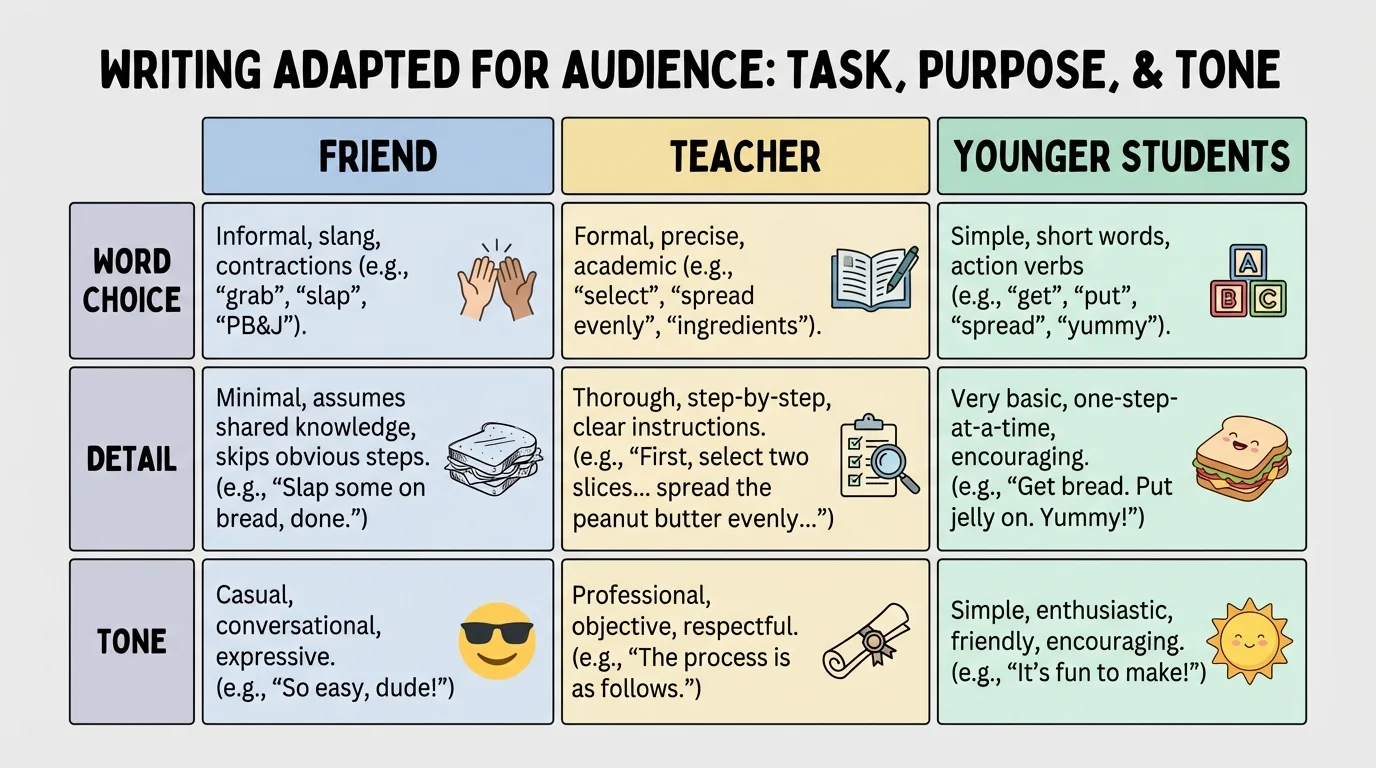
When writers understand task, purpose, and audience, they make better choices. They know whether to sound formal or friendly. They know whether to add facts, feelings, instructions, or reasons. They also know how much background information the reader will need.
Task is the kind of writing you are doing, such as a story, report, opinion paragraph, or letter.
Purpose is the reason for writing, such as to explain, persuade, entertain, or inform.
Audience is the person or group who will read the writing.
Sometimes one change affects everything else. If your audience is younger students, you may choose simpler words and extra explanation. If your purpose is to teach, you may organize ideas step by step. If your task is a story, you may include characters, setting, and events. Thinking about all three helps writing stay clear and appropriate.
[Figure 2] Good writing is not a pile of sentences. It has structure. The ideas fit together in order so the reader can move smoothly from one thought to the next. This is called organization.
Many pieces of writing use a simple beginning, middle, and end. In a story, the beginning introduces the characters and setting, the middle tells what happens, and the end shows how the story finishes. In an informative paragraph, the beginning names the topic, the middle gives facts and details, and the end wraps up the main idea.
Writers also organize ideas by using patterns. They may put events in time order, explain steps in order, group similar facts together, or list reasons and supporting details. The best pattern depends on the writing task. Directions should be in the order the reader must follow. A description may group details by what something looks, sounds, or feels like. An opinion piece often states the opinion first and then gives reasons.
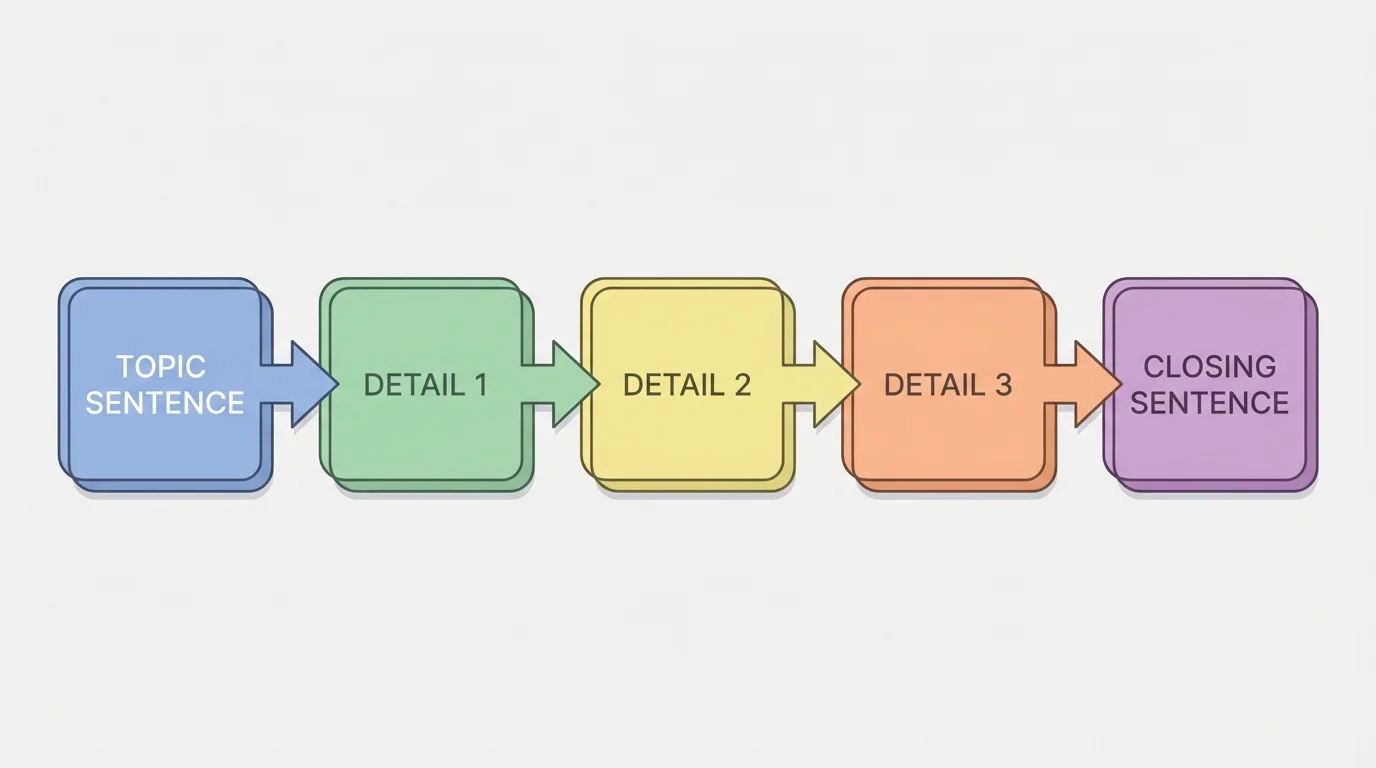
A paragraph works best when all the sentences stay on one main idea. Usually, a paragraph has a topic sentence that tells what the paragraph is about. The next sentences add facts, examples, or explanation. A final sentence may remind the reader of the main idea.
Look at this organized paragraph: "Our school garden helps students learn in many ways. We observe insects and plant growth during science. We measure stems and leaves in math. We also write about what we notice in journals. The garden is a place where learning comes alive." Every sentence supports the idea of the school garden helping students learn.
Now look at a less organized version: "Our school garden helps students learn in many ways. My favorite lunch is pizza. We observe insects and plant growth during science. Sometimes it rains in April." This version is confusing because some details do not fit the main idea. Coherent writing stays focused.
Comparing organization
Here is how a writer can improve a paragraph about caring for a pet.
Step 1: Start with a clear main idea.
"Taking care of a pet requires time and responsibility."
Step 2: Add details that match the main idea.
"Pets need fresh food and water every day. They also need exercise, playtime, and regular cleaning."
Step 3: End with a sentence that fits the topic.
"When people care for pets well, the animals stay healthy and happy."
The paragraph is clear because every sentence supports the same idea.
Transitions also help organization. Words and phrases such as first, next, also, for example, and finally show how ideas connect. These words act like bridges from one part of writing to another.
Development means building your ideas so the reader understands them. A piece of writing should not be too thin. If a writer says, "Dogs are helpful," that idea needs support. The reader may ask, "How are dogs helpful?"
To develop an idea, a writer can add facts, examples, descriptions, reasons, or explanations. Here is a stronger version: "Dogs are helpful in many ways. Some dogs guide people who cannot see well. Other dogs help police officers search for missing people. Many dogs also give comfort to families at home." Now the reader understands the idea better.
Clear development means adding the right details, not just more details. Extra sentences that do not match the main point can confuse the reader. Writers choose details carefully so each one helps the reader understand the topic.
Strong details make writing clearer
Details should answer the reader's questions. If you write about a place, include what it looks, sounds, or feels like. If you explain how to do something, include each step in order. If you share an opinion, include reasons and examples that support it.
Writers often ask themselves questions to develop ideas: What does my reader need to know? What example would help? What facts make this clearer? This thinking helps a writer turn a simple sentence into a richer and more useful paragraph.
Notice how development works in different tasks. In a story, development may come from actions, dialogue, and descriptions. In an informational piece, development may come from facts and explanations. In an opinion piece, development may come from reasons and examples. The goal is always the same: help the reader understand.
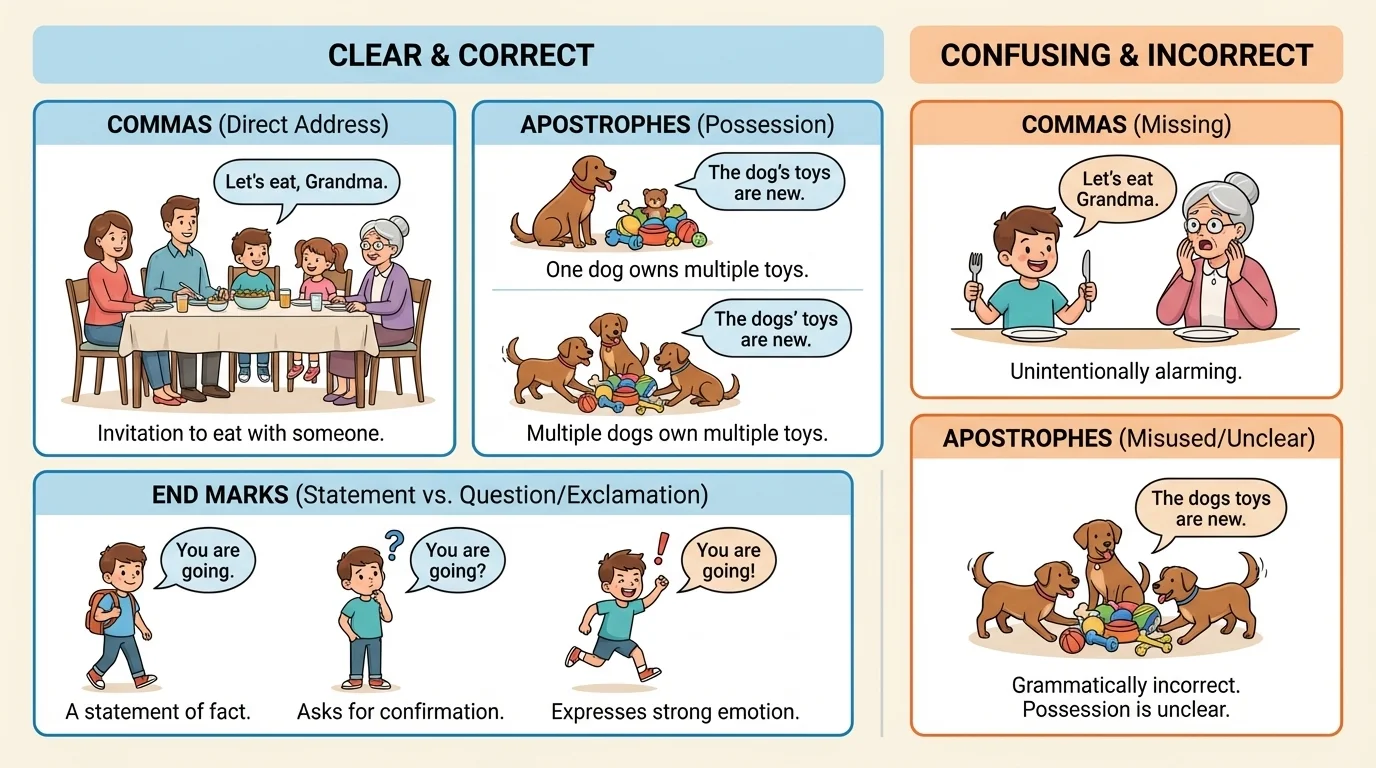
[Figure 3] The rules of standard English help writing say exactly what the writer means. Even a small change in punctuation can make meaning clear or confusing. Good writers use grammar, usage, capitalization, spelling, and punctuation to guide the reader.
A clear piece of writing uses complete sentences. A complete sentence has a subject and a predicate. For example, "The birds sang" is complete. "Because the birds sang" is not complete by itself because it leaves the reader waiting for more.
Punctuation matters, too. Compare these sentences: "Let's eat, Grandma!" and "Let's eat Grandma!" One comma changes the meaning completely. Punctuation marks help readers know where to pause and how ideas fit together.
Capital letters also help. Writers use capital letters at the beginning of sentences, for names, and for specific places and titles. Correct spelling helps the reader recognize words quickly. If too many words are spelled incorrectly, the reader may have trouble understanding the message.
Grammar and mechanics are tools for clear writing. Grammar includes how words work together in sentences. Mechanics includes punctuation, capitalization, and spelling. When these are used carefully, readers can focus on the ideas instead of trying to guess the meaning.
| Writing choice | Clear example | Why it helps |
|---|---|---|
| Complete sentence | We planted beans in the garden. | The reader understands who did the action and what happened. |
| Correct punctuation | After lunch, we watered the plants. | The comma helps the sentence read smoothly. |
| Correct capitalization | Maya visited Denver in June. | Names and places are easy to recognize. |
| Correct pronoun use | Jordan lost his notebook, so he looked under the desk. | The reader knows who the sentence is about. |
Table 1. Examples of writing choices that make meaning clearer.
Pronouns need to be clear as well. If a writer says, "Lena talked to Ana before she left," the reader may wonder who left. Good writers notice when a sentence could mean two things and revise it. For example, "Before Lena left, she talked to Ana" is clearer.
As seen earlier in [Figure 3], tiny marks such as commas and apostrophes can change meaning. That is why conventions of standard English are important. They are not decorations. They are signals that help the reader understand the writer's message.
Writers choose words based on who will read the piece. This is called word choice. If you are writing directions, your words should be exact. If you are writing a story, your words may be more descriptive. If you are writing to an adult, you may choose more formal language than you would use with a close friend.
The word voice means the feeling or style of the writing. A thank-you note may sound warm and polite. A report may sound serious and informative. A story may sound lively or suspenseful. Good writers make sure the voice fits the purpose and audience.
Precise words are often better than vague words. Instead of writing, "The animal was nice," a writer might say, "The golden retriever gently rested its head on my knee." The second sentence gives the reader a much clearer picture.
Readers understand writing more easily when sentences connect, details stay on topic, and words are chosen carefully. These are the same habits you use when speaking clearly and listening for main ideas.
Writers also avoid words that are too confusing for the audience. If younger students are reading, the writer may explain tricky words or choose simpler ones. If a teacher is reading a science response, the writer may use scientific vocabulary correctly. Matching language to the reader shows respect for the audience.
Different kinds of writing need different structures. A narrative tells a story, so it often includes characters, setting, events, and a problem to solve. An informative piece explains a topic with facts and details. An opinion piece states a point of view and gives reasons to support it.
Directions must be clear and in order. If a writer skips a step, the reader may not be able to follow the directions. A letter usually includes a greeting, a message, and a closing. A response to a reading selection may include the main idea, evidence from the text, and the writer's own explanation.
Even when the forms are different, strong writing still follows the same big rules. It matches the task. It serves the purpose. It fits the audience. It uses clear organization and helpful details. It follows standard English so the meaning stays sharp.
One topic, different writing situations
The topic is rain.
Story: "Rain tapped against the window while Eli searched for his lost puppy."
Informative sentence: "Rain forms when water droplets in clouds become heavy enough to fall to the ground."
Opinion sentence: "Rainy days are the best for reading because the sound outside makes the house feel calm."
The topic is the same, but the task and purpose change the writing.
Writers learn to notice these differences. They do not use the exact same style for every assignment. Instead, they adjust their writing to fit the situation, just as athletes adjust their moves for different games and musicians adjust their playing for different songs.
Coherence means the writing makes sense as a whole. The ideas connect well, and the reader can follow them without confusion. Coherent writing does not feel jumpy or mixed up.
Revising is when a writer looks again at the writing and improves it. During revision, writers ask important questions: Does every sentence fit the main idea? Are the ideas in the best order? Are transitions helping the reader? Is anything unclear or repeated too much?
A writer may move a sentence, replace a weak word, add a missing detail, or remove a detail that does not belong. Revising is not just fixing spelling. It is making the whole piece stronger and easier to understand.
Reading the writing out loud can help. When writers hear their own words, they often notice awkward parts, missing words, or places where ideas do not connect smoothly. Another helpful strategy is to imagine being the reader. Would the reader understand the message the first time?
Questions writers use when revising
Writers often check whether the opening introduces the topic, whether the middle stays focused, and whether the ending feels complete. They also check whether pronouns are clear, whether transitions connect ideas, and whether punctuation helps readers understand each sentence.
Sometimes small changes make a big difference. For example, adding the word because can explain a reason. Changing a pronoun to a name can remove confusion. Breaking a long sentence into two shorter ones can make the writing easier to read.
Clear and coherent writing grows from good habits. Writers take time to think before they begin. They stay focused on the topic as they draft. They reread their work and revise it to help the reader.
One strong habit is to keep the audience in mind the whole time. Another is to check whether each paragraph has one main idea. Writers also make sure their endings fit what came before instead of ending suddenly.
Another important habit is using conventions carefully. A sentence should start and end correctly. Verbs should agree with subjects. Pronouns should point clearly to the right nouns. Punctuation should help the reader move through the writing with ease. These choices show that the writer cares about being understood.
When you write clearly, you are doing more than finishing an assignment. You are helping another person understand your ideas. That is a powerful skill. Whether you are telling a story, explaining a topic, sharing an opinion, or writing directions, thoughtful choices about task, purpose, audience, organization, development, and standard English make your writing stronger.
