Have you ever read a page about sharks, weather, or video games and then someone asked, "What was it mostly about?" If you can answer that clearly, you are using one of the most important reading skills of all. Strong readers do more than list facts from a text. They figure out the big message the author wants them to understand, notice the details that support it, and then put those ideas together in a short, clear summary.
Informational texts are everywhere. You read them in science books, social studies articles, directions for games, websites, and even signs at museums or zoos. Sometimes a text gives lots of facts, but those facts are not all equally important. Some facts are there to help explain one central point. That central point is the heart of the text.
When readers find the main idea, they understand the text better. They can remember it longer, talk about it more clearly, and explain it to someone else. If a reader only collects random facts, the text can feel like a big pile of information. Finding the main idea helps organize that information.
Your brain remembers information better when ideas are grouped together instead of kept as a long list of separate facts. Finding the main idea helps your brain organize those ideas into a meaningful group.
That is why readers look for the big idea and the details that support it. Once those parts are clear, writing a summary becomes much easier.
The main idea is the most important point the author wants the reader to understand. It is what the text is mostly about and what the author says about that topic. In [Figure 1], a comparison chart makes it easier to see that a topic is just a word or short phrase, while the main idea is a complete thought.
A topic is simply the subject. For example, a paragraph might be about bees. But "bees" is only the topic. The main idea would be something like: Bees help plants grow by carrying pollen from flower to flower. The topic tells who or what the text is about. The main idea tells the important message about that topic.
Main idea is the most important point in a text or paragraph.
Topic is the subject of the text, such as "frogs," "recycling," or "storms."
Key details are the important facts, examples, or explanations that support the main idea.
Summary is a short retelling of the most important ideas in a text.
Look at this short paragraph:
Bees visit flowers to collect nectar. As they move from flower to flower, pollen sticks to their bodies. This pollen helps plants make seeds. Because of this, bees are important helpers in nature.
The topic is bees. The main idea is Bees are important because they help plants make seeds by moving pollen. Notice that the main idea includes the topic and the important point about it.
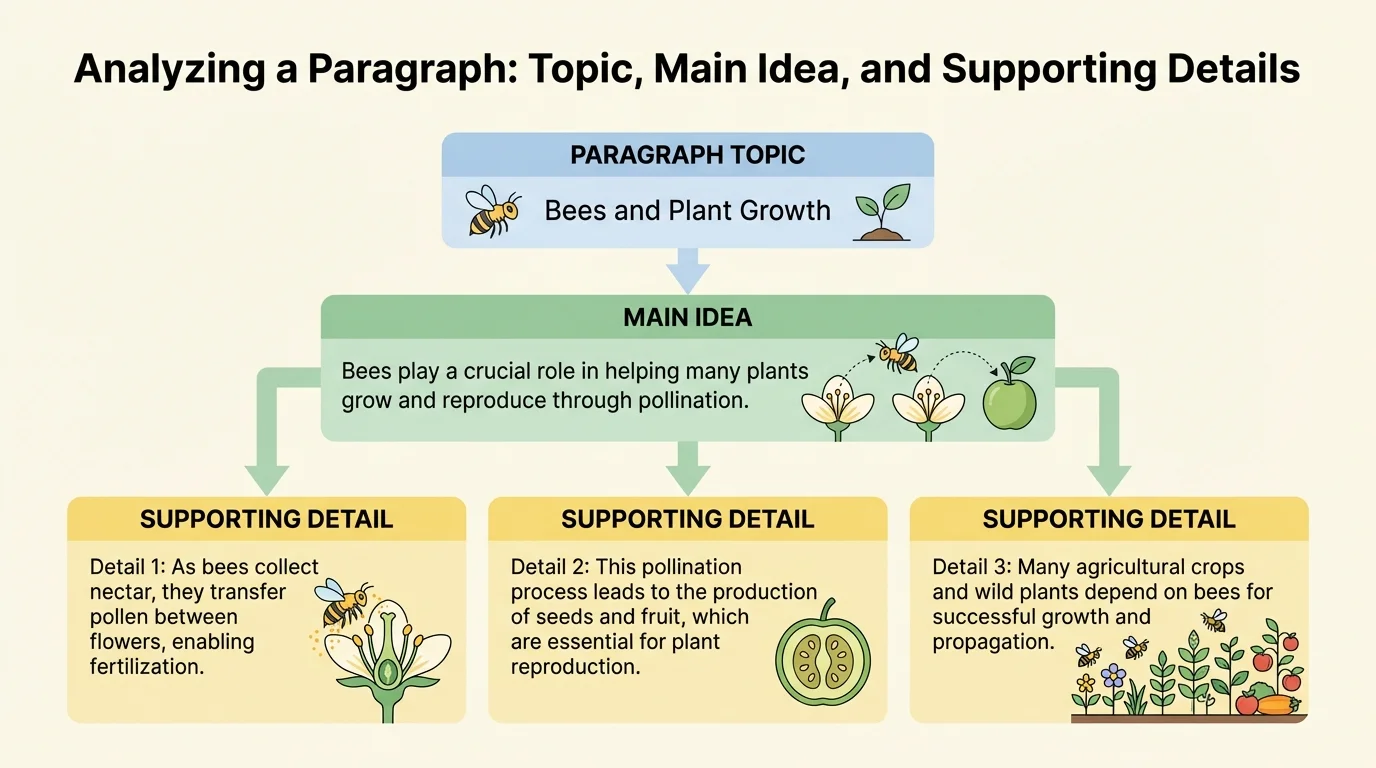
Key details are the important pieces of information that help prove, explain, or develop the main idea. They answer questions like: How do we know? or What facts support that idea?
In the bee paragraph, the details include: bees visit flowers, pollen sticks to their bodies, and pollen helps plants make seeds. Each of those details supports the main idea that bees are important helpers in nature.
Not every detail in a text is a key detail. Some details are interesting but not central. Suppose an author writes that bees can be black and yellow and that some bees live in hives. Those facts may be true, but if the paragraph is mainly about pollination, those details may not be the most important support for the main idea.
Readers ask themselves: Which details really help explain the big point? That question helps separate important details from extra information.
How details and main idea work together
Think of the main idea as the trunk of a tree and the key details as the branches. The trunk holds everything together. The branches grow from it. If a fact does not connect well to the trunk, it may not be a key detail for that text.
This is why readers should not just underline many facts. They should choose the details that most strongly connect to the main idea, like the supporting facts shown earlier in [Figure 1].
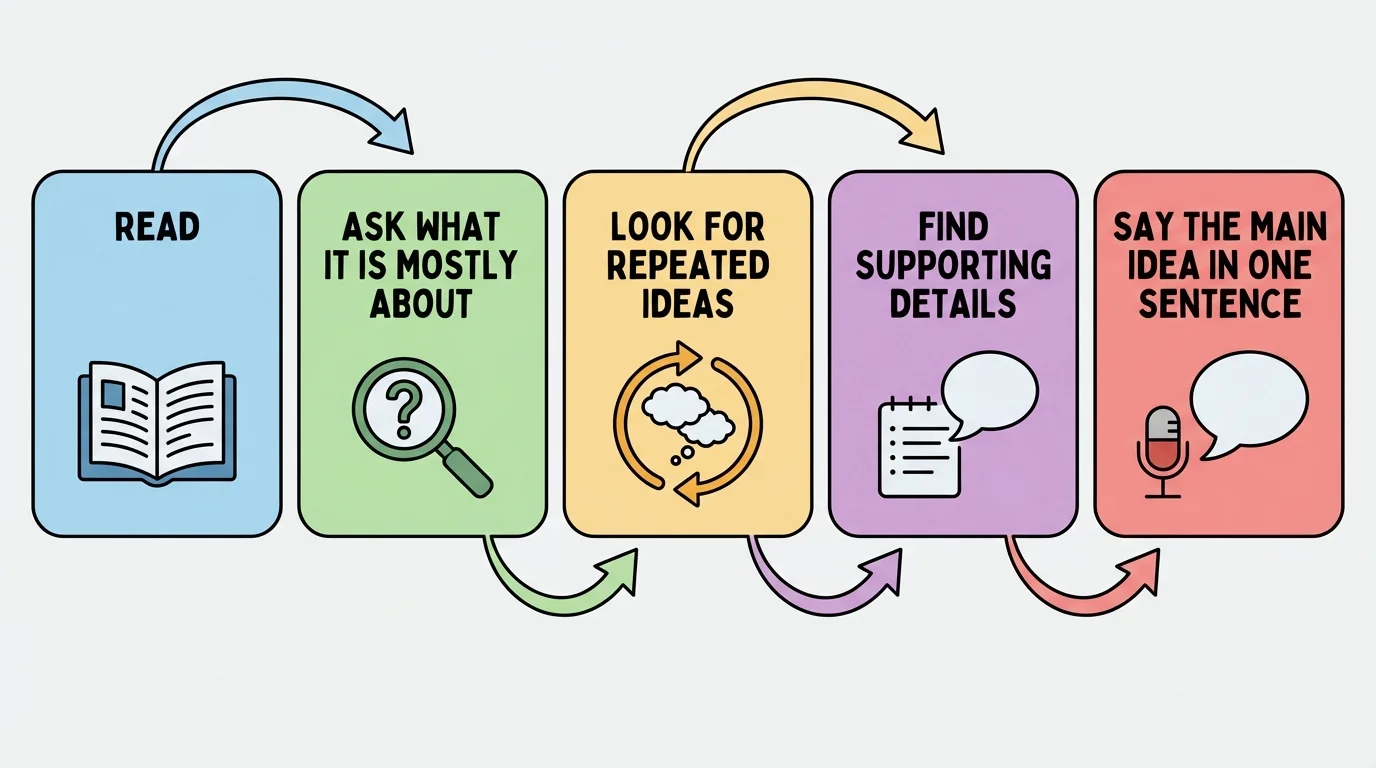
Finding the main idea is easier when you follow a plan. The process in [Figure 2] breaks the work into simple steps readers can use again and again with articles, textbook pages, and short passages.
First, read the whole paragraph or text carefully. Next, ask yourself, What is this mostly about? That helps you find the topic. Then ask, What does the author want me to understand about this topic? Now you are thinking about the main idea.
It also helps to notice ideas that repeat. If an author keeps mentioning one important point in different ways, that repeated message may be the main idea. After that, look for details that connect to the same point. If several details fit together, they probably support the main idea.
Finally, try saying the main idea in one clear sentence using your own words. If the sentence matches most of the key details, it is probably a strong main idea statement.
Here is another example:
Some animals are active at night instead of during the day. Owls hunt when it is dark. Bats use sound to find food at night. Raccoons search for food after sunset. Nighttime activity helps these animals survive.
The topic is animals active at night. The main idea is Some animals survive by being active at night. The details about owls, bats, and raccoons all support that idea.
Finding the main idea in a short paragraph
Recycling helps reduce trash in landfills. It allows paper, plastic, glass, and metal to be used again. Recycling also saves some natural resources. When people recycle, they help protect the environment.
Step 1: Find the topic.
The topic is recycling.
Step 2: Notice the important repeated message.
The paragraph keeps explaining how recycling helps.
Step 3: Put the idea into one sentence.
The main idea is Recycling helps protect the environment by reducing trash and saving resources.
Step 4: Check the details.
The details about reusing materials, reducing landfill trash, and saving resources all support the main idea.
Good readers know that the main idea is not always copied word-for-word from the text. Sometimes they must combine clues and say the idea in their own words.
The main idea does not always appear in the same place. It may come at the beginning, in the middle, at the end, or it may be implied instead of directly stated.
[Figure 3] At the beginning: Sometimes the author tells the main idea first and then adds details. Example: Whales are mammals, not fish. They breathe air, are warm-blooded, and feed milk to their young.
At the end: Sometimes the author gives details first and then states the main idea. Example: They have strong back legs, long tails, and powerful hops. Because of these features, kangaroos move very efficiently.
In the middle: Sometimes the main idea is placed after one or two opening details and before more support.
Implied: Sometimes the author never writes the main idea in one exact sentence. The reader must infer it from the details. For example, if a paragraph says that camels can go a long time without water, have wide feet for sand, and thick eyelashes to block blowing dust, the reader can infer that camels are well adapted for desert life.
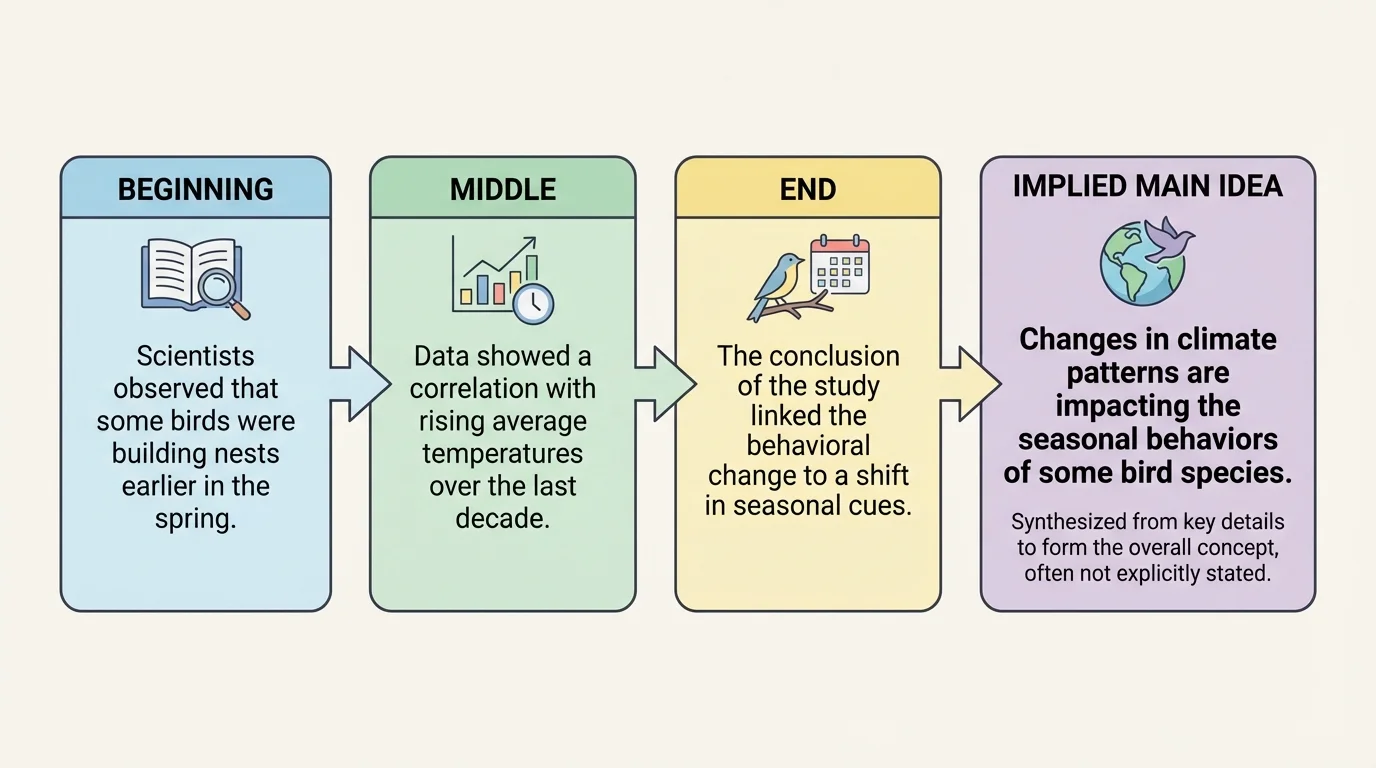
When the main idea is implied, readers need to think carefully about what the details have in common. They should ask, What single message ties these details together?
This is where strong thinking matters most. The boxes in [Figure 3] help show that readers cannot rely on only the first sentence every time.
A summary is a brief explanation of the most important parts of a text. It tells the main idea and the key details, but it leaves out less important information.
A good summary is short, clear, and accurate. It should be written in your own words as much as possible. It should not include every tiny fact. It should also not include your opinion, such as "I liked this part" or "This was boring." A summary tells what the text says, not what the reader thinks about it.
When you retell a story, you may include many events in order. A summary of informational text is different. It focuses on the most important ideas, not every single fact or sentence.
Suppose you read a passage about how rainforests help Earth. A summary would include the main idea that rainforests are important ecosystems and key details such as providing homes for many animals, helping produce oxygen, and affecting climate. A summary would not need every small fact, example, or descriptive word.
Readers move from notes to a finished summary by combining the main idea with the strongest supporting details. The process in [Figure 4] shows how many details can be grouped into a few important points and then turned into a short paragraph.
One helpful way to build a summary is to think in this order: topic, main idea, key details. First, name the topic. Next, say what the text teaches about that topic. Then add two or three important details that support the main idea.
Read this passage:
Sea turtles face many dangers. Some are harmed by plastic in the ocean. Others lose nesting beaches when shores change. Bright lights near beaches can confuse baby turtles. People and groups are working to protect sea turtles and their habitats.
The topic is sea turtles. The main idea is Sea turtles face dangers, but people are trying to protect them. Key details include plastic in the ocean, loss of nesting beaches, and bright lights confusing baby turtles.
Turning a passage into a summary
Step 1: Identify the topic.
The topic is sea turtles.
Step 2: State the main idea.
The text explains that sea turtles face dangers and need protection.
Step 3: Choose the best supporting details.
Important details are ocean plastic, changing shores, and bright lights near beaches.
Step 4: Write the summary in your own words.
Sea turtles face several dangers, including plastic in the ocean, loss of nesting areas, and bright lights that confuse baby turtles. People are working to protect sea turtles and the places where they live.
The summary is much shorter than the original passage, but it still includes the most important ideas. It does not copy every sentence. It keeps the focus on the central message.
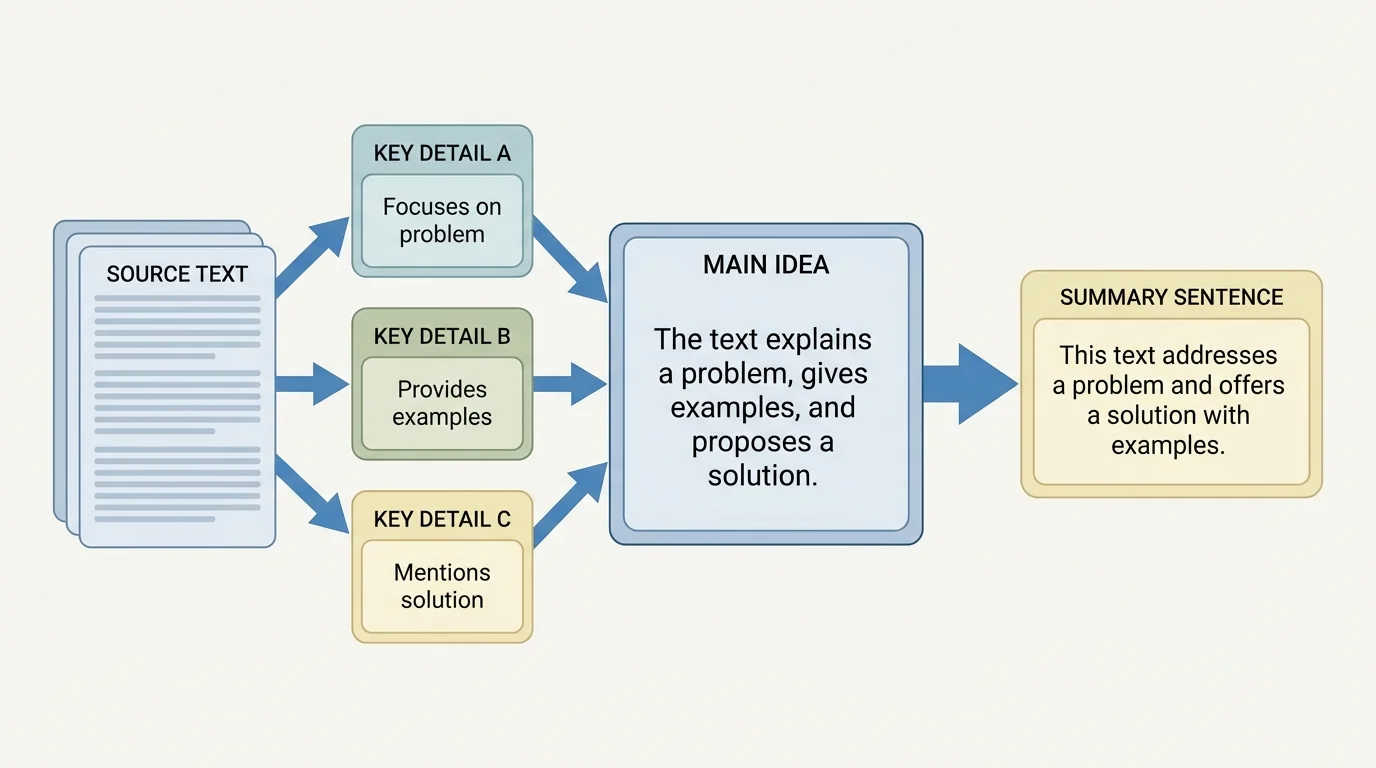
Writers often use this same thinking with longer articles too. They collect details, group related information, and then write only what matters most, just as [Figure 4] shows.
One common mistake is confusing the topic with the main idea. If a student says the text is about penguins, that is only the topic. The reader still needs to say the important point about penguins, such as Penguins have special features that help them live in cold places.
Another mistake is choosing details that are interesting but not important. A small fact may be true, but if it does not strongly support the main idea, it does not belong in the summary.
A third mistake is writing too much. A summary should be shorter than the original text. If it includes nearly every fact, it is not really a summary.
Another problem is adding opinions. For example, "I think sea turtles are cute" does not belong in a summary because it is not a fact from the text.
| Mistake | Why it is a problem | Better choice |
|---|---|---|
| Writing only the topic | It does not tell the important message | Write a full sentence that explains the point about the topic |
| Including too many details | The summary becomes too long | Keep only the strongest supporting details |
| Adding opinions | Opinions are not part of the author's information | Use facts from the text only |
| Copying exact sentences | It does not show understanding | Use your own words when possible |
Table 1. Common mistakes readers make when finding main idea and writing summaries, with ways to improve.
When readers slow down and check whether each detail supports the main idea, their summaries become much clearer.
"Good readers do not just collect facts. They connect facts to an important idea."
This simple idea can help with almost every kind of informational reading.
These skills are useful far beyond reading class. In science, you may read about animal habitats and need to explain the most important concept. In social studies, you may read about a historical event and identify the key reasons it happened. In health, you may read directions about safety and need to remember the most important steps.
Even outside school, people use these skills. When someone reads a sports article, a weather report, or instructions for building something, they often look for the main idea first. Then they notice the important details. That helps them understand quickly and remember what matters.
News reporters and scientists often write with a clear main idea because readers need to find the most important information quickly. Strong reading skills help you do that effectively as a reader.
The more you practice noticing what a text is mostly saying, the easier it becomes to separate the big ideas from the smaller details. Then you can explain the text clearly and accurately.
