Have you ever heard someone say, "Pizza is the best lunch," and then quickly add, "because it is warm, filling, and easy to share"? That person is not just giving an opinion. That person is trying to support a point. Authors do the same thing in informational texts. They do not just tell readers what they think. They explain why their idea makes sense and give proof to back it up.
When you read nonfiction, such as an article about animals, weather, health, or schools, you are not only learning facts. You are also noticing how the author builds an idea. Good readers pay attention to the author's point, the reasons that support it, and the evidence that proves those reasons. This helps you understand the text more clearly and decide whether the author's ideas are believable.
Authors of informational texts usually have a purpose. They may want to teach something, explain how something works, or convince readers that an idea is important. To do that well, they need to support their ideas. If an author writes, "Drinking water is important," most readers will want to know why. The author might answer with reasons such as "water helps your body work properly" and "water helps prevent dehydration." Then the author may include evidence such as facts from health experts or examples of what happens when people do not drink enough water.
As a reader, understanding support helps you separate strong writing from weak writing. A strong text gives clear points, solid reasons, and useful evidence. A weak text may repeat opinions without proof. This skill is important in school, but it is also important in daily life when you read websites, signs, articles, or even product ads.
Point is the main idea, opinion, or claim the author wants the reader to understand.
Reason is an explanation that tells why the point makes sense.
Evidence is the proof that supports a reason. Evidence can include facts, examples, quotations, observations, or numbers.
These three parts work together. The point is what the author wants you to understand or accept. The reasons explain why. The evidence provides the proof. If one part is missing, the writing is usually less convincing or less clear.
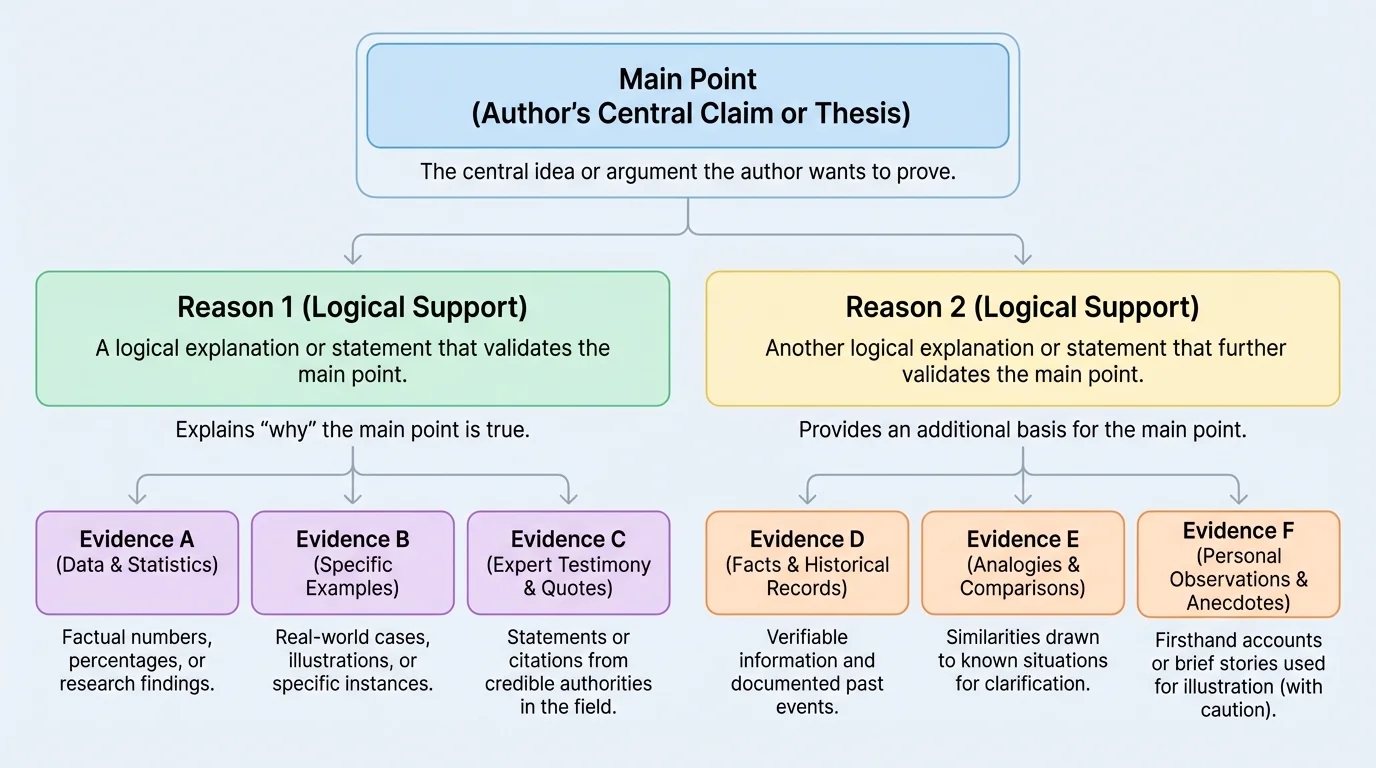
An informational text often works like a support structure, as [Figure 1] shows. At the top is the main point. Under that are reasons. Under each reason is evidence. This structure helps the author build an idea step by step so the reader can follow the thinking.
For example, suppose an article says, "School gardens are valuable." That sentence is the point. One reason might be, "Gardens help students learn science in a real way." Another reason might be, "Gardens can provide fresh vegetables." Evidence for the first reason could include a description of students observing roots, stems, and insects. Evidence for the second reason could include a fact that the vegetables are used in the cafeteria or donated to families.
Notice that reasons and evidence are not the same thing. A reason answers the question "Why?" Evidence answers the question "How do you know?" When readers mix those up, the text can seem confusing. Keeping them separate makes it easier to explain what the author is doing.
Sometimes a point is stated directly in the text. The author may write it plainly in the introduction or conclusion. Other times, the point is not said in one exact sentence, and the reader must infer it from the whole text. Strong readers gather clues from headings, repeated ideas, and details to figure out the point.
Authors do not use just one kind of proof. Different kinds of evidence can support the same point. Learning to recognize these kinds helps you read more carefully.
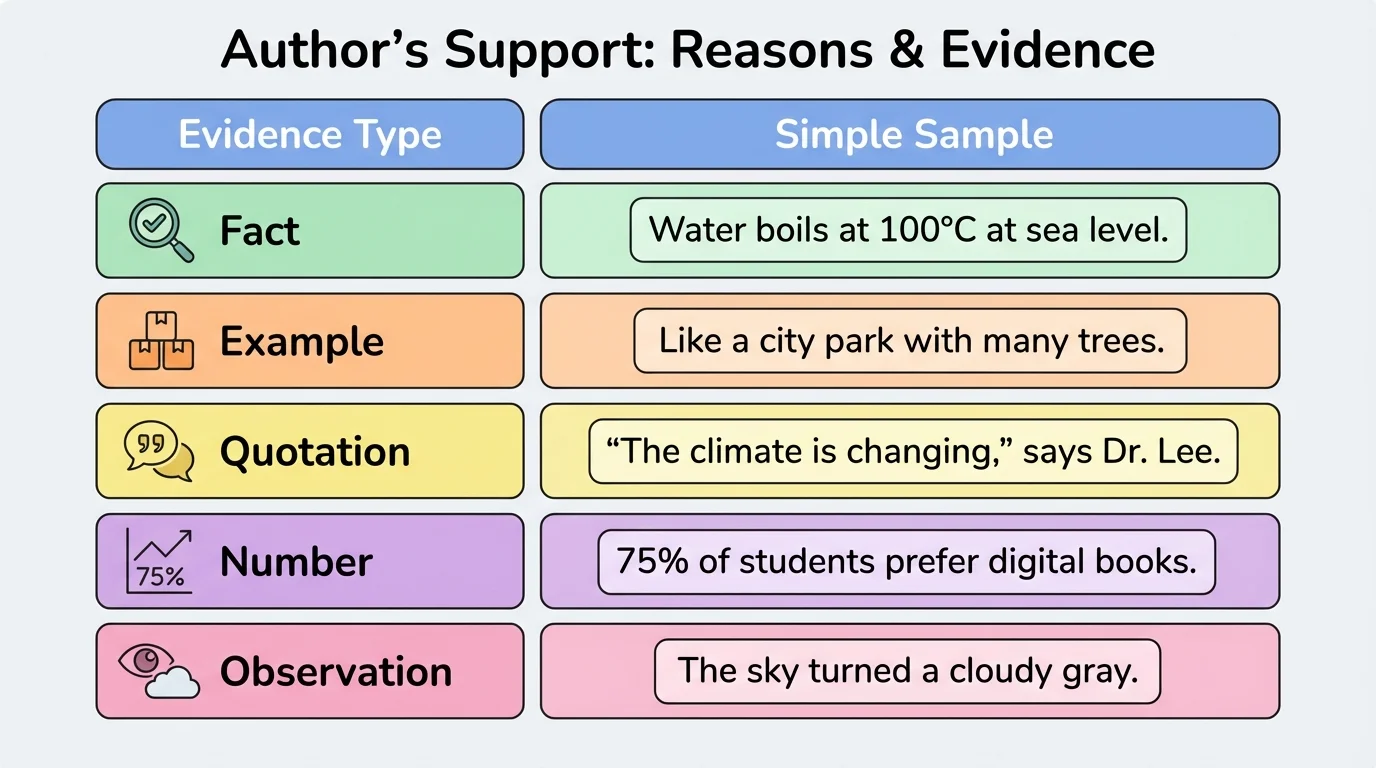
[Figure 2] One common kind of evidence is a fact. A fact is something that can be checked and shown to be true. If an author writes, "Bees help pollinate many crops," that is a fact if it can be confirmed by science sources.
Another kind is an example. An author may tell about one specific school, park, or animal to help readers understand a bigger idea. An example is useful because it makes the point more concrete. Instead of only saying, "Recycling helps communities," the author might describe one town that reduced waste by starting a recycling program.
Authors may also use a quotation from an expert, a number or statistic, or an observation. A quotation gives the words of someone who knows about the topic. A number, such as "the library loaned 500 books in one month," can make a point more exact. An observation tells what someone noticed directly, such as birds returning to a wetland after it was cleaned.
Not every detail in a text is evidence. Some details only add description or make the writing more interesting. To decide whether a detail is evidence, ask yourself, "Does this detail help prove the author's reason or point?" If the answer is yes, it is evidence. If not, it may just be extra information.
Some authors use more than one kind of evidence for the same reason. That often makes the support stronger because readers can see the idea from different angles.
For instance, an author writing about exercise might use a fact from a health organization, a number about how many minutes children should move each day, and an example of a school walking club. All of these pieces work together to support the same point.
Good readers do more than spot reasons and evidence. They also check whether the support truly matches the point. This is called being relevant. Relevant support fits the idea being discussed.
Suppose an author's point is, "Reading before bed can be a good habit." A matching reason might be, "Reading can help people relax." Matching evidence might include examples of bedtime reading routines or facts about calming activities. But if the author starts giving details about how books are printed, those details may be interesting without being relevant to the point.
One helpful habit is to link each part together in your mind. You can think: "The point is this. The reason is this. The evidence proves that reason by showing this." If you cannot make that link, then the support may be weak, off-topic, or unclear.
[Figure 3] Not every detail is equally helpful. Strong support is clear, specific, and tied closely to the point. Weak support is often vague, repeated, or based only on opinion.
Look at these two examples. First: "Recess should stay in the school day because students need movement. Studies and teacher observations show that short breaks can help students refocus in class." This is stronger because it gives a reason and evidence. Now look at this one: "Recess should stay because recess is great and everyone likes it." That sentence gives a feeling, but it does not give much proof.
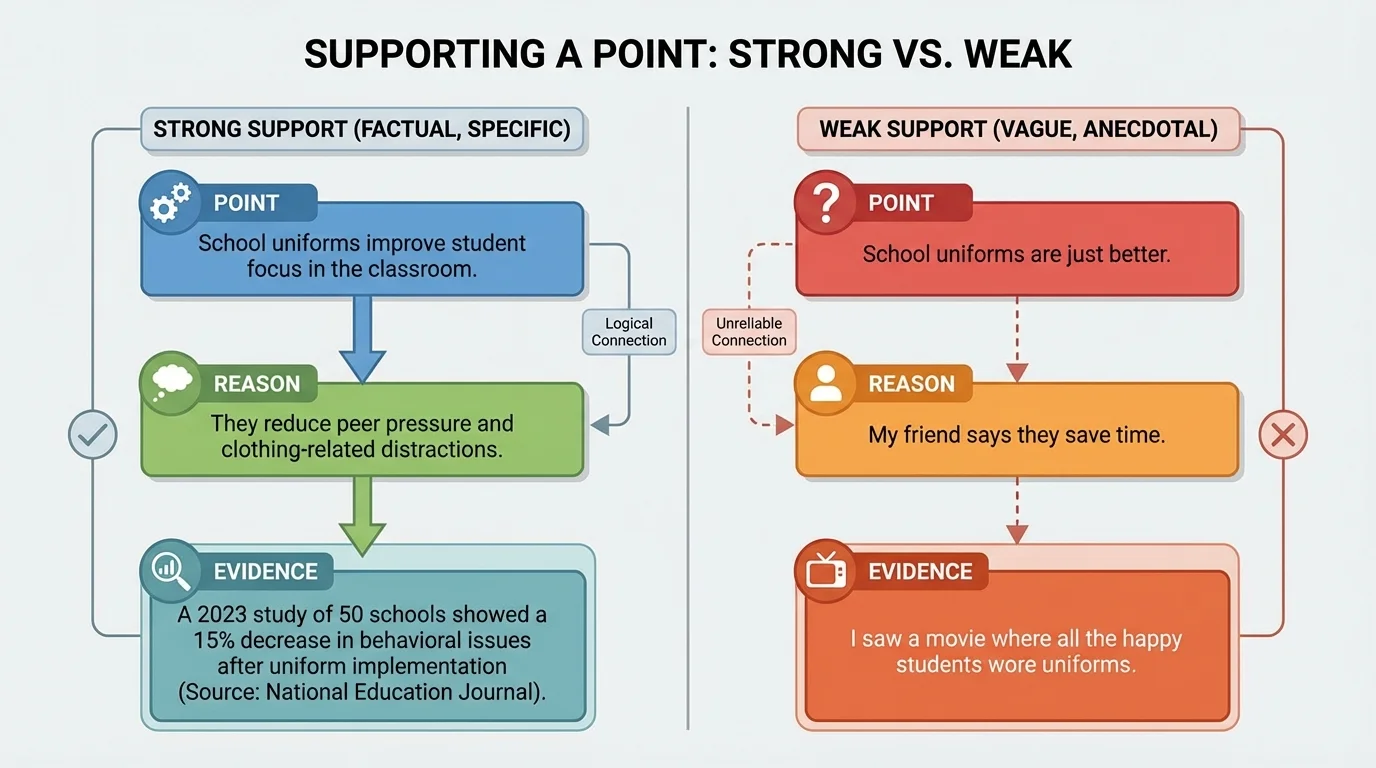
Strong evidence is often specific. It may name a source, describe a clear example, or include exact details. Weak evidence may be too broad, such as "stuff happens" or "people say so." When readers notice the difference, they become better at understanding and evaluating what they read.
How support builds trust
Readers are more likely to trust a text when the author gives reasons that make sense and evidence that matches those reasons. Trust grows when the author's support is specific, clear, and connected to the topic.
This matters because some texts sound convincing at first even when they are not well supported. Smooth wording is not enough. Readers need to look underneath the words and ask what proof the author actually gives.
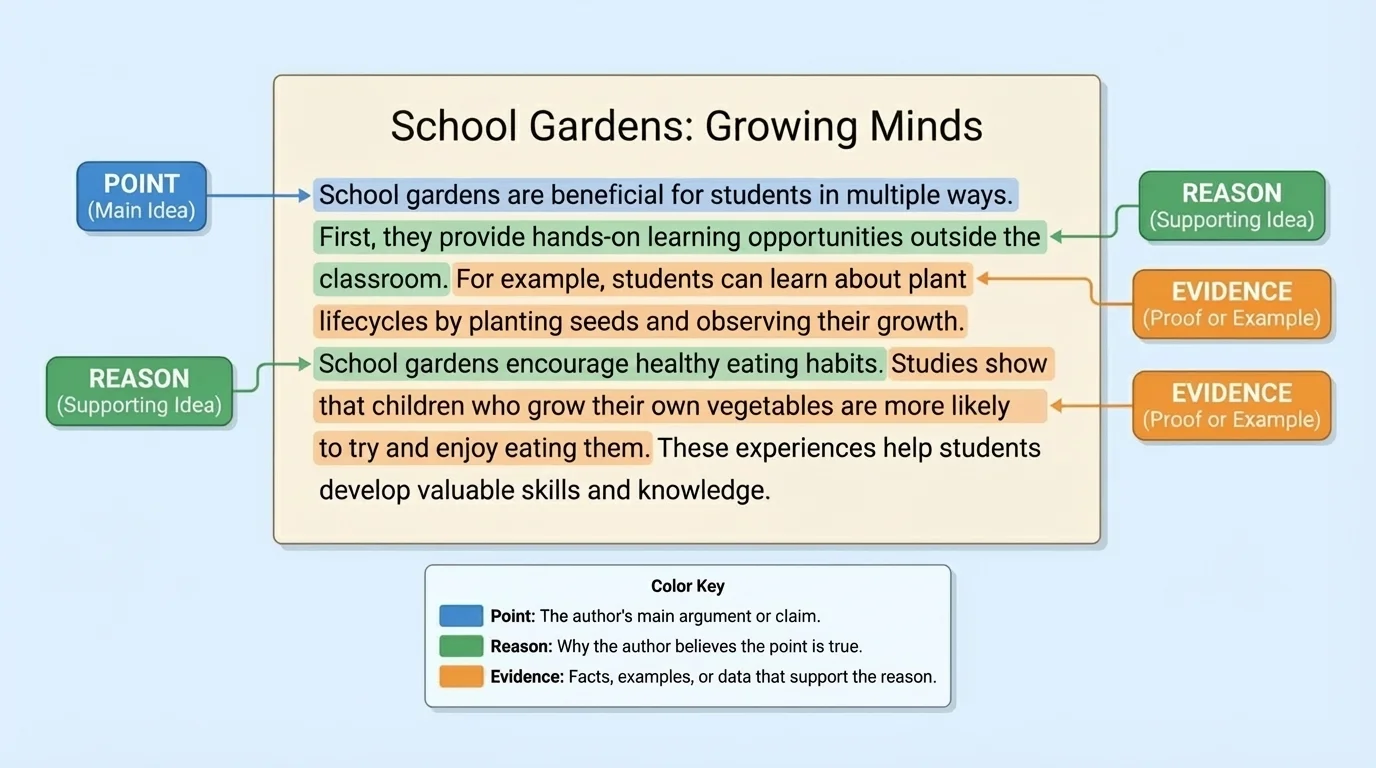
[Figure 4] To see how this works, let us examine a short passage. Read the passage and notice how the author connects a point to reasons and evidence.
School gardens should be part of more elementary schools. First, gardens help students learn by doing. In one class, students measured plant growth each week and kept science journals. Second, gardens can help the community. At one school, students grew tomatoes and lettuce that were shared with families.
The point is: School gardens should be part of more elementary schools. The author gives two reasons. One reason is that gardens help students learn by doing. The evidence for that reason is the example of students measuring plant growth and keeping science journals. The second reason is that gardens can help the community. The evidence is the example of vegetables being shared with families.
This passage is effective because the examples directly support the reasons. The examples are not random. They are closely connected to the point. They answer the reader's silent question: "What makes school gardens so useful?"
If the author had written only, "Gardens are nice," the passage would be much weaker. "Nice" is a feeling, not strong support. By adding specific examples, the author gives readers something they can picture and believe.
Analyzing another passage
Passage: Libraries are important community spaces. They give people free access to books and computers. In many towns, libraries also offer homework help and reading programs after school.
Step 1: Find the point.
The point is: Libraries are important community spaces.
Step 2: Find the reasons.
Reason 1: They give people free access to books and computers.
Reason 2: They offer homework help and reading programs after school.
Step 3: Look for evidence.
In this short passage, the details about books, computers, homework help, and reading programs act as evidence because they show specific ways libraries help communities.
This passage becomes stronger because it does more than praise libraries. It explains why they matter.
The same thinking works in science articles, history texts, and news stories for children. Once you learn to ask what the point is and how it is supported, reading becomes much more powerful.
Many texts do not have just one point. An author might make several points in different sections. For example, an article about rain forests might explain that rain forests help the climate, provide habitats for animals, and offer plants used in medicine. Each point can have its own reasons and evidence.
That means readers must stay organized. One useful strategy is to notice section headings and topic sentences. Each new section may introduce a different point. Then the details in that section usually serve as reasons and evidence for that specific point.
Think back to the support structure in [Figure 1]. In a longer text, the author may build several ladders, one for each important point. Understanding that structure can help you take notes, answer questions, and explain the text clearly.
When you read an informational text, it helps to ask yourself questions. These questions guide your thinking and help you notice how the author is building ideas.
You might ask: "What does the author want me to understand?" "Why does the author think that?" "What proof is given?" "Is the proof a fact, an example, a quotation, or a number?" "Does this support really match the point?" These questions help you become an active reader instead of a passive one.
Authors often organize nonfiction with headings, topic sentences, and details. Those text features can help you locate main points and the support that goes with them.
Another smart question is, "Is the author repeating the same idea, or adding new support?" Sometimes a text sounds full of proof, but it is really just saying the same thing again and again. Strong support usually adds new information, not just repeated opinion.
Sometimes a text has a clear point but weak support. The author may give a reason without enough evidence. Or the author may include evidence that does not fully connect. Readers should notice these gaps.
For example, if a text says, "Pets improve children's lives because they are wonderful," that is not enough. The point may be interesting, but "wonderful" is not a clear reason with proof. A stronger version would explain that pets can teach responsibility or provide companionship, then support those reasons with examples or facts.
You can also notice when evidence is confusing. Maybe a quotation is included, but the speaker is not an expert. Maybe a number is given, but the reader is not told what it measures. Maybe an example is true but only shows one small case. Careful readers look for these problems.
Earlier, [Figure 3] compares strong and weak support. That same idea helps here: if the support is vague, off-topic, or hard to connect, the text is less convincing.
This skill is useful far beyond school assignments. You can use it when you read a website that recommends a product, an article about healthy habits, a poster about helping the environment, or a news piece about a local event. In each case, someone is making a point and trying to support it.
Even advertisements often use reasons and evidence. An ad might claim that a backpack is durable. Then it may support that point by saying the material is strong, the zippers were tested, or many customers gave positive reviews. A smart reader asks whether that evidence is enough and whether it truly matches the claim.
When you understand support, you become a stronger thinker. You can explain how an author builds ideas, decide whether the text is convincing, and better understand what you read. The goal is not just to say, "I read it." The goal is to know how the author made the text work.
As you read more nonfiction, keep noticing the pattern we saw in the annotated passage in [Figure 4]. Find the point. Name the reasons. Look for evidence. Then ask whether the support is clear, specific, and relevant. That is how readers uncover the thinking inside a text.
