Sometimes a short poem can teach a big lesson, and sometimes a long story can be remembered in just a few lines. That is one of the most interesting things about reading: words on a page can tell us what happened, but they can also reveal a deeper message about life. Strong readers do more than follow the action. They notice what the text seems to say about friendship, courage, kindness, honesty, or hope.
When you read literature, you are not only learning what happens. You are also thinking about what it means. A story may be about a child who loses a race, a drama may show two people solving a problem together, and a poem may describe a lonely bird in winter. In each case, the text can suggest a larger idea. That larger idea is often the lesson, message, or truth the writer wants readers to think about.
Readers also need to be able to tell what happened in a short, clear way. That is called a summary. A summary helps you hold on to the important parts of a text without retelling every tiny detail. If theme is the text's deeper message, a summary highlights the important events or ideas that lead to that message.
Theme is the message, lesson, or big idea in a literary text.
Summary is a short retelling of the most important parts of a text.
A good reader uses both skills together. First, the reader understands the important details. Then the reader puts those details together to decide what message the author may be sharing.
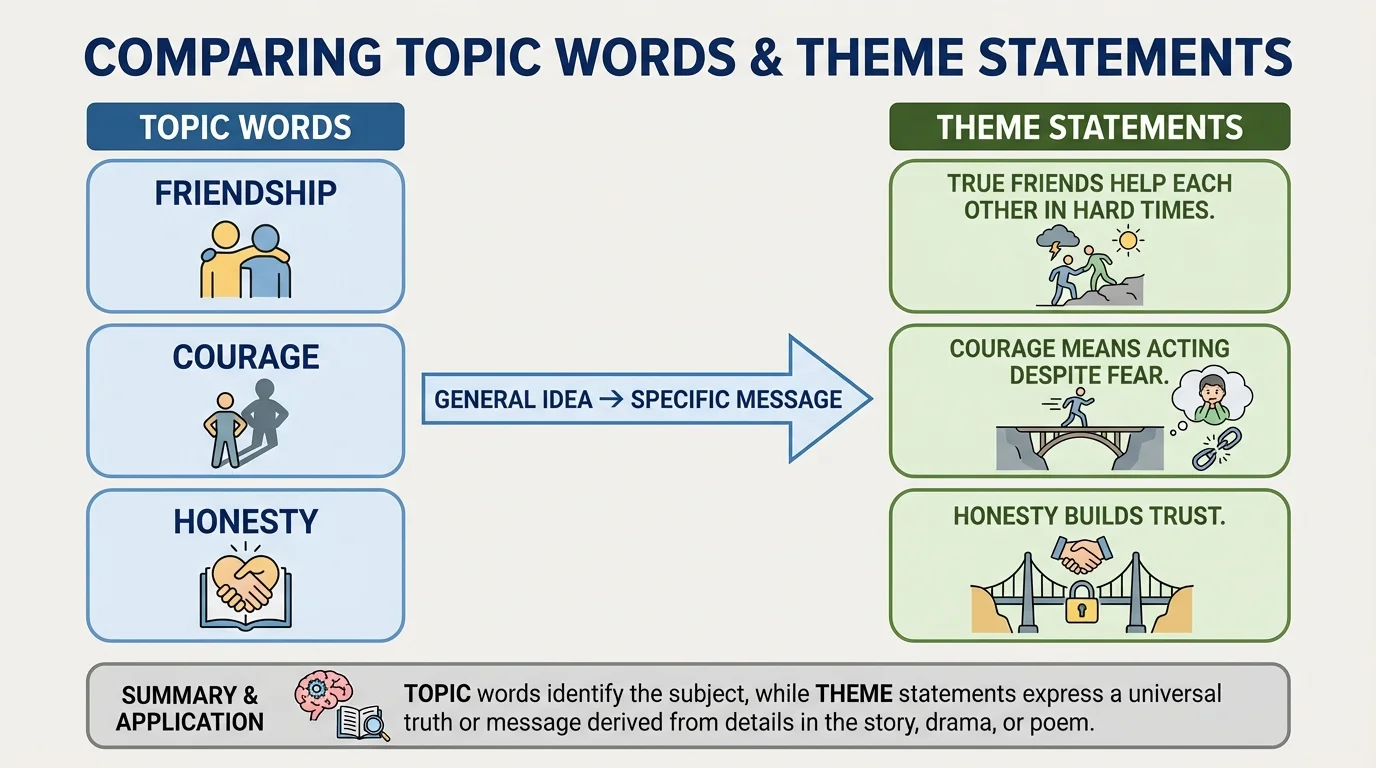
A theme is not just one word. It is a complete idea about life or people. For example, the topic might be friendship, but the theme could be, "True friends help each other during hard times." As [Figure 1] shows, a topic is a subject, while a theme is something the text says about that subject.
Theme is different from topic. A topic is the subject of the text, such as family, teamwork, or courage. A theme goes further. It makes a statement about the topic. If the topic is courage, a possible theme might be, "Courage means doing what is right even when you feel afraid."
Theme is also different from plot. Plot is the series of events in a story. Theme is the meaning you learn from those events. Two different stories may have very different plots but share the same theme.
Sometimes a text has more than one theme. A story about siblings crossing a forest might show that teamwork helps people succeed and that growing up means taking responsibility. Readers should choose a theme that is supported by details in the text, not just a theme that sounds nice.
Many famous tales are remembered for their themes more than for every event in the plot. That is why people can tell the same folktale in different ways and still keep the same lesson.
To state a theme well, use a full sentence. Instead of saying only "kindness," say something like, "Small acts of kindness can change someone's day." That sounds more like a message the text teaches.
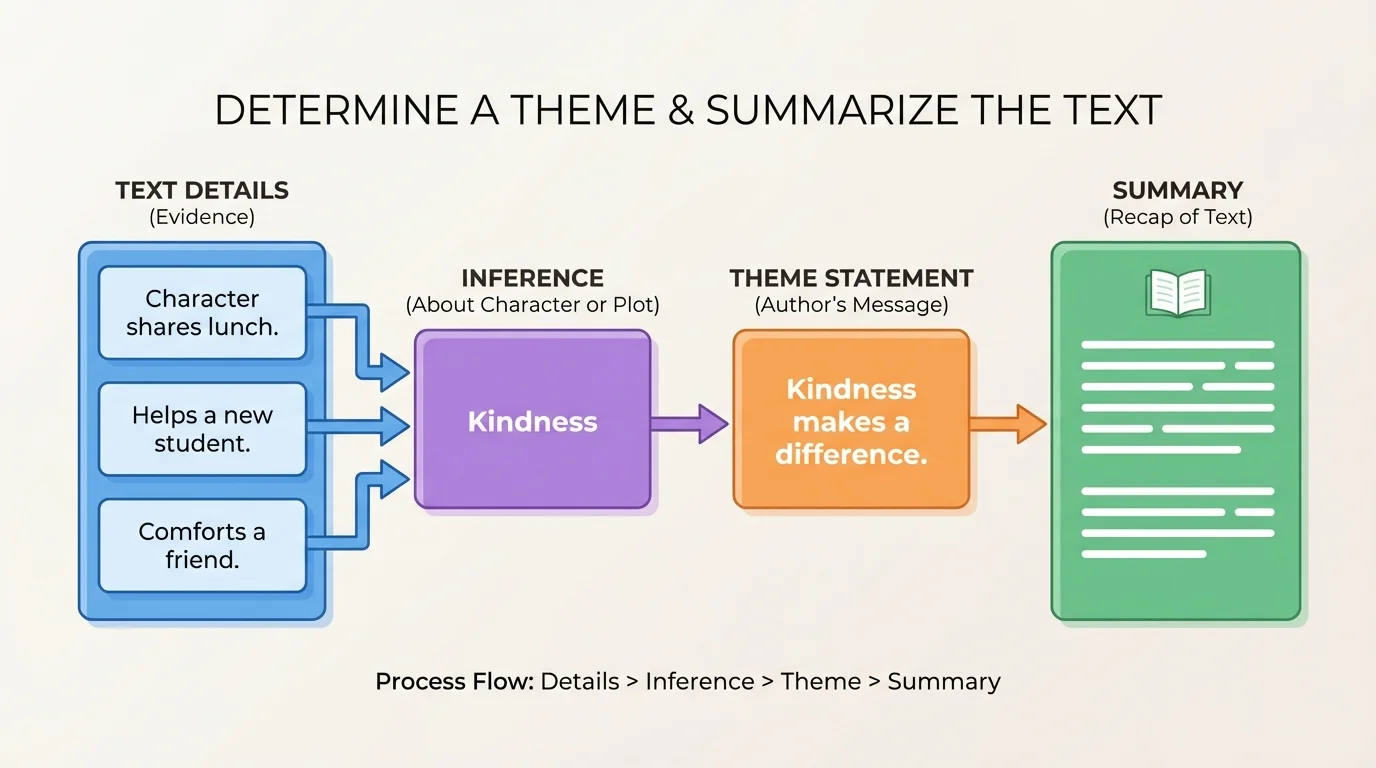
Writers usually do not say the theme directly. Instead, they give readers clues. Those clues include what characters say, what they do, what problems they face, and how the text ends. In this way, readers make an inference, or a reasoned conclusion, from the evidence in the text, and [Figure 2] illustrates how small details can lead to a big idea.
Look closely at the characters. Do they change? Do they learn something? If a selfish character learns to share, the theme may connect to generosity or caring for others. If a frightened character speaks up to protect a friend, the theme may connect to bravery or loyalty.
Look at the conflict, which is the problem in the text. Ask what the problem teaches. Also watch for repeated details. If a poem keeps returning to images of light after darkness, the poet may be showing that hope can remain during hard times. Repetition matters because writers often repeat details to point readers toward an important idea.
Endings are important too. The ending often helps reveal the theme. If the ending shows characters solving a problem together, the theme may be about teamwork. If the ending shows that lying caused a larger problem, the theme may be about honesty.
When you name a theme, you need evidence from the text. That means you should be able to point to details that support your thinking. A strong answer sounds like this: "The theme is that patience can lead to success because the character keeps practicing, does not give up, and finally reaches the goal."
A story usually shows theme through characters, events, setting, and plot. A drama, which is a text written to be performed, often reveals theme through dialogue and stage action. A poem may reveal theme through word choice, images, rhythm, and repeated lines.
In a story, you might follow a character from the beginning of a problem to the end. That journey can reveal a lesson. In a drama, you may need to pay close attention to what the characters say to each other. Their words can show feelings, choices, and changes. In a poem, there may not be a full plot, but images and repeated ideas can still build a message.
For example, suppose a poem describes a tiny seed pushing through cold soil toward the sun. The poem may not say, "Never give up." But the image of the seed continuing to grow can suggest a theme of perseverance. The message comes from the details.
Different texts, same skill
No matter what kind of literary text you read, the process is similar: notice important details, think about what those details show, and turn that thinking into a message or lesson. Stories, dramas, and poems may look different on the page, but all of them can communicate theme.
That is why readers need to ask, "What do these details add up to?" Theme is built from evidence, not guessing.
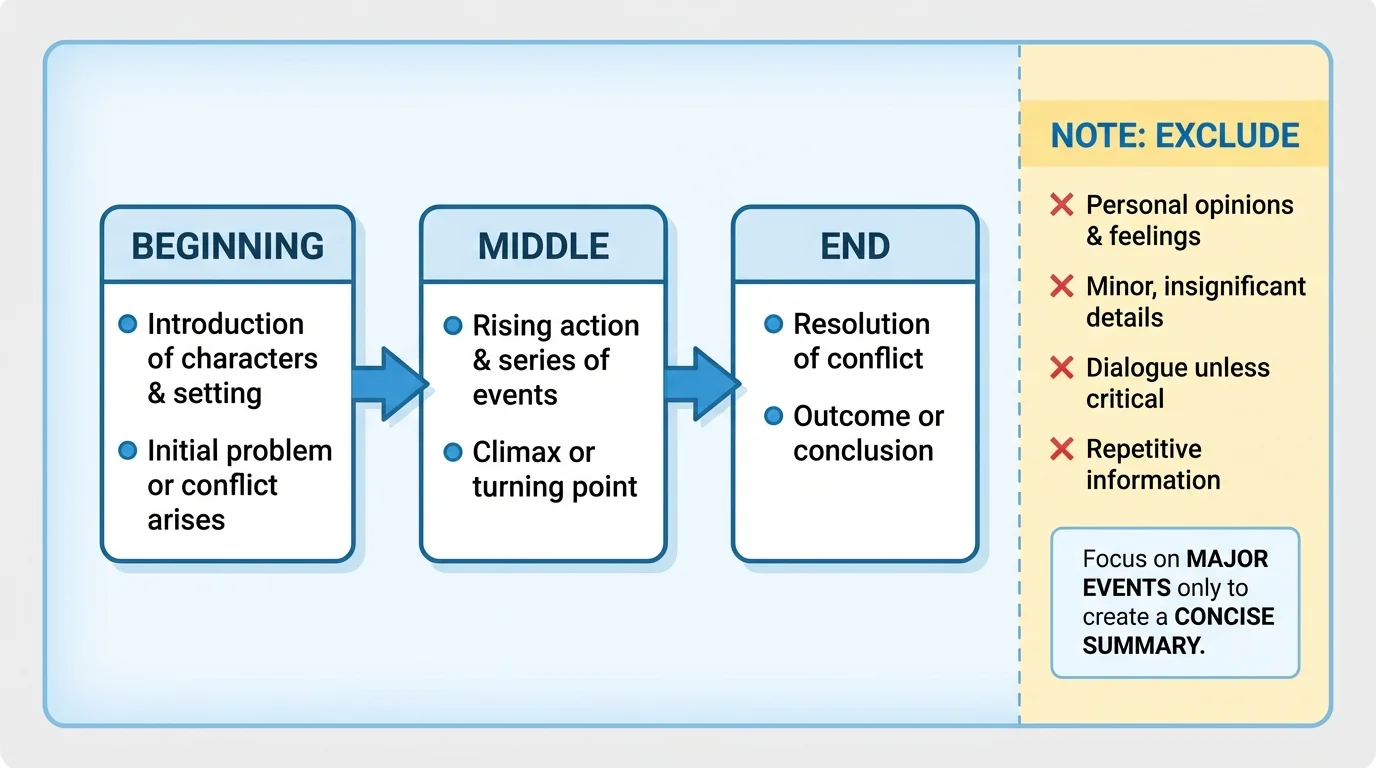
A good summary is like a short path through the text from beginning to end, as [Figure 3] shows. It includes the most important characters, events, or ideas, but leaves out extra details. A summary is short, clear, and accurate.
When you summarize a story, include the beginning, middle, and end. Tell who the main character is, what the main problem is, what important events happen, and how the problem is solved. When you summarize a drama, include the main conflict and key actions in the scenes. When you summarize a poem, include the main idea, important images, and how the poet develops the feeling or message.
A summary should not include every detail. It should not retell every conversation or name every small action. It should also not include your opinion. A sentence like "I loved the ending" does not belong in a summary because it is a personal reaction, not part of the text itself.
A strong summary uses your own words. You can look back at the text for help, but do not copy large parts of it. The goal is to show that you understand the important parts well enough to explain them clearly.
Later, when you decide on the theme, that short summary can help you. It reminds you of the important actions and changes in the text. Just as [Figure 3] organizes the beginning, middle, and end, your thinking about theme can grow from the most important parts of the summary.
You can use a simple process each time you read literature.
Step 1: Read carefully and notice the important details. Look for the main character or speaker, the setting, the problem, and key events or images.
Step 2: Ask what changes or lessons appear. Does the character learn something? Does the poem repeat an idea? Does the drama show a problem being solved in a meaningful way?
Step 3: Think about the topic. Is the text about friendship, courage, fairness, nature, or another big subject?
Step 4: Turn the topic into a message. Use a full sentence. For example, change "teamwork" into "Working together helps people solve problems they could not solve alone."
Step 5: Create a summary using only the most important details. Focus on the big events or ideas, not every little part.
These steps work well together. The same details that help you write a summary can also help you infer the theme. In fact, the evidence trail in [Figure 2] matches the way good readers move from details to message.
Now look at how this works in different texts.
Example 1: Story
A girl named Lila wants to ride her bike down a steep hill, but she is scared. Her older brother offers to help her practice on smaller hills first. Lila falls once, gets back up, and keeps trying. At the end, she rides down the big hill by herself.
Step 1: Find the important details.
Lila is afraid, she practices, she does not give up, and she succeeds in the end.
Step 2: Think about the lesson.
The story shows that courage grows through practice and persistence.
Step 3: State a theme.
The theme could be: People can overcome fear by practicing and not giving up.
Step 4: Write a summary.
Lila is afraid to ride down a steep hill, so her brother helps her practice on smaller hills. Even after she falls, she keeps trying. In the end, she rides down the big hill on her own.
Notice that the summary includes the major events, but the theme explains the message behind those events.
Example 2: Drama
In a short play, two classmates are supposed to build a model bridge. At first, each wants to be the leader, so they argue and waste time. Then they decide to divide the work, listen to each other's ideas, and fix mistakes together. Their bridge is finished just in time.
Step 1: Find the important details.
The characters argue, then cooperate, and finally succeed.
Step 2: Think about the message.
The play shows that listening and teamwork lead to better results.
Step 3: State a theme.
The theme could be: Working together helps people solve problems more successfully.
Step 4: Write a summary.
Two classmates argue over how to build a model bridge and lose time. They finally decide to work together and share ideas. Because they cooperate, they finish the bridge before the deadline.
The drama example shows how dialogue and action can reveal theme. The conflict and the solution matter most.
Example 3: Poem
A poem describes a candle glowing in a dark room during a storm. The wind rattles the windows, but the candle keeps burning. In the last lines, the speaker says the small light is enough to guide the way.
Step 1: Notice the repeated image.
The candle keeps shining even though the storm is strong.
Step 2: Think about what the image suggests.
The candle may stand for hope in difficult times.
Step 3: State a theme.
The theme could be: Even a small amount of hope can help during hard times.
Step 4: Write a summary.
The poem describes a candle burning in a dark room during a storm. Although the weather outside is harsh, the candle continues to glow. The speaker explains that the light is enough to guide the way.
Here the poem may not have a full plot like a story, but the image of light in darkness still creates meaning. This is why poetic details matter so much.
One common mistake is giving a topic instead of a theme. If you say only "friendship," you have named the subject, not the message. Use a full idea instead. Figure out what the text says about friendship.
Another mistake is choosing a theme with no evidence. A theme should grow from the text. If the details do not support your idea, choose a different one. The topic-and-theme comparison in [Figure 1] reminds us that a theme must be a full message, not just a single word.
Students also sometimes make summaries too long. They may include tiny details that do not matter to the whole text. A summary should stay focused on the main parts. If a detail does not change the main events or ideas, it may not belong.
Another mistake is adding opinions to the summary. A summary is not a review. Save your personal thoughts for discussion or writing about your reaction, but keep the summary centered on the text itself.
When you read carefully, details begin to connect. A character's choices, a problem's solution, or a repeated image in a poem can lead you toward a message about life. That message is the theme. Then, when you explain the text briefly in your own words, you create a summary.
These skills make reading stronger and deeper. They help you understand not only what a text says, but also why it matters. Whether you read a folktale, a scene from a play, or a poem full of strong images, you can look for the important details, build a clear summary, and decide what message the text shares.
Remember that good readers always support their thinking with evidence from the text. If you can point to actions, words, and important images, your theme idea will be stronger.
As you keep reading, you will notice that many texts speak to the same big ideas in different ways. One writer may use a brave child, another may use a stormy setting, and another may use a bird, a candle, or a seed. Different details can still lead to powerful themes.
