Have you ever noticed that some writing marches across the page in neat paragraphs, some dances in short lines, and some looks almost like a script actors would read on a stage? Writers do not choose these shapes by accident. The way a text is structured helps create meaning. A mystery story in paragraphs feels different from a poem about the same mystery, and both feel different from a play where characters speak the lines out loud.
Authors make choices about structure, or how writing is organized. Structure helps readers know how to read a piece of writing. If you open a novel, you expect paragraphs. If you open a poem, you may see short lines and repeated sounds. If you open a play, you will probably see character names and dialogue. Learning these differences helps you become a stronger reader because you notice not only what a text says, but also how it says it.
When readers talk about literature, they should use exact words. Instead of saying, "It looked different," you can say, "The poem uses short lines and rhythm," or "The drama uses dialogue and stage directions." These details make your thinking clearer and stronger.
Prose is writing that is organized into sentences and paragraphs. Poetry is writing that often uses lines, stanzas, rhythm, and carefully chosen words to create strong feelings or images. Drama is writing meant to be performed by actors, so it usually includes characters, dialogue, and stage directions.
These three forms can all tell stories, share ideas, or express feelings. The big difference is the way they are built on the page and how readers or performers use them.
Prose is the kind of writing you see most often in stories and informational books. It uses regular sentences that are grouped into paragraphs. Chapters in novels, short stories, biographies, and many articles are written in prose.
Because prose usually follows normal sentence patterns, it often feels like the closest form to everyday speaking and writing. In prose, the author may describe a place, tell what a character is thinking, or explain events in order. Readers move through the text sentence by sentence and paragraph by paragraph.
Here is a short example of prose: Leo opened the back door and stepped into the cold morning. Frost covered the grass, and the birdbath glittered like glass. He pulled his jacket tighter and listened for the first robin. This example is written in complete sentences and arranged like typical narrative writing.
When you talk about prose, you can mention paragraphs, sentences, chapters, description, and narration. Narration means the telling of the story by a narrator.
Many books mix forms. A novel may mostly be prose but include a poem or a letter. A play may begin with a setting description before the dialogue starts.
Prose can be simple or richly detailed. Some prose moves quickly with action. Other prose slows down to help readers picture a setting or understand a character's feelings. Even though prose does not usually depend on line breaks the way poetry does, writers still make careful choices about words, pacing, and description.
Poetry is a form of writing that often uses short lines, repeated sounds, patterns, and vivid language. Poems do not always follow one rule. Some rhyme, and some do not. Some have a steady beat, and some sound more free. What makes poetry special is that poets pay close attention to how words look, sound, and feel.
One important poetry word is verse. Verse can mean writing arranged in lines rather than paragraphs. When a poem is written in verse, the line breaks matter. A poet chooses where one line ends and the next line begins. That choice can create emphasis, surprise, or a special sound.
Another important word is rhythm. Rhythm is the beat or flow of a poem. You can often hear rhythm when a poem is read aloud. Some words are stressed more strongly than others, and this creates a pattern. Rhythm can sound smooth, bouncy, slow, or strong.
A related term is meter. Meter is a regular pattern of stressed and unstressed syllables in a poem. For fourth-grade readers, it is enough to know that meter is a kind of repeated beat pattern. Not every poem has a clear meter, but many do. For example, in a line like The sun was warm upon the hill, your voice may naturally stress certain syllables and create a beat.
Poetry also uses images and feelings in powerful ways. A poet might say, The moon hung like a silver lantern. That comparison helps the reader picture the moon clearly. Because poems are often shorter than prose passages, each word has an important job.
Poems have special parts that readers can name, as [Figure 1] illustrates with labels for lines and groups of lines. Knowing these parts helps you explain your ideas clearly. Instead of saying only "It is a poem," you can say, "The poet uses two stanzas," or "The short lines create a quick rhythm."
A line is one row of words in a poem. A stanza is a group of lines, similar to how a paragraph groups sentences in prose. Some poems have one stanza. Others have many stanzas. A poet may separate stanzas to show a new idea, a new image, or a change in feeling.
Read this short poem example:
Wind on the rooftop,
Tap on the door,
Leaves race together
Over the floor.
In this poem, each row is a line. All four lines together make one stanza. The repeated beat gives it rhythm. The end words door and floor rhyme, which adds sound play.
Sometimes poets repeat words or phrases. Repetition can make a poem easier to remember and can emphasize an important idea. A poet may also choose very short lines to slow readers down or to make each word stand out.
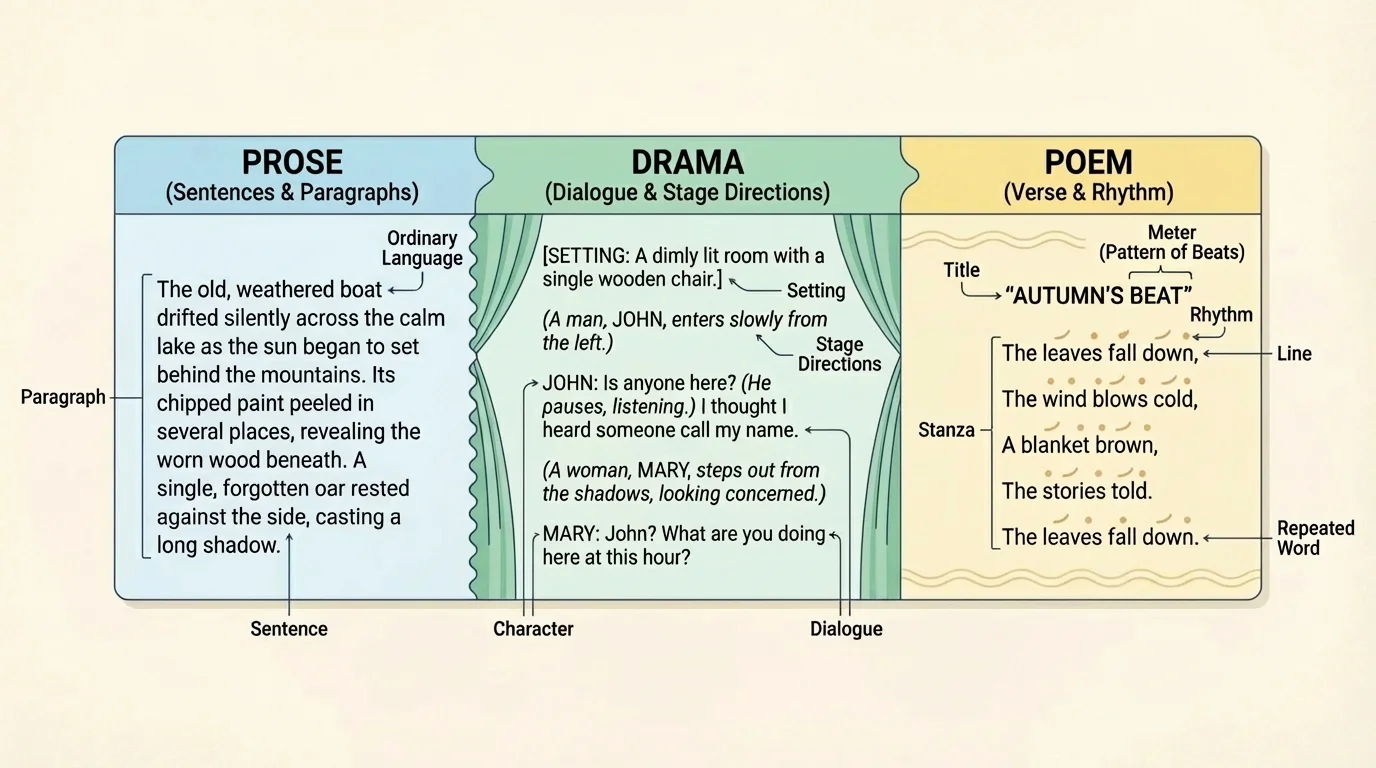
When you write or speak about a poem, mention the parts that matter most. You might say, "The poem's rhythm sounds gentle," or "The final stanza changes from sadness to hope." As seen again in [Figure 1], naming lines and stanzas helps readers point to exact evidence instead of making vague comments.
How poem structure affects meaning
A poem's shape is not just decoration. Short lines can make a poem feel quick or sharp. Longer lines can feel smoother. A repeated rhythm can sound like footsteps, rain, or a heartbeat. A break between stanzas can signal a change in time, place, or mood.
Poetry is often meant to be heard as well as seen. Reading aloud helps readers notice rhythm, rhyme, and meter. That is one reason poem structure matters so much.
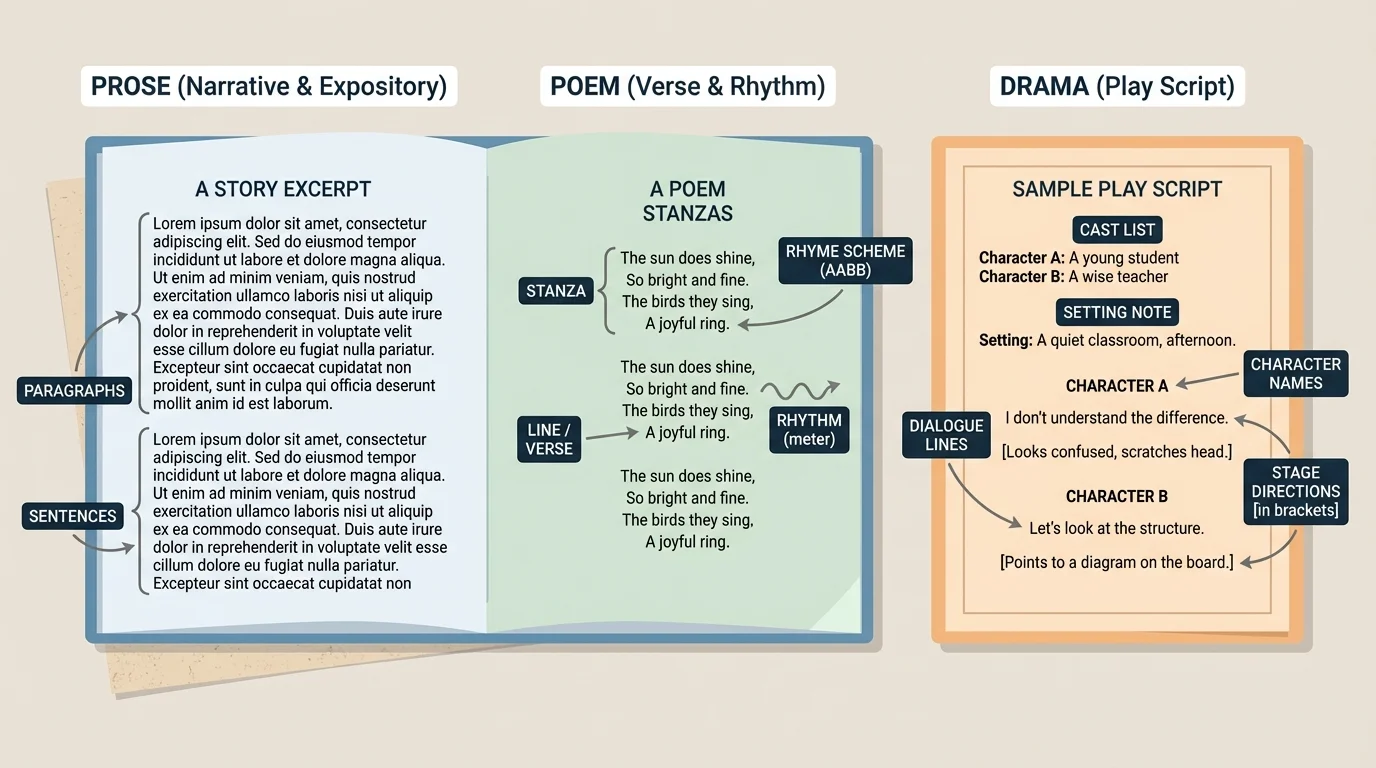
Drama is writing meant to be performed. [Figure 2] shows a script layout with special parts that look different from prose and poetry. When you read drama, you are reading words that actors can speak and actions they can perform.
One important drama part is the cast of characters. This is the list of people in the play. It may appear at the beginning and helps readers know who is in the story.
Another important part is the setting. The setting tells where and when the action happens. In a play, a setting note might say something like A school playground, late afternoon. This helps readers and actors picture the scene.
Drama also uses dialogue, which is the spoken conversation between characters. In a script, each line of dialogue usually begins with a character's name. For example: Maya: Did you hear that sound?
Another special feature is stage directions. These are instructions that tell how characters move, speak, or act. They may appear in parentheses or italics. For example: (Maya steps behind the tree.) Stage directions are not usually spoken aloud. They help performers know what to do.
A drama may also include brief setting descriptions at the beginning of a scene. These descriptions can explain the setting, mood, or important objects on the stage.
Here is a short example of drama:
Characters: Maya, Ben
Setting: A windy park after school
Maya: I think the kite is stuck.
Ben: On that branch?
(Ben shades his eyes and points upward.)
Maya: Yes, and the wind keeps pulling it higher.
This example looks different from prose because it is written for speaking and acting. It looks different from poetry because its main job is not to arrange ideas in lines for rhythm, but to show character speech and action. When you compare forms, this script layout helps you remember that drama includes parts readers can identify quickly on the page.
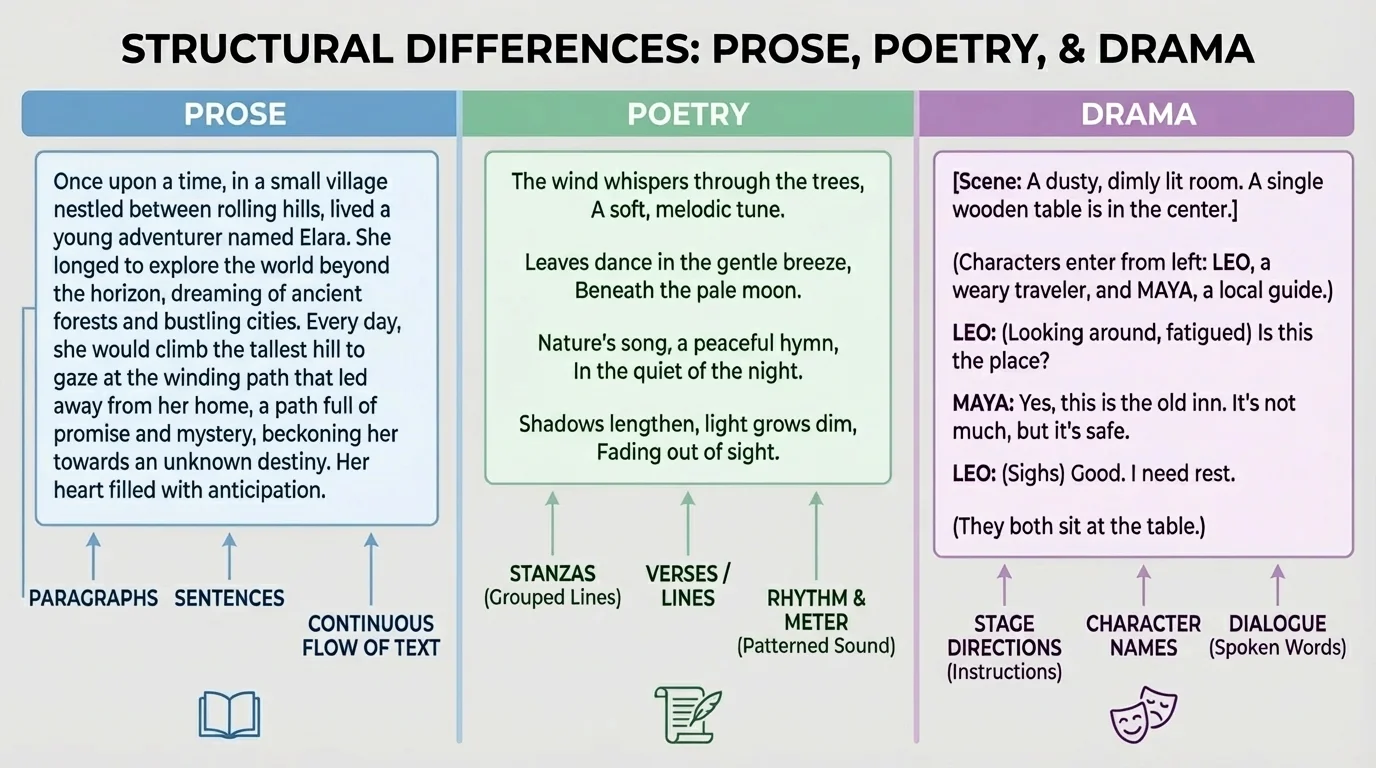
The three forms look different on the page and guide readers in different ways, as [Figure 3] shows in a side-by-side comparison. Learning to notice those differences helps you understand a text more deeply.
| Form | How It Is Structured | Important Elements to Mention | How It Is Often Read |
|---|---|---|---|
| Prose | Sentences and paragraphs | Paragraphs, sentences, chapters, narration, description | Read as regular story or informational writing |
| Poetry | Lines and stanzas | Verse, rhythm, meter, rhyme, repetition, line breaks | Read for sound, feeling, and imagery, often aloud |
| Drama | Script form with speakers | Cast of characters, setting, dialogue, setting descriptions, stage directions | Read as a script and often performed |
Prose usually tells through paragraphs. Poetry often creates meaning through line breaks, rhythm, and carefully packed language. Drama tells through characters speaking and acting. A reader of drama must often imagine what the stage would look like and how the actors would move.
Even when all three forms tell a similar story, they do not feel the same. A rainy day described in prose may give details in full sentences. A rainy day poem may focus on the sound of drops and the mood of gray skies. A rainy day drama may show two characters talking while thunder booms offstage.
Good readers use the right words for the right form. If you are discussing prose, talk about paragraphs, narration, and description. If you are discussing poetry, talk about lines, stanzas, rhythm, and meter. If you are discussing drama, talk about dialogue, setting, cast of characters, and stage directions.
Here are strong ways to speak or write about a text:
Try to avoid weak comments such as "It sounds nice" or "It is interesting" without giving evidence. A stronger comment names the structure and explains its effect: "The repeated rhythm makes the poem sound like falling rain," or "The stage directions show that the character is nervous because she keeps pacing."
Using exact literary language
A student wants to describe three different texts about a storm.
Step 1: Name the form.
Say whether the text is prose, poetry, or drama.
Step 2: Name the structure.
For prose, mention paragraphs. For poetry, mention lines, stanzas, rhythm, or meter. For drama, mention dialogue or stage directions.
Step 3: Explain the effect.
Tell how that structure helps create meaning, mood, or action.
Example response: The poem uses short lines and repetition to make the storm feel fast and loud.
Writers and speakers sound more thoughtful when they point to exact features of a text. This is an important reading skill because structure is part of meaning.
To see the difference clearly, think about one simple idea: a child finds a lost dog.
As prose: Nina heard a soft bark behind the fence. She pushed aside the vines and found a muddy brown dog with a red collar. The dog wagged its tail and licked her hand.
As poetry: Behind the fence
a bark, a shake,
muddy paws,
a tail like a flag.
As drama: Nina: I hear something behind the fence.
(She pulls the vines apart.)
Nina: Oh! A little dog!
Dad: Is there a tag on its collar?
The story idea stays similar, but the structure changes the reading experience. The prose gives a flowing description in sentences. The poem uses line breaks and images. The drama turns the moment into speech and action. Looking back at [Figure 3], you can see why each version feels different before you even read every word.
You already know that authors choose words carefully. Now add one more idea: authors also choose forms carefully. The same subject can be shaped as prose, poetry, or drama depending on the effect the author wants.
This is why structure matters so much in reading. If you know what kind of text you are reading, you know what details to watch for.
When readers pay attention to structure, they understand more. In a poem, noticing rhythm may help you hear the mood. In drama, noticing stage directions may help you understand what characters are doing even when they do not say it directly. In prose, noticing long descriptive paragraphs may help you picture the setting.
Ask yourself questions such as: Is this text built in paragraphs, lines, or dialogue? Does the poem have stanzas? Does the drama include a cast of characters? Does the prose narrator describe thoughts and events in detail? These questions help you gather clues.
Structure is not separate from meaning. It is one of the tools authors use to communicate. A poem's meter may make it memorable. A play's dialogue may reveal conflict quickly. A prose passage may explain events clearly through narration and description.
As you grow as a reader, keep using the names of text features. Those words help you notice, explain, and support your ideas with evidence from what you read.
