Have you ever listened to a classmate explain something, looked at a chart, or heard a teacher read a story aloud and then thought, "I know what that means, but how do I say it in my own words?" That skill is called paraphrasing, and it is one of the best tools for showing that you truly understand information. It helps you in reading, science, social studies, math, class discussions, and even everyday conversations.
When you paraphrase, you do more than repeat words. You show that your brain has taken in the meaning and can explain it clearly. This is important because good listeners do not just hear sounds. They pay attention, think about the message, and then respond in a way that matches what was said.
Paraphrasing also helps you become a better classmate. If a partner shares an idea, paraphrasing lets you check whether you understood correctly. If a teacher reads a paragraph aloud, paraphrasing helps you hold onto the important ideas. If you study a diagram, chart, or set of numerical data, paraphrasing helps you turn what you see into clear language.
Your brain remembers ideas better when you restate them in your own words instead of only hearing them once. That is one reason paraphrasing is such a powerful learning tool.
Paraphrasing is closely connected to listening with care. It also connects to asking strong follow-up questions. When you can restate what you heard, you are in a much better position to ask a useful question like, "Do you mean that the storm started after lunch?" or "Are you saying the wolf was protecting its family?"
A paraphrase is a restatement of information in your own words that keeps the same meaning. The words may change, but the idea should stay accurate.
Paraphrasing is not exactly the same as copying. Copying uses the same words or almost the same words. Paraphrasing changes the wording while keeping the meaning. Paraphrasing is also not exactly the same as a summary. A summary gives only the most important points and is usually shorter. A paraphrase can be about a sentence, a paragraph, a speaker's statement, or a chart, and it often keeps more of the original details.
Paraphrase means to restate information in your own words without changing its meaning.
Summary means a shorter statement that includes only the main ideas.
Main idea is the most important point the speaker, text, or media is communicating.
Here is a simple example. Suppose a teacher reads aloud: "The desert becomes very cold at night because dry air does not hold heat well." A paraphrase could be: "Deserts can get cold after dark since the dry air does not keep warmth for very long." The wording changes, but the meaning stays the same.
Before you can paraphrase well, you need active listening. Active listening means giving full attention to the speaker and thinking about the message, as shown in [Figure 1]. Your eyes, ears, and mind all work together. You notice who is speaking, what the main idea is, and which details matter most.
Strong listeners often do several things: they face the speaker, avoid interrupting, notice important words, and think about what makes the message clear. They also listen for signal words such as first, because, for example, and finally. These words help organize information.
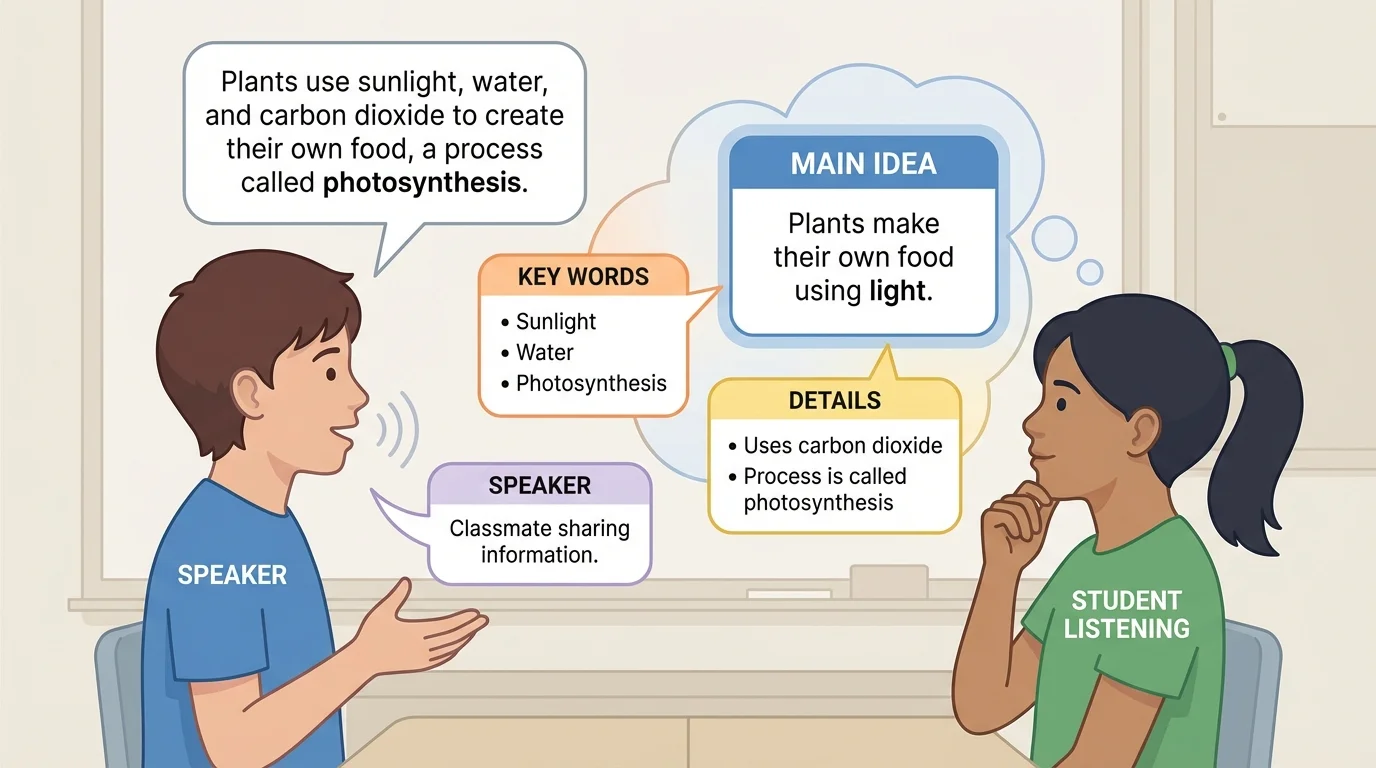
When listening to text read aloud, pay attention to the order of events, the cause and effect, or the problem and solution. For example, if you hear, "The class planted seeds, watered them daily, and soon noticed green shoots," you should notice the sequence. The order matters. A strong paraphrase should keep that order: "The students put seeds in the soil, gave them water every day, and then saw sprouts appear."
Sometimes people listen only for one interesting detail and miss the bigger point. That can lead to a poor paraphrase. If you hear a long explanation about pollution in a river and only remember that fish were mentioned, you may miss the real message. Good paraphrasing begins with hearing both the main idea and the key details.
Good comprehension starts with asking yourself: "What is this mostly about?" and "Which details support that idea?" Those questions make paraphrasing much easier.
Later, when you respond to others in discussion, the listening habits shown in [Figure 1] still matter. If you do not listen actively, your paraphrase may sound clear, but it may not match what the speaker actually meant.
Information does not come only from books. Sometimes it comes through speech, videos, diagrams, photos, charts, maps, or number data. A strong paraphraser can turn ideas from many formats into clear sentences. When students study visual and number-based information, they can learn how a graph can be turned into a sentence in everyday language.
[Figure 2] Oral information comes from what people say. If a classmate explains, "Our group thinks recycling bins should be in every hallway because students use lots of paper," you might paraphrase: "Your group believes more recycling bins would help because students throw away a lot of paper."
Visual information comes from pictures, diagrams, photographs, and illustrations. If a picture shows dark clouds, bending trees, and people running for shelter, a paraphrase might be: "The image shows a strong storm arriving, and people are hurrying to stay safe."
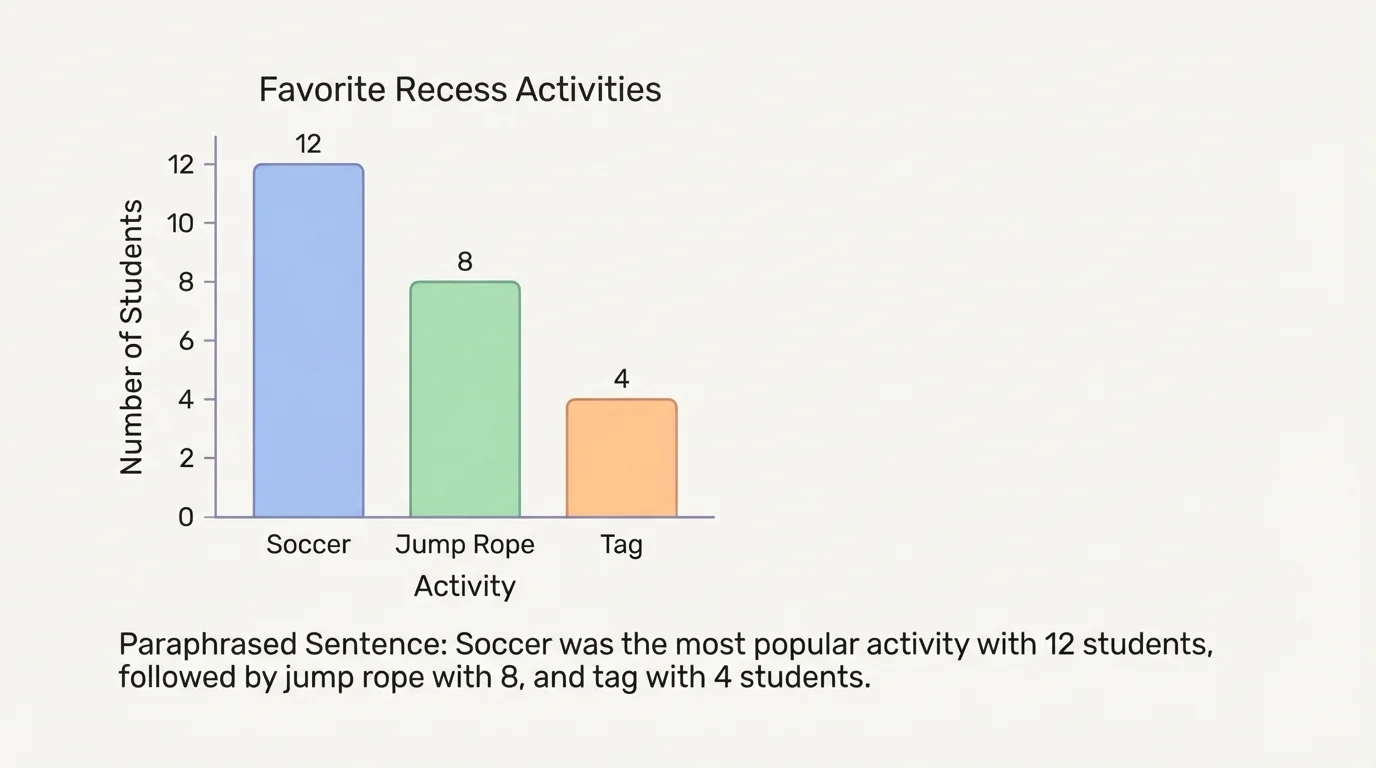
Quantitative information means information shown with numbers, amounts, or measurements. This might appear in a chart or graph. If a bar graph shows that soccer is the most popular recess activity, jump rope is next, and tag is the least chosen, a paraphrase could be: "The graph shows that most students picked soccer, fewer chose jump rope, and the smallest number chose tag."
Read-aloud text is another important format. If you hear a passage rather than read it yourself, you still need to notice key words and meaning. You may not be able to look back at the words, so listening closely is extra important.
A useful way to think about these formats is this: no matter how information arrives, your job is to understand it and explain it clearly. The graph in [Figure 2] uses bars to represent values, but your paraphrase turns those visual clues into words someone else can understand.
| Format | What you notice | Example of a paraphrase |
|---|---|---|
| Speech | Main claim, reasons, examples | "She says the field trip teaches us more because we can observe animals directly." |
| Read-aloud text | Events, ideas, vocabulary, details | "The passage explains that beavers build dams to slow water and make safer homes." |
| Picture or diagram | What is happening, labels, parts, actions | "The diagram shows water evaporating, forming clouds, and falling again as rain." |
| Chart or graph | Most, least, increases, decreases, comparisons | "The chart shows that reading time went up each month." |
Table 1. Different formats of information and how they can be paraphrased.
Paraphrasing and asking questions work together. After you paraphrase, you may realize that one part is still confusing. That is the perfect time to ask a thoughtful question. Thoughtful questions are respectful, clear, and connected to what the speaker or source said.
For example, if a friend says, "Our experiment failed because the water was too cold," you might paraphrase first: "You think the temperature of the water affected the results." Then you could ask, "How do you know the water was the problem and not the amount of yeast?" This question shows that you listened and want to understand more deeply.
How paraphrasing leads to better questions
When students restate information first, they slow down and think about meaning. That makes their questions more accurate and more helpful. Instead of asking random questions, they ask questions tied to the real message.
Here are some strong question starters after listening: "Do you mean...?" "Can you explain why...?" "What evidence shows...?" "What happened next?" "How are these two ideas connected?" These questions help check meaning, gather more detail, and keep discussions respectful.
A weak question might ignore what the speaker actually said. A strong question grows out of the paraphrase. This is one reason careful listening matters so much in conversation, teamwork, and classroom learning.
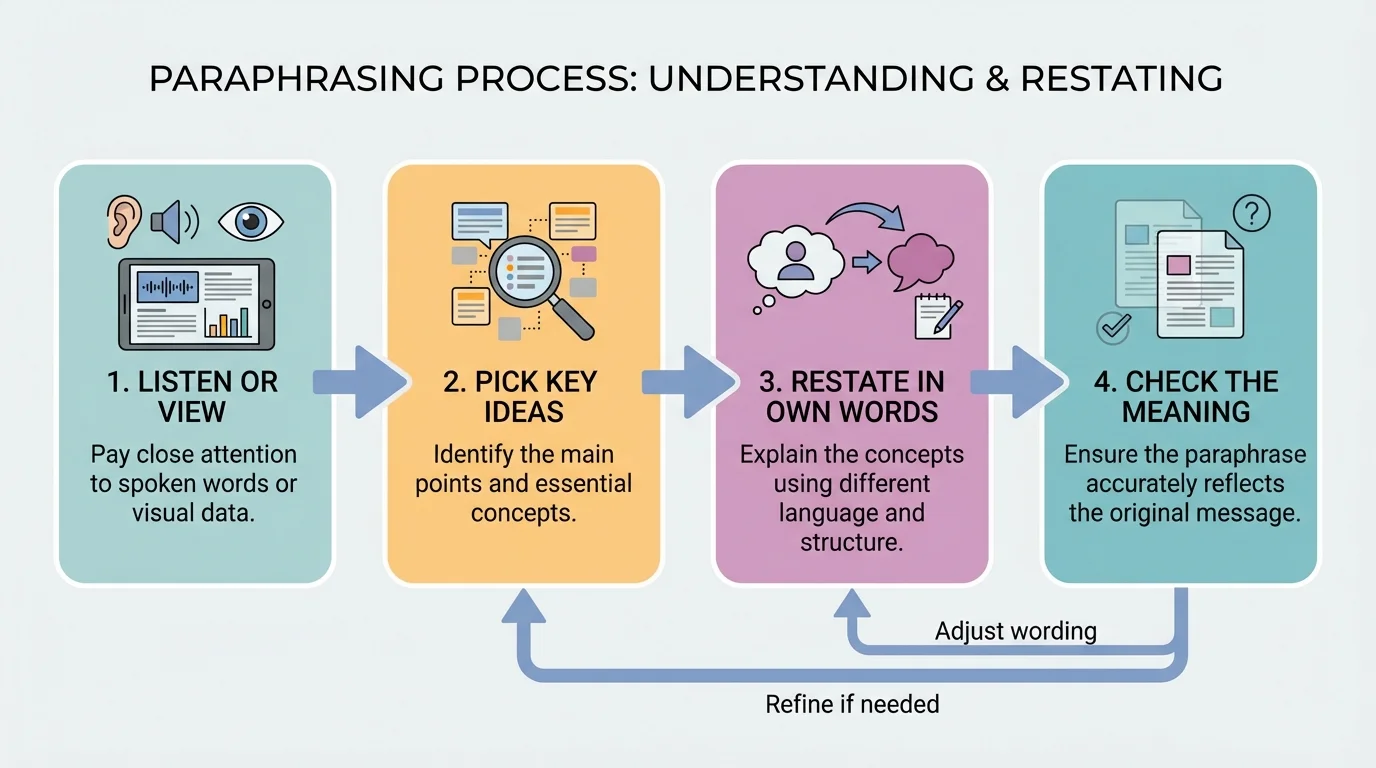
[Figure 3] There is a process you can follow every time. The steps move from understanding to restating. First, listen, watch, or read closely. Next, identify the most important idea and the details that support it. Then restate those ideas in your own words. Finally, check that your new sentence still means the same thing as the original.
This process helps because many weak paraphrases happen when students rush. They may replace one word and think they are done. Real paraphrasing means thinking about the whole message, not just switching a few words.
Example 1: Paraphrasing a sentence read aloud
Original sentence: "Honeybees communicate the location of flowers by performing a waggle dance."
Step 1: Find the key idea.
The key idea is that honeybees show where flowers are by using a special dance.
Step 2: Restate it in new words.
"Honeybees use a waggle dance to tell other bees where to find flowers."
Step 3: Check the meaning.
The new sentence keeps the same meaning. It changes the wording but not the idea.
One helpful strategy is to cover the original words in your mind after hearing or seeing them. Then say the idea naturally, as if you were explaining it to someone younger. If your explanation still matches the original meaning, you likely have a solid paraphrase.
Example 2: Paraphrasing a short explanation from a speaker
Speaker says: "We should leave some logs in the garden because insects and small animals use them as shelter."
Step 1: Listen for the opinion and reason.
The opinion is to leave logs in the garden. The reason is that small creatures use them for protection.
Step 2: Put it into your own words.
"You think the garden should keep a few logs because they provide homes or hiding places for insects and small animals."
Step 3: Check for accuracy.
The idea is still the same. No important reason has been removed.
The flow in [Figure 3] also works when the source is visual. You look closely, identify what matters most, say it in your own words, and then check whether you stayed true to the original message.
A detail can make the difference between a strong paraphrase and a weak one. Strong paraphrases keep the important details that support the idea. Weak paraphrases often make one of three mistakes: they copy too much, leave out something important, or change the meaning.
Suppose the original statement is: "After the heavy rain, the creek overflowed its banks and covered the nearby trail with mud." Here are three responses:
Strong paraphrase: "The big storm caused the creek to spill over, and mud spread onto the trail nearby."
Too close to the original: "After the heavy rain, the creek overflowed its banks and covered the nearby trail with mud."
Changes the meaning: "The creek dried up after the rain and made the trail easy to use."
The first one works because it keeps the meaning while using different wording. The second one is copying. The third one is inaccurate.
Example 3: Paraphrasing a graph correctly
Original information: A chart shows that library visits were highest on Monday, lower on Wednesday, and lowest on Friday.
Step 1: Notice the comparisons.
The chart compares three days and shows the most, fewer, and the fewest visits.
Step 2: Turn the pattern into words.
"More students visited the library on Monday than on the other two days, Wednesday had fewer visits, and Friday had the fewest."
Step 3: Check the pattern.
The paraphrase keeps the same order of comparison shown in the graph.
Sometimes students add opinions that were not in the source. That is another weak habit. If a graph shows that one month had the most rainfall, you should not say it was "the best month" unless the source actually says that. Paraphrasing means restating information, not adding your own judgment.
Paraphrasing is useful in many places. In school, it helps during read-alouds, partner talk, science observations, and social studies discussions. If your teacher reads a paragraph about an explorer's journey, paraphrasing helps you explain the route and purpose in clear language. If your group studies a food web diagram, paraphrasing helps you tell how the animals are connected.
Outside school, paraphrasing matters too. If a coach explains a play, a player may paraphrase it to make sure the team understands. If a family member gives directions, paraphrasing helps avoid mistakes. If you watch a weather report, paraphrasing helps you explain to someone else that a storm is expected later and people should prepare.
Reporters, scientists, doctors, and engineers all need paraphrasing skills. They often take information from spoken explanations, notes, visuals, or data and turn it into clear language for others.
These real-life uses all depend on the same idea: understand first, then restate clearly. Whether you are using conversation, a picture, or a data display, the goal is accurate meaning.
One common mistake is changing only one or two words. That is usually too close to the original. Another mistake is forgetting a key detail, such as a cause, order, or comparison. A third mistake is changing the meaning by adding something that was never said.
A fourth mistake is mixing up paraphrasing and summarizing. If someone says three connected sentences and you turn them into only one tiny sentence with almost no detail, that may be a summary instead of a paraphrase. Both skills are useful, but they are not the same.
Another mistake is not asking for clarification when needed. If you are unsure, it is better to ask a thoughtful question than to guess. Good listeners do not simply guess when they are unsure. They are careful thinkers who check understanding.
Paraphrasing is not just a school skill. It is also a respectful way to communicate. When you paraphrase what someone says, you show that their ideas matter and that you are trying to understand them honestly.
Respectful paraphrasing often sounds like this: "So you are saying...," "I think you mean...," or "In other words...." These sentence starters can help in discussions, but they only work well when they are followed by an accurate restatement.
When a discussion becomes confusing, remember the habits from [Figure 1]: listen closely, notice the main idea, and pay attention to supporting details. Then use the process from [Figure 3] to build your paraphrase, and if anything is still unclear, ask a thoughtful question. That combination makes you a stronger learner, a stronger speaker, and a stronger teammate.
