Even famous authors do not usually write a perfect first draft. They plan, they change their ideas, and they fix mistakes. Strong writing is not magic. It is a process. When writers get help from classmates, teachers, or family members, their writing can become clearer, stronger, and more interesting.
Writing is a little like building a treehouse. You do not begin by hanging decorations. First, you make a plan. Next, you build and adjust the structure. Last, you tighten the boards and smooth the rough spots. Writers do something similar. They plan, revise, and edit. Each step has an important job.
Planning means getting ready to write by thinking about your topic, purpose, and ideas.
Revising means improving the writing by changing ideas, adding details, removing parts, or making meaning clearer.
Editing means correcting grammar, spelling, punctuation, capitalization, and usage so the writing follows standard English rules.
When writers use these steps, their words are easier for readers to understand. That matters in school, but it also matters in real life. Clear writing helps when you explain game rules, tell a true story, write instructions, send a message, or share an opinion.
A writer does not usually do everything at once. First comes the big thinking: What am I writing about? Why am I writing it? Who will read it? Then comes drafting. After that, the writer looks again and improves the piece. Finally, the writer checks the writing carefully for mistakes.
This process works best when writers have support. A classmate may notice that a part is confusing. A teacher may suggest adding an example. An adult at home may help spot a missing capital letter or an awkward sentence. Support does not mean someone else does the writing. It means the writer gets helpful guidance and stays in charge of the piece.
Good writers also understand that changing writing is normal. If you cross out words, move sentences, or start over with a better idea, that is not failure. That is how writing grows stronger.
Many books you see on library shelves were revised many times before they were published. Writers often keep changing their work until the meaning is just right.
It helps to remember that writing has two kinds of improvement. One kind is about the ideas themselves. The other kind is about the rules that make the writing correct and clear. Writers need both.
[Figure 1] Before a writer begins drafting, it helps to organize thoughts. A graphic organizer can help a writer sort ideas clearly. Some writers make a list. Some draw boxes and arrows. Some jot down key words for the beginning, middle, and end.
Planning starts with a purpose. The purpose is the reason for the writing. A writer may want to tell a story, explain a topic, give directions, or share an opinion. Planning also includes thinking about the audience, which means the people who will read the writing. If you are writing for younger students, you may use simpler words. If you are writing to classmates, you may include details they will understand.
Next, writers gather ideas. Suppose the topic is recess. A writer might brainstorm: soccer game, teamwork, funny moment, scraped knee, best friend, sunny weather. After brainstorming, the writer chooses the best details and puts them in order.
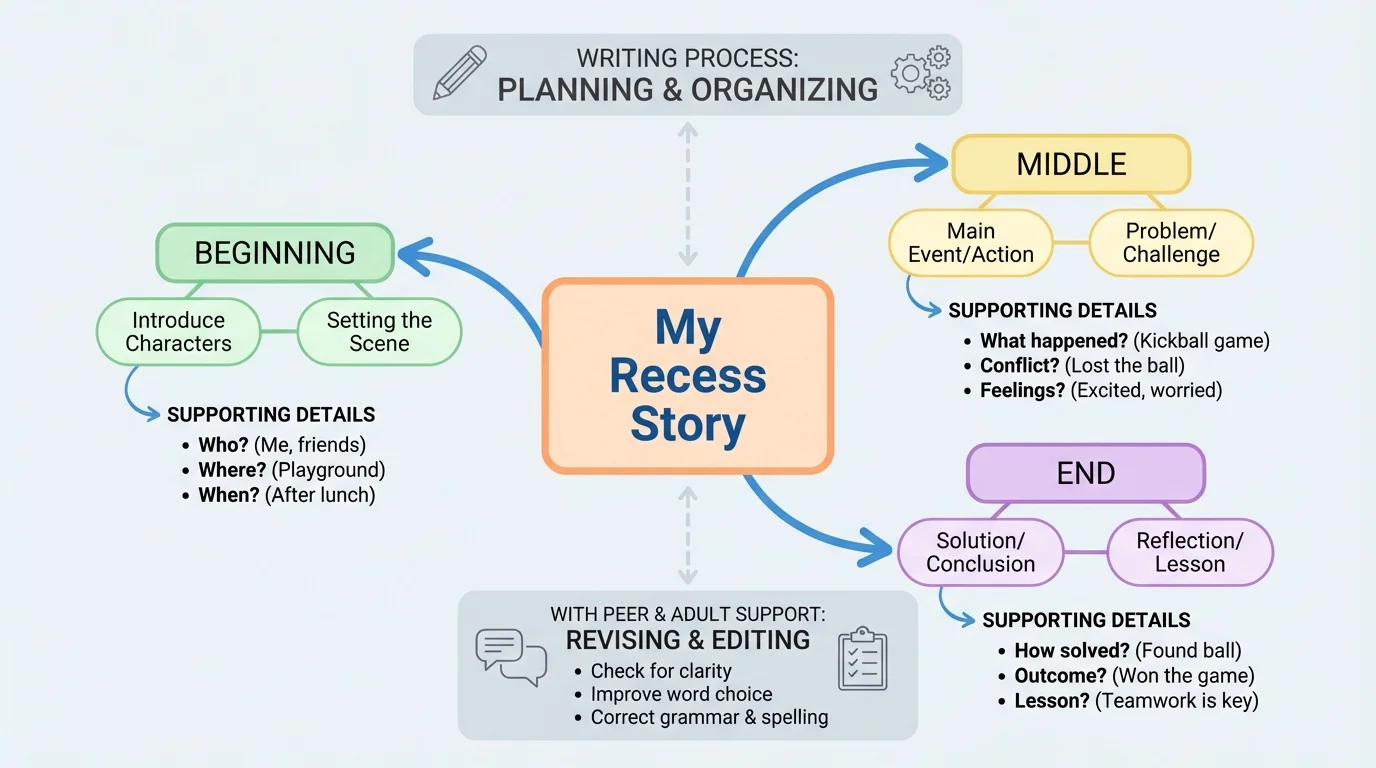
A plan does not need to be long. It can be as simple as three parts: beginning, middle, and end. For an informational paragraph, the plan might be main idea plus three supporting details. For an opinion piece, the plan might be opinion, reasons, and ending.
Planning saves time later. When your ideas are organized first, the draft is easier to write. Writers who skip planning sometimes get stuck, repeat themselves, or forget important details.
Why planning matters
Planning helps a writer keep the topic focused. It also helps the writer decide what belongs in the piece and what does not. A strong plan is like a map. It does not write the paragraph for you, but it helps you know where you are going.
Later, when a writer revises, that early plan can still help. If the paragraph suddenly jumps to a new idea, the writer can compare it to the plan and see what needs to change.
After planning comes the draft. A draft is the first version of writing. During drafting, the main job is to get ideas down. Writers should try to use complete sentences and stay on topic, but the draft does not have to be perfect.
Some students stop too often while drafting because they worry about every spelling word. That can interrupt thinking. It is often better to keep writing and come back later to fix small mistakes. Drafting is about building the piece. Editing comes later.
Writers often read their drafts silently to themselves. This helps them notice if a sentence sounds strange or if a part does not make sense. Reading aloud can uncover missing words, repeated ideas, and confusing parts.
A strong draft includes enough information for a reader to understand. If the sentence says, "We had fun at the park," the reader still wonders: What made it fun? What happened? Adding details during drafting or revising will make the writing more interesting and clearer.
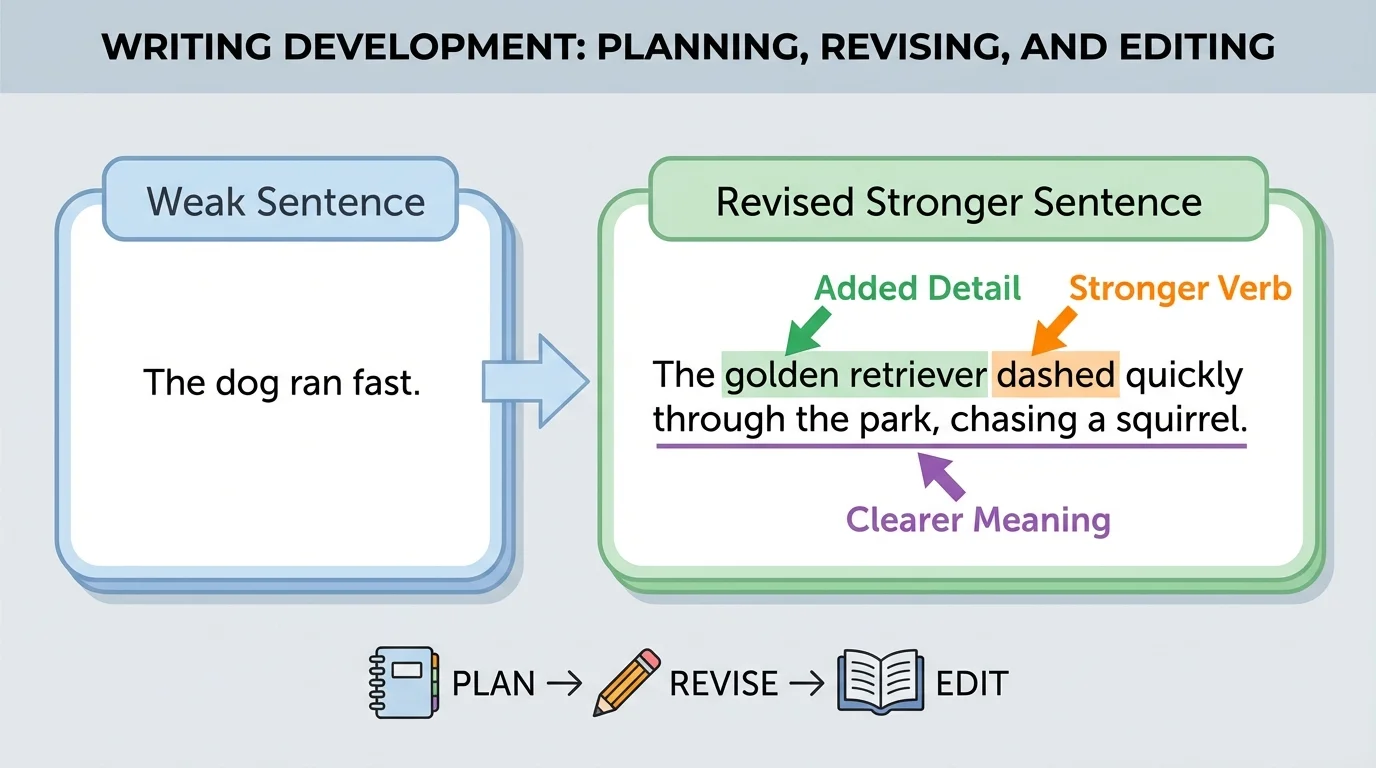
[Figure 2] Revision is where writers improve meaning. It is not just fixing errors. It is changing the writing so it communicates the message more clearly. Revising may mean adding examples, taking out repeated words, moving sentences into a better order, or choosing more exact words.
Think about this sentence: "The dog was nice." A writer might revise it to say, "The golden dog wagged its tail and licked my hand." The new sentence gives a clearer picture. It helps the reader understand why the dog seemed nice.
Writers revise when they ask questions such as these: Does this part make sense? Did I explain enough? Is my beginning interesting? Do my ideas stay on the same topic? Are my words specific? Can I combine short choppy sentences into a smoother one?
Revising can also mean removing extra parts. Sometimes writers add details that do not fit. Suppose a paragraph is about planting beans in science class, but two sentences suddenly describe a birthday party. Those sentences may be fun, but they do not belong there. Revising helps writing stay focused.
Another useful revision move is changing the order of ideas. If a story starts with the ending, then jumps back with no clue, readers may become confused. Writers can move sentences or paragraphs so events happen in an order that makes sense.
Revision example
Original sentence: "My trip was good."
Step 1: Ask what the reader wants to know.
Where did you go? What happened? Why was it good?
Step 2: Add specific details.
"My trip to the lake was exciting because I caught my first fish and saw a bald eagle."
Step 3: Check for stronger word choice.
The word exciting tells more than the word good.
The revised sentence gives the reader a clearer picture and stronger meaning.
Peer and adult feedback matters a lot during revision. A classmate might say, "I do not understand who 'she' is in this sentence." That tells the writer to be clearer. A teacher might say, "Add one more fact to support your opinion." That guidance helps the writer strengthen the piece without taking over.
Later, when you compare new sentences to old ones, the changes in [Figure 2] remind you that revision is about clarity and detail, not just neatness.
[Figure 3] After revising ideas, writers begin editing. Editing checks the rules of standard English so the reader can follow the writing easily. Editing looks at grammar, usage, capitalization, punctuation, and spelling.
Grammar is how words work together in sentences. Usage means choosing the correct form of words in standard English. For example, "We was playing" is not correct standard English. "We were playing" is correct. Editing helps writers choose the form that sounds right and follows the rules.
Writers also check sentence completeness. A complete sentence has a subject and a predicate. "The excited puppy" is a fragment because it does not tell what happened. "The excited puppy ran across the yard" is complete.
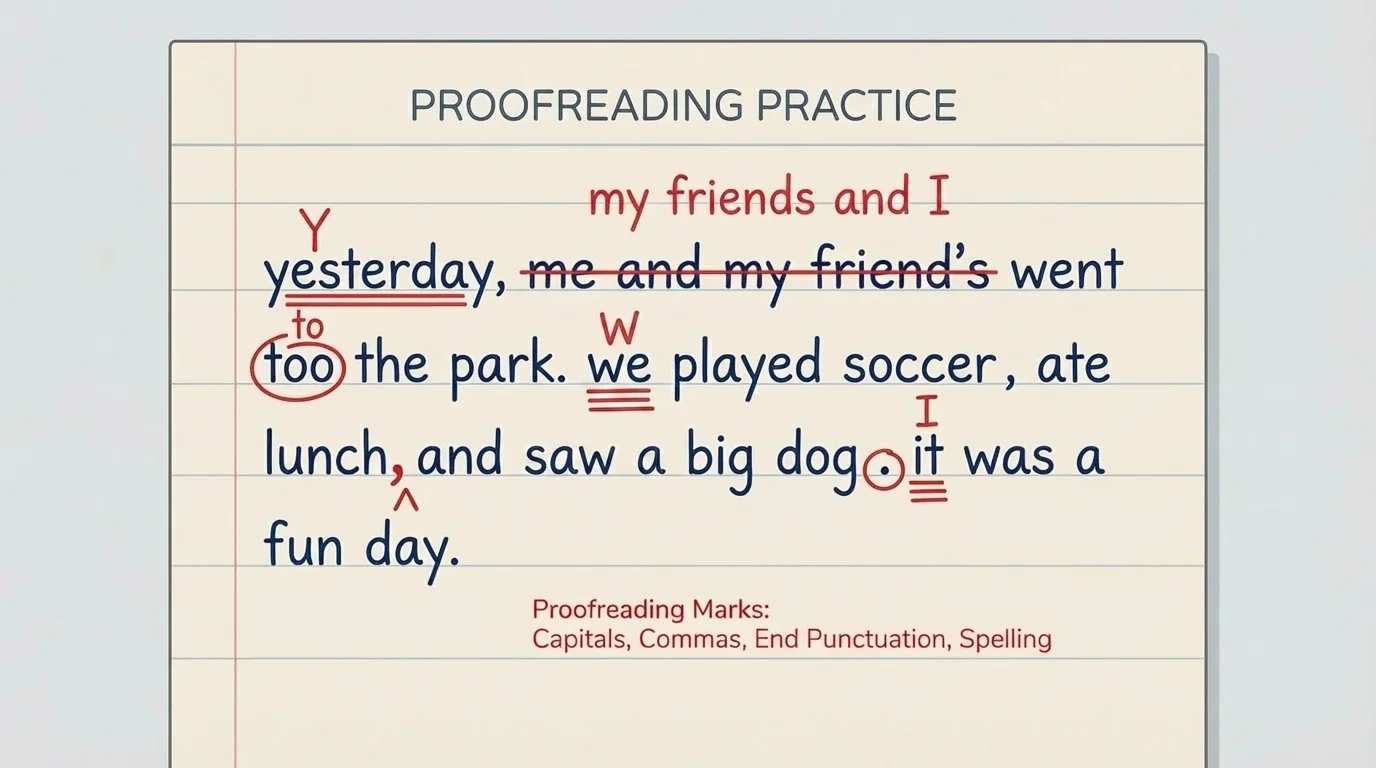
Capitalization matters too. Writers use capital letters at the beginning of sentences, for the word I, and for proper nouns such as names of people, places, days, and months. Punctuation also guides readers. A period ends a statement. A question mark ends a question. A comma can separate items in a series, such as "markers, paper, glue, and tape."
Spelling helps readers trust and understand the writing. If many words are misspelled, the reader may slow down or misunderstand the meaning. Writers can use word walls, dictionaries, classroom charts, or digital tools to check uncertain words.
| Editing Check | What to Look For | Example |
|---|---|---|
| Capitalization | Beginning of sentences and proper nouns | "monday" becomes "Monday" |
| Punctuation | End marks and commas | "What time is it" becomes "What time is it?" |
| Grammar | Words working correctly together | "He go" becomes "He goes" |
| Usage | Correct word form | "Them apples" becomes "Those apples" |
| Spelling | Words written correctly | "frend" becomes "friend" |
Table 1. Common editing checks and examples of corrections.
Editing is usually easier when you slow down and look for one kind of mistake at a time. Read once for capitals and punctuation. Read again for spelling. Read a third time for grammar and missing words.
A sentence should express a complete thought. Earlier writing lessons about subjects, predicates, and punctuation help during editing because those skills make writing easier to read.
Much later in the writing process, the corrections seen in [Figure 3] still matter because even a great idea can confuse readers if the grammar or punctuation is incorrect.
Writers grow faster when they learn how to use feedback well. A peer can notice what a writer may miss because the peer reads with fresh eyes. An adult can often explain why a sentence sounds confusing or why a punctuation mark is needed.
Helpful feedback is specific. "It is good" is kind, but it does not tell the writer what works. "Your opening sentence made me want to keep reading" is more useful. "I think you should explain how the volcano erupted" is useful too because it points to a place that needs more detail.
Writers should also ask questions when getting help. They can ask, "Which part is unclear?" "Did I stay on topic?" "Is my ending strong?" These questions help the writer get feedback that can truly improve the piece.
Receiving feedback takes practice. Sometimes a writer feels proud of a sentence and does not want to change it. That feeling is normal. Still, strong writers stay open-minded. They listen, decide what advice helps, and then make thoughtful changes.
"Writing is rewriting."
— A common writer's saying
Giving feedback also requires kindness and respect. A good response might begin with something strong, then offer one clear suggestion. For example: "Your story has a funny ending. Maybe add one sentence to explain why the character was late." That kind of response helps the writer improve without feeling discouraged.
Let us look at how one short piece can change through the writing process. Suppose a student wants to write about helping in the garden.
The plan might say: Topic: helping Grandma in the garden. Main ideas: pulled weeds, planted tomatoes, felt proud. Ending: learned patience and teamwork. This simple plan keeps the topic focused.
From plan to final version
First draft: "I helped my grandma outside. We did work in the garden. It was fun."
Step 1: Revise for details
The writer adds specific actions: "I helped my grandma in her garden by pulling weeds and planting tomato seedlings."
Step 2: Revise for meaning
The writer explains feelings and learning: "At first the work seemed slow, but I felt proud when we finished the rows together."
Step 3: Edit for correctness
The writer checks capitals, punctuation, and spelling so the final version is clear and correct.
Final version: "I helped my grandma in her garden by pulling weeds and planting tomato seedlings. At first the work seemed slow, but I felt proud when we finished the rows together."
Notice what changed. The final version is not simply longer. It is stronger because it gives clear actions, a feeling, and a complete thought. The details help the reader picture the experience.
If a peer reads this piece, the peer might say, "What color were the tomatoes?" or "What did your grandma say?" Those questions could lead to another revision. If a teacher reads it, the teacher may point out a missing comma or suggest a more exact word. This is how guidance helps writing grow.
Planning also still matters here. The final piece stays focused on the garden because the writer began with a clear idea. That is the same lesson shown earlier in [Figure 1], where organized ideas support a stronger draft.
Strong writers build habits over time. They reread their work. They notice when something sounds confusing. They keep trying even when a draft feels messy. They understand that writing improves step by step.
One useful habit is using a checklist. A checklist might include these questions: Did I stay on topic? Did I add enough details? Did I revise confusing parts? Did I check capitals, punctuation, spelling, grammar, and usage? A checklist helps writers remember important steps without rushing.
Another habit is leaving a little time between drafting and editing. When writers return to their work later, they often notice mistakes more easily. Their eyes are fresher, and their thinking is clearer.
Writers also learn to celebrate improvement. Maybe the first draft had only simple sentences, but the revised version includes stronger verbs and better details. Maybe the final copy has cleaner punctuation and fewer spelling mistakes. Those changes show growth.
With guidance and support from peers and adults, every student can become a stronger writer. Good writing is not about getting everything perfect the first time. It is about thinking carefully, making changes, and using the rules of language to make meaning clear.
