A strong researcher is a bit like a detective. If you want to learn why bees matter, how volcanoes form, or what life was like long ago, you do not just grab one fact and stop. You ask a good question, search for helpful information, keep the important parts, and organize what you find so it makes sense. That is how people build knowledge.
Research begins with curiosity. Sometimes you want to know about animals, weather, communities, famous people, or inventions. A good research topic often starts with an open-ended research question. This is a question that cannot be answered with just "yes" or "no." It needs facts, details, and explanation.
For example, "Do bees live outside?" is a very small question. "How do bees help plants and people?" is a bigger question. That bigger question invites you to gather many kinds of information. You might need facts about pollination, food crops, bee habitats, and dangers bees face.
Relevant information is information that helps answer your question. If your question is about how bees help plants, then facts about pollination are relevant. A fact about the fastest fish in the ocean is not relevant because it does not help answer the question.
Good researchers stay focused. They do not collect every fact they see. They choose information that connects clearly to their question.
Before opening a book or a website, start by thinking about your own experiences. Your memories, class discussions, field trips, science observations, and things you have seen in daily life can help you begin. This is called recalling information from experience.
If you are researching weather, you may remember a strong thunderstorm, a snowy day, or a weather map from the news. If you are researching community helpers, you may remember visiting a fire station or seeing road workers repair a street. These memories are useful because they help you connect new learning to something real.
Still, personal experience is only a starting point. Memory can help you ask better questions, but it does not replace research. You may remember seeing bees near flowers, but you still need sources to learn how pollination works and why it matters.
Think about what you already know, what you think you know, and what you still need to find out. This helps you avoid wasting time and gives your research a clear direction.
A smart way to begin is to make a short list with three parts: things I know, things I wonder, and things I need to check. That keeps your mind organized before you start gathering new information.
Your research question guides everything you do. It helps you decide which sources to use, which notes to take, and which facts matter most. A weak question may lead to weak research, but a strong question helps you learn deeply.
Open-ended questions often begin with words like how, why, or what are some ways. Here are examples:
These questions are broad enough to explore, but not so broad that you cannot manage them. "Everything about animals" is too big. "How do penguins stay warm in cold places?" is much clearer.
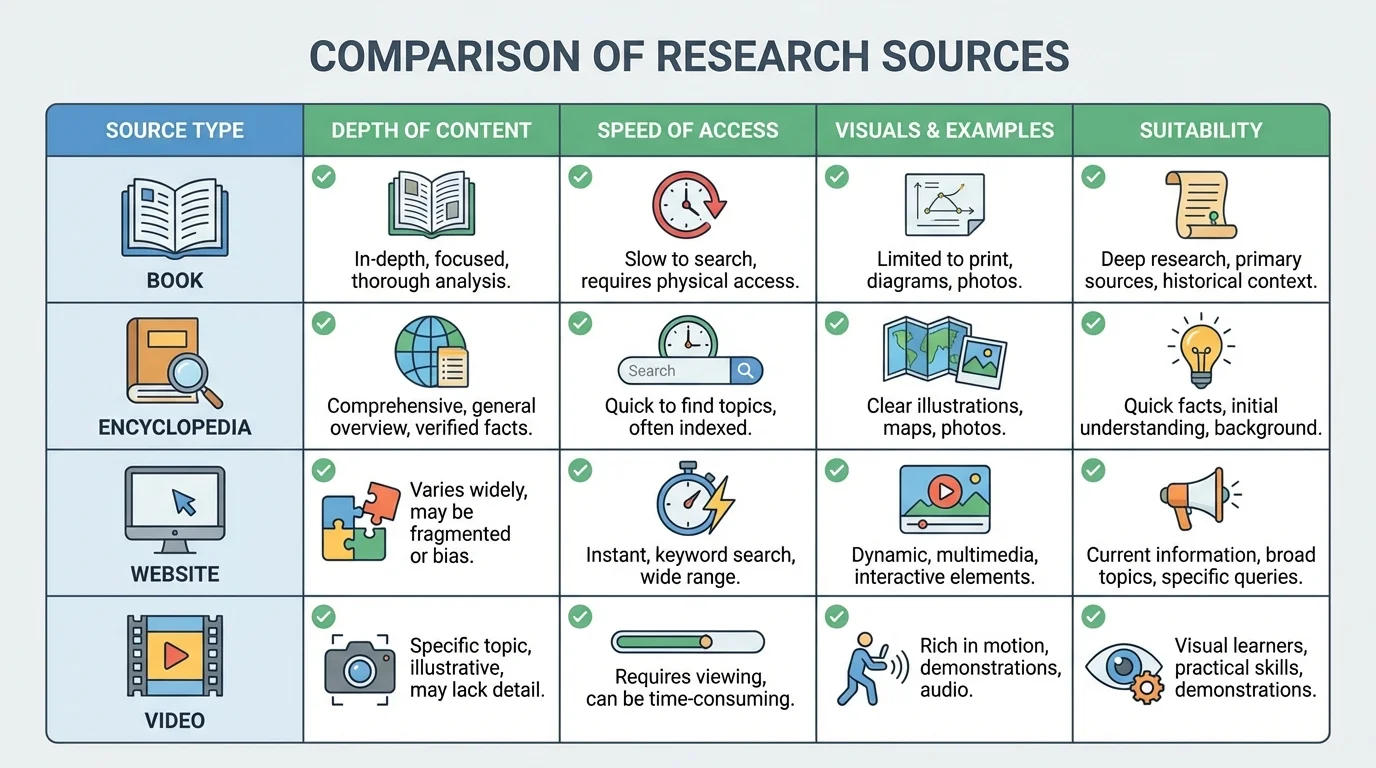
Once you have a question, you need sources. [Figure 1] compares print and digital sources that can help answer different parts of a question. A book may give deep explanations, while a video may help you see a process in action.
Print sources are materials you can hold in your hands, such as books, encyclopedias, newspapers, and magazines. Digital sources are materials you read or view on a computer or tablet, such as websites, online articles, digital encyclopedias, and educational videos.
Both types can be useful. Print sources are often carefully edited and organized. Digital sources can be quick to search and may include videos, sound, or updated information. A strong researcher often uses more than one kind.
Comparing the strengths of different source types can help you decide which one best fits your question.
Not every source is equally helpful. When choosing a source, ask simple questions: Who made this? Is the information clear? Does it match my topic? Does it seem trustworthy? School library books, classroom materials, museum websites, and educational organizations are often strong choices for students.
You should also watch for signs of poor sources. A website with no author, many mistakes, or confusing information may not be reliable. A source might also be off-topic. If you are researching bees, a long article about butterflies may have only one useful sentence.
Some researchers use many kinds of sources on purpose because each one adds something different. A photograph may show what a place looks like, while a book explains its history and a chart gives data.
When you gather information, read with your question in mind. That helps you notice important details and ignore facts that do not fit.
After finding information, the next step is taking notes. Notes are short pieces of information you write down to help you remember and use what you learned. Good notes are not long copies of whole pages. They are quick, clear reminders.
One strong method is to write key words and short phrases. For example, instead of copying a full paragraph about bees, you might write: "Bees move pollen," "help flowers make seeds," and "important for many crops." These notes are easier to reread later.
Another important skill is paraphrase. To paraphrase means to say the idea in your own words. If a source says, "Honeybees are important pollinators for agricultural crops," you might write, "Honeybees help pollinate farm plants." The meaning stays the same, but the wording is yours.
Why note-taking matters
Taking notes helps your brain sort information. It slows you down enough to think about what matters. It also helps you avoid copying too much, because you are choosing ideas instead of grabbing every sentence.
Sometimes a source uses exact words that are especially important. In that case, you may copy a very short part exactly, but you should mark it clearly as an exact quote and record the source. Most of the time, though, your notes should be in your own words.
Useful notes are usually short, organized, and connected to the question. If a note does not help answer the question, it probably does not belong.
Once you have several notes, it is time to categorize them. [Figure 2] shows how sorting notes into clear topic groups can make research easier to understand. Categorizing means sorting information into groups that belong together.
If your topic is bees, your categories might be: body parts, habitat, jobs bees do, how bees help plants, and dangers to bees. Each note goes into the group where it fits best.
You can categorize information in many ways. You might sort by main idea, by time, by place, by cause and effect, or by problem and solution. The best categories depend on your question.
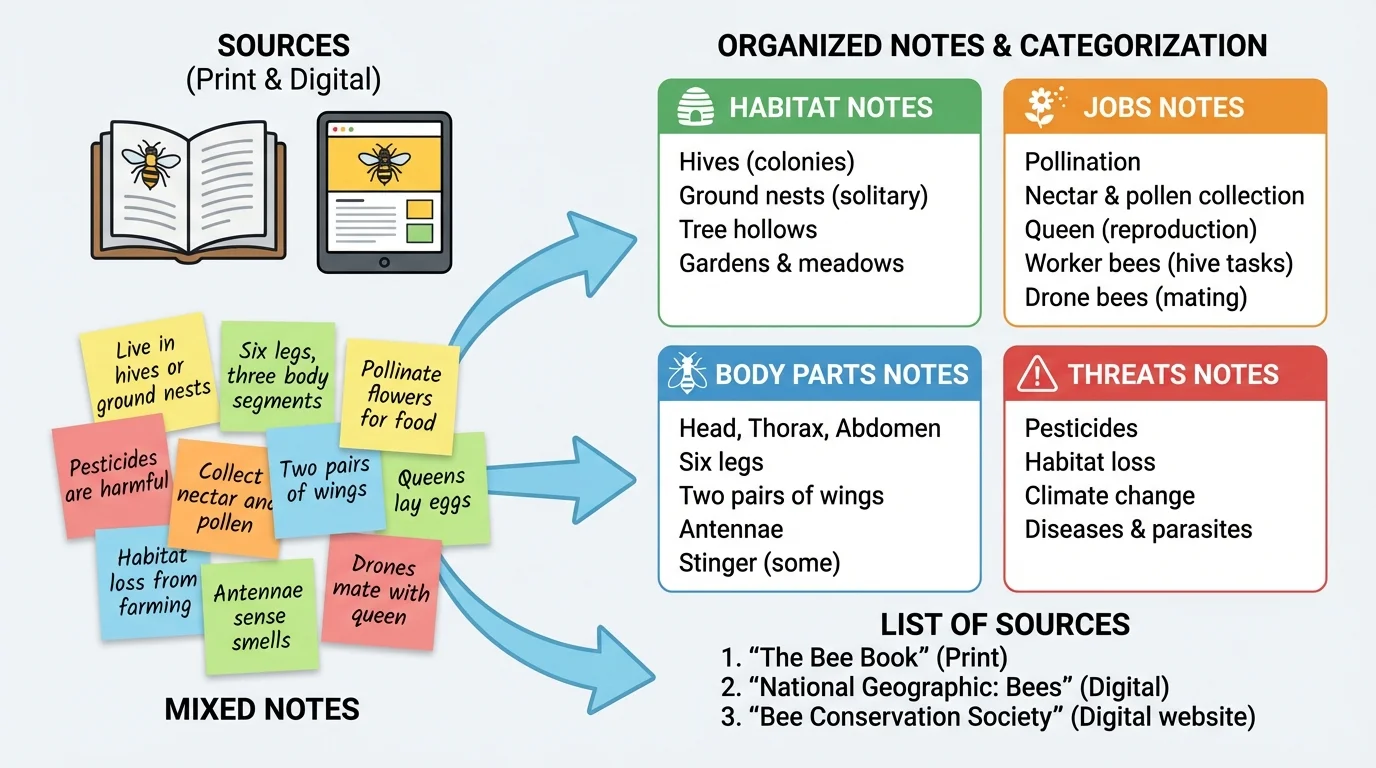
For example, if your question is "How do bees help plants and people?" you might use these categories:
Now your notes are not just a pile of facts. They are arranged in a way that helps you explain your learning clearly. Later, when you write or present, each category can become a section.
Organizing notes into categories also helps you notice gaps. Maybe you have many notes about what bees do, but almost none about the problems they face. That tells you what to research next. Looking back at the grouped notes, you can see how this organization makes missing parts easier to spot.
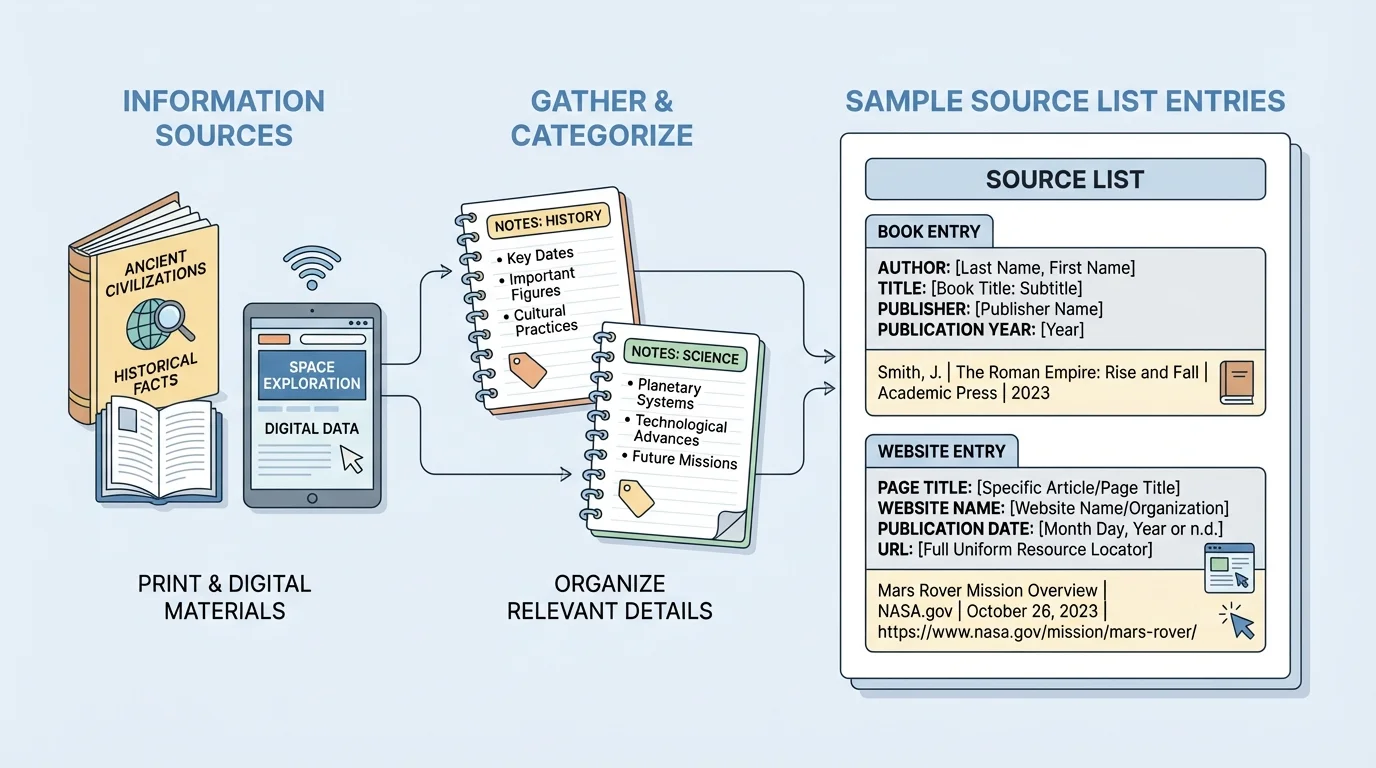
Researchers must show where their information came from. [Figure 3] shows examples of how a simple source list can record the books, articles, or websites that were used. Recording source details right away is important.
If you wait until the end, you may forget the title, author, or website name. That makes your work less complete and harder to check.
For a book, try to record the author, the title, and the publisher. For a website, try to record the title of the page, the website name, the author if listed, and the web address. Some teachers may also ask for the date.
Here is a simple table showing what details are helpful to save.
| Type of source | Helpful details to record |
|---|---|
| Book | Author, title, publisher |
| Encyclopedia article | Article title, encyclopedia title, publisher |
| Website | Page title, website name, author if listed, web address, date if given |
| Video | Title, creator or channel, website name |
Table 1. Helpful details to record for different kinds of research sources.
A source list does two important jobs. First, it gives credit to the people who created the information. Second, it helps others find the same source if they want to learn more. Later, when you reread your work, [Figure 3] reminds you that complete source details save time and prevent confusion.
Simple source list example
A student researching bees might keep a source list like this:
Step 1: Record a book source
Martin Jenkins. The Bee Book. Candlewick Press.
Step 2: Record a website source
"Why Pollinators Matter." National Geographic Kids. kids.nationalgeographic.com
Step 3: Add new sources as you use them
Each time you gather information from a new place, add it to the list right away.
A source list does not need to be fancy to be useful. It needs to be clear and complete enough that someone else can understand where the information came from.
Suppose a student wants to answer this question: "How do bees help plants and people?" First, the student recalls seeing bees near flowers in a garden. That experience suggests a connection between bees and plants.
Next, the student gathers information from a library book, a kid-friendly science website, and a short educational video. While reading and watching, the student writes short notes: "bees carry pollen," "pollination helps seeds grow," "many fruits depend on pollinators," and "bee populations can be harmed by habitat loss."
Then the student categorizes the notes into groups: how bees help flowers, how bees help food growth, and dangers to bees. That organization makes it easier to explain the answer in a clear order.
Research example from question to source list
Step 1: Start with experience
Remember seeing bees on flowers in a garden.
Step 2: Ask the question
How do bees help plants and people?
Step 3: Gather relevant information
Use a book, a website, and a video about pollination and bees.
Step 4: Take notes
Write short phrases in your own words instead of copying full paragraphs.
Step 5: Categorize notes
Sort into groups such as plant help, food help, and threats.
Step 6: Record sources
Keep a list of every book, website, and video used.
This process works for many topics, not just bees. You can use the same steps for history, science, geography, biographies, or local community research.
One common mistake is collecting facts that do not answer the question. Another is copying whole sentences without thinking. A third is forgetting where the information came from.
Smart researchers build good habits. They keep their question nearby, write short notes, use categories, and record source details early. They also reread their notes to make sure each one is relevant.
"Good research is not about finding the most facts. It is about finding the right facts and organizing them well."
Another smart habit is checking more than one source. If two strong sources say similar things, that can make you more confident. If sources disagree, you may need to read more carefully and learn why.
Research is a skill that grows with practice. Each time you recall what you know, gather information carefully, take notes, sort ideas into categories, and list your sources, you become a stronger learner and communicator.
