One small word change can completely change a sentence. Compare these: "Maya said hello," "Maya whispered hello," and "Maya stammered hello." The action is similar, but each sentence gives a different picture. Good readers and writers notice these differences. They learn not just more words, but the right words.
When you choose words carefully, your speaking and writing become clearer, stronger, and more interesting. Precise words help readers understand exactly what happened, how someone felt, or what a topic is about. Instead of using a plain word like "went," you might say someone hurried, strolled, or marched. Each word gives more exact information.
Readers also need strong vocabulary to understand books, articles, and classroom discussions. Many school texts use longer and more challenging words. If you know how words work, you can decode them, figure out their meanings, and use them accurately in your own sentences.
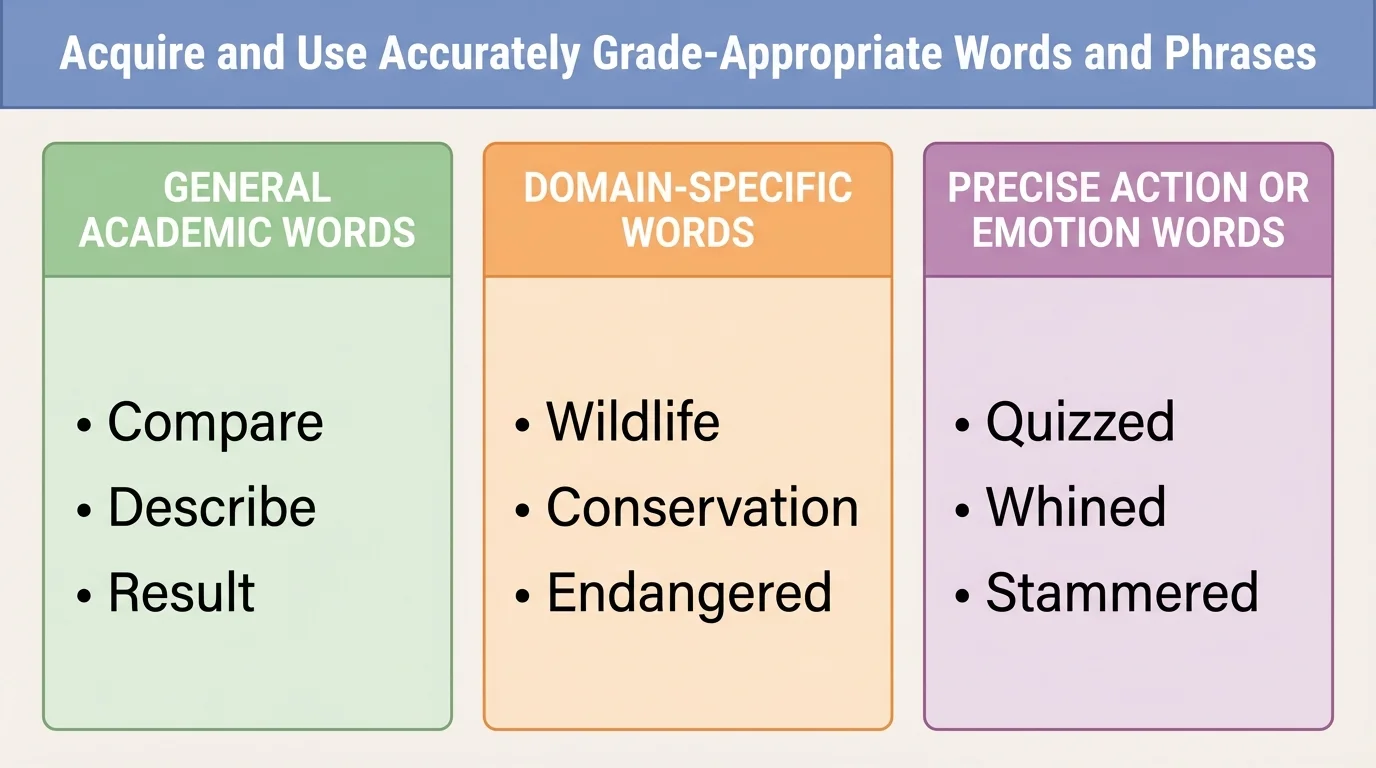
General academic words are words that are useful in many subjects, such as compare, describe, result, and observe.
Domain-specific words are words connected to one topic or subject, such as habitat in science, fraction in math, or citizen in social studies.
Precise words are exact words that give a clear meaning, especially for actions, emotions, and states of being.
Strong vocabulary helps in every subject. In reading, it helps you understand the author. In writing, it helps you explain your ideas. In speaking, it helps you sound clear and thoughtful. In listening, it helps you understand what teachers and classmates mean.
There are three especially useful groups of words, as shown in [Figure 1]: words used across many subjects, words used in one special topic, and words that make actions and feelings more exact. Learning all three groups helps you become a stronger reader and writer.
First, general school language includes words you see again and again in class. A teacher may ask you to compare two stories, describe a character, or explain the result of an event. These words are not tied to only one subject. They work in reading, science, math, and social studies.
Second, some words belong mostly to one topic. In a unit about animals, you may read about wildlife, conservation, and endangered species. In a weather unit, you may learn words like forecast, precipitation, and climate. These words are important because they help you talk accurately about that topic.
Third, some words sharpen meaning by showing exact actions, emotions, or states of being. Instead of "The boy talked," you can write "The boy stammered," "The boy whined," or "The boy quizzed his friend." These verbs tell much more than the word "talked."
When you read, ask yourself, "Is this a word I can use in many classes, or is it a word for this special topic?" That question helps you organize vocabulary in your mind. It also helps you know when a word needs a more exact meaning.
Some of the strongest writers do not always use the longest words. They use the most accurate words. A short word like glared can be more powerful than a longer but less exact word.
Later, when you return to a topic such as animal protection, the category chart in [Figure 1] still helps: compare stays a general academic word, while conservation remains a domain-specific word connected to that science topic.
Sometimes you meet a long word you do not know. Good readers do not stop right away. They use the sentence around the word, and they use word parts to unlock meaning.
Context clues are hints in the words and sentences around an unknown word. Read this sentence: "The turtle is endangered, so people are working hard to protect it from disappearing." Even if you do not know the word endangered, the rest of the sentence suggests that the turtle is in danger and needs protection.
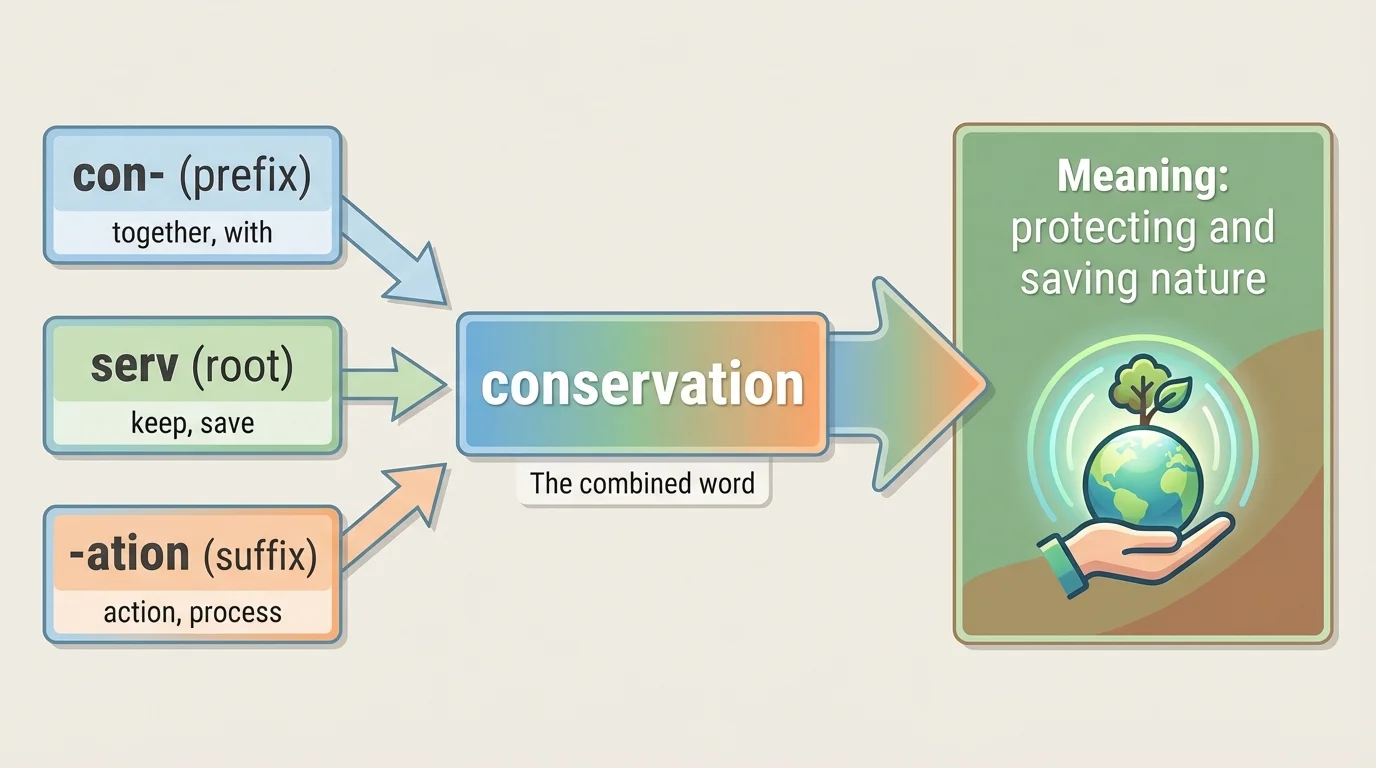
[Figure 2] Word parts help too. Many multisyllable words have a prefix, a root, and a suffix. A prefix comes at the beginning of a word. A suffix comes at the end. The root is the main part that carries the core meaning.
Look at the word conservation. You can notice the root serv, which is related to keeping or saving, and the suffix -ation, which turns it into a noun. So conservation means the act or process of protecting and saving something. In a science unit, that usually means protecting nature, land, water, or animals.
Now look at the word careless. The base word is care. The suffix -less means "without." So careless means "without care" or "not careful." In the word hopeful, the suffix -ful means "full of," so hopeful means "full of hope."
Spelling patterns can also help you read longer words. If you know common syllable patterns, you can break a word into smaller parts. For example, an-i-mal, en-dangered, and con-ser-va-tion become easier to read when you divide them into chunks. This is called decoding multisyllable words.
How morphology helps
Morphology is the study of meaningful parts of words. When you know common prefixes like un-, re-, and dis-, and suffixes like -ful, -less, -tion, and -ment, you can figure out many unfamiliar words. This does not mean you will know every word perfectly, but it gives you a strong clue.
As you continue reading more advanced texts, the word-part strategy from [Figure 2] becomes especially useful because many science and social studies words are long and built from smaller meaningful parts.
Verbs are action words, but they can also reveal emotion and attitude. The words said, muttered, whispered, whined, and shouted all connect to speaking, yet they are not the same. A reader learns more from the specific verb.
Read these examples:
"I forgot my homework," Liam said.
"I forgot my homework," Liam mumbled.
"I forgot my homework," Liam whined.
Each sentence changes how we imagine Liam. The first is plain. The second suggests quiet or unclear speech. The third suggests complaining. That is the power of precise vocabulary.
Words can also describe feelings and states of being more exactly. Instead of saying someone was "sad," you might say the person felt disappointed, lonely, or gloomy. Instead of "happy," you might choose proud, relieved, or cheerful. Exact words help readers understand the situation better.
Improving a plain sentence
Plain sentence: "The girl went to the stage and said her lines."
Step 1: Replace a weak action word.
Instead of went, choose hurried, marched, or tiptoed, depending on the scene.
Step 2: Replace a plain speaking word.
Instead of said, choose announced, whispered, or stammered.
Step 3: Build the stronger sentence.
"The girl hurried to the stage and announced her lines."
The new sentence gives a clearer picture.
Precise words are not always dramatic. They are simply accurate. If someone questions another person to check what that person knows, quizzed may fit. If someone speaks in a shaky, broken way, stammered is better. If someone complains in an annoying tone, whined is the best choice.
School subjects each have their own important vocabulary. These words act like tools. If you know them, you can understand the topic better and explain your thinking more clearly.
In science, a text about animal protection may use words such as habitat, species, wildlife, conservation, and endangered. The sentence "The wildlife refuge protects endangered animals and their habitat" is much clearer if you know what those topic words mean.
In social studies, you might read words such as government, citizen, community, and region. In math, you may see words like equation, product, factor, and estimate. In reading class, you may hear words like character, theme, paragraph, and evidence.
| Subject | Examples of Topic Words | How They Help |
|---|---|---|
| Science | habitat, species, conservation | Help describe living things and how to protect them |
| Social Studies | citizen, government, region | Help explain people, places, and systems |
| Math | factor, product, estimate | Help talk about numbers and solving problems |
| Reading/Writing | theme, evidence, paragraph | Help explain texts and written ideas |
Table 1. Examples of domain-specific words in different school subjects.
General academic words travel across these subjects. For example, you can compare two regions, compare two animals, or compare two solutions to a math problem. You can describe a character, describe an experiment, or describe a pattern. That is why general academic vocabulary is so powerful.
You already know that long words can often be broken into syllables when reading. The same skill helps when learning vocabulary. If you can read the parts clearly, you have a better chance of understanding and remembering the whole word.
When students use the right topic words, they sound more knowledgeable. Instead of saying "animal home," a science writer might say habitat. Instead of saying "animals that may disappear," the writer can use endangered species. The exact words make the writing clearer and more mature.
Some words are close in meaning, but not exactly the same. These small differences are called shades of meaning. A word's shade of meaning changes the picture in the reader's mind, especially with several speaking verbs.
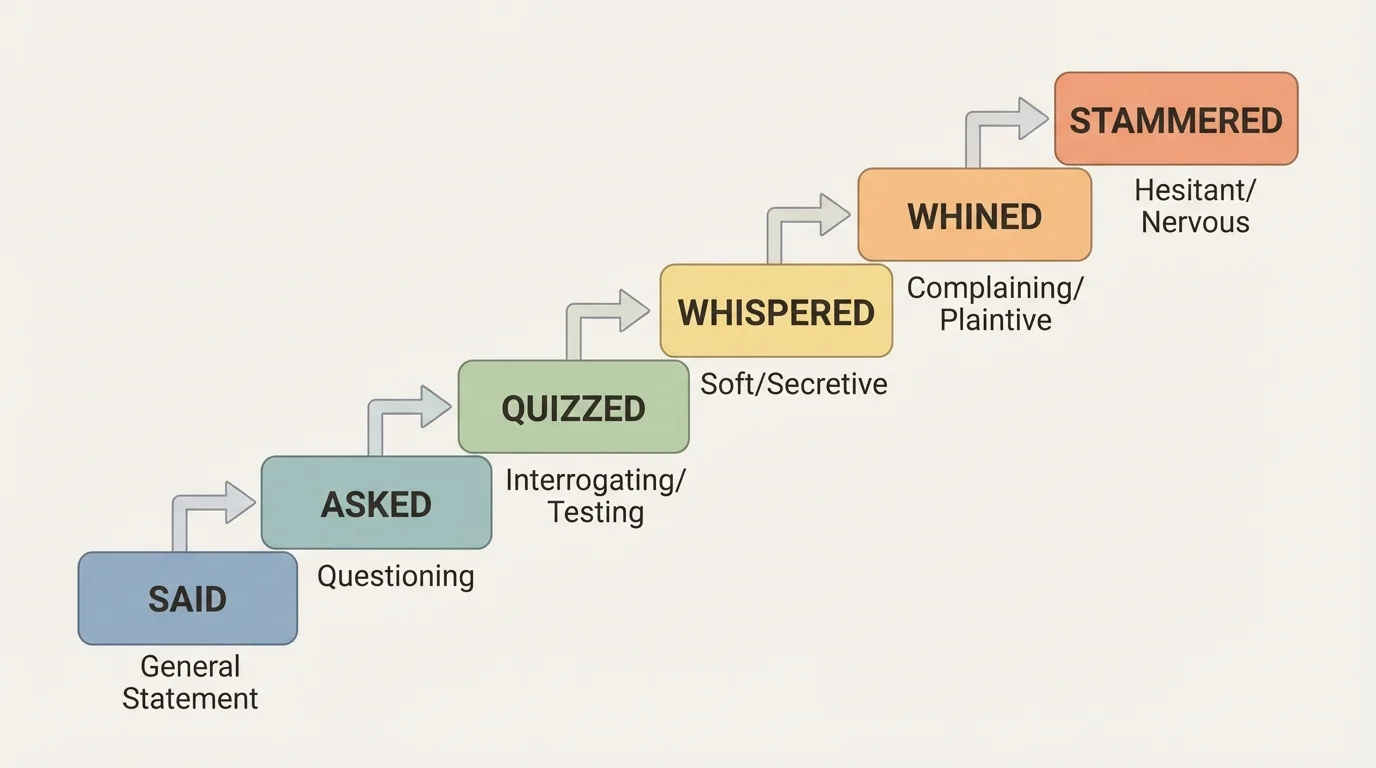
[Figure 3] Think about the words said, asked, quizzed, whined, and stammered. Said is general. Asked means someone wanted an answer. Quizzed suggests asking many questions, often to test someone. Whined shows a complaining tone. Stammered suggests broken or hesitant speech.
Writers choose among similar words on purpose. If a character is nervous, stammered may fit. If a coach checks what players remember, quizzed works well. If a child complains about chores, whined gives the right tone.
Shades of meaning matter in nonfiction too. The words protect, preserve, and conserve are related, but they are not identical. Protect means keep safe. Preserve often means keep something in its original state. Conserve often means save and use carefully so it lasts.
Later, when you choose between similar words, the speaking-word ladder in [Figure 3] reminds you that no two words are exactly alike. Good writers listen for those small differences.
"The difference between the almost right word and the right word is really a large matter."
— Mark Twain
This idea is important because a precise word can change a sentence from ordinary to vivid. It can also prevent confusion. If you mean examined, do not write looked at if the exact meaning matters. If you mean observed, choose that word.
Accurate vocabulary is not only about meaning. It is also about reading and spelling words correctly. Orthography means the patterns and rules of spelling in a language. When you learn common spelling patterns, longer words become easier to decode, pronounce, and remember.
For example, the suffix -tion appears in words like action, protection, and conservation. The suffix -ment appears in words like movement and excitement. Seeing these patterns helps you read unfamiliar multisyllable words more smoothly.
Words may also have smaller familiar chunks inside them. In endangered, you may notice danger. In carefully, you see care plus suffixes. In disagree, the prefix dis- means "not" or "opposite," helping you infer that the word means "not agree."
When reading, it helps to slow down and chunk the word: con-ser-va-tion, ob-ser-va-tion, in-for-ma-tion. Once the parts are clear, the whole word is easier to understand and use.
Knowing a word is the first step. Using it accurately is the next step. To use vocabulary well, match the word to the situation. A science report should use science words correctly. A story should use precise action and emotion words. A class discussion may need general academic words such as explain, support, and compare.
Suppose you are writing about sea turtles. A strong sentence might say, "People work on conservation projects to protect endangered sea turtles and their habitat." That sentence uses topic vocabulary correctly. It is much clearer than saying, "People help animals and their homes."
Suppose you are writing a story scene. "Nora said she was upset" is understandable, but "Nora muttered that she was frustrated" gives a sharper image. The second version uses more exact vocabulary for both action and feeling.
From simple to precise across subjects
Simple: "The class looked at the bird and talked about it."
More precise for science: "The class observed the bird's habitat and discussed how conservation can protect local wildlife."
More precise for storytelling: "The class watched quietly as Ava whispered that the injured bird looked frightened."
Both improved versions are clearer because the words fit the purpose.
When you learn a new word, pay attention to three things: what it means, how it is spelled, and when it should be used. A word is most useful when you can read it, understand it, pronounce it, and choose it correctly.
Building vocabulary is a little like building a toolbox. General academic words are tools you use almost everywhere. Domain-specific words are special tools for certain jobs. Precise action and feeling words are the fine tools that help you shape meaning exactly.
