A bridge does not stand because the pieces are merely sitting together. It stands because each part connects in the right way. Reading informational texts works like that too. Good readers do not only notice the parts; they connect them. They explain what happened and why it happened. That is how a science article, a history passage, or a set of directions begins to make sense clearly.
When you read an informational text, you are reading to learn about the world. You may be learning how a volcano erupts, why a group of people moved to a new place, or how to build a birdhouse. If you can explain what happened and why, you are doing more than reading words. You are understanding the text's central idea.
This skill helps in many school subjects. In social studies, you explain events and their causes. In science, you explain ideas and processes. In technology or everyday directions, you explain procedures and the purpose of each step. The same thinking works in all of them: first figure out the important action, change, or idea, and then explain the reason using details from the text.
Event is something that happens.
Procedure is a set of ordered steps to do something.
Concept is an important idea.
Cause is why something happens.
Effect is what happens because of a cause.
Sometimes students think explaining means telling every single detail. It does not. Explaining means choosing the most important details and showing how they connect. A strong explanation answers questions such as: What changed? What steps happened? What idea is being taught? Why did it happen that way?
Informational texts come in different forms. A historical text tells about people and events from the past. A scientific text explains the natural world, such as animals, weather, plants, energy, or the human body. A technical text gives instructions or explains how to use tools, devices, or systems.
Even though these texts are different, readers ask similar questions. In a historical text, you might ask, "What happened first, next, and last?" and "Why did this event happen?" In a scientific text, you might ask, "What process took place?" and "What caused the change?" In a technical text, you might ask, "What are the steps?" and "Why must they be done in this order?"
| Type of text | What the reader explains | Questions to ask |
|---|---|---|
| Historical | Events and results | What happened? Why did it happen? What changed? |
| Scientific | Ideas, processes, and causes | What process occurred? What caused it? What was the result? |
| Technical | Steps and purpose | What are the steps? Why is the order important? What does each step do? |
Table 1. This table compares what readers explain in historical, scientific, and technical texts.
Knowing the type of text helps you know what to look for, but every time you should still search for specific information in the passage. Your explanation should come from the text, not from a guess.
The first part of explaining is identifying what happened. In some texts, this means finding an event. In others, it means finding the main process, the important steps, or the central idea. Look for the parts the author spends the most time describing.
Signal words can help. Words like first, next, then, after, and finally often show sequence. These words can point you to the order of events or steps. In a science text, words like when, as a result, and because often show how one thing leads to another.
Remember that the main idea tells what a text is mostly about. Explaining goes one step further: it tells what happened or what process occurred and shows how details support that understanding.
A good reader asks, "Which details are central?" For example, if a passage explains how butterflies grow, the key events are not every tiny detail in the paragraph. The key events are that the butterfly begins as an egg, changes into a caterpillar, forms a chrysalis, and becomes an adult butterfly. Those are the important changes.
After you know what happened, the next step is to explain why it happened. This is often about cause and effect. The cause is the reason, and the effect is the result. Many informational texts are built on this structure.
Authors often use clue words to show cause and effect. Watch for words and phrases such as because, since, so, therefore, as a result, led to, and due to. These clues help you connect the reason to the outcome.
For example, if a text says, "Heavy rain fell for three days, so the river flooded," you can explain the event this way: The river flooded because heavy rain fell for three days. This explanation tells both what happened and why.
Explaining is more than retelling
Retelling gives back the details in order. Explaining connects the details. If you retell, you might say, "It rained, the river rose, and the town flooded." If you explain, you say, "The town flooded because days of heavy rain made the river rise above its banks." The second answer shows the relationship between the details.
Sometimes the reason is stated clearly in one sentence. Other times you must put details together from several parts of the text. That is why careful reading matters.
[Figure 1] History is full of events that connect to one another. In a historical text, your job is often to identify the important event and explain what caused it and what happened afterward. Historical writing usually includes people, places, dates, and actions.
Suppose a passage says that a town had many wooden buildings, the weather was very dry, and a small spark started a fire. The text then explains that the fire spread quickly and many people worked together to rebuild. You could explain: A major fire spread through the town because the buildings were made of wood and the weather was dry. After the fire, people rebuilt the town.
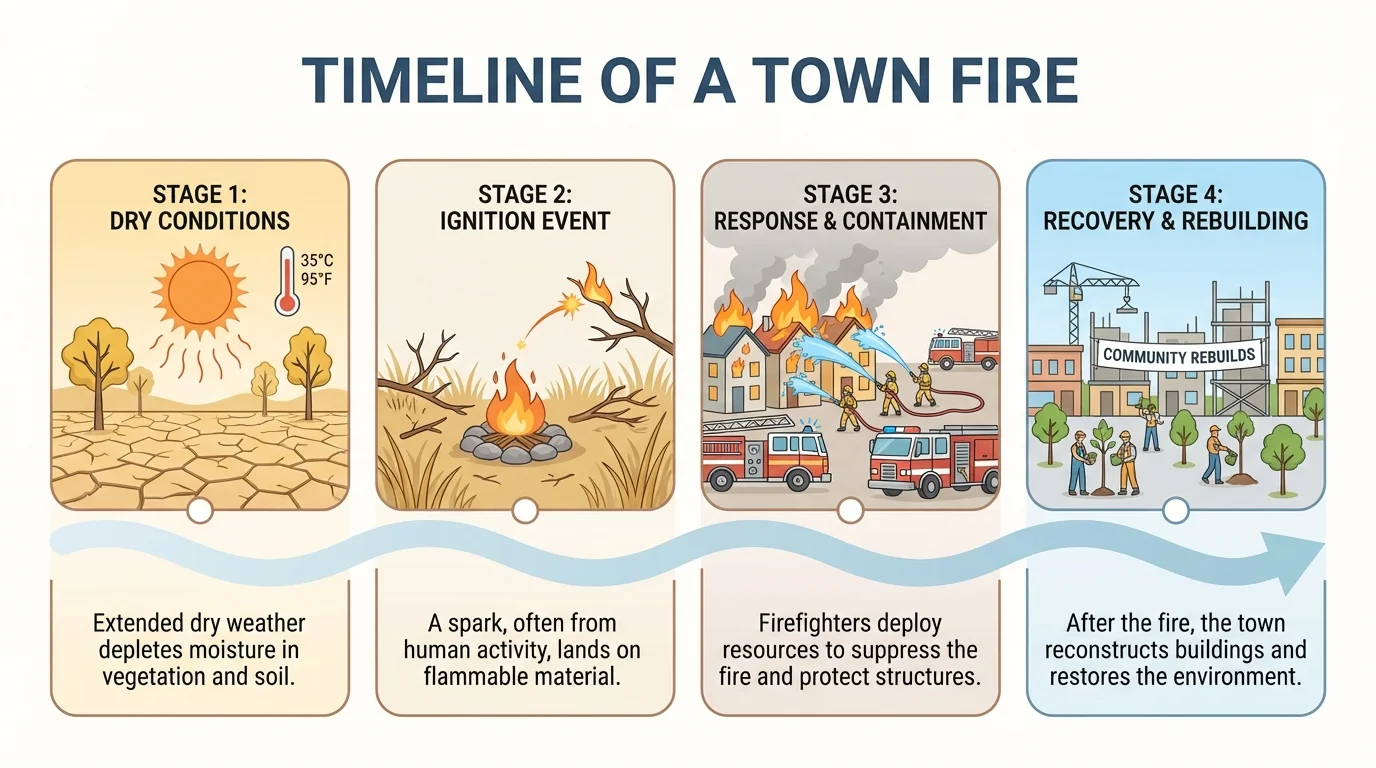
Notice how that explanation includes both the event and the cause. It also includes an effect, which is the rebuilding. Historical texts often work this way. One event leads to another.
Historical texts may also include timelines, maps, letters, diary entries, or photographs. A timeline helps you see the order of events. A diary entry or letter can act as a primary source, which means it comes from someone who was there at the time. A textbook or article written later is a secondary source, which explains the event using information from multiple sources.
When you explain history, focus on the most important causes. A war might begin because of arguments over land, power, or unfair rules. A group of settlers might move because they need better farmland or more safety. A law might change because people protested against something unfair. As seen again in [Figure 1], one cause can begin a chain of results.
Historical text example
Text detail: "The bridge washed away after days of hard rain. Without the bridge, people could not easily bring food into town. Workers built a stronger stone bridge the next year."
Step 1: Identify what happened.
The bridge washed away, and later a stronger bridge was built.
Step 2: Find why it happened.
Days of hard rain caused the river to rise and wash away the bridge.
Step 3: Put it together clearly.
The old bridge washed away because heavy rain made the river rise. After that, workers built a stronger stone bridge so people could travel safely again.
This kind of explanation uses details from the text and shows relationships between them. It does not wander away from the passage.
[Figure 2] Science texts often explain how the natural world works. Instead of focusing on wars or leaders, scientific texts may explain plant growth, weather, animal behavior, magnetism, or the water cycle. Here, "what happened" may really mean "what process took place" or "what change occurred."
For example, a science passage may explain that a seed absorbs water, begins to swell, grows roots, and then sends up a shoot toward sunlight. A strong explanation would be: The seed began to grow because it absorbed water. Then roots and a shoot formed as the young plant received the water and sunlight it needed to continue growing.
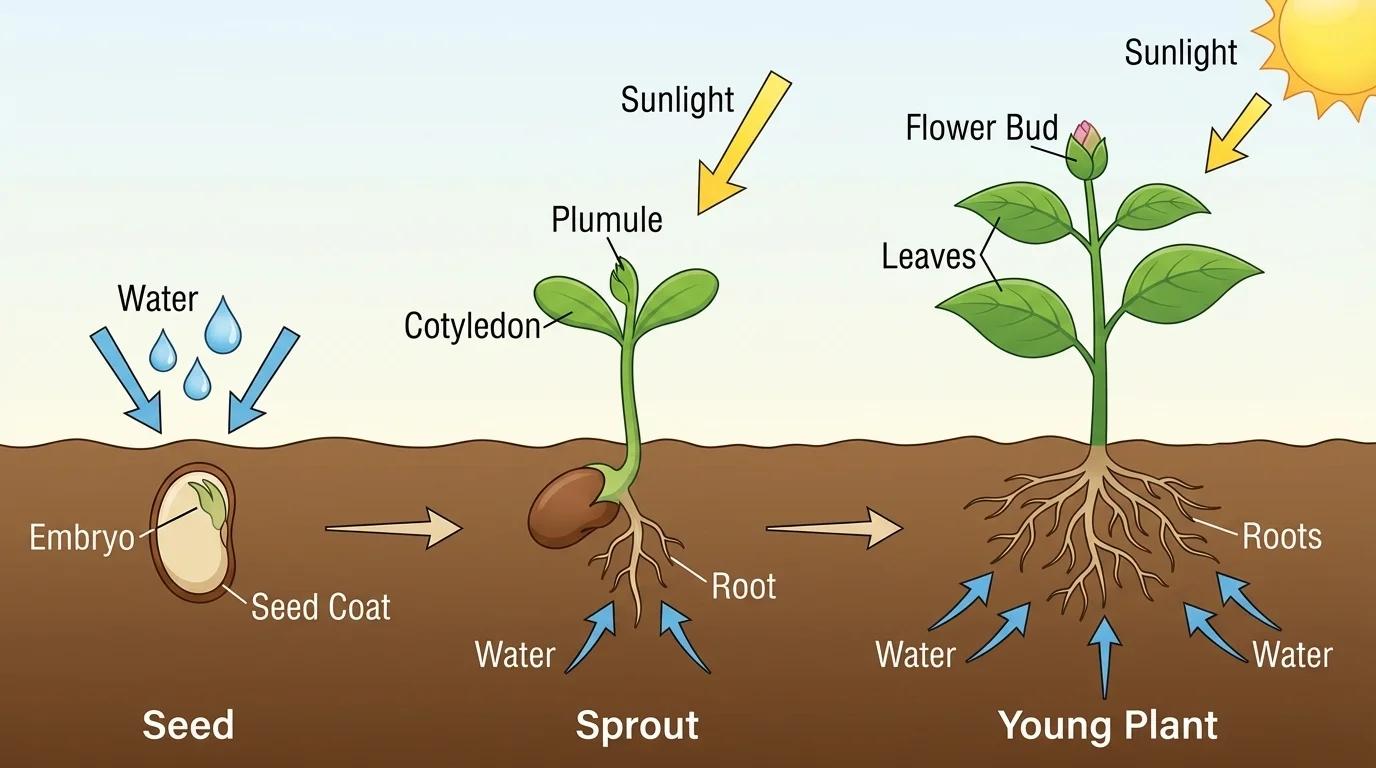
This explanation works because it uses exact information from the text. It tells what happened and why. It does not simply say, "The seed grew," which is true but not complete.
Science texts often include diagrams, captions, labels, and bold vocabulary. These text features help explain the process. A labeled diagram can show parts that are difficult to describe with words alone. Later, when you explain the idea in your own words, you should still use information from both the words and the features in the text.
Some seeds can wait a very long time before growing. They may stay dormant until they finally get enough water, warmth, and the right conditions to begin the growth process.
Scientific explanations usually depend on careful causes. Ice melts because the temperature rises. Shadows change because Earth turns and the Sun appears to move across the sky. Plants lean toward light because they need sunlight to make food. These are not guesses; they are explanations based on evidence. The stages in [Figure 2] make the sequence of growth easier to follow from first change to later result.
Scientific text example
Text detail: "When warm air rises, cooler air moves in beneath it. This movement of air can create wind."
Step 1: Identify what happened.
Wind developed.
Step 2: Find the cause.
Warm air rose, and cooler air moved in beneath it.
Step 3: Explain using both parts.
Wind formed because warm air rose and cooler air moved in beneath it.
That explanation is short, but it is complete because it includes the event and the reason.
[Figure 3] Technical texts explain how to do something. These texts may be directions for planting a tree, using a camera, logging in to a learning website, or building a simple model. In technical reading, "what happened" often means "what steps were done," and "why" means "why each step matters or why the steps must happen in that order."
Suppose a set of directions says: plug in the tablet, press the power button, wait for the home screen, and tap the learning app. You could explain: The user first plugged in the tablet so it had power, then turned it on, waited for it to load, and opened the app. Each step had to happen in order so the device would work correctly.
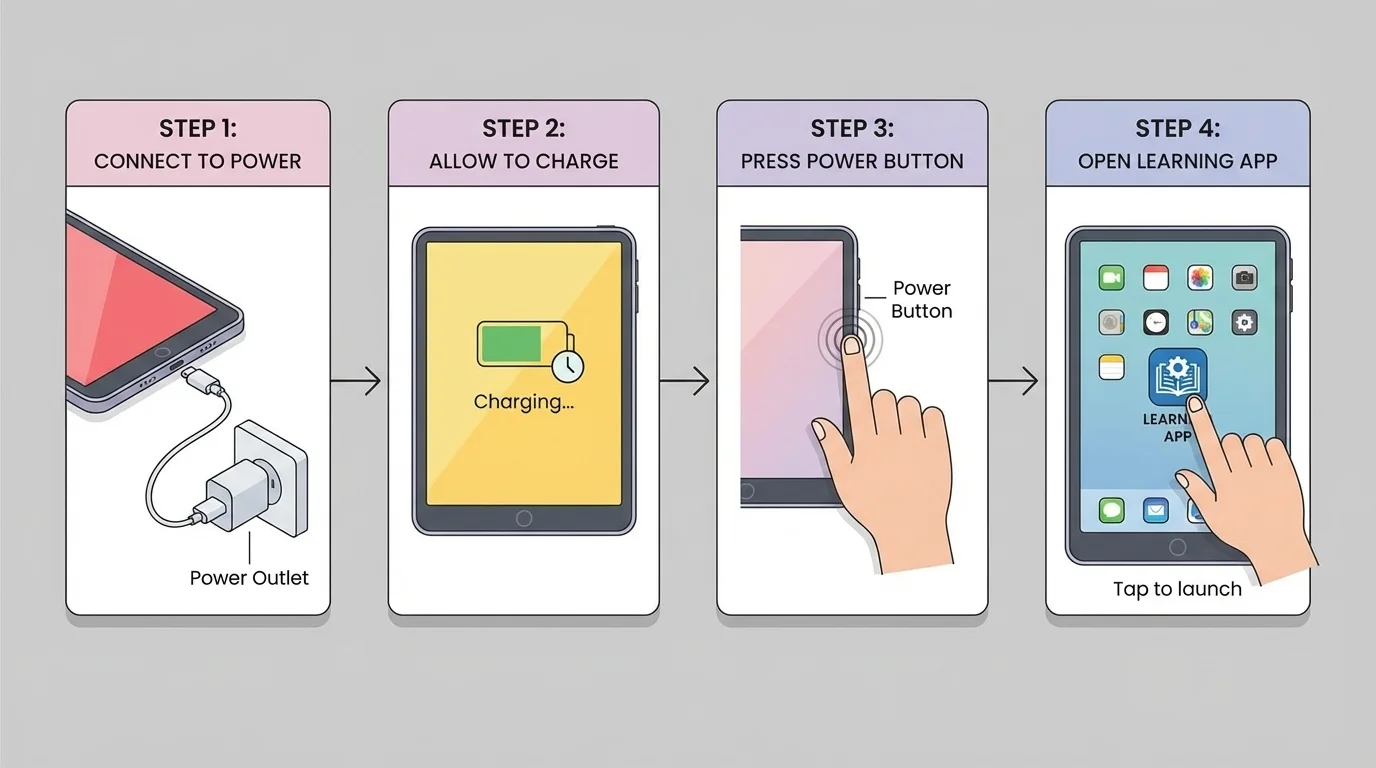
If the order changes, the procedure may fail. You cannot open the app before the device turns on. This is why sequence words are especially important in technical texts.
Technical texts may include numbered lists, warning boxes, labels, and diagrams. They often use very exact language. Words such as insert, attach, connect, press, and tighten tell you exactly what action to take. The flow of steps in [Figure 3] helps show that each action leads to the next one.
Technical text example
Text detail: "First, place the paper under the clip. Next, lower the clip firmly. Finally, test the pages by lifting the stack."
Step 1: Identify the procedure.
The procedure tells how to secure papers with a clip.
Step 2: Notice the order.
The paper must be placed first, then the clip is lowered, and then the stack is tested.
Step 3: Explain why the order matters.
The clip can only hold the papers after they are placed correctly, so the steps must be done in sequence.
Clear explanations of technical texts tell both the steps and the reason for the order.
Strong readers support their explanations with exact details. They may use names, dates, actions, sequence words, or cause-and-effect clues from the passage. This is called using text evidence. Text evidence helps prove that your explanation matches the text.
For example, if a passage says the explorers turned back because winter storms blocked the mountain pass, then your explanation should mention the storms. If you only say, "They turned back because it was hard," your answer is too vague. The text gives a more exact reason, so your explanation should too.
Sometimes it helps to turn a note into a full explanation. A note might say, "cause: little rain; effect: crops died." A full explanation would be: The crops died because there was too little rain. The full sentence makes the relationship clear.
Ask two powerful questions
When you finish a paragraph or section, pause and ask: "What happened?" and "Why did it happen?" If you can answer both with details from the text, you are building a strong explanation.
You do not need to copy large parts of the text. Often it is better to put the ideas into your own words while keeping the important facts accurate.
A complete explanation often has two parts. First, it names the event, procedure, idea, or concept. Second, it explains the reason, cause, or purpose. Sometimes it also includes an important result.
Here is a model for history: "The town moved to higher ground because yearly floods damaged homes near the river." Here is a model for science: "The puddle disappeared because the Sun's heat caused the water to evaporate." Here is a model for a procedure: "The machine had to be unplugged before cleaning so it would be safe to touch."
These examples are different, but they all do the same job. They explain what happened and why, based on details from the text. The answer is not a guess and not just a list. It is a connected explanation.
One common mistake is giving only the event and leaving out the reason. Another mistake is giving your opinion instead of the author's information. For example, saying "I think the settlers moved because the old place was boring" is not supported unless the text really says that.
Another mistake is including too many small details and missing the big idea. If a passage is about how a storm caused a blackout, the main explanation should focus on the storm, the damaged power lines, and the loss of electricity. Tiny side details should not take over the answer.
A final mistake is mixing up the order. In many texts, order matters. The event happened because of a cause, not the other way around. The step came before the result, not after it. Keeping sequence clear helps your explanation stay accurate.
"Good readers do not just collect facts. They connect them."
When you read carefully, look for the important action, process, or idea. Then ask why it happened. Use the author's details to build your answer. That is how you explain events, procedures, ideas, and concepts in informational texts with clarity and confidence.
