Two people can describe the very same event and make it sound almost like two different stories. One person might say, "I was nervous when the thunder cracked above me," while another might say, "The storm caused road closures across town." Both could be talking about the same storm, but each account gives different details. Learning to compare these accounts helps you become a stronger, more thoughtful reader.
When people write about an event or topic, they do not all tell it the same way. The writer's job, purpose, and experience matter. A person who was actually there may notice sounds, sights, and feelings. A person who learns about the event later may include facts from interviews, books, articles, or reports.
That is why readers need to ask important questions: Who is telling this? Was this person there? What details matter most in this account? These questions help us compare and contrast accounts of the same event or topic.
Firsthand account means a description told by someone who experienced the event directly. Secondhand account means a description told by someone who did not experience the event directly but learned about it from other sources. Focus is what the writer pays the most attention to. A source is where information comes from, such as a person, book, article, or video.
Sometimes the event is something exciting, like a parade, a storm, or a championship game. Sometimes the topic is something from history, such as the first moon landing, or something from science, such as volcanoes. In all of these cases, readers can compare how different accounts present information.
When we compare texts, we look for similarities and differences. To compare means to tell how things are alike. To contrast means to tell how things are different. When you compare and contrast accounts, you are not deciding which one is "better." You are studying how each one helps the reader understand the event or topic in a different way.
One useful idea is point of view. Point of view is the position or perspective from which something is told. In an account, point of view affects what the writer notices, what details are included, and what feelings are shared.
As [Figure 1] shows, a firsthand account comes from someone who was there and includes direct experience and personal details. The writer or speaker saw it happen, heard it, felt it, or took part in it. This kind of account often uses words such as I, me, my, we, and our.
Firsthand accounts often include sensory details. A writer may explain what the air smelled like, how loud the crowd was, or how scared or excited people felt. These details help the reader feel close to the event.
For example, a student writing about a field trip might say, "I held my notebook tightly when the guide showed us the dinosaur bones. The room felt cool and quiet." This is firsthand because the student experienced the trip directly.
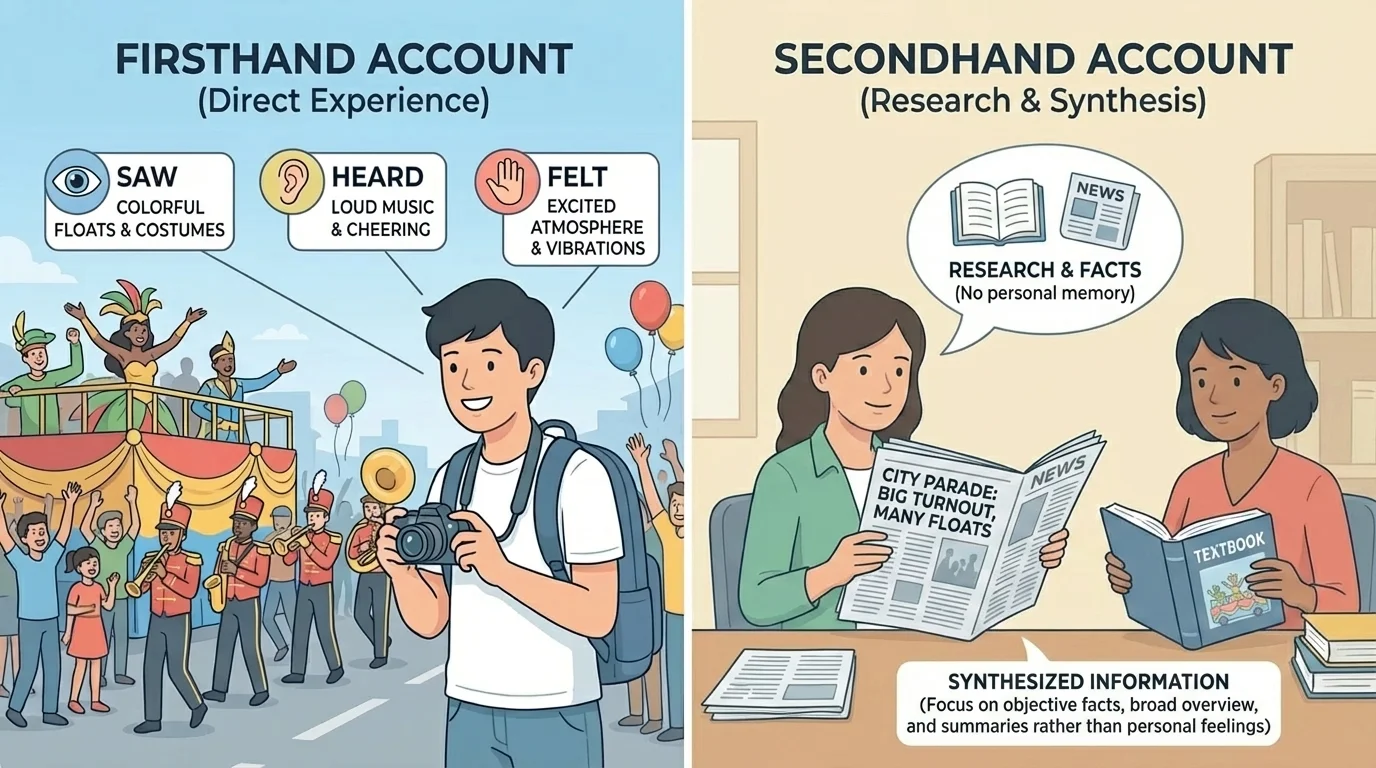
A firsthand account may not include every fact about an event. The writer can only share what was personally experienced or noticed. If ten students attended the same assembly, each one might remember different parts. One student might remember the loud music, while another remembers the speech from the principal.
This means firsthand accounts are often rich in emotion and detail, but they can also be limited. A person who was there knows what it felt like, but may not know everything that happened before, after, or in other places at the same time.
A secondhand account is told by someone who was not there. This writer learns about the event from other people or sources. A secondhand account might come from a textbook, encyclopedia, article, documentary, or news report.
Secondhand accounts often use words such as he, she, they, or the names of people involved. Instead of saying, "I saw the fireworks," a secondhand account might say, "Witnesses reported that the fireworks began at sunset."
Because the writer gathers information, a secondhand account may include a broader view. It can explain background information, causes, results, and facts from several people. For example, a news article about a parade might tell how many people attended, who organized it, and why it was important to the community.
Why secondhand accounts can be useful
A secondhand account can bring together information from many places. This helps the reader learn more than one person could know alone. A historian writing about an old battle, for example, may use letters, maps, and diaries to build a fuller picture of what happened.
Secondhand does not mean false. It simply means the writer did not experience the event directly. In fact, some secondhand accounts are very carefully researched and can give lots of important information.
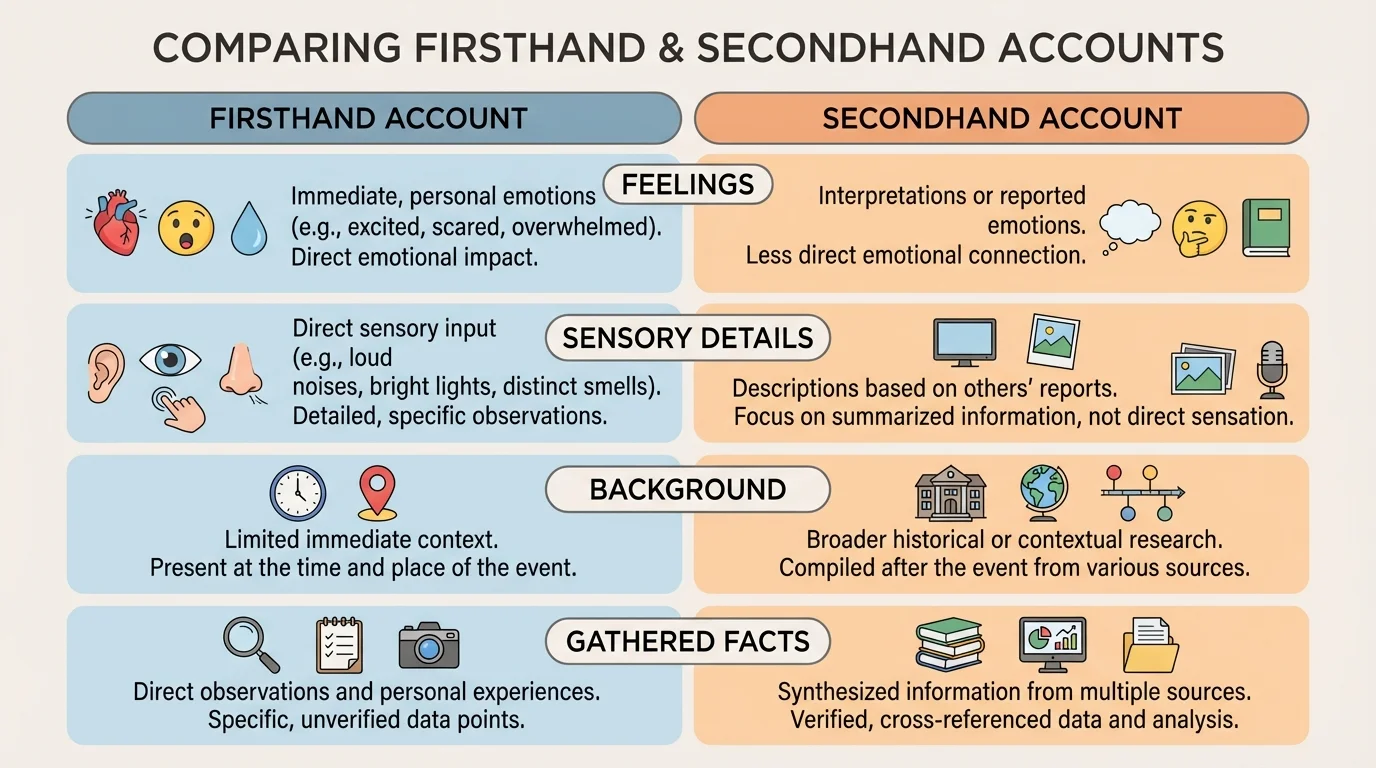
As [Figure 2] shows, one of the biggest differences between these accounts is focus. Readers can compare what each account pays attention to. A firsthand account often focuses on personal experience. A secondhand account often focuses on gathered facts and the bigger picture.
If two texts are about the same soccer game, a player's firsthand account may focus on the pressure of taking the final kick, the cheering crowd, and the muddy field. A sports article written later may focus on the score, the key plays, the coach's comments, and how the win affects the team's season.
Neither focus is wrong. They are simply different. One helps you understand what it was like to be inside the event. The other helps you understand the event more fully from the outside.
| Feature | Firsthand Account | Secondhand Account |
|---|---|---|
| Who tells it | Someone who was there | Someone who learned about it later |
| Main focus | Personal experience | Facts, background, and overall event |
| Common details | Feelings, senses, reactions | Research, interviews, dates, explanations |
| Common pronouns | I, me, we | He, she, they, names |
Table 1. Comparison of common features in firsthand and secondhand accounts.
As the chart in [Figure 2] shows, focus changes the kind of information a reader receives. If you want to know how an event felt, a firsthand account is especially useful. If you want a fuller explanation with more background, a secondhand account may help more.
The information in the two types of accounts can differ in several ways. A firsthand account may include strong emotions, exact moments, and personal opinions. A secondhand account may include dates, causes, effects, and details gathered from more than one person.
Think about a snow day. A child's firsthand account might say, "I raced to the window before breakfast and shouted when I saw snow covering the whole yard." A secondhand account in a local news report might say, "Schools in the county closed after overnight snowfall made roads unsafe." The first tells a feeling and a moment. The second gives a larger fact about the community.
Readers should notice what each account includes and what it leaves out. A firsthand account might leave out information the writer did not know. A secondhand account might leave out small personal moments because the writer is focused on explaining the event clearly and completely.
Many history books use secondhand accounts, but historians often study firsthand sources such as letters, diaries, speeches, and photographs to help them learn what happened.
That is why reading both types can be powerful. One account gives closeness. The other gives context. Together, they can help readers understand an event more deeply.
As [Figure 3] illustrates, let's look at one event from two viewpoints. A school garden opening is a single event, but it can be described in very different ways, with the same ribbon-cutting scene presented for different purposes. The event includes students, teachers, families, and a principal cutting a ribbon.
Here is a sample firsthand account: "I stood next to the tomato plants while the principal held the big green ribbon. My hands were dirty because I had been planting herbs all morning. When everyone clapped, I felt proud that our class helped build the garden."
This account is firsthand because the speaker was there. It uses I and gives feelings and sensory details. We learn what the student saw, where the student stood, and how the student felt.
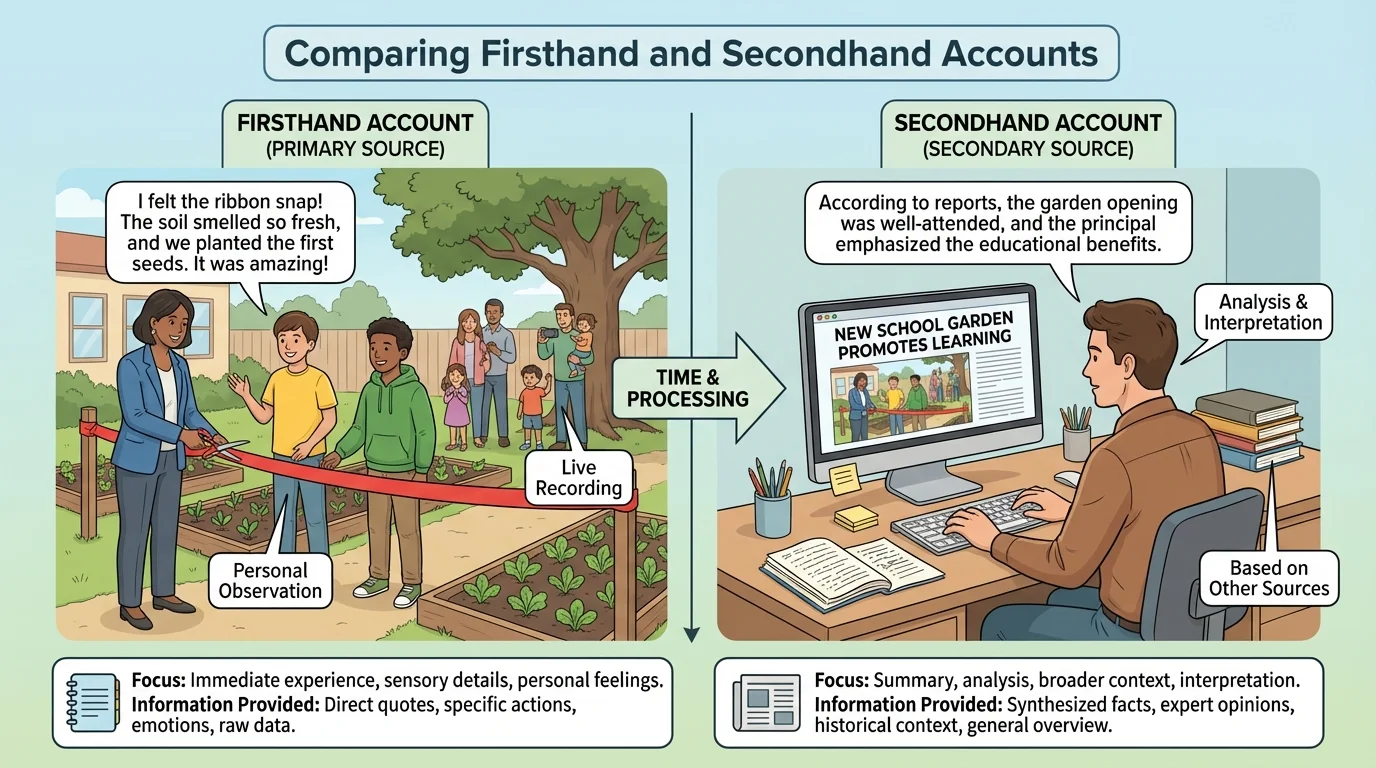
Now read a sample secondhand account: "At Lincoln Elementary, students and teachers opened a new school garden on Friday. The garden was created to teach children about plants and healthy food. According to the principal, families and local volunteers helped build the raised beds."
This account is secondhand because the writer reports information without being part of the event. It gives facts about when the opening happened, why the garden was created, and who helped.
Comparing the school garden accounts
Step 1: Identify who is telling each account.
The first is told by a student who was there. The second is told by someone reporting on the event.
Step 2: Notice the focus.
The first focuses on personal experience and feelings. The second focuses on facts and purpose.
Step 3: Compare the information provided.
The first gives details like dirty hands and pride. The second gives information about the date, the reason for the garden, and community help.
Both accounts are about the same event, but they help the reader in different ways.
When we return to the garden scene, we can see why both accounts matter. The picture stays the same, but the writer's purpose changes what the reader learns from that picture.
Suppose a thunderstorm knocks down tree branches across town. A child who experienced the storm might write, "I jumped when lightning flashed across my bedroom wall. The rain hit the windows so hard that I could barely hear my dad talking." That account helps us feel the storm.
A secondhand account might say, "A severe storm moved through the town Tuesday night, causing power outages and blocked streets. City workers cleared branches by morning." This account tells results and useful facts for the public.
Again, the event is the same, but the accounts are different. The firsthand account gives a close-up view. The secondhand account gives a wider view.
Readers can search for clues to decide what kind of account they are reading. Pronouns are one clue. A lot of I and we may point to a firsthand account. Names, reported facts, and references to interviews may point to a secondhand account.
Another clue is the kind of details included. If the text includes feelings, direct actions, and sensory details, it may be firsthand. If it includes research, background, or facts from different people, it may be secondhand.
Sometimes a text even tells you its source. A diary entry is usually firsthand. A textbook chapter is usually secondhand. A biography is generally secondhand because the author writes about another person's life. An autobiography is usually firsthand because the person writes about his or her own life.
When readers study informational texts, they often ask who wrote the text, why it was written, and where the information came from. Those same questions help identify whether an account is firsthand or secondhand.
Good readers also think about what each source can and cannot provide. As we saw earlier in [Figure 1], direct experience gives strong personal details. As the comparison in [Figure 2] shows, researched reporting often gives broader facts and explanations.
This reading skill matters in school and in everyday life. In social studies, students may read a diary entry from someone who lived through a historical event and also read a textbook explanation of that same event. In science, students may read a field scientist's notes and then a science article that explains the topic more fully.
It also matters when reading news. A person at a community event may share what it felt like to be there. A reporter may explain what happened, who was involved, and what may happen next. When readers can compare these accounts, they understand more.
Being able to compare focus and information also helps readers ask smart questions. What does this writer know firsthand? What did this writer learn from others? What details are included? What details are missing?
One common mistake is thinking that firsthand always means completely correct. People can forget details or see only one part of an event. Another mistake is thinking that secondhand means untrustworthy. A careful secondhand account may use many strong sources.
Another mistake is focusing only on who tells the account and forgetting to compare the details. The real skill is not just naming the type of account. The real skill is explaining how the source, focus, and information are different.
Strong readers look at both kinds of accounts carefully. They notice feelings, facts, perspective, and purpose. Then they use all of that information to build a clearer understanding of the event or topic.
"Who is telling the story changes what we learn from the story."
When you read about the same event from more than one account, you are doing the work of a careful investigator. You are noticing not only what happened, but also how it is told. That makes your reading deeper, more thoughtful, and more complete.
