Have you ever asked two different people about the same event and noticed that each person tells part of the story? One person might remember what happened first, while the other remembers the most exciting detail. Reading works the same way. When you read two texts on the same topic, you can put their information together to understand the subject more fully and talk about it with confidence.
A single text can teach you a lot, but two texts can often teach you more. One article might explain the main idea clearly, while another gives examples, pictures, or special facts. When readers use both, they build a stronger understanding.
This is called integrating information. To integrate means to combine parts into a whole. When you integrate information from two texts, you do not just read them one after the other. You connect their ideas so you can explain the topic in a thoughtful way.
This skill matters in school and in everyday life. If you want to learn about volcanoes, weather, a famous person, or how recycling works, it helps to gather facts from more than one source. Good readers know that knowledge grows when they compare and combine information.
Integrating information means taking ideas, facts, and details from two texts on the same topic and putting them together to understand the topic better. A text can be an article, a book page, a website page, a chart, a diagram, or another source of information.
When you later write or speak, integrated information helps you sound knowledgeable. Instead of saying just one fact, you can explain the topic with several connected ideas. That makes your thinking clearer and stronger.
Integrating information is more than spotting that two texts share a topic. Suppose two texts are both about dolphins. One text may explain how dolphins communicate. Another may focus on where dolphins live and what dangers they face. If you combine them, you can say something richer: dolphins use sounds to communicate, live in oceans around the world, and face dangers such as pollution and fishing nets.
Notice what happened in that example. The reader did three important things. First, the reader found the important ideas in each text. Second, the reader connected those ideas. Third, the reader used the combined information to explain the topic.
Integrated reading helps you answer questions like these: What information do both texts share? What detail does one text include that the other does not? Do the texts focus on different parts of the same topic? When you answer these questions, your understanding becomes deeper.
Before you combine two texts, make sure you understand each one separately. If one text is confusing, your combined understanding will also be confusing. Start by finding the main idea of each text. The main idea is the most important point the author wants readers to understand.
Then look for key details. These are the facts, examples, explanations, or descriptions that support the main idea. Ask yourself, "What is this text mostly teaching me?" and "Which details matter most?"
You should also notice the source. Is the text a magazine article, a science book page, or a website from a museum? The source can help you understand what kind of information the text gives. Some texts are broad and give an overview. Others zoom in on one part of the topic.
Good readers already know how to find a main idea and supporting details in one text. Integrating information uses that same skill again, but now you do it with two texts and connect the results.
If a text includes headings, captions, labels, or diagrams, use them. These features often point directly to important ideas. A heading may tell the topic of a section, while a caption may explain a photo or picture with a useful fact.
Once you understand each text, you are ready to compare them. Readers often sort information into three groups, as [Figure 1] shows: information both texts share, information that is different, and information that is new in only one text. This simple way of thinking helps you organize ideas without getting lost.
Start with what is the same. If both texts say that bees pollinate flowers, that shared fact is important. Shared facts often point to the biggest ideas on the topic. Next, look for what is different. One text may focus on how bees help plants grow, while another may explain how bees live in colonies. Finally, find what is new. A second text may add details you did not see in the first one, such as how some bees live alone instead of in hives.
When you compare, do not assume that different means wrong. Two texts can both be correct and still focus on different parts of the topic. One may be more general, and the other may be more specific. Together, they give a fuller picture.
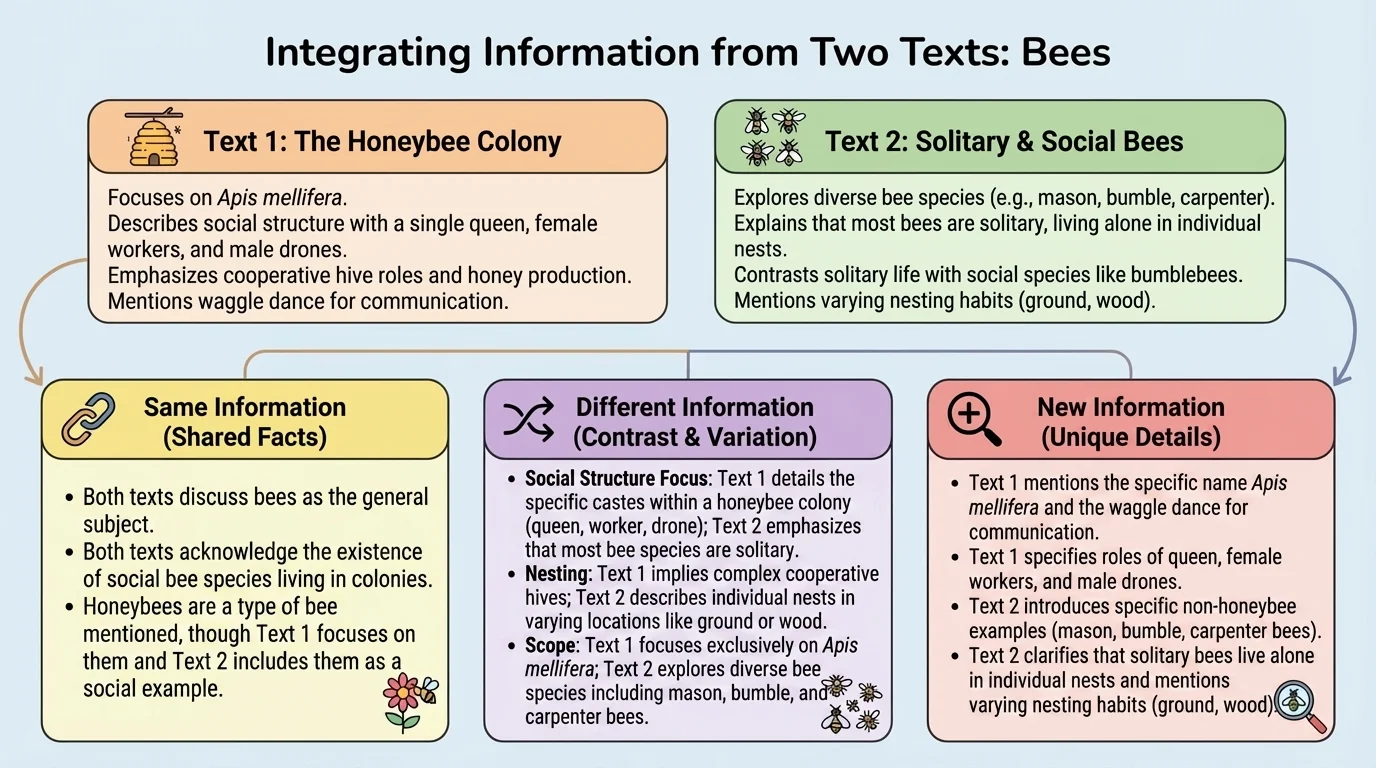
A strong reader asks questions while comparing. What idea appears in both texts? Which details only appear once? What can I learn by putting these facts together? These questions turn reading into active thinking.
Same, different, and new is a powerful way to combine texts. Same information tells you the big ideas both texts agree on. Different information shows that each text may have a special focus. New information helps you expand what you know beyond one source.
Later, when you explain the topic, you can use all three groups. You might say, "Both texts explain that bees help plants. One text focuses on pollination, while the other adds information about life inside a hive." That is knowledgeable speaking because it shows that you used more than one source.
Sometimes the most helpful information is not only in the main paragraphs. Text features, as [Figure 2] illustrates, guide readers to important facts and help them connect ideas across texts. A title tells the overall topic. Headings break the topic into parts. Captions explain pictures. Charts and maps present facts in a quick, organized way.
For example, one text about sea turtles may include a map showing where they travel. Another may include a diagram of the turtle life cycle. If you read only the paragraphs and skip the text features, you miss information that can help you understand the whole topic.
Text features can also help you compare two texts. If both texts have headings about food, habitat, and danger, you can line up those sections and notice what matches or differs. If one text has a timeline or chart, it may reveal facts the other text does not explain in words.
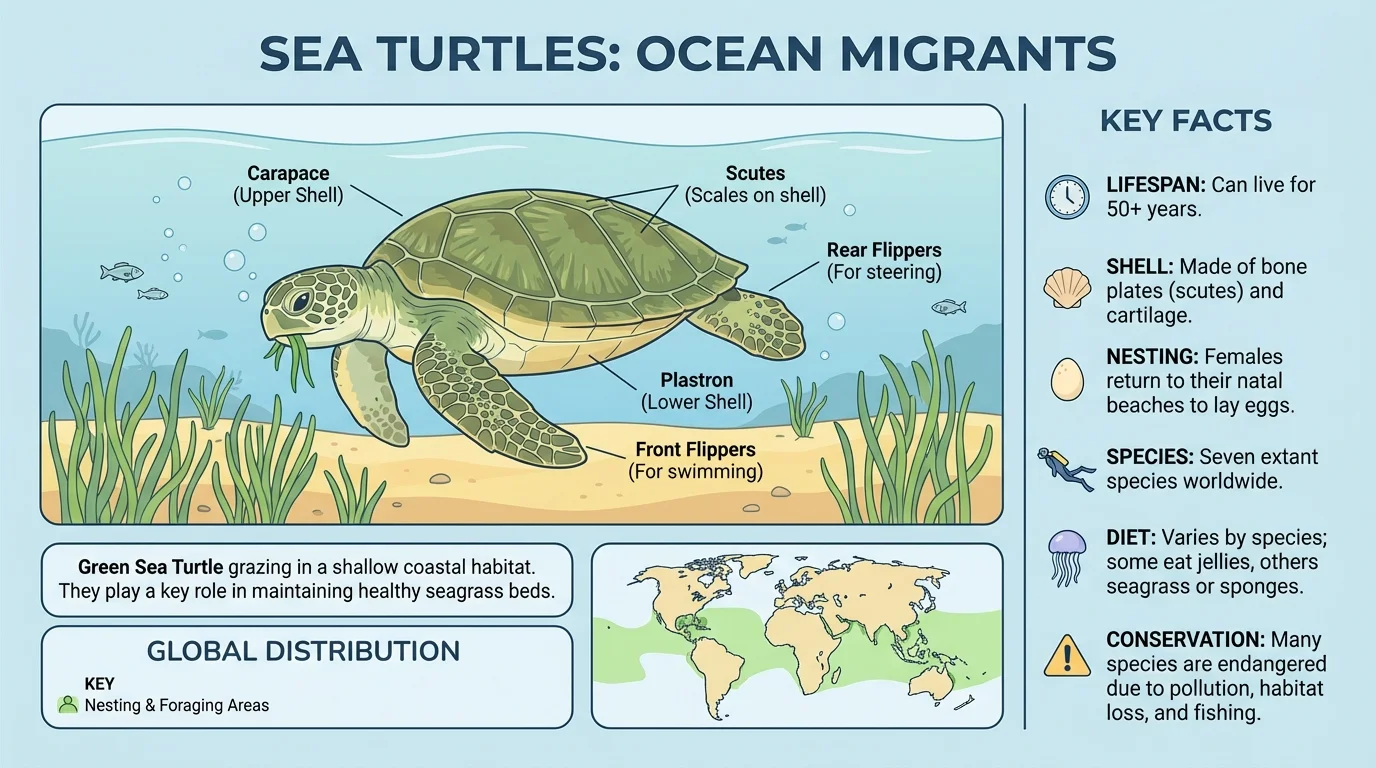
Readers should treat text features as part of the text, not extras. A photo caption may tell where an animal lives. A diagram label may identify an important part. A chart may compare different types of storms. These details can become evidence when you write or speak.
As you continue comparing, remember the sea turtle page in [Figure 2]. It shows how different parts of a page each give a different kind of information. One source might teach through a paragraph, while another teaches through a labeled image or map.
Two texts on the same topic are not always arranged the same way or written for the same purpose. One author may want to explain. Another may want to persuade. One may focus on causes. Another may focus on effects. That does not stop you from integrating information, but it means you must read carefully.
Suppose you read two texts about saving water. One text may explain ways families can use less water at home. Another may tell why water shortages happen in dry places. These texts are connected even though they focus on different questions. You can integrate them by noticing how the problem and the solutions fit together.
Sometimes one text gives more detail than another. Sometimes one uses easier words, and another includes more technical facts. A thoughtful reader does not ignore one text just because it is shorter or longer. Instead, the reader asks what each text contributes.
Scientists, historians, and reporters often read many sources on the same topic before sharing information. Using more than one source helps them notice missing details, check facts, and understand a subject more completely.
If two texts seem to disagree, slow down and check closely. Are they truly saying opposite things, or are they discussing different parts of the topic? For example, one text might say bats rest during the day, while another says some bats search for food at sunset. Those facts can fit together because sunset leads into nighttime activity.
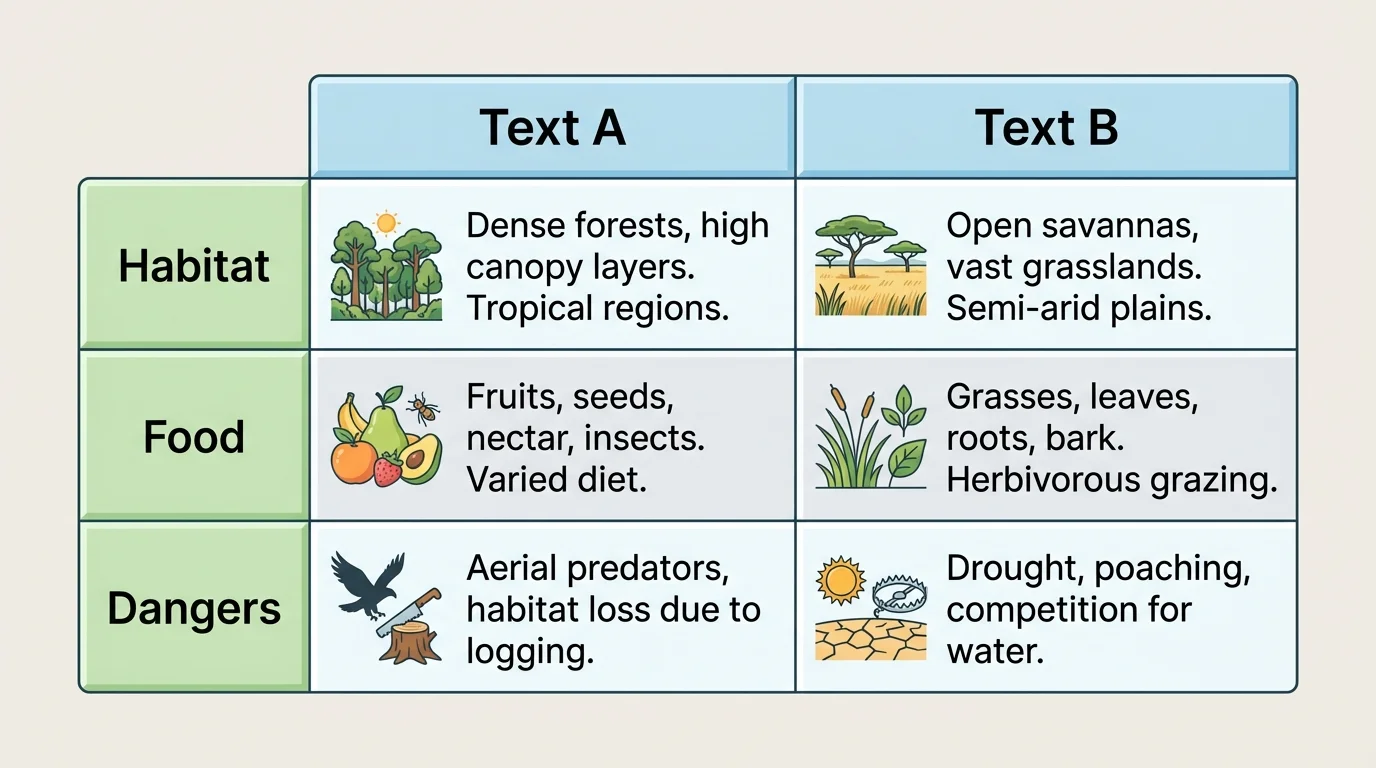
When information from two sources starts to pile up, a note organizer helps keep it clear, as [Figure 3] shows. You can make two columns, one for each text, and then list details under shared topic categories such as habitat, food, or dangers.
Another smart way to organize notes is by idea instead of by source. For example, if both texts are about rain forests, your note categories might be climate, animals, plants, and threats. Under each category, you can place details from Text A and Text B together. This makes it easier to combine the information later.
Short notes work better than copying whole sentences. Write only the important words and ideas. This keeps your thinking active and helps you avoid simply repeating what an author wrote.
You can also use symbols in your notes. A check mark can show a fact found in both texts. A star can show a surprising new detail. A question mark can mark something you want to reread. Organized notes save time when you prepare to speak or write.
Example: Organizing information about penguins
Text A explains where penguins live and how they stay warm. Text B explains what penguins eat and how parents care for chicks.
Step 1: Find the main ideas.
Text A is mostly about penguin bodies and habitat. Text B is mostly about penguin behavior and family care.
Step 2: Sort the key details.
Under habitat, note icy environments from Text A. Under body features, note thick feathers and fat from Text A. Under food, note fish and krill from Text B. Under family care, note that parents protect and feed chicks from Text B.
Step 3: Combine the ideas.
You can now explain that penguins live in cold places, stay warm with special body coverings, eat sea animals, and care for their young carefully.
Looking back at the organizer in [Figure 3], notice how categories help separate ideas clearly. Without that structure, details from one text can easily get mixed up with details from the other.
The goal of integrating information is not just to collect facts. The goal is to use those facts well. When you write or speak about a topic, you should combine details from both texts into clear sentences and organized ideas.
Knowledgeable speaking and writing often sound like this: "Both texts explain that coral reefs are home to many sea creatures. One text focuses on how reefs form, and the other explains how pollution damages them." That response is stronger than giving one fact from only one source.
When you speak, use complete ideas, not a random list. Start with the topic. Then explain the most important information from both texts. You may mention what they share first, then add a detail that only one text includes. This helps listeners follow your thinking.
When you write, make sure your sentences connect the information. Words such as both, also, however, another detail, and in addition can help. These words show how ideas from two texts fit together.
Example: Speaking about recycling using two texts
One text explains how recycling turns old materials into new products. Another text explains why recycling reduces trash in landfills.
Step 1: Start with a shared idea.
Both texts show that recycling helps the environment.
Step 2: Add a different focus from each text.
One text focuses on the process of reusing materials. The other focuses on the problem of too much waste.
Step 3: Turn the notes into a strong statement.
Recycling helps the environment because it reuses materials and keeps more trash out of landfills.
Notice that the final statement sounds informed because it combines ideas from both sources into one explanation. That is what knowledgeable communication looks like.
One common mistake is using only one text even though two were read. A student may know both texts but only mention facts from the one that was easier. A smart fix is to check your notes and make sure at least one important idea from each text appears in your speaking or writing.
Another mistake is copying exact sentences. Copying does not show your understanding. Instead, think about what the author is teaching and say it in your own words. Your goal is to explain, not to repeat.
A third mistake is mixing details incorrectly. If one text says frogs lay eggs in water and another says adult frogs can live on land, those facts should not be blended into a wrong statement such as "frogs lay eggs on land." Keep track of which detail belongs where.
Sometimes readers focus only on differences and forget the shared big idea. Other times they focus only on similarities and ignore useful new information. Strong integration includes both: what connects and what adds.
Let's look at how this works with a complete example. Text A is about monarch butterflies. It explains that monarchs migrate long distances and travel south when the weather turns cold. Text B is also about monarch butterflies. It explains that monarch caterpillars feed on milkweed plants and that monarch numbers can drop when these plants disappear.
If you read only Text A, you learn about migration. If you read only Text B, you learn about food and survival. But if you integrate the texts, you can explain the topic much better. You can say that monarch butterflies migrate long distances, depend on milkweed during part of their life cycle, and may struggle when their habitat changes.
Now your explanation is broader and more accurate. It includes movement, food source, and survival challenges. That is exactly why readers use more than one text.
Example: Writing one strong paragraph from two texts
Text A teaches that monarch butterflies migrate to warmer places. Text B teaches that monarchs need milkweed plants, especially when they are young.
Step 1: State the topic clearly.
Monarch butterflies have special behaviors and needs that help them survive.
Step 2: Add evidence from both texts.
One text explains that monarchs migrate when cold weather comes. The other explains that monarch caterpillars need milkweed plants for food.
Step 3: Connect the ideas.
These details show that monarch survival depends on both traveling to safe places and having the right plants available.
That paragraph sounds knowledgeable because it does not treat the texts as separate pieces. Instead, it combines them into one clear explanation of the subject.
| Reading move | What the reader does | Why it helps |
|---|---|---|
| Find the main idea | Decide what each text is mostly about | Builds a clear understanding of each source |
| Spot key details | Notice important facts and examples | Gives evidence to use later |
| Compare texts | Look for same, different, and new information | Shows how the texts connect |
| Organize notes | Sort details by source or category | Keeps ideas from getting mixed up |
| Write or speak | Combine information in your own words | Shows true understanding of the topic |
Table 1. A summary of the main reading moves used to integrate information from two texts.
As you become better at this skill, you will notice that reading becomes more powerful. Instead of holding one small piece of knowledge, you begin building a bigger, connected understanding. That is what skilled readers do when they learn from more than one source.
