Have you ever heard two people talk about the same movie, but one person gives a flat description like "It was sad," while the other says, "It was sad because the main character tried to be brave, but her voice shook and she would not look at her friend"? The second person helps you see the moment. Strong readers do the same thing when they talk or write about stories. They do not just name a trait or repeat what happened. They explain it with clear details from the text.
When authors write stories and dramas, they choose details for a reason. A character's whisper may show fear. A stormy night may make the setting feel dangerous. A slammed door may turn a small disagreement into an important event. Readers who notice these details understand the story more deeply.
Describing something in depth means giving more than a short or general answer. Instead of saying a character is "nice," you explain how the text shows that. Instead of saying the setting is "the woods," you explain what the woods are like and how they affect the story. Instead of saying an event is "important," you tell why it matters and what it changes.
Text evidence means the exact details from a story or drama that support an idea. These details may come from what a character thinks, says, or does, from how a setting is described, or from what happens during an event.
In depth means fully and carefully, with enough explanation to help someone understand your thinking.
Good descriptions are built from the text. They do not come from guessing or from personal opinions alone. A reader might think, "I like this character," but that is not enough. A stronger response would be, "The character seems caring because she gives her lunch to her little brother and tells him she is not hungry, even though the text says her stomach growls." That answer includes a claim and proof.
A shallow description is short and unclear. For example, "The boy is brave." That tells an idea, but it does not explain it. An in-depth description adds details and meaning: "The boy is brave because he enters the dark barn alone, even though the text says his hands are shaking. He also tells his sister to stay behind where it is safe." Now the reader understands not just the trait, but the evidence behind it.
In-depth descriptions often answer questions like these: What exact detail shows this? Why is this detail important? What does it help the reader understand? Does the character, setting, or event change over time? The best answers connect details to ideas.
Stories usually include characters, a setting, and a series of events. These parts work together. A character acts in a setting, and those actions help create events.
Sometimes one detail is enough to support a small idea, but often you need several details. If you are describing a character in depth, you may need to look at the character's actions in one part of the story, words in another part, and thoughts in yet another part. Putting details together helps you build a fuller picture.
A character trait is a quality that describes a character, such as kind, stubborn, patient, nervous, or curious. But readers should not stop at naming a trait. To understand a character fully, they study several kinds of clues, as [Figure 1] shows: thoughts, words, actions, and feelings all help reveal who a character is.
Suppose a story says, "Mina looked at the high diving board and wished her knees would stop trembling. 'I can do this,' she whispered. Then she climbed the ladder anyway." From this one moment, a reader can describe Mina in depth. She is nervous because her knees tremble. She is determined because she tells herself, "I can do this." She is brave because she climbs the ladder even while she is afraid. Notice that bravery here does not mean having no fear. It means acting despite fear.
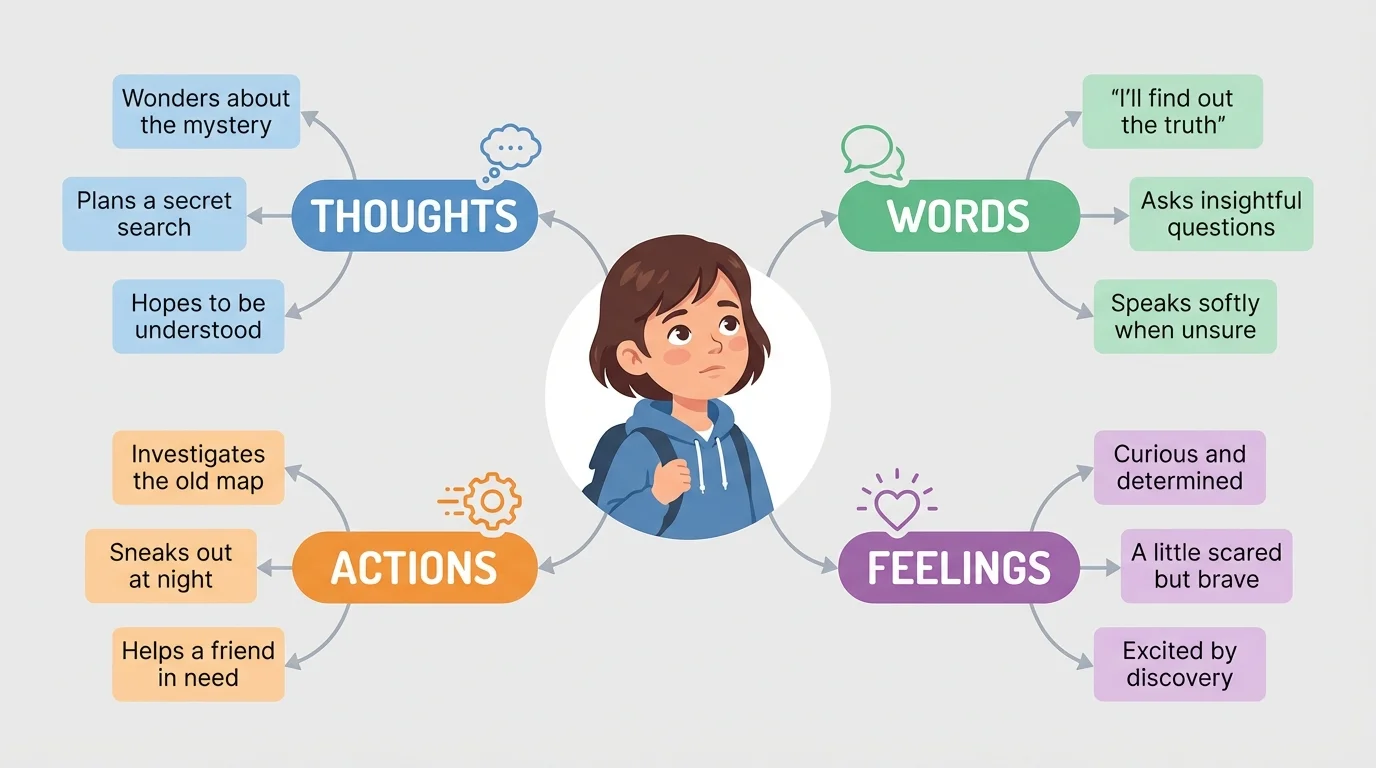
Readers should also watch for how characters treat others. If a character shares, lies, apologizes, argues, or helps, those actions reveal important traits. A character's dialogue can be just as important. Polite words may show respect. Sharp, impatient words may show anger or frustration. Silence can matter too. If a character says nothing when others are talking, that may show sadness, fear, or careful thinking.
Characters can also have motivation. Motivation means the reason a character does something. A girl might sneak outside because she wants to prove she is independent. A boy might hide a broken vase because he fears getting in trouble. When you describe a character well, you explain not only what the character does, but why the character may do it.
Another important idea is character change. Some characters stay mostly the same, but many change as the story moves forward. A shy character may become confident. A selfish character may learn generosity. When describing a changing character, use details from different parts of the story. For example: "At first, Leo avoids speaking in class and stares at his desk. By the end, he raises his hand and presents his project proudly. These details show that Leo grows more confident."
Example: describing a character in depth
Read this short passage: "Tara saw the lost puppy shivering by the curb. She pulled off her jacket and wrapped it around the dog. 'We have to help him now,' she said, tugging her brother's sleeve."
Step 1: Name a possible trait.
Tara seems caring.
Step 2: Find exact details.
She takes off her jacket to warm the puppy. She says, "We have to help him now."
Step 3: Explain what the details show.
These details show that Tara notices another creature's suffering and acts quickly to help.
A strong description is: Tara is caring and responsible because she wraps her jacket around the lost puppy and urges her brother to help right away.
As with Mina in [Figure 1], one character can show more than one trait at the same time. Real characters, like real people, are often complicated. A character can be excited and worried, kind and stubborn, or brave and unsure. Good readers allow room for that complexity.
The setting of a story is more than just a location. It includes where and when the story happens, and it often includes weather, sounds, sights, and other details that shape the mood, as [Figure 2] illustrates. A beach at noon feels different from a beach at night. A classroom on the last day of school feels different from a classroom during a test.
Setting can affect what characters do. If a story takes place during a snowstorm, characters may get trapped inside, travel slowly, or face danger in the cold. If the setting is a crowded city, characters may hear car horns, see bright lights, and move through busy streets. These details are not decorations. They help create the world of the story.
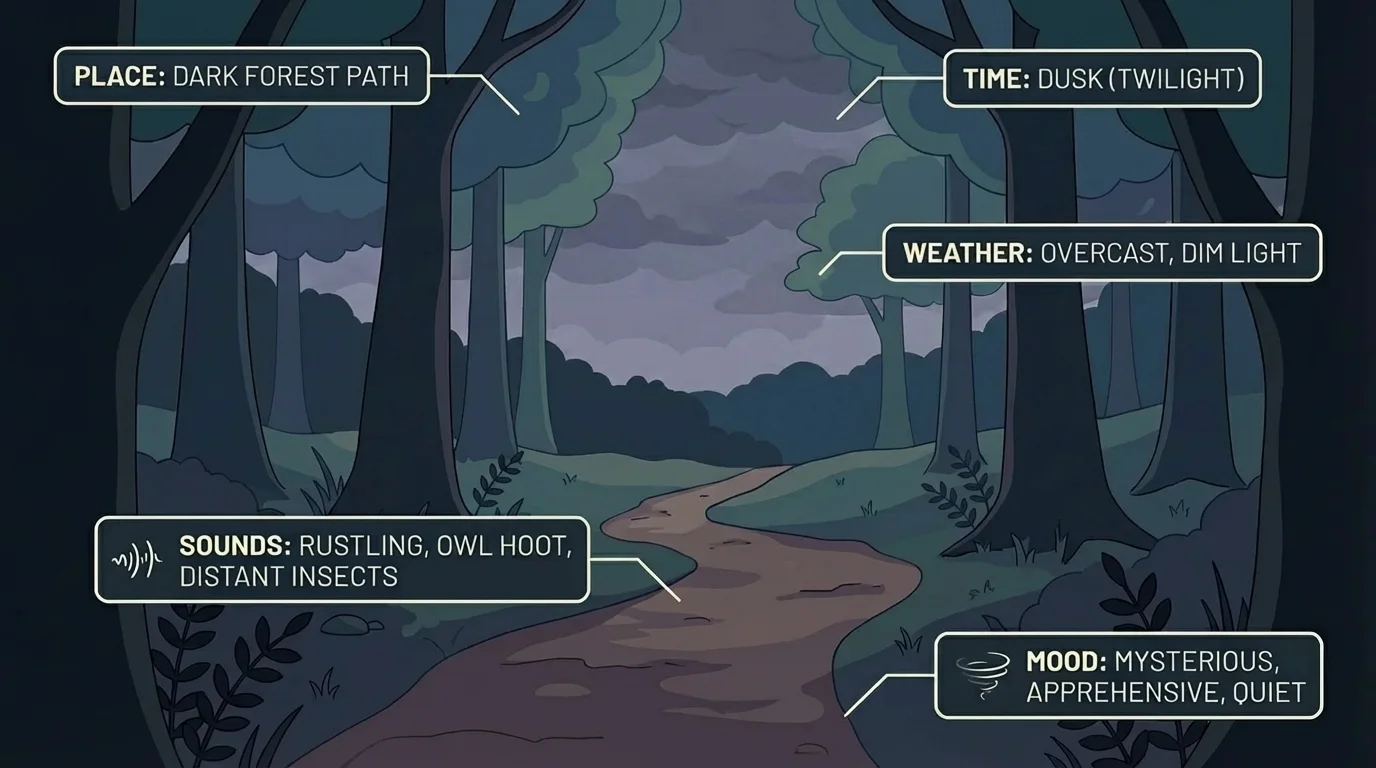
Setting also helps create mood, which is the feeling a reader gets. A sunny garden with buzzing bees and bright flowers may create a peaceful or cheerful mood. A broken house with creaking floors and cold wind may create a spooky or tense mood. When you describe setting in depth, include the details that create that feeling.
Think about this example: "Fog curled around the empty playground. The swings squeaked in the wind, and the last bit of daylight slipped behind the school." A weak description would be, "The setting is outside." A stronger description would be, "The setting is an empty playground at evening, and the fog, squeaking swings, and fading light create a lonely, uneasy mood."
Sometimes setting can almost act like a force in the story. A desert can test a character's strength. A tiny apartment can make a family feel crowded. A peaceful library can give a character a place to think. Later, when you explain events, the setting in [Figure 2] still matters because place and mood often influence what happens next.
In plays and dramas, setting may be shown through stage directions, props, lighting, sounds, and scenery, not only through paragraphs of description. Readers and viewers still use those details to understand place, time, and mood.
To describe setting well, look for sensory details. Ask: What do characters see? hear? smell? feel? Is it day or night? What season is it? Is the place safe, busy, quiet, exciting, or threatening? The answers help turn a basic description into a vivid one.
An event is something that happens in a story or drama. Important events are not random. They connect in a chain of cause and effect, as [Figure 3] shows. One event leads to another, and some events change the direction of the story.
To describe an event in depth, explain what happens, why it happens, and what it causes. Suppose a story says, "After Jamal forgot the map, the hikers took the wrong trail. Soon, thunder rumbled above them, and they realized they were lost." An in-depth description would not stop at "They got lost." It would explain that forgetting the map caused the mistake, and the storm made the situation more dangerous.
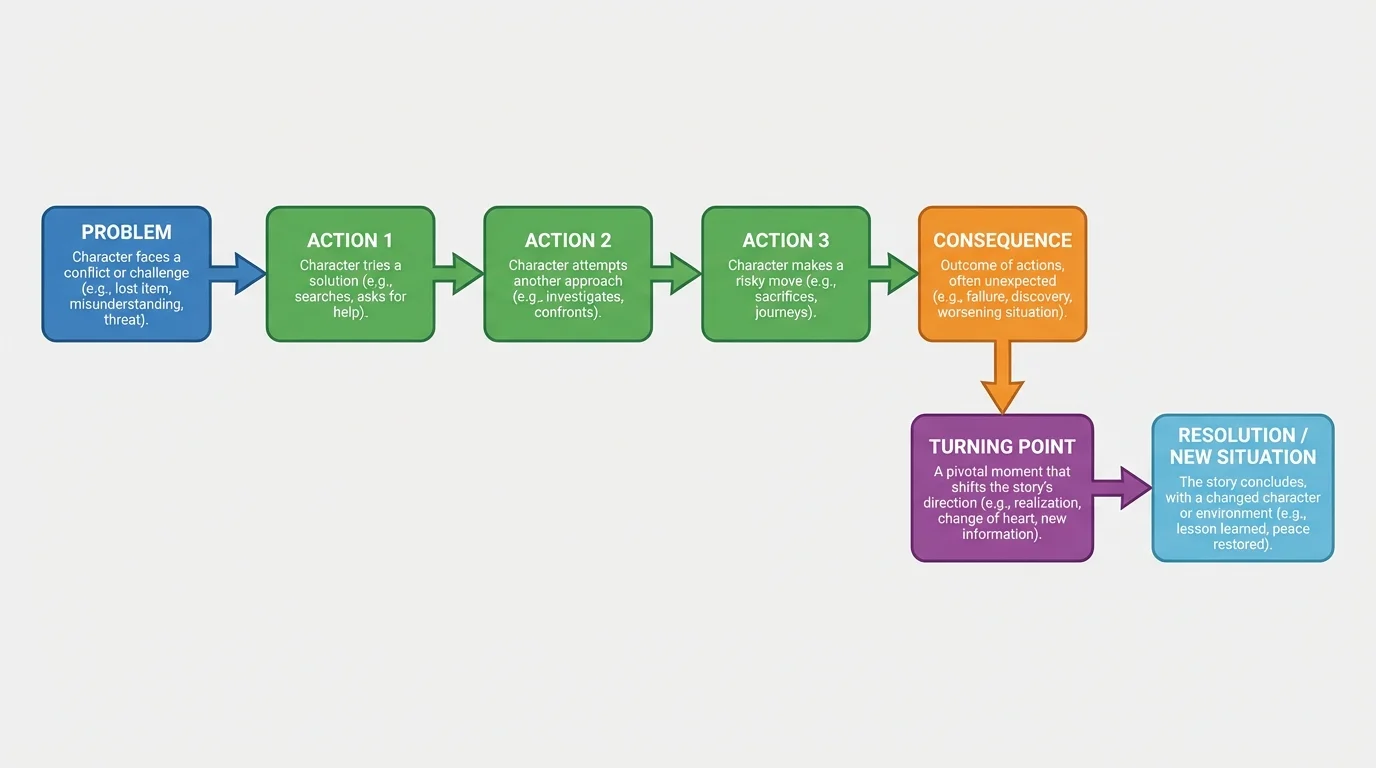
Some events are especially important because they are turning points. A turning point is a moment when the story changes in a major way. A secret may be revealed. A character may make a big decision. A problem may become harder or begin to be solved. Turning points deserve careful attention because they often help readers understand the message or theme of the story.
For example, imagine a drama in which two friends argue for many scenes. Then one friend finally admits, "I broke your model airplane, and I was afraid to tell you." That confession is a turning point. It changes the conflict. It also helps the audience understand the character's fear and guilt.
Cause and effect in story events
A strong description of an event usually includes both the event itself and its results. If a character misses the bus, that may seem small at first. But if missing the bus makes the character late for an audition, and being late changes the rest of the story, then that event matters. Readers should trace what leads up to an event and what follows it.
When you describe events, avoid listing every little thing that happens. Choose the events that matter most. Focus on the problem, important actions, conflicts, and changes. The event chain in [Figure 3] helps show that stories move forward through connected moments, not through isolated details.
Strong readers use details that truly match their idea. If you say a character is generous, your evidence should show generosity. If your evidence only shows that the character is loud or funny, then it does not support the point. The detail and the idea must fit together.
Text evidence can be a direct quote, a paraphrased detail, or both. A direct quote uses the exact words from the text. A paraphrase restates the detail in your own words. For grade 4 reading, both can be useful. For example, "Nora is impatient because she keeps interrupting and says, 'Come on, hurry up!'" This combines explanation and exact words from the story.
From weak evidence to strong evidence
Claim: The setting feels tense.
Weak support: The story is in a house.
This detail is too general. Many stories happen in houses.
Strong support: The lights flicker, the hallway is silent, and footsteps creak upstairs.
These details create suspense and help explain why the setting feels tense.
The stronger answer uses exact details that match the idea.
It is also important to explain the evidence instead of dropping it into a sentence and moving on. Compare these two responses: "The character is worried because 'her fingers twisted the edge of the blanket.'" That is pretty good. But this is stronger: "The character is worried because 'her fingers twisted the edge of the blanket,' which shows nervous movement while she waits." The second response tells what the detail means.
Here is a helpful way to build stronger descriptions. Start with the topic: character, setting, or event. Next, state the idea you want to prove. Then add one or more specific details. Finally, explain how those details support your idea.
You can think of it like this: idea + detail + explanation. This structure helps readers understand your thinking clearly.
| Topic | Weak Description | Strong Description |
|---|---|---|
| Character | The boy is helpful. | The boy is helpful because he carries his neighbor's groceries and stays to clean up the spilled apples. |
| Setting | The park is scary. | The park feels scary because the benches are empty, the fog covers the path, and the trees block the moonlight. |
| Event | The race was important. | The race is important because winning it gives Ana the confidence to believe in herself after many failures. |
Table 1. Comparison of weak descriptions and stronger descriptions supported by specific details.
Notice that the strong examples do not just add more words. They add the right kind of words: exact details and explanations. More words without evidence do not make a better answer. Specific, meaningful details do.
"Good readers do not just say what they think. They show why they think it."
That idea matters whether you are describing a hero, a spooky old house, or a surprising event. Your job is to make your thinking visible.
In many stories, characters, settings, and events are closely connected. A fearful character may react differently in a bright, friendly room than in a dark cave. A stormy setting may turn a small mistake into a dangerous event. A major event may cause a character to change. Strong readers notice these connections.
Consider this short example: "The river roared after days of rain. Elena clutched the rescue rope and stared at the other side. 'If I wait any longer, the dog will be swept away,' she said. She stepped into the icy water." A rich description could include all three parts: the setting is dangerous because the river roars after rain; Elena is brave and worried because she speaks urgently and steps into the icy water; the event is important because her decision begins the rescue.
This kind of response is powerful because it draws on several details. It also shows how the dangerous setting pushes the event forward and reveals Elena's character. In that way, reading closely helps you understand the whole scene, not just one part.
You can also connect ideas across a whole story. A setting introduced early may later become important during a turning point. A shy character from the beginning may act boldly near the end. A small event may grow into a major problem. Looking for these patterns helps you move from simple noticing to deeper understanding.
One common mistake is retelling instead of describing. Retelling means repeating what happened in order. Retelling can be useful sometimes, but if the task is to describe in depth, you need more than a list of events. You need explanation.
Another mistake is using labels without proof. Saying "She is kind" or "The setting is creepy" is only the beginning. Ask yourself, "Which detail shows that?" If you cannot answer, the description is not complete yet.
A third mistake is choosing details that are true but not important. For example, if you are proving that a character is brave, the color of the character's backpack probably does not matter. Choose evidence that connects directly to your point.
Finally, be careful not to confuse your opinion with text evidence. You may personally like or dislike a character, but your description should still be based on the story itself. Even when readers disagree, strong evidence gives their ideas support.
