Have you ever wanted to combine two short sentences into one smoother, stronger sentence? Instead of saying, "I have a neighbor. She bakes bread," a writer can say, "I have a neighbor who bakes bread." One small word can do a big job. Words like who and where help writers connect ideas so their sentences sound natural and clear.
Good writers do not always write many short, choppy sentences. They often join ideas together in a way that helps readers understand how the ideas are connected. Relative pronouns and relative adverbs help do that job. They point back to a person, place, thing, time, or reason and then add more information.
These words are useful in stories, reports, directions, and even conversations. You might say, "The park where we play soccer is closed," or "Tuesday is the day when we have art." In both examples, the sentence gives extra details without starting a whole new sentence.
Relative pronouns are words that connect a noun to more information about it. The main relative pronouns are who, whose, whom, which, and that.
Relative adverbs are words that connect an idea about a place, time, or reason to more information. The main relative adverbs are where, when, and why.
The group of words that begins with one of these words is called a relative clause. A relative clause tells more about a noun or idea.
Look at this example: "The girl who won the race smiled." The noun is girl. The words who won the race tell more about the girl. That group of words is a relative clause.
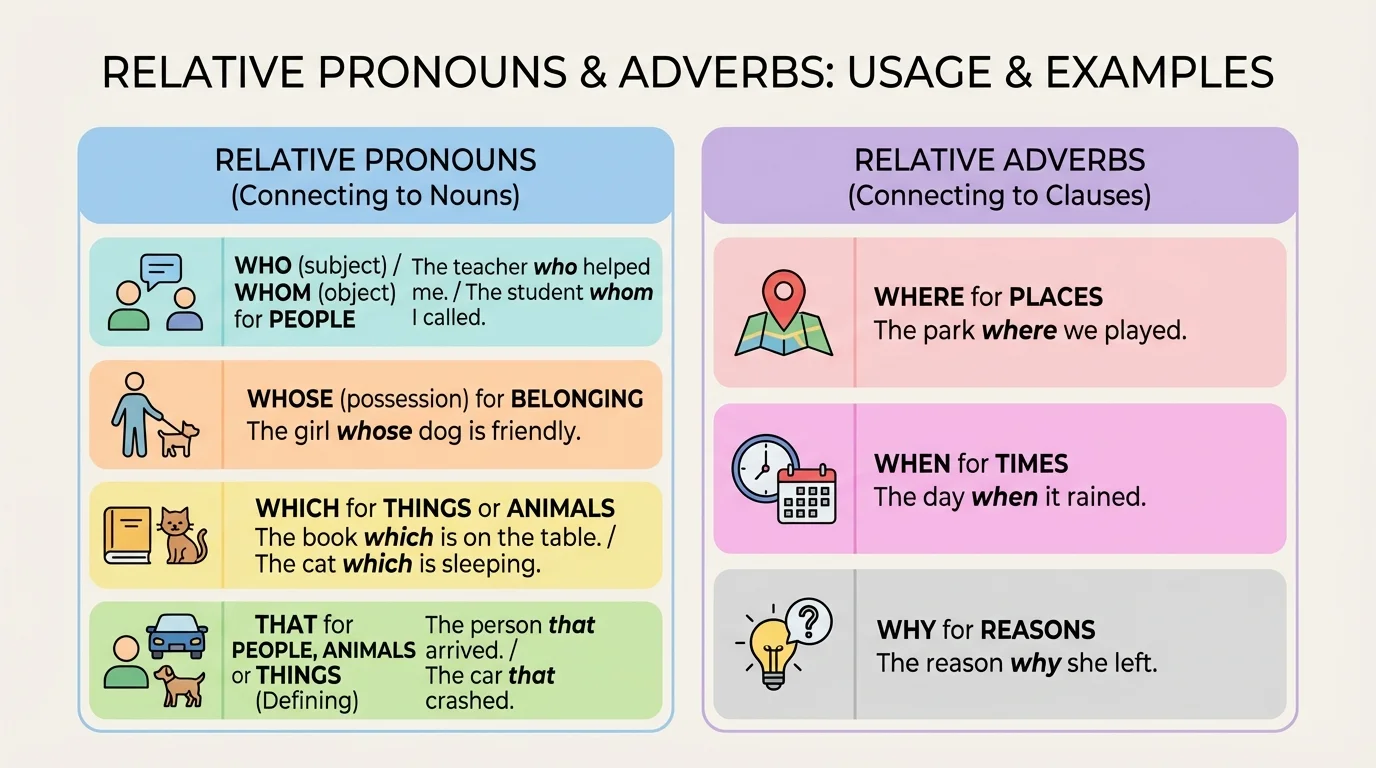
[Figure 1] Relative words act like bridges. They connect one part of a sentence to another part. They keep writing from sounding bumpy or repetitive. Different relative words match different kinds of ideas: people, things, places, times, and reasons.
Without these words, writing can sound awkward. Compare these sentences: "This is the museum. We visited it last spring." A smoother version is, "This is the museum that we visited last spring." The second version sounds more coherent.
Sometimes the relative word is the subject of the relative clause. In "The teacher who helps us is kind," who acts as the subject of helps. Sometimes the relative word is not the subject. In "The coach whom we thanked waved," whom receives the action of thanked.
A relative clause usually begins with a relative pronoun. The pronoun points back to a noun that already appears in the sentence. That noun is called the antecedent. In the sentence "The boy who found the kite cheered," the antecedent is boy.
Each relative pronoun has a special job. Some are mainly used for people, while others are used for things or animals. Choosing the correct one makes a sentence sound natural and helps readers understand exactly what you mean.
Who is used for people. It tells more about a person and often acts as the subject in the relative clause.
Examples: "The singer who performed last night has a powerful voice." "I know the student who solved the puzzle." "The firefighter who rescued the cat smiled."
Whose shows belonging. It tells who owns or has something.
Examples: "The author whose book we read visited our school." "I found the dog whose collar was red." "She is the girl whose backpack has the star patch."
Whom is also used for people, but it is used when the person receives the action. In everyday speech, many people use who instead of whom. Still, it is helpful to know how whom works, especially in careful writing.
Examples: "The woman whom we greeted waved back." "The player whom the crowd cheered scored again." In both sentences, we greeted the woman, and the crowd cheered the player. The woman and player receive the action.
How to test who and whom
A simple trick can help. Try replacing the word with he or him.
Step 1: Read the sentence: "The boy whom we invited came early."
Step 2: Ask: Did he invite, or did we invite him?
Step 3: Since we invited him, whom is correct.
This trick is not perfect for every sentence, but it helps in many cases.
Which is usually used for things or animals. It adds information about a nonhuman noun.
Examples: "The bicycle which has blue tires is mine." "We saw a movie which made us laugh." "The turtle which lives in the pond is very old."
That is very flexible. It can often be used for people, animals, or things. In many sentences, that sounds natural and simple.
Examples: "The cake that Mom baked was delicious." "The team that practiced hardest improved the most." "The dog that chased the squirrel barked loudly." Some writers prefer who for people, especially in formal writing, but that is common too.
Notice how the pronoun helps avoid repetition. Instead of saying, "The cake was delicious. Mom baked the cake," you can say, "The cake that Mom baked was delicious." The sentence becomes smoother and stronger.
Relative adverbs connect ideas too, but they give information about place, time, or reason. They do not stand for a person or thing. Instead, they link to an idea like place, time, or reason.
Where refers to a place. It means something like "in which" or "at which."
Examples: "This is the gym where we practice." "I remember the street where my grandmother grew up." "That is the shelf where the science books belong."
When refers to a time. It means something like "at which time."
Examples: "Friday is the day when we present our projects." "There was a moment when the room became completely quiet." "Winter is the season when many bears sleep more."
Why refers to a reason. It means something like "for which reason."
Examples: "I know the reason why she was excited." "That is the reason why the game was delayed." "No one understood the reason why the lights flickered."
How relative adverbs save words
Relative adverbs let writers combine ideas neatly. Instead of saying, "This is the park. We met there," a writer can say, "This is the park where we met." Instead of "I remember the day. We moved then," a writer can say, "I remember the day when we moved." These forms sound natural and keep the sentence connected.
Sometimes a writer can choose between a relative adverb and a relative pronoun with other words. For example, "the house where I was born" can also be written as "the house that I was born in." Both are understandable, but where often sounds smoother.
Some relative clauses give information you really need. Other relative clauses just add extra details. This difference matters because it can change punctuation.
Essential information tells which person or thing you mean. Without it, the sentence would be unclear. Example: "The student who forgot his notebook borrowed paper." The clause who forgot his notebook tells which student. It is necessary.
Extra information adds a detail that is nice to know but not necessary to identify the noun. Example: "My brother, who loves chess, practices every day." If you remove who loves chess, the sentence still tells who is being discussed: my brother. The extra information is set off with commas.
For grade-level writing, a simple rule helps: if the information is needed to know exactly whom or what the sentence means, do not use commas. If the information only adds an extra detail, use commas.
| Type of clause | What it does | Example |
|---|---|---|
| Essential | Names exactly which person or thing | The book that is on the desk is overdue. |
| Extra | Adds detail that is not required | My book, which is on the desk, is overdue. |
Table 1. This table compares essential and extra relative clauses.
Notice the difference. In the first sentence, that is on the desk tells which book. In the second, the speaker already means one specific book, and which is on the desk simply adds detail. Later, when you revise your writing, thinking about this difference can make your punctuation clearer.
Writers often have more than one possible choice. The best choice depends on what kind of noun comes before the clause and what job the word does in the clause.
Use who for people when the word acts as the subject: "The doctor who checked my arm was kind." Use whom for people when the word receives the action: "The doctor whom we thanked smiled." Use whose when you need to show belonging: "The doctor whose advice helped me was patient."
Use which for things and animals, especially when adding extra information: "The robot, which moved slowly, stopped at the wall." Use that often for things, animals, and sometimes people in essential clauses: "The robot that moved slowly stopped at the wall."
Use where for places, when for times, and why for reasons. As you saw earlier in [Figure 1], each word matches a certain kind of idea, and choosing the correct match helps the sentence make sense right away.
You already know that a noun names a person, place, thing, or idea. Relative words connect back to those nouns and add information. If you can find the noun being described, you are much more likely to choose the correct relative word.
Here is a useful way to think about it. Ask yourself, "Am I talking about a person, a thing, a place, a time, or a reason?" Then choose the relative word that fits. This quick check can prevent many mistakes.
One common mistake is using the wrong word for the noun. A sentence like "The teacher which helped us" sounds wrong because which is usually not used for people. "The teacher who helped us" is the better choice.
Another mistake is repeating the subject. Do not say, "The dog that it barked woke me up." The word that already connects the clause, so the extra it is unnecessary. The correct sentence is "The dog that barked woke me up."
Writers also sometimes leave out an important word. For example, "I know the reason she left" is understandable, but "I know the reason why she left" may sound clearer for younger writers. As students grow, they learn that some relative words can sometimes be left out, but using them clearly is a good habit while learning.
Another mistake is choosing where for something that is not really a place. For example, "I like the book where the hero travels" is not the best choice because a book is not a place. A better sentence is "I like the book in which the hero travels," or more simply for grade 4, "I like the book that tells the story of a hero who travels."
Many excellent authors use relative clauses all the time because they help sentences carry more detail without becoming a list of short, repeated statements. These tiny connecting words are part of what makes writing sound fluent.
Be careful with long sentences. Relative clauses are helpful, but too many in one sentence can confuse readers. A sentence such as "The boy who lives next door whose dog that barks at night chased the cat that climbed the fence" becomes hard to follow. Good writers use these clauses clearly, not endlessly.
Relative pronouns and relative adverbs are not just grammar rules to memorize. They are tools for making your meaning clear. In a story, they help you describe characters and settings: "The village where the hero lived was surrounded by snow." In an opinion paragraph, they help you explain ideas: "Recess is the time when students can move, talk, and recharge." In a report, they help you add exact details: "The invention that changed farming saved time and labor."
These words also help your speaking sound more natural. Instead of saying, "I have a cousin. She lives in Texas. Her dog can catch a Frisbee," you can say, "I have a cousin who lives in Texas and whose dog can catch a Frisbee." The second version sounds more connected.
When you revise your own writing, look for places where two short sentences can be combined. If the second sentence tells more about a noun in the first sentence, a relative word may help. You can combine "We visited a farm. The farm had goats" into "We visited a farm that had goats." You can combine "That was the summer. I learned to swim then" into "That was the summer when I learned to swim."
Writers choose these words because they guide readers smoothly from one idea to the next. Strong grammar is not about sounding fancy. It is about making your meaning easy to understand.
"The right little word can connect big ideas."
If you remember what each word points to, you will make stronger choices. Who and whom point to people. Whose shows belonging. Which and that often point to things or animals, and that can also point to people in many everyday sentences. Where points to places, when to times, and why to reasons.
As your writing grows, you will notice that these words help you sound more precise. A sentence with the right relative word tells readers exactly how ideas fit together. That is one reason grammar matters: it helps your thoughts travel clearly from your mind to someone else's.
