Have you ever noticed that reading a recipe, a mystery story, and instructions for a game do not feel the same? That is because good readers do not read everything in the same way. They read with a purpose. Purpose helps a reader know what to pay attention to, how carefully to read, and what to do when a word or idea is tricky.
Reading with purpose means you know why you are reading. You might read to enjoy a story, learn new facts, answer questions, solve a problem, or follow directions. When readers know their purpose, they make smarter choices. They may slow down, reread, take note of important details, or focus on key ideas.
If you read a chapter about volcanoes, your purpose may be to learn how volcanoes form. You will probably pay attention to important words, headings, diagrams, and cause-and-effect ideas. If you read a funny adventure story, your purpose may be to enjoy the characters and understand the plot. You will pay attention to actions, feelings, and changes in the story.
Purpose changes how you read. Strong readers adjust their reading to match the task. They may skim a page to get the main idea, read slowly to understand a hard part, or reread to clear up confusion. Purpose acts as a guide for the reader's attention.
Purpose does not only matter in school. People read for all kinds of reasons every day: menus, sports schedules, game rules, weather reports, song lyrics, websites, and directions for building or cooking something. The better you match your reading to your purpose, the more successful you become.
An on-level text is a text that is appropriate for your grade. It should be challenging enough to help you grow, but not so hard that you cannot understand it even with effort and strategies. Grade-level reading includes longer sentences, richer vocabulary, and more complex ideas than easier texts.
Reading on-level text does not mean every word feels easy. In fact, strong readers expect to meet some new words and some tricky parts. They use what they know about spelling patterns, word parts, and meaning to work through those challenges. They stay with the text instead of quitting when a part gets hard.
You already know many helpful reading skills from earlier grades: sounding out words, noticing punctuation, reading common sight words, and checking whether something makes sense. Grade-level reading builds on those skills and asks you to use them more flexibly and independently.
Reading on-level text also means building stamina. Stamina is the ability to stay focused and keep reading for a longer time. Just as athletes build strength by practicing, readers build stamina by reading often and working through texts that require attention and effort.
[Figure 1] Accuracy, fluency, and comprehension are connected. If a reader struggles to read many words correctly, it becomes harder to understand the message of the text. If a reader reads too slowly or without expression, the meaning may also get lost.
Accuracy means reading words correctly. When you read accurately, you match the printed words to the right spoken words. Fluency means reading smoothly, at a sensible pace, with phrasing and expression. Comprehension means understanding what the text says and what it means.
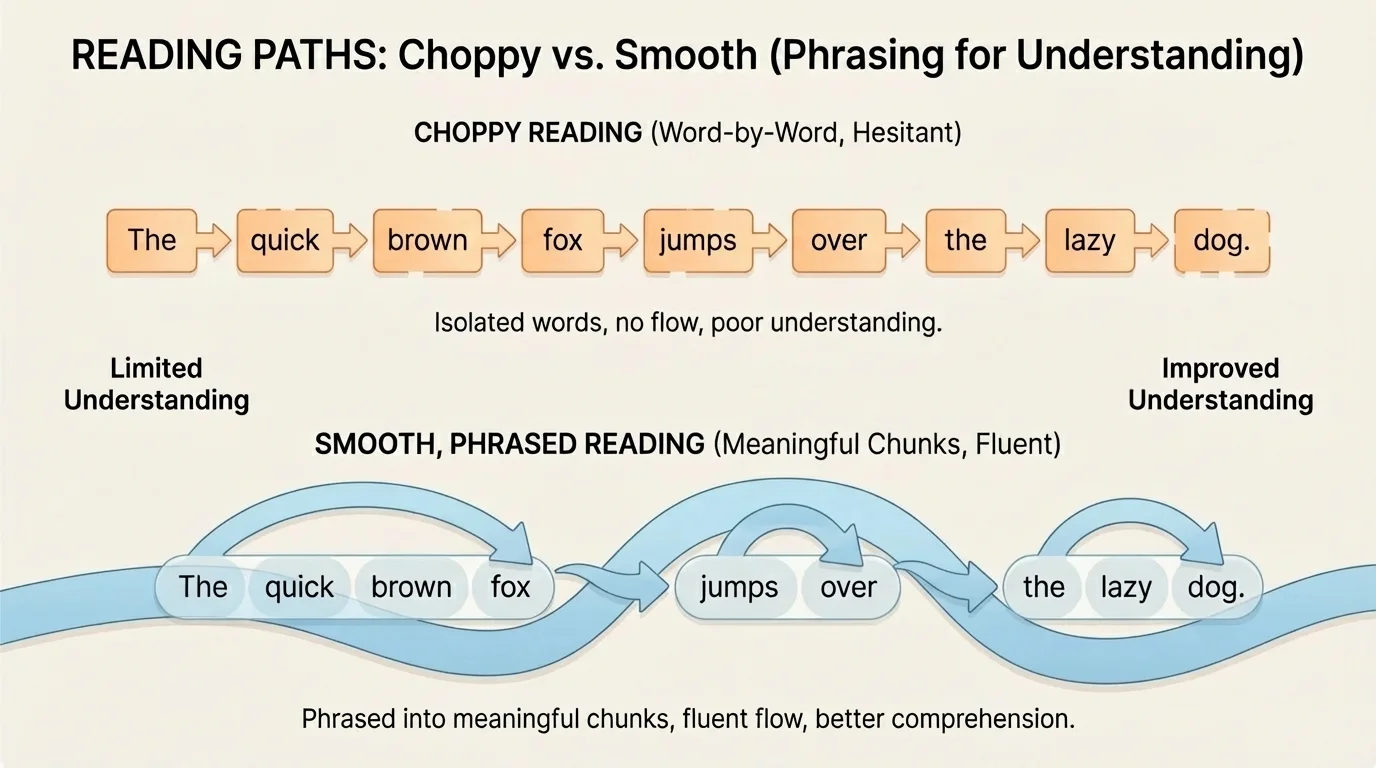
Think about this sentence: The tired puppy curled up beside the warm fireplace. A fluent reader groups words in a way that makes sense: The tired puppy / curled up / beside the warm fireplace. A choppy reader might stop after almost every word. That makes the sentence harder to understand because the ideas do not stay connected.
Punctuation helps fluency. Periods tell you to stop. Commas often signal a shorter pause. Question marks and exclamation points can change your voice. Reading with expression is not acting for fun only; it shows that you understand the meaning. When a character whispers, asks, or shouts, your voice should reflect that meaning.
Accuracy is reading words correctly. Fluency is reading smoothly, with appropriate speed, phrasing, and expression. Comprehension is understanding the ideas in a text.
Fluency does not mean racing. Reading too fast can hurt understanding. A good pace is one that lets you read smoothly and still think about the meaning. As you become more fluent, your brain spends less energy on figuring out each word and more energy on understanding the text.
Later, when you read a science passage or a story dialogue, the same idea from [Figure 1] matters again: smooth phrasing helps you hold ideas together. That is one reason repeated reading, listening to strong reading, and practicing tricky words can improve comprehension.
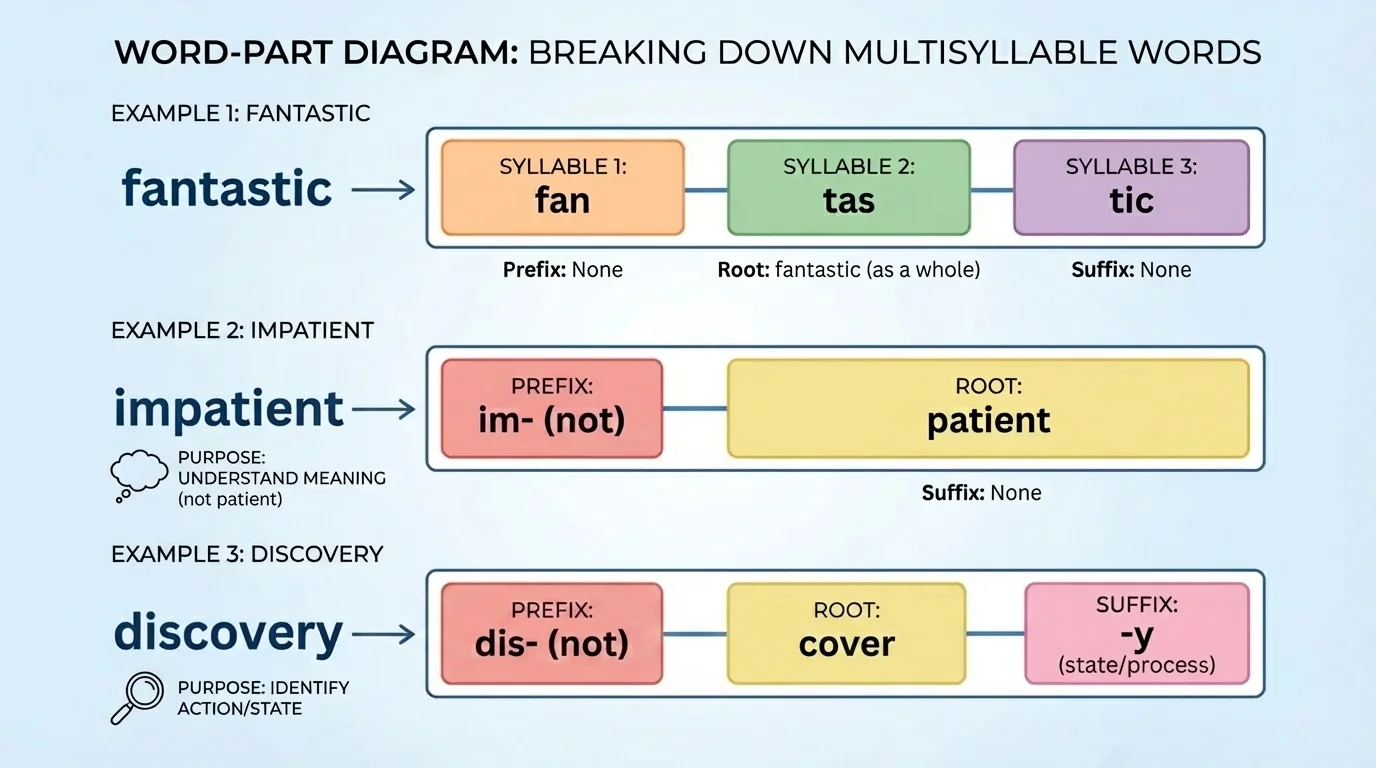
Readers in grade 4 often meet long words with many parts. [Figure 2] A multisyllable word has more than one syllable. Instead of getting stuck, strong readers break the word into smaller chunks. They look for familiar spelling patterns, syllables, and word parts.
Suppose you see the word fantastic. You might break it into syllables: fan / tas / tic. If you see discovery, you might notice dis / cov / er / y. Chunking a word into parts makes it easier to decode than trying to read the whole word at once.
Some spelling patterns are especially helpful. Vowel teams such as ai, ea, and oa often signal a vowel sound. Silent letters may appear in words like knock or write. Open and closed syllables can also help. In an open syllable, a vowel often says its long sound, as in ba in baby. In a closed syllable, a vowel often says its short sound, as in rab in rabbit.
Readers also look for parts they already know. In sunflower, you can read sun and flower. In backpack, you see back and pack. In longer words, known chunks still help. For example, careless contains care and -less. Replaying contains re-, play, and -ing.
Decoding a long word
Read the word impatiently.
Step 1: Look for familiar parts.
You may notice im-, patient, and -ly.
Step 2: Break it into chunks.
im / pa / tient / ly
Step 3: Blend the chunks smoothly.
Say the parts and then read the whole word: impatiently.
Step 4: Check the sentence.
If the sentence is "He waited impatiently at the door," the word sounds right and makes sense.
When decoding a hard word, use three checks: Does it look right? Does it sound right? Does it make sense? Good readers use all three. A word may sound close, but if it does not make sense in the sentence, it is worth checking again.
As you keep reading, the chunking pattern in [Figure 2] helps with other words too. Once you learn to notice syllables and familiar letter patterns, many long words become much less intimidating.
Morphology is the study of meaningful word parts. [Figure 3] shows how words can be built from prefixes, base words, and suffixes. This is powerful because you can often figure out an unknown word even if you have never seen it before.
A prefix is a word part added to the beginning of a word. A suffix is a word part added to the end. A base word is the main part that carries the core meaning. In unhappy, the prefix un- means "not," and the base word happy tells the main idea. So unhappy means "not happy."
Here are some common prefixes and suffixes that help readers figure out meaning:
| Word Part | Meaning | Example |
|---|---|---|
| un- | not | unsafe = not safe |
| re- | again | replay = play again |
| dis- | not, opposite of | disagree = not agree |
| -ful | full of | hopeful = full of hope |
| -less | without | fearless = without fear |
| -er | one who | teacher = one who teaches |
Table 1. Common prefixes and suffixes that help readers decode and understand unfamiliar words.
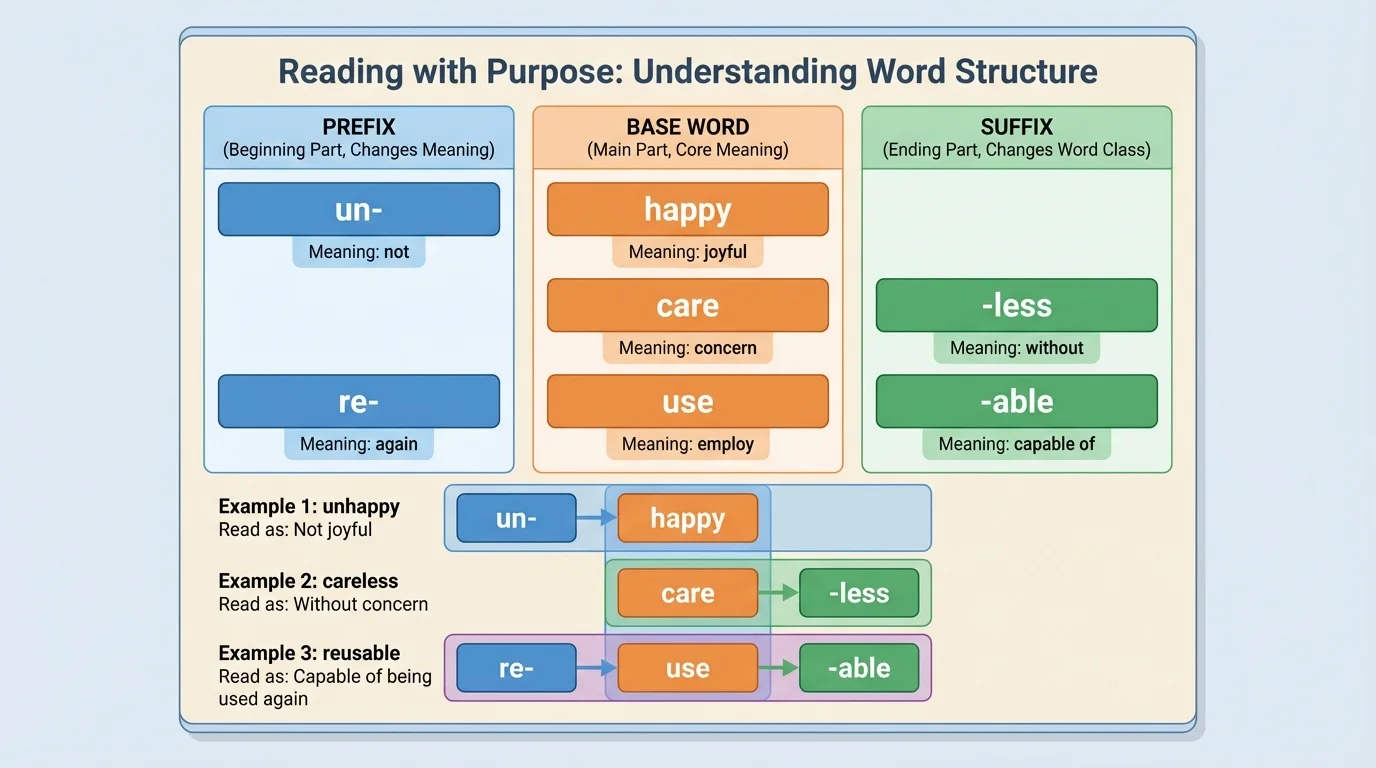
If you meet the word careless, you may know the base word care. The suffix -less means "without." So careless means "without care" or "not careful." If you meet reusable, the prefix re- means "again," and the base idea of use helps you understand that something reusable can be used again.
Many long words are like puzzles made of meaningful pieces. Once you learn common prefixes and suffixes, learning one new word part can help you understand many other words that share the same parts.
Morphology also helps with academic words in science and social studies. For example, preview means to view before. Misbehave means behave in a wrong way. Homeless means without a home. Instead of guessing wildly, readers use the parts of the word and the sentence around it.
That same structure from [Figure 3] works across many subjects. When you notice that a word has a beginning part, a main meaning part, and an ending part, you are using word knowledge to understand text more deeply.
Comprehension is active. Good readers think before reading, during reading, and after reading. Before reading, they preview the title, headings, pictures, captions, or first lines. This gives clues about the topic and helps set a purpose.
During reading, strong readers monitor their understanding. That means they notice when meaning breaks down. If a paragraph is confusing, they do not just keep marching ahead. They may slow down, reread, read the next sentence for a clue, or stop to think about what just happened.
Monitoring understanding means paying attention to whether the text makes sense to you. When something becomes confusing, a strong reader chooses a fix-up strategy, such as rereading, reading ahead for clues, or breaking apart a hard word.
Questions help comprehension. While reading, you might wonder: Who is speaking? Why did this happen? What is the main idea? What details support it? What might happen next? These questions keep your brain involved with the text.
After reading, readers often think back over the important ideas. In a story, they may remember the characters, problem, key events, and solution. In an informational text, they may remember the topic, main idea, and supporting details. This mental review helps the learning stick.
Sometimes a single unknown word causes confusion. Other times the words are easy, but the ideas are complex. Good readers notice the difference. They know when to use decoding and when to slow down and think more carefully about the meaning of a section.
[Figure 4] Different purposes call for different strategies, and the chart connects reading purposes to text types. A story, an article, a set of directions, and a poem each ask readers to pay attention in a slightly different way.
When reading stories, readers often focus on characters, setting, conflict, and theme. They notice how people change and how events connect. Expression and phrasing are especially helpful in dialogue because voice clues often reveal feelings.
When reading informational texts, readers focus on main ideas, details, text features, and important vocabulary. Headings, captions, and bold words often signal what matters most. If the purpose is to learn facts, it helps to pause and ask, "What did I just learn?"
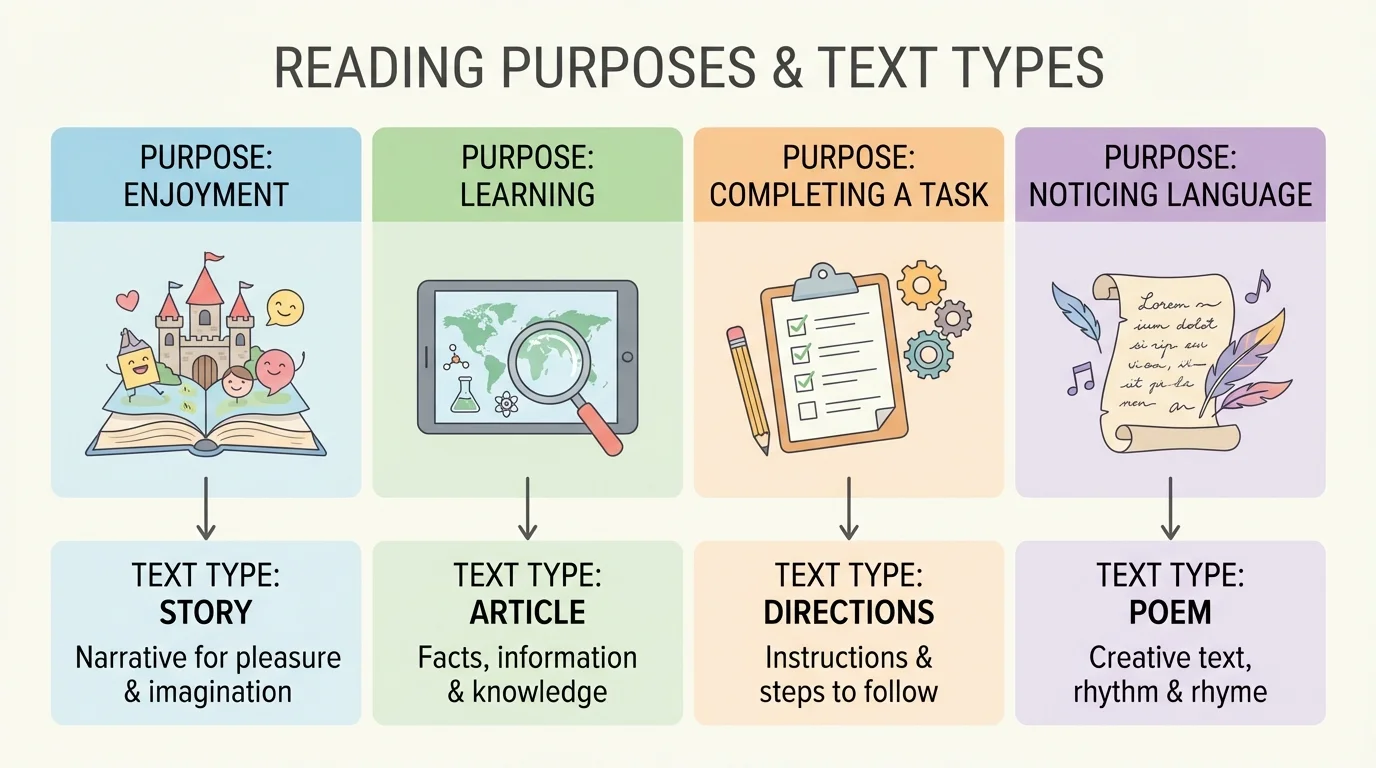
When reading directions, sequence matters. A missed word can cause a mistake. If you are building a model, following a recipe, or learning a game, you may need to read slowly and check each step in order.
When reading poetry, readers pay attention to rhythm, repeated words, images, and feeling. Poems may not always explain everything directly. You may need to reread and think about what the poet wants you to see, hear, or feel.
Changing strategy by purpose
Suppose you read the sentence: Mix the batter gently, then pour it into the pan.
Step 1: Identify the purpose.
The purpose is to follow directions correctly.
Step 2: Notice important action words.
Mix and pour tell what to do.
Step 3: Watch sequence words.
Then tells the order of actions.
Step 4: Read carefully enough to avoid mistakes.
This kind of reading may be slower than reading a story for fun.
If you compare your reading choices across text types, the idea in [Figure 4] becomes clear: purpose shapes attention. Strong readers stay flexible and choose strategies that fit the text in front of them.
Becoming a stronger reader is not about one magic trick. It comes from habits that build over time. Read often. Read a variety of texts. Practice hard words instead of skipping them. Notice punctuation. Reread when meaning breaks down. Use word parts to decode and understand vocabulary.
It also helps to hear fluent reading. Listening to a teacher, family member, or audiobook model can teach your ear how phrasing and expression sound. Then, when you read aloud, you can try to make your reading sound like meaningful speech, not a list of separate words.
"Read not to contradict and confute, nor to believe and take for granted, nor to find talk and discourse, but to weigh and consider."
— Francis Bacon
Reading growth is gradual. One day a word feels impossible; later it becomes familiar. One week a passage feels slow; later it flows smoothly. Every time you read with purpose, use spelling patterns, notice word parts, and check your understanding, you strengthen your skills.
That is what it means to read grade-level text with purpose and understanding: you read accurately enough to keep meaning clear, fluently enough to support comprehension, and thoughtfully enough to learn, enjoy, and use what you read.
