Have you ever been in a conversation where everyone seemed to know what was happening except one person? That person may have missed the reading, forgotten the details, or not thought about the topic ahead of time. In class discussions, preparation makes a big difference. When you are ready, you can join the conversation with confidence, understand what others are saying, and help the group think more deeply.
A discussion is not just talking. A good discussion is a shared process of learning. Students listen, think, ask questions, answer questions, and connect ideas. To do that well, students need to know the topic. That is why teachers often ask students to read a passage, study notes, watch a demonstration, or learn facts before a discussion begins.
Being prepared means you already know something important about the topic before the discussion starts. You may have read a story, studied a science article, reviewed class notes, or looked over a social studies map. This earlier work gives you ideas to bring into the conversation. Instead of guessing, you can speak from what you learned.
Preparation helps in several ways. First, it helps you understand the topic better. Second, it helps you listen more carefully because you can connect what others say to what you already know. Third, it helps you ask stronger questions. Fourth, it helps you explain your thinking clearly. A prepared student does not have to say the most words. A prepared student makes meaningful contributions.
Prepared means ready for a task because you have already read, studied, thought, or practiced. In a class discussion, being prepared means you know the topic well enough to talk about it, listen to others, and use what you learned.
Discussion is a conversation in which people share ideas, ask questions, and respond to one another about a topic or text.
Evidence is information that supports an idea. In class discussions, evidence often comes from a book, article, notes, observations, or facts you learned.
Preparation also shows respect. When everyone does the reading or studies the topic, the group can have a richer conversation. No one has to stop and explain everything from the beginning. Instead, the class can spend time exploring ideas, comparing opinions, and thinking more deeply.
Coming prepared does not mean memorizing every word. It means understanding the important parts. You should know the main topic, some key details, and at least a few ideas you want to share. You should also be ready to listen and respond when someone says something new or surprising.
For a reading discussion, being prepared might mean you know the characters, setting, problem, and important events in a story. If the class is discussing an article, you should know the main idea and details that support it. For science, you may need to know the steps in a process, such as how plants grow or how weather changes. For social studies, you may need facts about people, places, or events.
Preparation also includes thinking ahead. You might ask yourself: What surprised me? What did I learn? What is still confusing? What do I agree or disagree with? These questions turn reading into thinking, and thinking helps discussions become stronger.
Preparation turns private thinking into shared learning. First, you learn on your own by reading or studying. Then, during a discussion, you bring that learning into a group. You also hear new ideas from classmates. This means preparation is not just for speaking. It is also for understanding, questioning, and growing your thinking when others share.
Sometimes students think being prepared only matters if the teacher calls on them. Actually, it matters even when you are mostly listening. A good listener who is prepared can understand connections, notice strong evidence, and ask a thoughtful question at the right time.
One strong way to prepare is to make quick notes while you read or study. A simple organizer, as shown in [Figure 1], helps you collect the title, the main idea, important details, new words, and questions. This keeps your thinking in one place so you can use it when the discussion begins.
Start by reading or studying the required material carefully. If it is a story, pay attention to what happens and why it matters. If it is an article, notice what the author is teaching. If it is a science observation, focus on what you saw and what changed. If it is notes from class, review the parts your teacher said were important.
Next, find the most important ideas. Ask yourself, "What is this mostly about?" Then ask, "What details help explain that?" You do not need to write everything down. Choose the details that matter most.
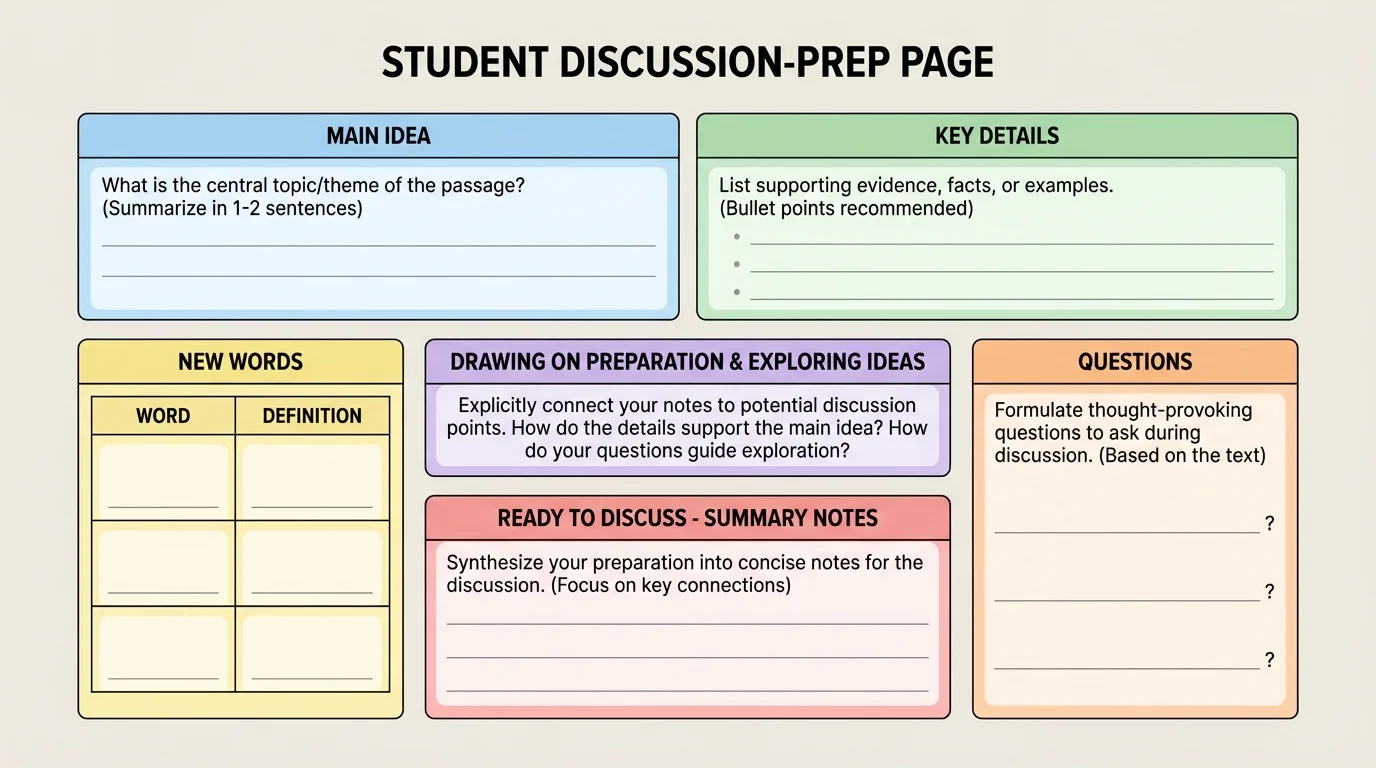
It also helps to notice words you do not know. An unfamiliar word can make part of a text confusing. If you learn the word before the discussion, you will understand more. You can also write down a question about that word if you still are not sure.
Finally, think of something you might say. This could be an idea, a connection, or a question. For example, after reading a story about a boy rescuing a dog during a storm, you might prepare to say, "I think the boy was brave because he put the dog's safety before his own comfort." That comment shows you read the story and thought about it.
The same note-taking pattern in [Figure 1] works for many subjects. In science, your key details might be observations. In social studies, they might be facts about a place or event. In reading, they might be character actions and important events.
Example: Preparing for a story discussion
The class reads a story about a girl who wants to win a race but stops to help a friend who falls.
Step 1: Find the main idea.
The story is mostly about kindness and sportsmanship.
Step 2: Choose key details.
The girl trains hard, starts the race, sees her friend fall, stops to help, and finishes later than expected.
Step 3: Prepare a comment.
"I think the author shows that doing the right thing matters more than winning."
Step 4: Prepare a question.
"Why do you think the girl chose to stop, even though the race was important to her?"
Notice that the student is not just retelling the whole story. The student is selecting the most important parts and getting ready to explore an idea.
When the discussion begins, prepared students do more than speak from memory. They use details from the text, notes, or lesson to support what they say. A strong classroom conversation, as shown in [Figure 2], includes a claim, support from the material, and a response that moves the idea forward.
You can show preparation by naming the part of the reading you mean. For example, you might say, "In the second paragraph, the author explains that turtles return to the same beach to lay eggs." Or you might say, "At the end of the story, the character changes her mind." These kinds of comments show that your ideas come from what you studied.
Another good habit is using your notes while you talk. Notes are not cheating. Notes are tools. They help you remember details and stay focused. A quick look at your paper can help you share a clearer answer or ask a better question.
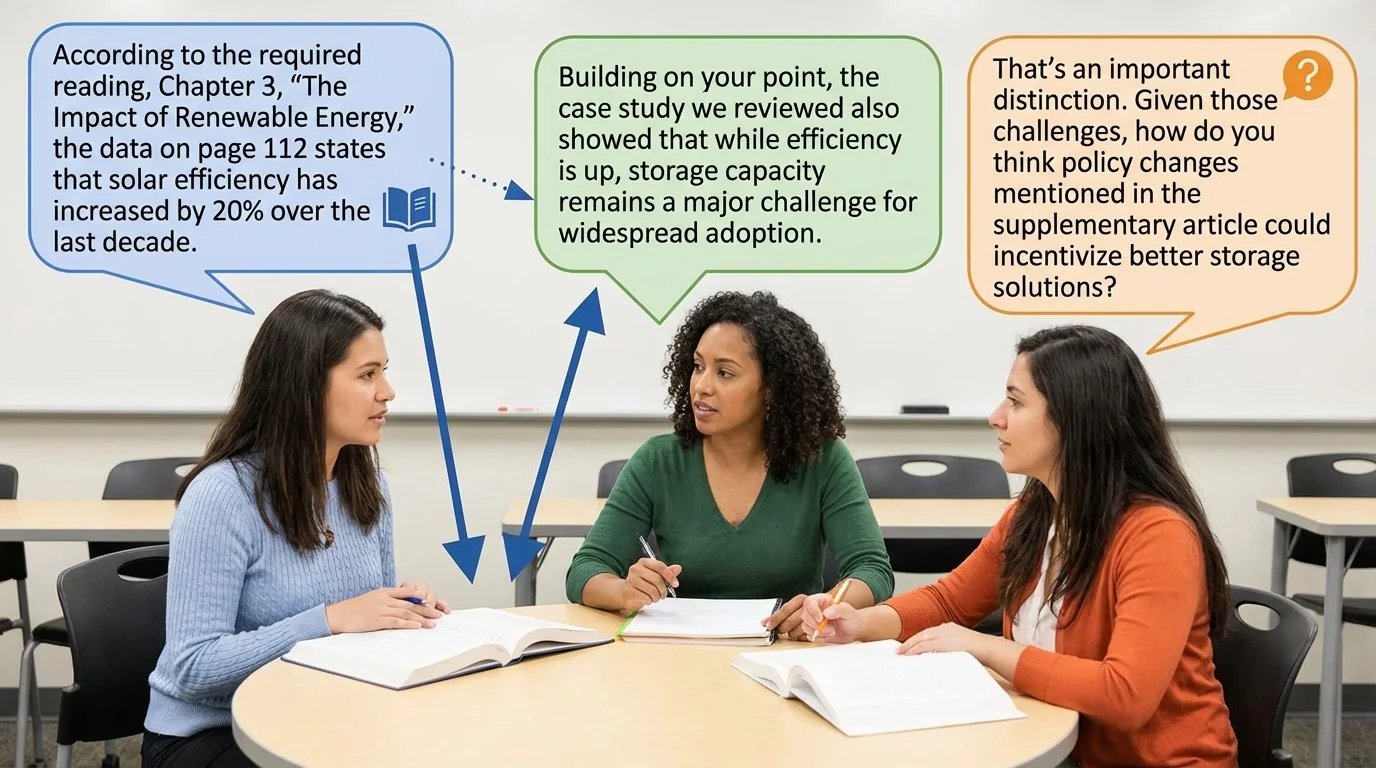
You can also show preparation by making connections. Maybe a classmate talks about a character's courage, and you connect that to a different part of the story. Maybe a student shares a science fact, and you add an observation from an experiment. This is how discussions grow.
Prepared speaking often sounds like this:
Later in a longer discussion, the speaking pattern in [Figure 2] still matters: one idea leads to evidence, then evidence leads to another question or comment. This helps the group explore the topic instead of jumping around randomly.
A discussion is not a line of separate speeches. It is a connected conversation. That means you must listen actively. Active listening means listening with care so you can understand, think, and respond. Your eyes, ears, and mind are all involved.
When you listen actively, you notice what others are really saying. Then you can build on their ideas. To build on an idea means to add something that helps the discussion go farther. You might add a new detail, ask a follow-up question, offer another example, or explain why you agree or disagree.
Here are some respectful ways to build on ideas:
Suppose one student says, "The main character seems selfish at first." A prepared listener might answer, "I thought that too, but later she shares her supplies with her brother. That made me think she changed." This response shows listening, evidence, and deeper thinking.
Good discussions often sound slower than casual conversations because thoughtful speakers pause, listen, and choose details carefully. That slower pace usually means stronger thinking is happening.
Sometimes building on an idea means asking for clarification. If someone says, "The storm was the most important part," you could ask, "Do you mean it changed the problem in the story, or do you mean it changed the character?" That question helps the group become more precise.
Classroom discussions happen in different formats, and each one asks for preparation in a slightly different way. The comparison in [Figure 3] shows that partner, small-group, and teacher-led discussions all use the same basic preparation, but students may participate differently in each one.
In a collaborative discussion with one partner, you may get more chances to speak. Because only two people are talking, both students need to be ready. If one person is unprepared, the conversation can stop quickly. In a partner talk, it helps to bring at least one idea and one question.
In a small group, several students share ideas. Here, preparation helps you stay involved. You can listen to different opinions, compare evidence, and notice patterns. A group discussion becomes stronger when students do not repeat the same point over and over. Prepared students help by adding new information.
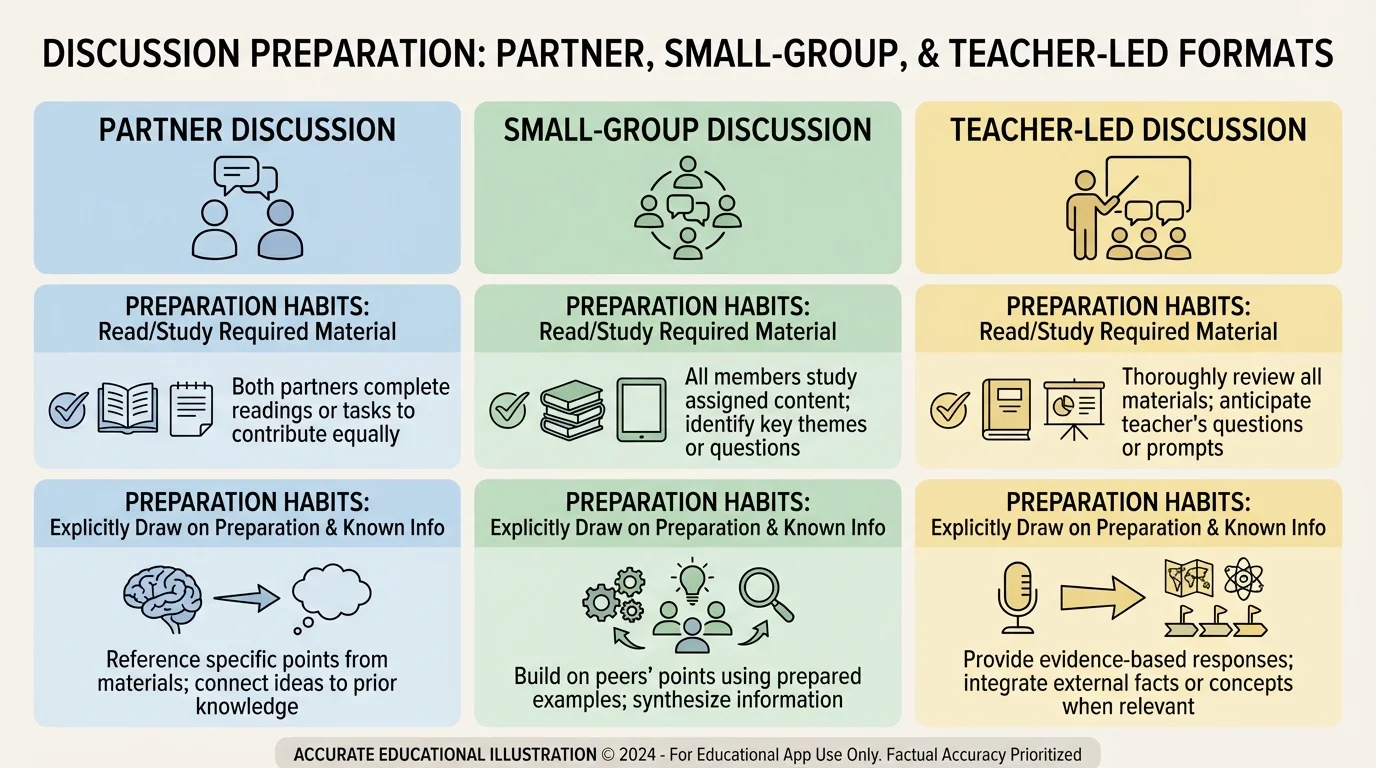
In a teacher-led discussion, the teacher may guide the class with questions. You still need to be ready, because the teacher may ask you to explain your thinking, support an answer, or respond to a classmate's comment. Preparation helps you answer with confidence instead of saying only, "I don't know."
| Discussion type | How preparation helps | What you might do |
|---|---|---|
| Partner discussion | Keeps the conversation going | Bring one idea and one question |
| Small-group discussion | Helps you add new details and respond to several classmates | Use notes and listen for connections |
| Teacher-led discussion | Helps you answer clearly and support your thinking | Refer to the text or lesson facts |
Table 1. This table compares how preparation supports different kinds of classroom discussions.
Later, when you switch from a partner talk to a whole-class conversation, the same categories in [Figure 3] still apply. You are still expected to know the material, listen carefully, and use details to support your ideas.
Sometimes students want to be prepared but run into problems. One common problem is forgetting what they read. A smart solution is to jot down a few notes right away. Another problem is not understanding part of the text. A smart solution is to reread, ask about unknown words, or review class notes before the discussion starts.
Another challenge is feeling nervous. Some students worry that their answer might be wrong. Preparation helps because it gives you something solid to stand on. If your comment comes from the text or from your notes, you have a strong reason for saying it. You do not have to be perfect. You just need to be thoughtful and ready.
Remember that discussions are not contests to see who talks most. They are chances to learn together. Listening carefully, using evidence, and asking a useful question are all signs of strong participation.
A different challenge is talking without listening. This can happen when students are so busy waiting to speak that they miss what others say. Preparation helps here too. If you already know your idea, you can relax and listen instead of worrying about what to say next.
Sometimes students repeat the text but do not explore it. For example, saying "The character went home" is only a basic detail. A stronger comment would be, "The character went home because she finally understood her mistake." That second comment adds thinking, not just retelling.
Prepared discussion language is clear, polite, and connected to the topic. It helps others understand your thinking. You do not need fancy words. You need precise words.
Here are some helpful sentence starters:
These sentence starters are useful because they connect your speaking to your preparation. They remind you to use what you read or studied, not just your first guess.
"Good thinkers do not just have ideas. They can explain where their ideas come from."
For example, if the class studied animal habitats, a student might say, "I think desert animals have special body parts for saving water because the article explained that rain does not come often." This answer is stronger than saying only, "Desert animals are different."
In reading class, students discuss a folktale. One student says, "The clever rabbit solved the problem by tricking the larger animal." Another student responds, "I agree, and I think the author wants us to see that thinking can be stronger than size." Both students show preparation because they know what happened and what it means.
In science, students study the life cycle of a butterfly. A prepared student might say, "The chrysalis stage is important because that is when the caterpillar changes into a butterfly." Another student could ask, "Why do you think this change cannot happen all at once?" That question shows careful listening and curiosity.
Example: Preparing for a science discussion
The class reads about how shadows change during the day.
Step 1: Find the main idea.
Shadows change because the Sun appears to move across the sky.
Step 2: Collect evidence.
Morning shadows are long, noon shadows are shorter, and later shadows change direction.
Step 3: Prepare a response.
"I noticed that the shortest shadow happened near the middle of the day."
Step 4: Prepare a question.
"Would the shadow look the same in every season?"
In social studies, the class reads about a community working together after a flood. A prepared student might say, "The article shows cooperation because neighbors shared food and helped clean homes." A classmate can build on that by adding, "That makes me think communities become stronger when people help one another."
These examples show that preparation is useful in every subject. Whether you are talking about a story, a science process, or an event in history, the same habits matter: read or study carefully, choose important details, think ahead, listen actively, and speak clearly.
When students come prepared, discussions become more interesting. Instead of short answers, the class hears thoughtful ideas. Instead of confusion, there is understanding. Instead of silence, there is conversation that grows. Preparation helps each student contribute, and it helps the whole class learn together.
