Have you ever finished a story and felt like you really knew a character, almost like that character was a real person? That feeling does not happen by accident. Strong readers look closely at what the author tells them. They notice what a character says, thinks, and does. They pay attention to where the story happens and what important events change the plot. Then they use those details to explain their ideas.
When you read literature, you are not just finding out what happened. You are also figuring out how and why it happened. A short answer might say, "The character is brave." A stronger answer explains, "The character is brave because she climbed the dark hill alone, even though she said she was scared." The second answer is better because it includes details from the text.
This kind of reading is sometimes called close reading. Close reading means paying careful attention to the words in the story or drama. Instead of guessing, you go back to the text and find proof. That proof helps you explain your thinking.
Character is a person, animal, or imaginary being in a story.
Setting is where and when a story happens.
Event is something important that happens in the story.
Text evidence is information from the story or drama that supports your idea.
When readers describe something in depth, they do more than name it. They explain it fully. They include details, examples, and reasons. If you are describing a character in depth, you do not stop at one word like "kind." You explain what makes that character kind and which parts of the text prove it.
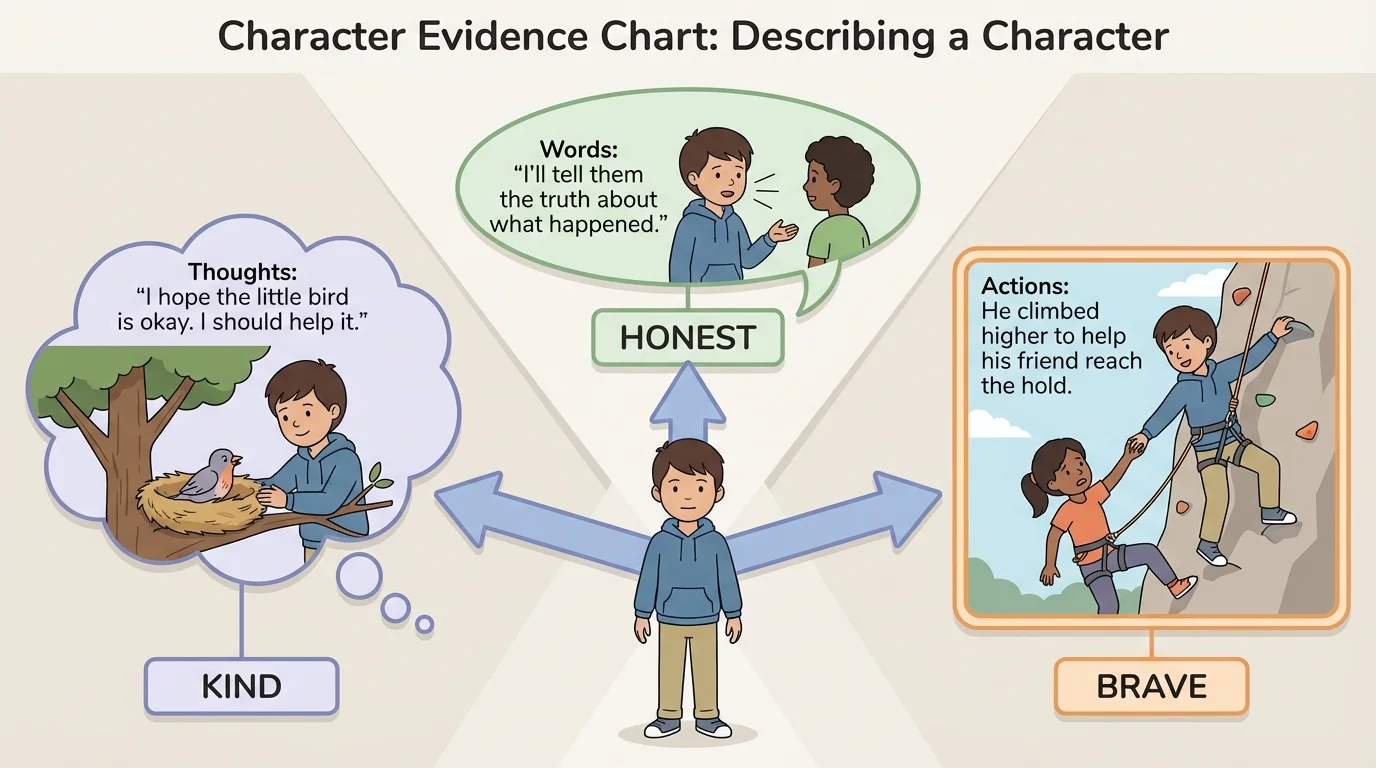
One important part of character analysis is the character trait, or the special quality that helps describe a character. Readers learn about character traits by noticing thoughts, words, and actions, as [Figure 1] illustrates. If a character thinks about helping others, speaks gently, and shares food with a friend, those details help show kindness.
Authors do not always say, "Mina was generous," or "Leo was impatient." Often, they expect the reader to figure that out. This is called making an inference. You collect clues from the text and use them to understand the character better.
For example, read this short story sentence: "Jalen's hands shook as he stepped onto the stage, but he smiled and began to sing anyway." From this detail, you can describe Jalen as nervous and brave. His shaking hands show fear, but singing anyway shows courage.
Good readers also notice whether a character changes. At the start of a story, a character may be selfish, shy, angry, or careless. After important events, that same character may become more thoughtful, confident, calm, or responsible. When you describe a character in depth, it helps to explain that change.
Suppose a story begins with a girl named Ana refusing to work with others. Later, she listens to her teammates, shares ideas, and helps finish a project. A strong description might say, "Ana changes from stubborn to cooperative. At first, she refuses help, but later she listens and works with her team." That answer uses more than one detail, so it gives a fuller picture.
Describing a character in depth
Story detail: "Mr. Lopez checked the map three times, packed extra water, and told everyone to stay together on the trail."
Step 1: Notice the clues.
He checks the map, brings extra water, and gives careful instructions.
Step 2: Infer a trait.
These actions suggest he is prepared and responsible.
Step 3: Write a strong description.
"Mr. Lopez is responsible because he plans ahead, checks the map carefully, and makes sure everyone stays safe."
Notice that the answer does not just say "responsible." It explains why. That is what strong literary analysis does.
Later, when you compare two characters or think about why a story feels realistic, you can return to the same kind of clues we saw in [Figure 1]: thoughts, words, and actions work together to reveal who a character really is.
The setting is much more than a place name. It includes where the story happens, when it happens, what the weather is like, and sometimes the feeling or mood the place creates. A mountain cabin during a winter storm feels very different from a sunny beach in the middle of summer.
Setting can affect what characters do. If a story takes place during a blizzard, characters may be trapped indoors. If it takes place in a noisy city, they may struggle to hear one another. If it happens long ago, the characters may travel by horse instead of car or send letters instead of texts.
[Figure 2] Writers often use sensory details to build setting. They may describe the crunch of leaves, the smell of rain, the flicker of candlelight, or the buzz of traffic. These details help readers picture the story clearly.
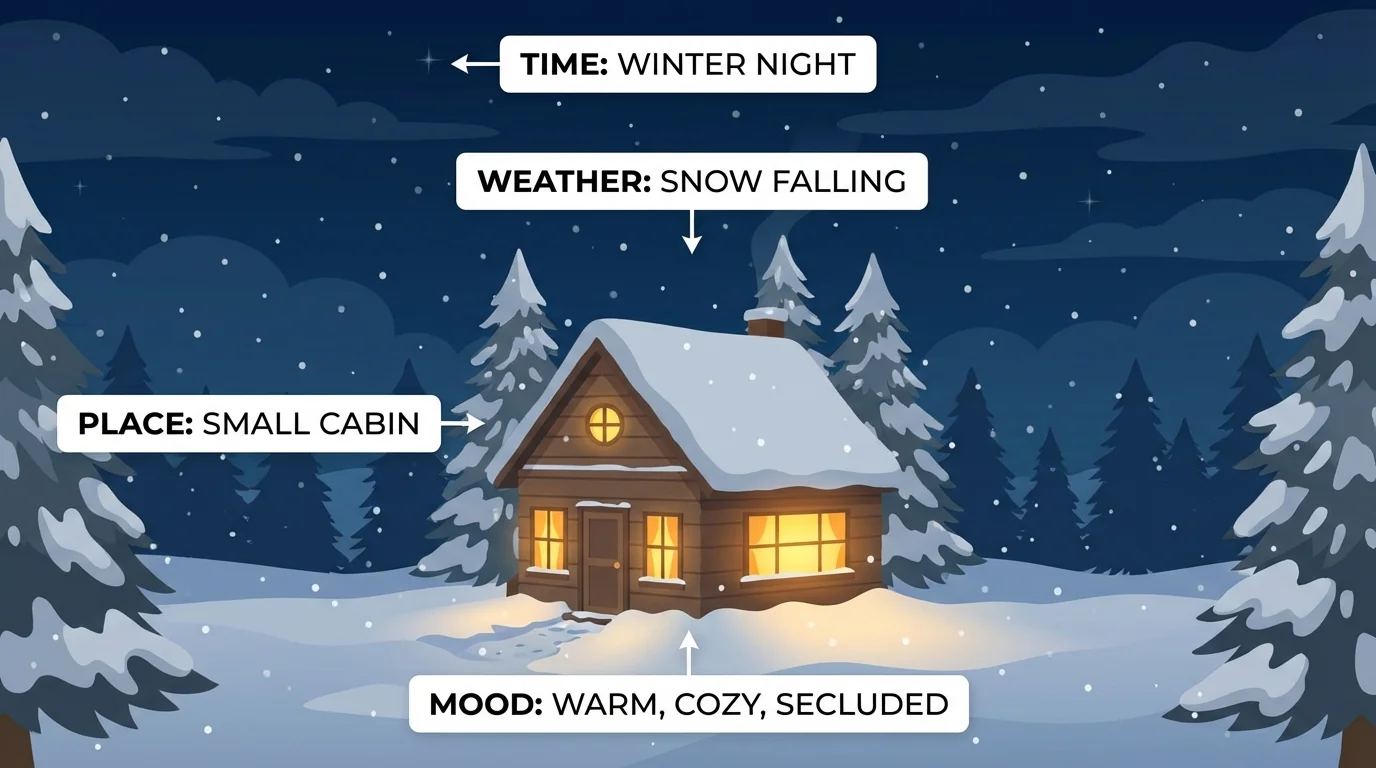
Here is an example: "The old barn leaned to one side. Wind whistled through the loose boards, and the last light of evening faded behind the fields." This setting feels quiet, lonely, and maybe a little mysterious. A strong reader does not only say, "The setting is a barn." A stronger reader explains the mood created by the barn and evening light.
Setting also matters because it can connect to the problem in the story. A lost hiker in a forest, a family in a crowded apartment, or children on a school field trip all face different challenges because of where they are. The setting can support the action or make it harder.
How setting shapes a story
Setting can influence mood, character choices, and the events that follow. A dark thunderstorm may build suspense. A peaceful garden may create calm. A setting is not just background decoration; it often helps explain why events happen the way they do.
When you write about setting, try to include several details together. You might describe the place, the time, the weather, and the feeling. That gives a deep answer instead of a thin one.
An event is not just anything that happens. In reading, we focus most on the important events that affect the characters or move the story forward. If a boy drops his pencil, that may not matter much. If he drops the map during a storm and the group gets lost, that event becomes important.
Readers should notice the order of events. Stories often have a beginning, middle, and end. Early events can cause later events. This is called cause and effect. If a character forgets to lock a gate, the horse escapes. If the horse escapes, the characters must search all night. One event leads to another.
To describe an event in depth, explain what happened, who was involved, what caused it, and what changed because of it. This helps you move beyond a simple retelling.
For example, instead of saying, "The storm came," you might say, "The storm is a major event because it knocks out the lights, traps the family in the house, and forces them to work together." This answer explains why the event matters.
Some of the most exciting moments in stories happen because of small choices. A tiny decision, like opening a door, telling a secret, or taking a shortcut, can lead to a huge event later in the plot.
Important events can also reveal character. If a child returns a lost wallet, that event shows honesty. If a friend stands up for someone being teased, that event shows courage. Events and characters are connected.
When you answer a question about literature, your ideas should be supported by text evidence. Text evidence can come from exact words, actions, descriptions, or dialogue in the story. It answers the question, "How do you know?"
Imagine someone says, "Nia is thoughtful." A teacher might ask, "What in the text makes you say that?" A strong response could be, "Nia notices that her grandfather is tired, so she quietly finishes the chores without being asked." That detail from the story supports the idea.
You do not always need to copy the exact sentence word for word. You can also explain details in your own words. The important part is that the evidence truly comes from the text, not only from your opinion.
| Weak response | Strong response |
|---|---|
| The character is nice. | The character is kind because she gives her lunch to a classmate who forgot his food. |
| The setting is scary. | The setting feels scary because the hallway is dark, silent, and empty. |
| The event is important. | The event is important because it changes the character's plan and starts the main problem. |
Table 1. Comparison of weak responses and stronger responses that use evidence.
When you use evidence well, your answer becomes clearer, stronger, and more believable. This skill is useful not only in reading class but also when you explain ideas in science, social studies, and research projects.
Stories and dramas are both forms of literature, but they often present information differently. In stories, a narrator may tell you what characters think and what happens next. In dramas, readers often learn through dialogue and stage directions. That means you have to pay close attention to what characters say and do on stage.
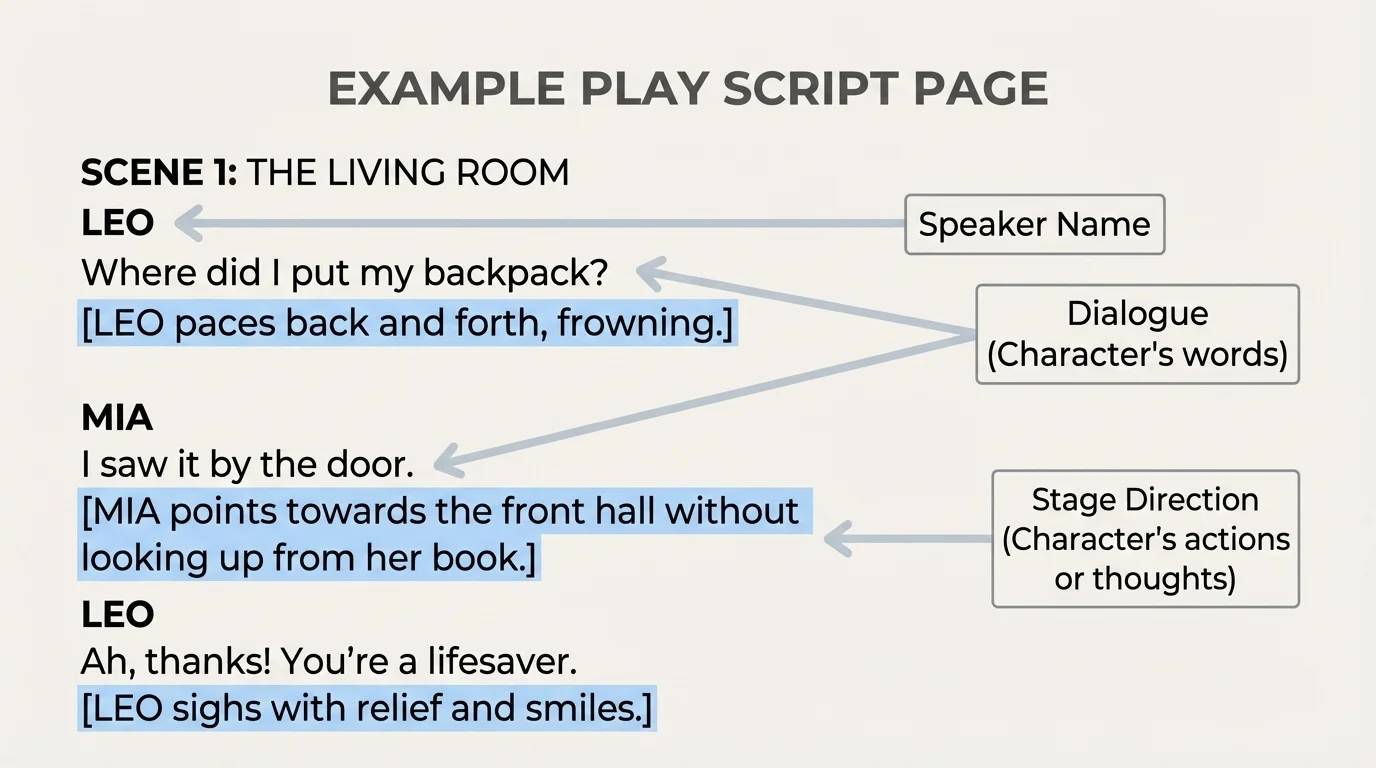
Dialogue is the spoken words of the characters. Stage directions are notes that tell how characters move, sound, or act. If a script says, "Mara backs away slowly," that action gives you evidence about her feelings, even if she never says, "I am afraid."
[Figure 3] Suppose a drama includes these lines: "Tariq: I'm not scared. Not even a little. [He grips the chair tightly and avoids the window.]" His words say one thing, but his actions show something else. A strong reader notices both and may conclude that Tariq is pretending to be brave.
This is why reading a drama carefully is important. You gather clues from speech, movement, and direction notes. In a regular story, the author may tell you directly that a character trembled with fear. In a drama, you may have to infer that from action on the stage.
Using evidence from a drama
Script detail: "Lena: Of course I'll go first. [She whispers the last words and looks at the floor.]"
Step 1: Read the dialogue.
Lena says she will go first, which sounds confident.
Step 2: Read the stage directions.
She whispers and looks down, which suggests she feels unsure.
Step 3: Describe the character fully.
"Lena tries to sound brave, but the stage directions show she is actually nervous."
Much later, if you compare a story and a play, the clues in [Figure 3] still matter: dialogue tells what a character says, while stage directions reveal actions and feelings that may not be spoken aloud.
Reading literature carefully helps you answer open-ended questions. An open-ended question is one that needs more than a one-word answer. For example: "How does the setting affect the main character?" or "How does the character change after the problem begins?" To answer these well, you need evidence from the text.
This is also part of research. Research is not only about looking up facts in books or online. Sometimes research means reading a text closely, asking a thoughtful question, and collecting evidence to support your answer. If you wonder, "Why does the hero finally tell the truth?" you can search the story for clues in the hero's words, thoughts, and actions.
When you learned to find the main idea in informational texts, you used supporting details to explain it. Literature works in a similar way. Your claim about a character, setting, or event needs supporting details from the text.
Reflection is another part of strong reading. Reflection means thinking deeply about what a text shows you. You might reflect on a character's mistake, a setting that feels lonely, or an event that teaches a lesson. But even during reflection, your ideas should stay connected to the text.
For example, you might write, "The story shows that courage does not mean being unafraid. The main character is scared, but she still crosses the bridge to help her brother." That reflection uses evidence from the story.
A common mistake is giving an answer that is too general. "The setting is good." "The event is sad." "The character is interesting." These answers are not wrong, but they are weak because they do not explain enough.
Another mistake is forgetting to use details from the text. If you say, "I think the character is selfish," but you cannot point to any words or actions that show selfishness, your answer is not well supported.
Strong responses usually do three things: they name the idea, they include details from the text, and they explain how those details support the idea. You can think of it like this: idea + evidence + explanation.
"Readers do more than notice details. They use details to build understanding."
Here are three stronger examples. "Ben is determined because he keeps practicing even after he misses the goal." "The setting feels tense because the room is silent and everyone is waiting for the judge to speak." "The bicycle breaking is an important event because it forces the sisters to walk home and talk about their argument." Each answer includes a claim and supporting evidence.
The more carefully you read, the more clearly you can explain. Literature becomes richer when you notice not only what happens, but also the clues that make it meaningful.
