Have you ever watched a game fall apart because teammates would not listen to one another? A classroom discussion can feel the same way. Even smart ideas can get lost if people interrupt, talk over each other, or forget their jobs. Strong discussions are not accidents. They work well because people follow shared rules and do their assigned roles.
Discussion is more than talking. It is a way to have a collaborative discussion with others so everyone can learn, solve problems, and understand topics more deeply. In grade 4, you are expected to speak clearly, listen carefully, ask meaningful questions, and respond to what others say. That means being both a careful speaker and a respectful listener.
When a class agrees on rules for discussion, everyone knows what to expect. Rules help people feel safe to share ideas. They also make sure the group stays focused on the topic instead of turning into random conversation. Without rules, some people may speak too much, others may stay silent, and important ideas may never be heard.
Rules also help make discussions fair. Fair does not mean every person says exactly the same number of words. It means each person gets a real chance to participate. If one student is always interrupted, that is not fair. If one student never listens, that is not fair either. Agreed-upon rules create a space where people can think, speak, and listen with respect.
These rules are useful in many places: during a partner talk, in a science group, in a class meeting, or when discussing a story with your teacher. The setting may change, but the need for respect and teamwork stays the same.
Discussion rules are shared expectations for how people speak, listen, and respond during a conversation. Assigned roles are special jobs given to group members to help the discussion run smoothly.
Before a discussion begins, the group or teacher may review the rules. This matters because people are more likely to follow expectations they remember clearly. Good rules are simple, fair, and connected to the goal of learning together.
A strong discussion has behaviors you can actually see, as [Figure 1] shows in a small group setting. People face the speaker, wait their turn, stay on topic, and respond to the ideas being shared. They are not just waiting for their chance to talk. They are truly paying attention.
In a good discussion, each speaker shares ideas clearly. Each listener shows active listening by looking at the speaker, thinking about the message, and remembering important details. Students may nod, take notes, or use short responses like "I see" or "Can you explain that more?" to show they are engaged.
A good discussion also includes respect. Respect means using polite words, not laughing at someone's idea, and disagreeing kindly. It means understanding that two people can have different opinions and still learn from each other.
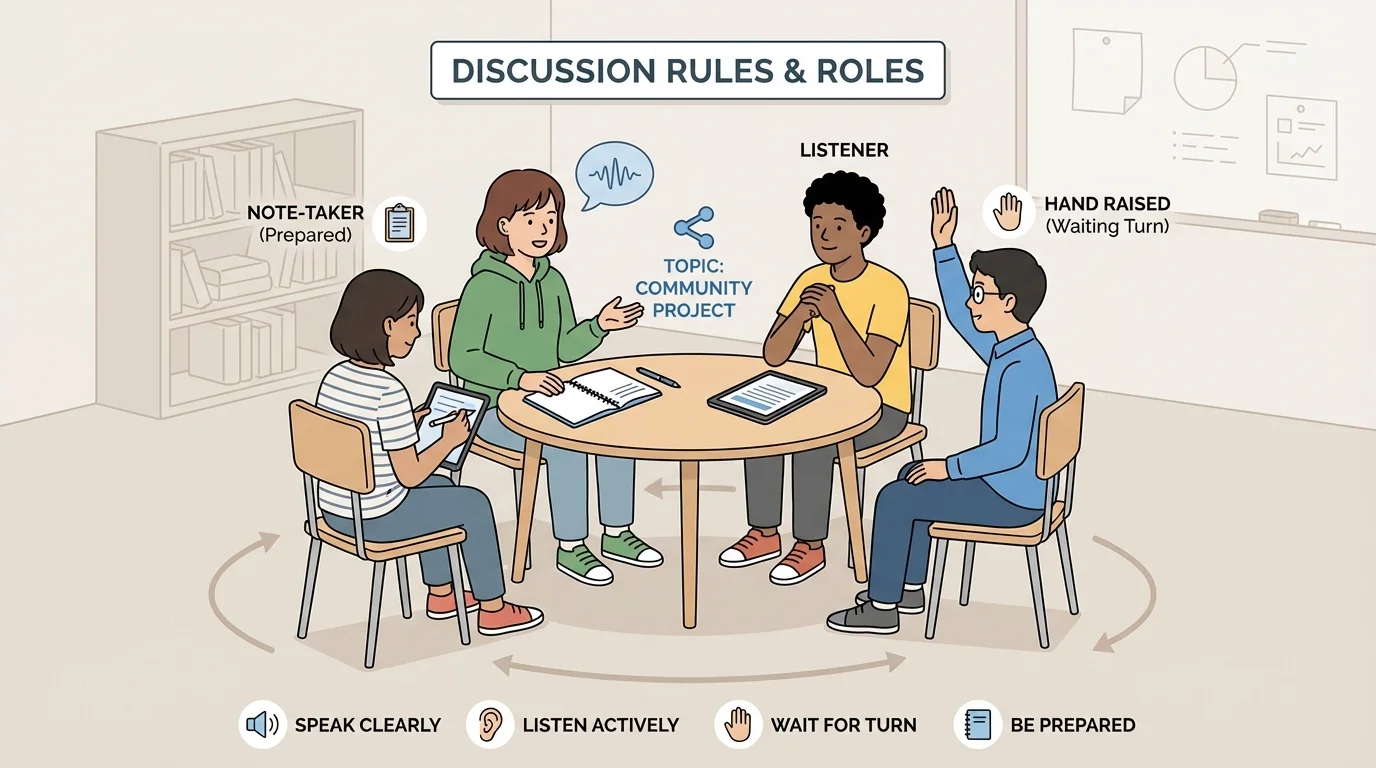
Another important feature is focus. When the topic is about an animal adaptation, a historical event, or a chapter in a book, speakers should connect their comments to that topic. If someone suddenly starts talking about lunch or recess, the discussion drifts away from its purpose.
Good discussions often sound like this: "I agree with Carlos because the text says the character felt nervous." "I heard Maya say the plant needs sunlight, and I want to add that it also needs water." "Can you explain why you think that?" These examples show people listening first and then building on ideas. The respectful turn-taking we saw earlier in [Figure 1] helps make these responses possible.
Many classes create a list of discussion rules together. Because everyone agrees to them, they become shared promises. Different classrooms may word the rules in different ways, but the main ideas are often similar.
Some common rules are: listen when someone else is speaking, take turns, raise your hand if that is the class procedure, speak in a clear voice, stay on topic, use kind words, and support your ideas with reasons or examples. Another important rule is to let others finish speaking before you respond.
Some rules happen before the discussion. For example, students may be expected to read the text, think about the topic, or bring notes. Some rules happen during the discussion, such as listening carefully and speaking respectfully. Some rules happen after the discussion, such as reflecting on what went well and what could improve next time.
The table below shows several common rules and why they matter.
| Rule | What it Means | Why it Helps |
|---|---|---|
| Listen without interrupting | Let the speaker finish | Everyone gets heard |
| Take turns | Share speaking time fairly | The group stays organized |
| Stay on topic | Talk about the question or text | The discussion reaches its goal |
| Use respectful words | Speak kindly, even in disagreement | People feel safe to share |
| Ask questions | Seek more information or clarification | Ideas become clearer and deeper |
| Build on ideas | Connect your thought to someone else's | The conversation grows stronger |
Table 1. Common discussion rules, what they mean, and how they help a group learn together.
Rules should not feel like punishment. They are tools that help a group succeed. Just as rules in a sport help the game work, discussion rules help conversation work.
Many adults use discussion rules in meetings, even if they do not call them that. Taking turns, staying on topic, and listening carefully are important in classrooms, offices, and community groups.
When students follow agreed-upon rules, they can spend less energy handling confusion and more energy learning from the topic and from each other.
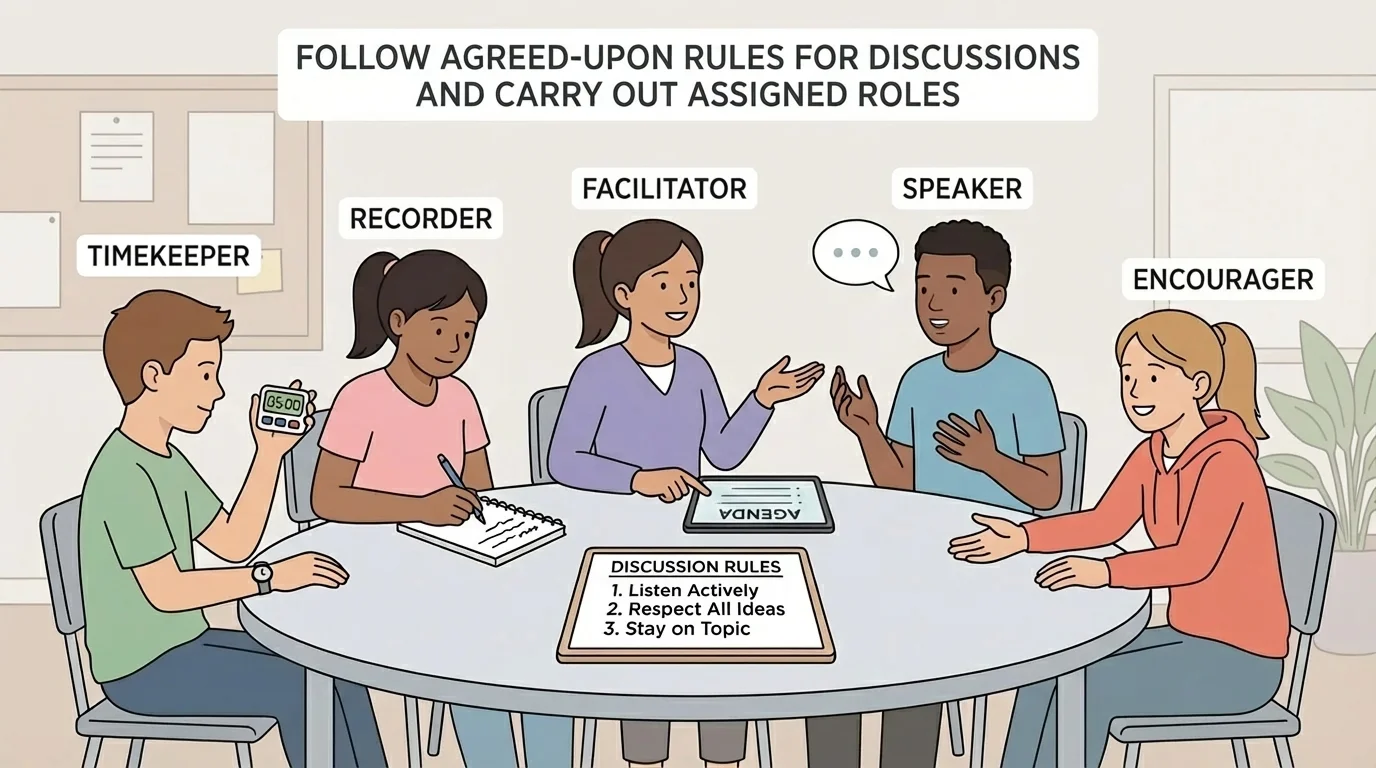
In many group conversations, special jobs help the group stay organized, as [Figure 2] illustrates. These jobs are called roles. A role is not about being more important than others. It is about helping the group work well.
One common role is the facilitator. The facilitator helps the group begin, keeps the conversation moving, and reminds members of the topic and rules. This student might say, "Let's hear from someone who has not spoken yet," or "How does that connect to the passage?"
Another role is the recorder. The recorder writes down key ideas, important details, or group decisions. This role matters because discussions can move quickly, and writing helps the group remember what was said.
A timekeeper watches the time. The timekeeper may remind the group when it is halfway through or when it is time to wrap up. This helps the group use time wisely and make sure all parts of the task are completed.
Some groups also have an encourager or participation helper. This person notices who has not had a turn and invites them in kindly. A speaker or reporter may share the group's ideas with the class at the end.
Roles may change from one discussion to the next. That is useful because students can practice different skills. A student who is quiet may become a strong recorder. A student who likes organizing may do well as a timekeeper or facilitator. Rotating roles helps everyone grow.
Even when you have a special role, you still follow the regular discussion rules. A recorder still listens. A facilitator still takes turns. A timekeeper still speaks respectfully. The role adds a job, but it does not replace good discussion behavior. The organized group jobs shown in [Figure 2] work best when every student also follows the shared rules.
Example: How roles help a reading discussion
A group of four students is discussing why a story character made a surprising choice.
Step 1: The facilitator reads the question aloud and invites the first response.
Step 2: The recorder writes down two different ideas from the group.
Step 3: The timekeeper reminds the group that they have two minutes left to decide which evidence from the story is strongest.
Step 4: The reporter shares the group's thinking with the class.
Because each student has a role, the group stays organized and focused.
Assigned roles are especially helpful when a task has several parts, such as reading, discussing, writing, and sharing.
Listening is not the quiet part before your turn to talk. It is active work. Active listening means paying close attention to words, ideas, reasons, and details. It also means noticing when something is confusing or especially important.
When you listen actively, you can ask a thoughtful question. A thoughtful question connects directly to what the speaker said. It helps the speaker explain more clearly, give evidence, or think more deeply.
Here are some examples of thoughtful questions: "What in the text makes you think that?" "Can you give an example?" "How is your idea different from Jayden's?" "Why do you think that happened?" These questions are better than questions that change the subject or show the listener was not paying attention.
There are different kinds of thoughtful questions. Some ask for clarification, such as "What do you mean by that?" Some ask for evidence, such as "Where did you find that in the article?" Some ask for comparison, such as "How are those two ideas alike?"
From hearing to understanding
Hearing means sounds reach your ears. Listening means your brain is working with those sounds. Active listening goes even further: you focus, think, remember, and prepare a response that connects to what was said.
If someone says, "I think the main character was brave because she told the truth even when she was scared," a weak response would be, "I like dogs." That has nothing to do with the idea. A better response would be, "What part of the story shows she was scared?" That question proves the listener paid attention.
Thoughtful questions also help the whole group. When one student asks a good question, everyone gets a clearer understanding. This is one reason discussion is so powerful for learning.
A discussion becomes stronger when people do more than share separate thoughts. They should connect ideas. This is called building on ideas. It means using what someone else said as a starting point for your own comment.
Building on ideas can happen in several ways. You can agree and add more information. You can disagree politely and explain why. You can connect someone's comment to the text, a fact, or another example. You can also combine two ideas to make a stronger one.
Helpful sentence starters make this easier. You might say, "I agree with you because..." "I want to add..." "I see it a different way because..." "Your idea makes me think..." "Can we connect that to the article?" These sentence starters help you speak clearly and respectfully.
Clarity matters. If your ideas are hard to follow, the group may misunderstand you. Speaking clearly means using enough detail, choosing words carefully, and staying connected to the topic. It does not mean using the fanciest words. It means being understandable.
Example: Building on an idea in science
Topic: Why do plants grow better in some places than others?
Step 1: One student says, "Plants need sunlight to grow."
Step 2: Another student builds on the idea: "I agree, and I want to add that plants also need water."
Step 3: A third student asks a thoughtful question: "Would a plant still grow well with water but no sunlight?"
Step 4: The group discusses evidence and reaches a deeper understanding.
Each comment connects to the one before it, so the discussion moves forward.
Building on ideas does not mean copying another person's words. It means listening, thinking, and then adding something meaningful of your own.
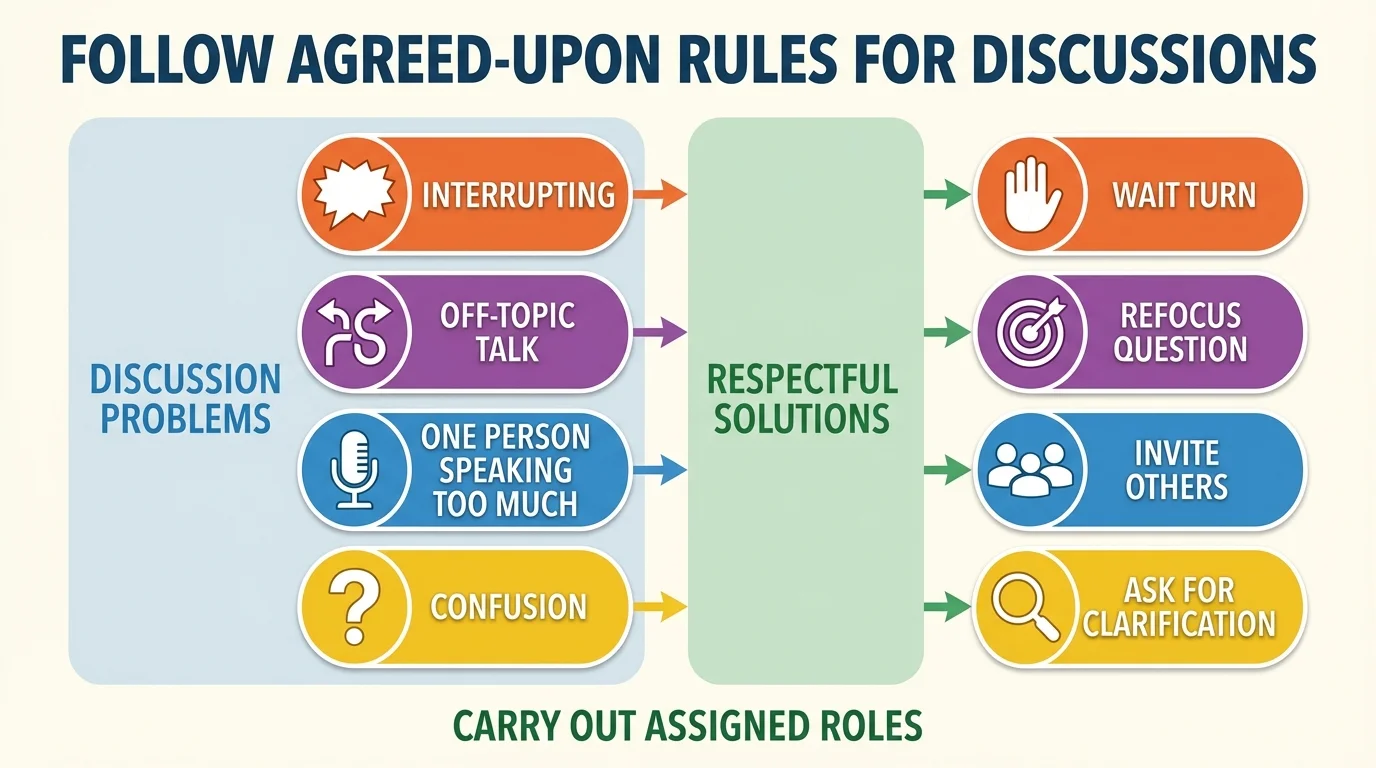
Even careful groups sometimes have trouble, and [Figure 3] lays out some common problems and respectful solutions. What matters is how the group responds. Good discussion skills include noticing problems and fixing them calmly.
One common problem is interrupting. If this happens, a student or teacher may remind the group, "Let's let her finish." Another problem is going off topic. In that case, the facilitator can say, "Let's come back to the question." If one person speaks too much, the group can invite others by saying, "We haven't heard from Amir yet."
Confusion is another problem. Sometimes a student's comment is unclear, or two people are using the same word in different ways. That is a good time for a thoughtful question such as "Can you explain what you mean?" Asking for clarification is not rude. It is a smart way to help the group understand.
Sometimes feelings can also affect discussion. A student may feel frustrated if others do not agree. This is when respectful language matters most. Instead of saying, "That makes no sense," a better response is, "I understand your point, but I see it differently because..." Kind words help people keep thinking instead of shutting down.
Groups also improve when they reflect. After a discussion, students might think: Did we all participate? Did we stay on topic? Did we ask good questions? The problem-solution steps in [Figure 3] are useful not only during a discussion but also when thinking about how to improve next time.
When you read closely, you look for key details and main ideas. Discussion uses that same skill. Strong speakers often refer back to the text, notes, or facts they have already read or learned.
Fixing problems respectfully helps the group stay productive. The goal is not to blame someone. The goal is to help the discussion work better.
Not all discussions look the same. In a teacher-led discussion, the teacher may ask questions, guide turn-taking, and help students connect ideas. This kind of discussion can help the whole class explore one topic together.
In a one-on-one discussion, only two people are talking. This often means each person has more time to speak, but it still requires careful listening and turn-taking. Because there are only two people, each one has a big responsibility to keep the conversation going.
In a small-group discussion, students may have more independence. This is where roles often become especially useful. Without a teacher guiding every moment, group members must depend on their rules, roles, and listening skills to stay organized.
Each setting may change how loudly you speak, how long you talk, or who starts the discussion. However, the most important habits stay the same: listen actively, follow agreed-upon rules, ask thoughtful questions, and express your ideas clearly.
Discussion skills are classroom skills, but they are also life skills. When families plan something together, they need turn-taking and listening. When a sports team talks strategy, players need to stay on topic and respect each voice. When people work together in a job someday, they will need to ask questions, explain ideas, and solve disagreements respectfully.
These skills also help you become a stronger learner. Listening to others can introduce you to ideas you had not considered. Asking good questions can help you understand a text or topic more deeply. Explaining your thinking clearly helps your brain organize what you know.
One powerful thing about discussion is that it combines speaking, listening, thinking, and learning all at once. When students follow agreed-upon rules and carry out assigned roles, the group becomes more than a collection of individuals. It becomes a team of thinkers.
"Seek first to understand, then to be understood."
— Stephen R. Covey
That idea fits strong discussions perfectly. First listen and understand. Then speak in a way that helps others understand you.
