People share opinions all the time. One person says a certain lunch is the best. Another says another game is more fun. But here is the big question: how do you make someone take your opinion seriously? The answer is not to repeat it more loudly. A strong writer backs up an opinion with reasons that are supported by facts and details.
When you write an opinion piece, you are telling what you think about a topic or a text. Good opinion writing does more than say, "I like it" or "I don't like it." It explains why. Then it proves that reason with information a reader can trust. That is what makes writing stronger, clearer, and more convincing.
An opinion is what someone thinks, feels, or believes. Opinions can be different from person to person. For example, one student may think dogs make the best pets, while another thinks cats do. Both are opinions.
A strong opinion needs support. Support is the information that helps a reader understand why the writer believes something. Without support, an opinion sounds unfinished. If a student writes, "Field trips are important," the reader may wonder, "Why?" and "How do you know?"
Supported opinion writing answers those questions. A writer gives reasons, then adds facts and details to show that the reasons make sense. This turns a simple thought into a careful argument.
Opinion is what a person thinks or believes.
Reason is why the writer holds that opinion.
Fact is something true that can be checked.
Detail is a specific piece of information that explains more.
Evidence is the facts and details a writer uses to support a reason.
Think of opinion writing as building a treehouse. The opinion is the platform at the top. The reasons are the beams that hold it up. The facts and details are the nails and boards that make the beams strong. If the support is weak, the whole piece wobbles.
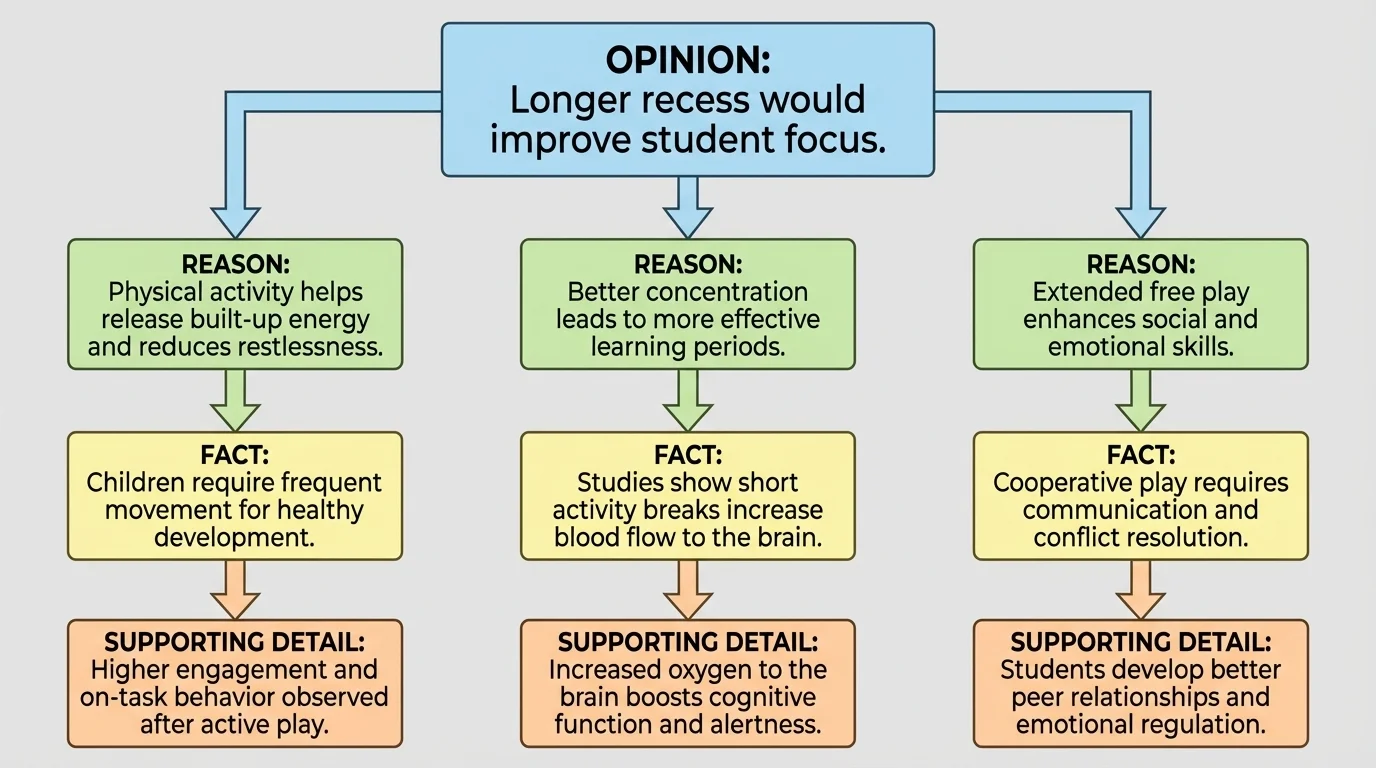
A reason tells why you believe your opinion is right. A fact is something true that can be proven. A detail gives extra information that helps the reader understand the fact or reason. These parts work together, as [Figure 1] shows in one simple example.
Look at this opinion: "Our school should have a longer recess." That is the writer's point of view. A reason might be: "Students need more time to move and play." A fact might be: "Exercise helps children stay healthy." A detail could be: "More recess gives students extra time to run, climb, and play active games."
Notice how each part has a job. The opinion tells what the writer believes. The reason tells why. The fact gives true information. The detail adds specifics. When these parts fit together, the writing becomes much stronger.
Sometimes students confuse reasons and facts. A reason explains the writer's thinking. A fact proves or supports that thinking. For example, "Reading every day improves vocabulary" can be used as a fact if it comes from trusted information. "Books help us learn new words" is a reason. They sound similar, but they do different jobs.
Specific details make writing more powerful. Instead of saying, "The library is good," a writer can say, "The library gives students access to chapter books, research books, and quiet study space." Specific details help the reader picture what the writer means.
Not every fact or detail is useful. Good writers choose support that matches the opinion exactly. If your opinion is "Students should wear helmets when biking," then facts about bicycle safety make sense. Facts about favorite bike colors do not. They may be true, but they do not support the opinion.
This idea is called evidence that is relevant. Relevant evidence connects directly to the point you are making. If it does not connect, it will not help your reader.
Suppose your opinion is "School gardens are a good idea." Strong support could include facts such as students learn about plants, gardens can provide vegetables, and working in a garden teaches responsibility. Weak support would be something like, "The fence around the garden is green." That detail may be true, but it does not really explain why school gardens are a good idea.
Strong support matches the opinion. Writers ask themselves, "Does this fact prove my reason?" and "Does this detail help the reader understand my point?" If the answer is no, the support should be changed or removed.
Trusted facts can come from books, articles, class lessons, observations, or information from teachers and other reliable sources. When you write about a text, the facts often come directly from what you read. When you write about a topic from everyday life, the facts may come from research or observation.
Writers can support reasons in different ways. One way is with examples. An example shows one clear case that helps explain the point. If your opinion is that teamwork is important, you might describe a basketball team that passes the ball well and scores more often because players work together.
Another way is with observations. These are things a writer has noticed. For example, if you are writing that morning routines help students prepare for class, you might observe that students who unpack quickly are ready to begin work on time.
Writers also use numbers and facts from research. A student might write that a class read 120 books during a reading challenge. The number 120 is a fact that makes the writing more exact. Exact information often sounds stronger than general words like "a lot."
Facts and details can also come from a text. If you read a passage about ocean animals, you can use information from the passage to support your opinion. You are not making up support. You are collecting it from the reading.
| Type of support | What it does | Example |
|---|---|---|
| Reason | Tells why you believe something | Recess helps students focus. |
| Fact | Gives checkable truth | Movement helps the body stay healthy. |
| Detail | Adds specific information | Students run, jump rope, and play tag during recess. |
| Example | Shows one clear case | After recess, many students return ready to learn. |
Table 1. Different kinds of support writers use to strengthen an opinion.
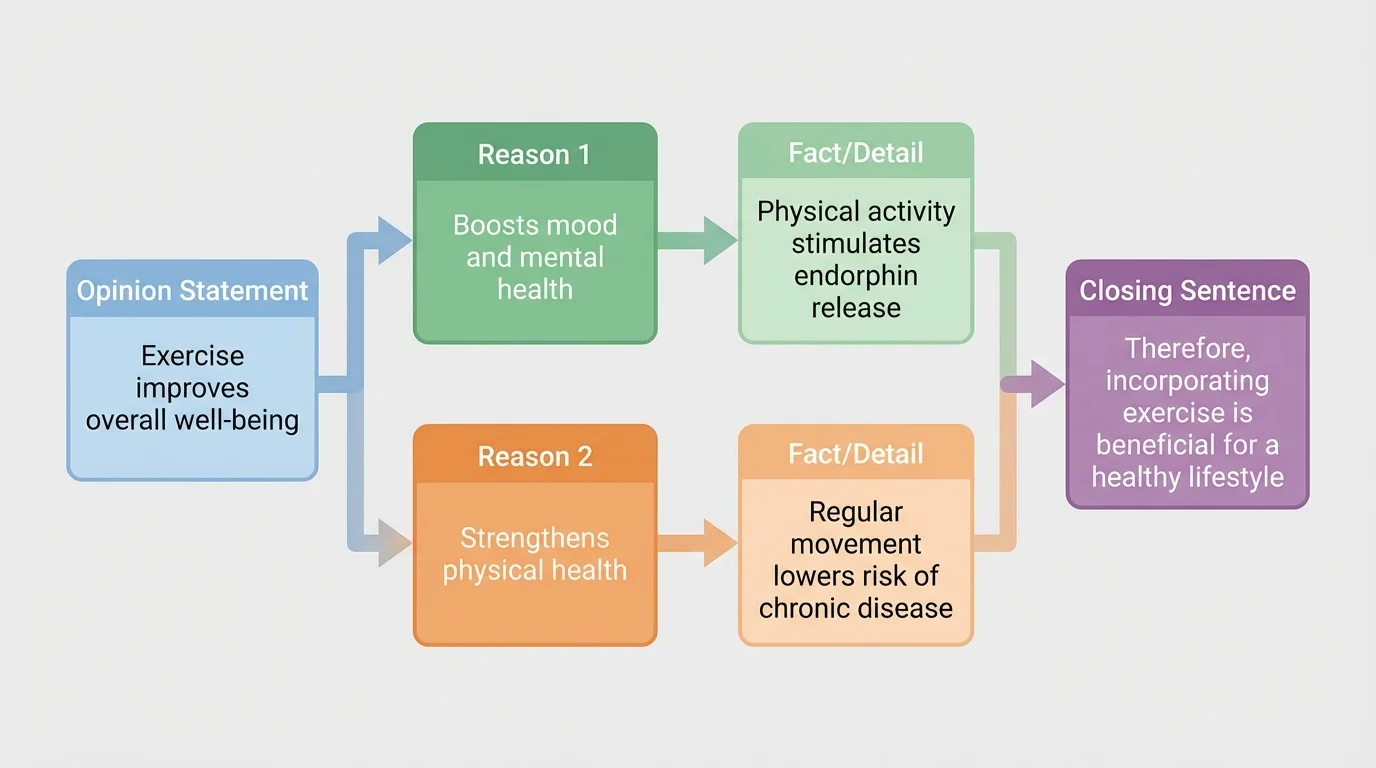
A clear opinion paragraph follows a pattern. It often begins with the opinion, then gives a reason, adds facts or details, gives another reason, and ends with a closing sentence. This structure helps the reader follow the writer's thinking, as [Figure 2] illustrates.
Here is a simple pattern: first, state the opinion. Next, tell one reason. Then support that reason with facts or details. After that, add another reason and support it too. Finally, end with a sentence that reminds the reader of your point.
For example, a student might write: "Our class should have more time for independent reading. First, reading helps students practice fluency and learn new words. When students read often, they become more comfortable with books. Also, independent reading lets students choose topics they enjoy, which can make them want to read more. For these reasons, extra reading time would help our class."
This paragraph works because the reasons connect to the opinion, and the details connect to the reasons. It does not jump around. It stays focused.
Sometimes one strong reason is enough for a short paragraph. In longer writing, two or three reasons can make the piece more convincing. The important part is not how many reasons you have. The important part is whether each reason is supported well.
Example paragraph with labeled parts
Step 1: Opinion
"School clubs are important for students."
Step 2: Reason
"They help students discover interests and build skills."
Step 3: Facts and details
"A science club gives students extra time to experiment. An art club gives students practice drawing and designing. Students can learn teamwork and responsibility in both."
Step 4: Closing sentence
"Because clubs help students grow in many ways, schools should offer them."
As you build a paragraph, make sure each sentence adds something useful. Repeating the same idea again and again does not make the writing stronger. New facts and fresh details do.
Sometimes a writer gives support that sounds too general. Other times the support is specific and believable. The difference matters, and [Figure 3] compares these two kinds of writing closely.
Weak support might sound like this: "School uniforms are good because they are nice. They help students. They are better." The reader still does not know how uniforms help or why they are better.
Stronger support sounds more like this: "School uniforms can help students focus on learning instead of clothing choices. Uniforms can also make mornings easier because students already know what to wear. In some schools, uniforms help create a feeling of belonging." These sentences give reasons and explain them.
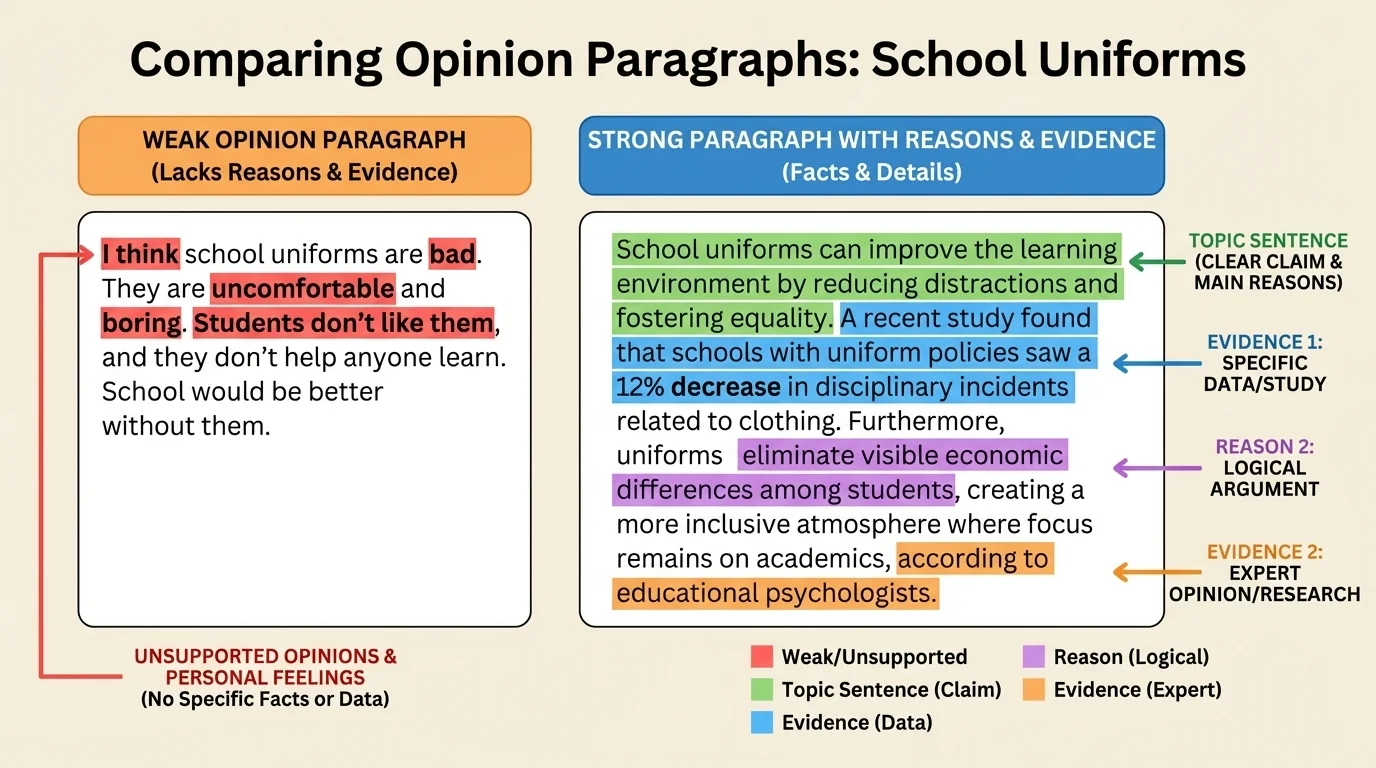
Strong support is usually specific, clear, and true. Weak support is often vague, repeated, or unrelated. A writer should always ask, "Would this help my reader understand and believe my opinion?"
Think back to the chart in [Figure 1]. The reason, fact, and detail each have a separate job. If one part is missing, the writing can feel incomplete. If all three are working together, the opinion stands on much stronger ground.
Lawyers, scientists, reporters, and even game reviewers all use evidence. Even though they write for different reasons, they all need facts and details to support what they say.
Even in everyday talk, people often trust the person who gives proof. If someone says, "This route is faster because there is less traffic after school on this road," that sounds stronger than just saying, "Trust me." Writing works the same way.
Sometimes you will write an opinion about something you read, such as a story, article, or poem. In that kind of writing, your support should come from the text. The text gives you facts, events, and details to use, as [Figure 4] demonstrates.
For example, if you read a biography and write, "The person in the biography was brave," you should support that opinion with events from the text. You might mention a dangerous challenge the person faced, a hard decision the person made, or a time when the person helped others even though it was risky.
Suppose a student reads an article about recycling and writes, "Recycling programs should be expanded." Good support would include facts from the article, such as how recycling reduces waste or conserves materials that can be used again. The student should not invent facts that were not in the reading.
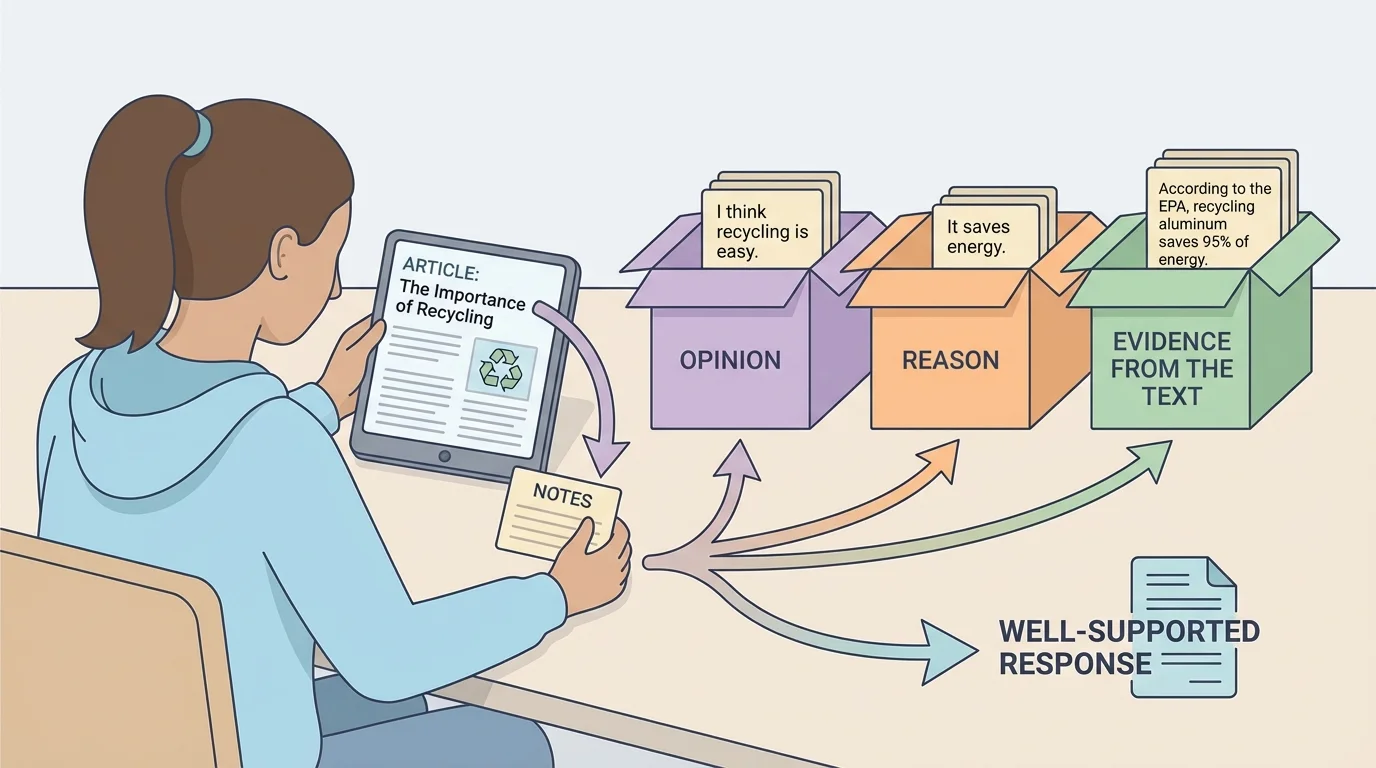
Using facts from a text means reading carefully. Mark important information. Notice what the author says directly. Pay attention to examples and details. Then choose the parts that best support your opinion.
Later, when you organize your writing, the sorting process from [Figure 4] becomes useful again. Not every interesting fact from a passage belongs in your paragraph. You choose the facts that match your opinion and your reasons.
Good writers use linking words and phrases to connect ideas. These words help the reader follow the writing. They show when a writer is giving a reason, adding a detail, or wrapping up a point.
Helpful linking words include because, for example, also, another, since, and therefore. These words act like bridges between sentences. They keep the writing from sounding choppy.
For example, compare these two versions. One says: "Pets help children. They teach responsibility. Children feed them." The other says: "Pets help children because they teach responsibility. For example, children may help feed them every day." The second version is smoother and clearer.
When you revise writing, read it aloud. If the ideas sound jumpy or disconnected, linking words may help show how one sentence connects to the next.
Linking words do not replace evidence. A sentence is not strong just because it uses the word "because." The support still needs to make sense and include facts or details.
Strong writers reread and revise. After drafting an opinion piece, stop and check each reason. Ask, "Does this reason match my opinion?" Then ask, "What fact or detail supports this reason?" If you cannot answer, the writing may need stronger evidence.
Here are some useful questions to ask yourself while revising:
A writer may also check for repeated ideas. Sometimes students write the same reason three different ways. That does not add support. It only adds more words. A stronger choice is to keep one clear reason and add better facts or details.
Writers also need to be careful with opinions that sound like facts. "Pizza is the best food ever" is an opinion, not a fact. "Many people enjoy pizza" is more factual, but even then, a writer should support the statement with real information if using it in formal writing.
This skill is useful far beyond writing class. Students use supported reasons when writing book responses, science explanations, and social studies paragraphs. They use it when recommending a class rule or explaining a choice in a project.
At home, a child might try to persuade a family member by saying, "We should plant tomatoes because they grow well in summer, and we can use them in salads and sandwiches." That is much more effective than simply saying, "Let's plant tomatoes."
In communities, leaders often explain their ideas with reasons and facts. They might support building a park by giving details about space for exercise, play areas for children, and safe walking paths. The same writing skill appears in news articles, speeches, letters, and reviews.
When you learn to support reasons with facts and details, you become a stronger writer and a clearer thinker. You learn how to explain your ideas so other people can understand them and respond to them thoughtfully.
