Have you ever read something that sounded interesting at first, but then it ended before you really learned anything? A writer might say, "Tigers are amazing animals," but if that is all the writer says, the reader is left with questions. Why are they amazing? What do they look like? Where do they live? What makes them different from other animals? Good informative writing answers those questions by developing the topic.
When writers develop a topic, they add enough information to help readers understand the subject. Instead of giving only a simple idea, they build it with supporting information. This makes writing clearer, more interesting, and more trustworthy.
Think about a sandwich. Two slices of bread alone would not make a satisfying meal. The filling is what makes the sandwich complete. In writing, the topic is like the bread, and the facts, details, examples, and explanations are the filling. Without those parts, the writing feels empty.
Topic development matters in school and in everyday life. A student writing about weather needs to explain more than "Tornadoes are dangerous." A report should include information such as what a tornado is, how fast it can move, what damage it can cause, and how people stay safe. The more clearly the writer explains the topic, the more the reader learns.
Topic development means expanding a subject by adding meaningful information that helps the reader understand it. Writers can develop a topic with facts, definitions, concrete details, quotations, and examples.
Strong topic development does not mean adding random extra sentences. Every added detail should connect to the main idea. Good writers choose information carefully so that each sentence helps explain the topic a little more.
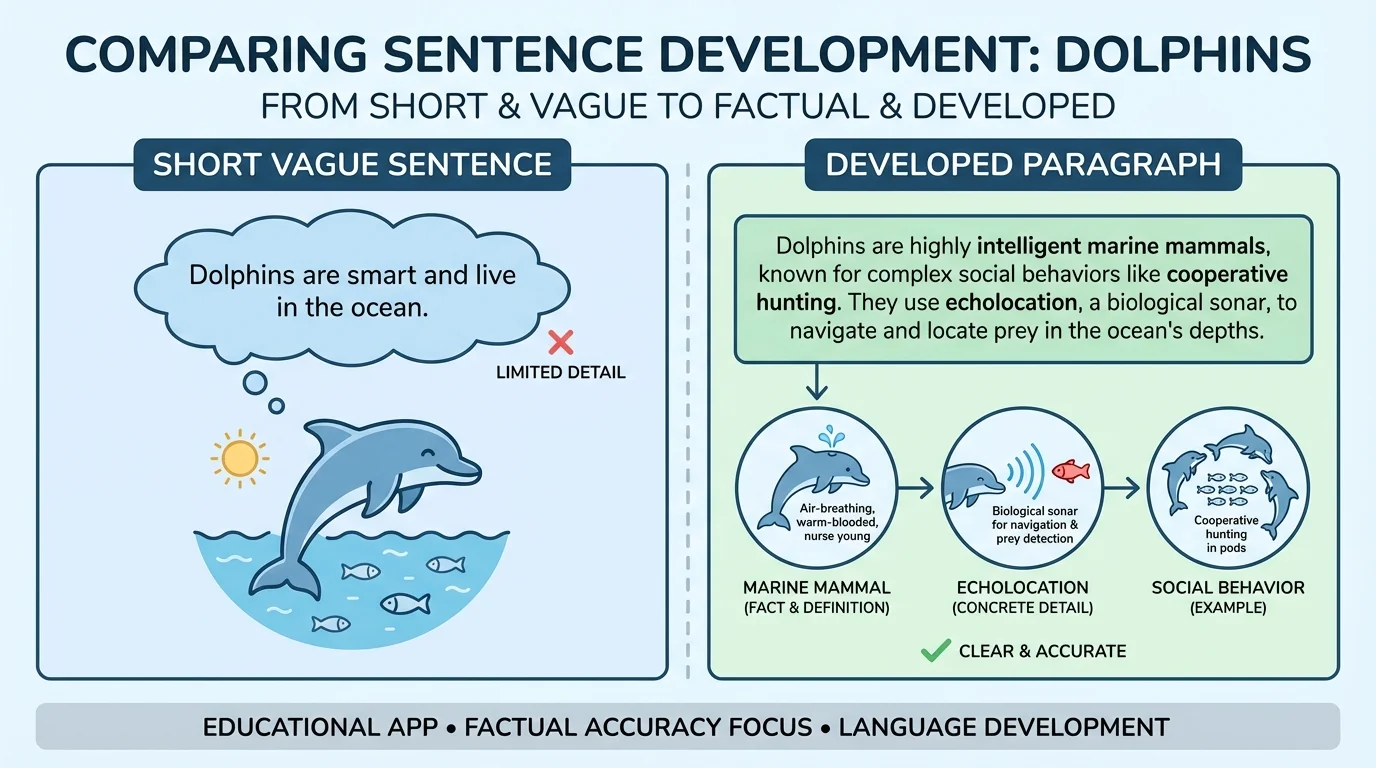
To develop a topic well, a writer begins with a main idea and then supports it with clear information, as [Figure 1] shows in a comparison between weak and stronger writing. The goal is to help the reader move from knowing very little to understanding much more.
A weak piece of writing might say, "Dolphins are smart." A stronger piece explains that dolphins can learn signals, solve problems, and work together in groups called pods. The second version teaches the reader something. It does not just make a statement; it supports the statement.
Writers can ask themselves helpful questions: What does my reader need to know first? What facts will explain this best? What details will help the reader picture it? Is there an example that makes the idea easier to understand? These questions guide strong writing.
Notice that developed writing often moves from general to specific. A writer may start with a broad idea, then explain it with details. For example, "Bats are helpful animals" can be developed by adding facts about insects bats eat, the role bats play in nature, and ways they help farmers protect crops.
A fact is a piece of information that can be proved true. Facts make writing accurate. If a student is writing about the moon, a fact might be that the moon does not make its own light. It reflects light from the sun. That fact teaches something real and specific.
A definition explains what a word or idea means. Definitions are especially helpful when the topic includes words that the reader may not know. If a report says, "A habitat is the natural home of a plant or animal," the definition helps the reader understand the rest of the information.
Facts and definitions work well together. For example, a paragraph about earthquakes might define magnitude as the measure of an earthquake's strength. Then it might give a fact such as, "A stronger earthquake has a higher magnitude." The definition tells what the word means, and the fact shows how it is used.
Example: Developing a topic with facts and a definition
Topic sentence: Penguins are well adapted to life in cold places.
Step 1: Add a definition.
An adaptation is a body part or behavior that helps a living thing survive.
Step 2: Add facts.
Penguins have thick layers of feathers and fat that help keep them warm. Many penguins also huddle together to share body heat.
Step 3: Connect the information.
These adaptations help penguins survive in freezing temperatures.
The paragraph now teaches the reader what adaptation means and how penguins use adaptations to live in cold environments.
Writers should make sure facts are correct. If a fact is wrong, the whole piece becomes less reliable. That is why good writers use trusted sources such as books, articles, and classroom materials.
Concrete details are specific pieces of information that help the reader picture, hear, or understand something clearly. They are stronger than general words. Compare "The flower was pretty" with "The flower had bright orange petals and a dark center." The second sentence gives the reader a much clearer image.
Concrete details are useful in informative writing because they make ideas easier to understand. A writer describing a beaver dam might explain that it is made of sticks, mud, and branches. A writer describing a desert might mention dry air, sandy ground, and very little rainfall. These details help readers build a picture in their minds.
Writers also need precise language. Precise language means choosing exact words instead of vague ones. Instead of saying "big," a writer might say "enormous." Instead of "went fast," the writer might say "raced" or "sprinted." In informative writing, exact words improve accuracy.
For example, if you are writing about a frog, saying "The frog is green" gives some information. Saying "The tree frog has smooth, bright green skin that helps it blend into leaves" is much stronger. It uses precise words and concrete details to explain the topic more fully.
Some of the strongest nonfiction books for children use very exact nouns and verbs. Instead of saying an animal "goes somewhere," they might say it "migrates," "dives," "glides," or "burrows." One powerful word can teach a lot.
Concrete details should fit the topic. If a writer is explaining how glaciers move, details about the color of a backpack would not belong. Good details are not just interesting; they are useful.
A quotation is someone's exact words written or spoken and repeated in quotation marks. Quotations can make writing stronger when they come from a knowledgeable person. For example, a writer discussing reading might include the words of an author or librarian to support an idea.
Here is a simple example: A paragraph about books might include the quotation, "Reading gives us someplace to go when we have to stay where we are," by Mason Cooley. That quotation adds another voice and supports the idea that reading can be powerful and meaningful.
"The more that you read, the more things you will know. The more that you learn, the more places you'll go."
— Dr. Seuss
An example is a specific case that helps explain a general idea. If a writer says, "Inventions solve problems," that statement becomes clearer with an example such as the invention of the umbrella to protect people from rain.
Examples can come from science, history, everyday life, or literature. If the topic is recycling, an example might explain how an old plastic bottle can be turned into part of a park bench. If the topic is bravery, an example might describe a firefighter rescuing a family from a burning building.
Writers should not overfill a piece with quotations. Too many quotations can make it seem like the writer is letting other people do the work. Quotations should support the writer's explanation, not replace it.
Even strong details can become confusing if they are not arranged well. A clear structure helps readers follow the writer's thinking, and [Figure 2] illustrates how one main idea can branch into several kinds of supporting details. Writers often begin with a topic sentence, then add related information in a logical order.
One way to organize information is by grouping similar details together. A paragraph about honeybees might first explain what they do, then describe how they help plants, and finally give an example of crops that depend on pollination. This order feels smooth because the ideas connect.
Another way is to use a text structure. Informative writing may use description, sequence, cause and effect, or compare and contrast. A piece about the water cycle may use sequence to show the order of evaporation, condensation, and precipitation. A piece about two planets may use compare and contrast to show how they are alike and different.
When writers stay on topic, readers do not become confused. Suppose the topic is how seeds travel. Facts about wind, water, animals, and exploding seed pods belong. A sentence about a favorite pizza does not. Good development includes enough information, but it also includes the right information.
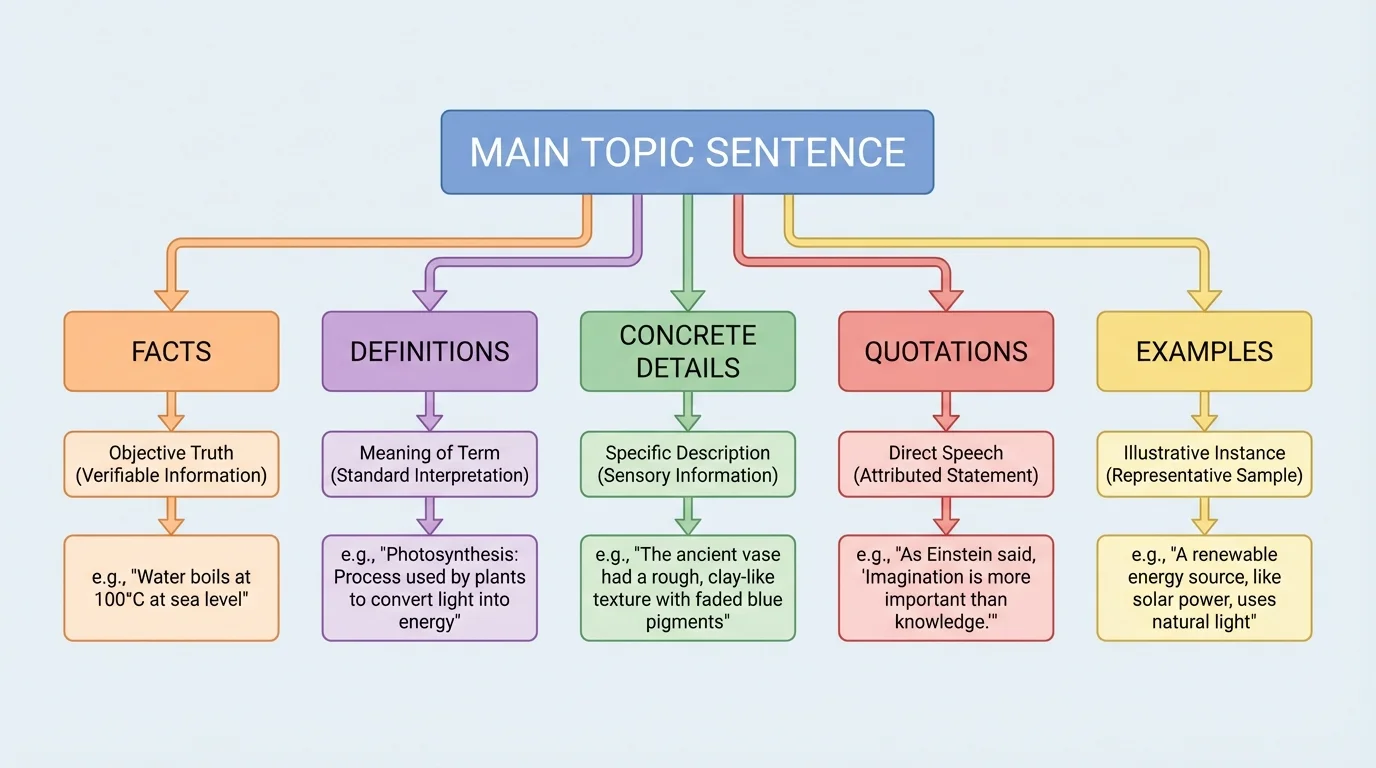
All supporting ideas should connect back to the main topic. If one branch does not fit, it should be revised, moved, or removed.
| Type of support | What it does | Example |
|---|---|---|
| Fact | Gives true information | Octopuses have eight arms. |
| Definition | Explains a word or idea | A predator is an animal that hunts other animals. |
| Concrete detail | Helps the reader picture the topic | The cactus has thick, waxy skin. |
| Quotation | Adds someone's exact words | "Look deep into nature..." |
| Example | Shows a specific case | A squirrel burying acorns is an example of animal behavior. |
Table 1. Different kinds of support writers use to develop a topic.
One of the best ways to understand topic development is to compare weak writing with stronger writing, as [Figure 3] does with a model about volcanoes. Weak writing often uses broad statements, repeated words, and very few details.
Read this weak paragraph: "Volcanoes are interesting. They are hot. They can erupt. People study them." These sentences are not wrong, but they are not fully developed. The reader learns very little.
Now read a stronger version: "Volcanoes are openings in Earth's crust where melted rock, called magma, can rise to the surface. When a volcano erupts, it may release lava, ash, and gases. Scientists study volcanoes to learn when eruptions might happen and how to keep people safe." This paragraph gives a definition, facts, and precise language.
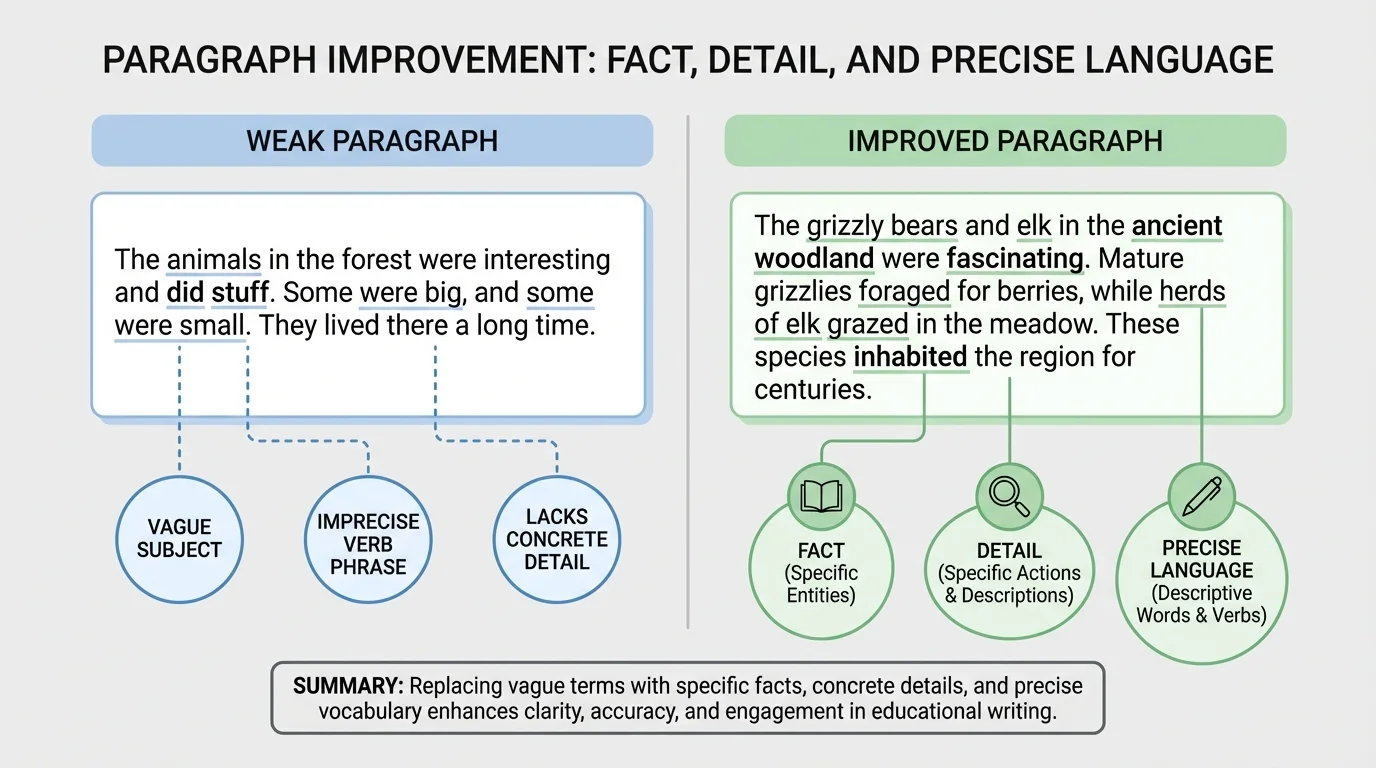
The stronger paragraph works better because each sentence adds new understanding. It explains what a volcano is, what happens during an eruption, and why scientists study volcanoes. Later, when writers revise, they can use this kind of comparison to check whether they have really taught the reader something.
Strong informative writing grows layer by layer. A writer begins with a topic, adds true information, chooses exact words, and includes examples that fit. Each added layer should help the reader understand more, not just make the piece longer.
Revision is often where topic development becomes stronger. Writers can reread each sentence and ask, "Does this sentence explain the topic? Does it add something useful? Is there a better detail I could use?" Those questions help turn simple writing into rich writing.
Some topics use special words that belong to a subject area. These are called domain-specific vocabulary. In science, words such as habitat, evaporation, and predator are domain-specific. In geography, words such as continent and climate belong to that subject. In music, terms like rhythm and melody are more exact than general words.
Using domain-specific vocabulary helps writing sound more informed and accurate. If a student writes about the solar system, the word orbit is more precise than saying a planet "goes around" the sun. If a student writes about baseball, the word inning is more exact than saying "one part of the game."
However, writers must think about their audience. If they use a special word, they may need to explain it. A good informative writer teaches the reader, not just shows off big words.
Remember that a paragraph usually begins with a main idea and then adds supporting details. Topic development builds on that skill by making the support stronger, clearer, and more complete.
When domain-specific vocabulary is used with facts and examples, writing becomes both clear and powerful. The reader learns not only about the topic but also about the language experts use to discuss it.
One common mistake is being too vague. Words like "nice," "cool," "stuff," and "things" do not teach much. Instead, writers should choose specific words that explain exactly what they mean.
Another mistake is repeating the same idea again and again. A writer may say, "Sharks are interesting. Sharks are amazing. Sharks are cool." This sounds repetitive because each sentence is nearly the same. Strong development adds new information, such as where sharks live, what they eat, or how they use their senses.
Some writers also add unrelated details. If the topic is thunderstorms, a sentence about a birthday party probably does not belong unless it directly connects to the explanation. Unrelated details distract the reader from the main idea.
A final mistake is using unsupported opinions in place of information. Saying "Space is the best topic ever" tells what the writer feels, but it does not explain anything. Informative writing can be interesting and even exciting, but it still needs support.
Let's put everything together in one paragraph. Suppose the topic sentence is: "Sea turtles face many dangers in the ocean." To develop this topic, a writer can add facts, examples, and precise language.
Model paragraph built step by step
Step 1: Start with the topic sentence.
Sea turtles face many dangers in the ocean.
Step 2: Add facts.
Some sea turtles are harmed by plastic waste, fishing nets, and boats.
Step 3: Add a concrete detail.
A floating plastic bag can look like a jellyfish, which may trick a hungry turtle into eating it.
Step 4: Add an example or explanation.
Because of these dangers, many people work to clean beaches and protect nesting areas.
The final paragraph gives the reader a fuller understanding of the problem.
Here is the developed paragraph as one smooth piece: "Sea turtles face many dangers in the ocean. Some are harmed by plastic waste, fishing nets, and boats. A floating plastic bag can look like a jellyfish, which may trick a hungry turtle into eating it. Because of these dangers, many people work to clean beaches and protect nesting areas." This paragraph teaches the reader something specific and important.
Strong topic development helps writing become more than a list of simple sentences. It turns writing into real explanation. When writers use facts, definitions, concrete details, quotations, examples, precise language, and clear organization, they help readers truly understand a subject.
