Have you ever heard someone tell a story that made you feel like you were right there with them? You could almost hear the voices, see the place, and feel the excitement or worry. That is what good narrative writing does. It does not just tell readers that something happened. It helps readers experience what happened. Two powerful tools help writers do this: dialogue and description.
When writers use these tools well, a story feels alive. Readers can tell who is speaking, what is happening, and how characters react when something changes. A simple event, like losing a library book or seeing dark clouds before a soccer game, can become a vivid scene when the writer includes the right words, details, and reactions.
A narrative is a story about real or imagined events. In a strong narrative, events happen in an order that makes sense. Characters face situations, make choices, and react to what happens next. Readers want more than a list of events. They want to know what the characters say, what the setting is like, and how the moment feels.
Dialogue helps readers hear the characters. Description helps readers picture the setting, actions, and emotions. Together, they turn a plain report into a story.
Dialogue is the exact words a character says in a story. Description is language that helps readers imagine people, places, objects, actions, and feelings. Narrative is writing that tells a sequence of events.
If a writer says, "Mina went to the fair. She was scared of the ride," the reader understands the basic idea. But if the writer adds dialogue and description, the scene becomes much stronger: " 'I'm not going on that,' Mina whispered, gripping the metal gate as the ride clanked and rattled above her." Now the reader can hear Mina's voice, picture the setting, and notice her fear.
[Figure 1] Dialogue and description each have important jobs in a story. Sometimes they work alone, but often they work best together.
Dialogue can show what characters want, how they feel, and how they relate to each other. A cheerful greeting sounds different from a warning. A short answer can show anger, nervousness, or impatience. Readers can learn a lot from what a character says and how the character says it.
Description can show the setting, mood, and important actions. It can help readers understand whether a place feels warm and friendly, dark and mysterious, or loud and busy. Description can also slow down an important moment so readers can notice details that matter.
Writers often use dialogue to move the story forward and description to help readers understand the moment. For example, if two friends find a strange box in the attic, description can show the dusty room and the creaking floorboards, while dialogue can show whether the friends are excited, worried, or curious.
How dialogue and description work together
Think of dialogue as the part of the story readers can hear and description as the part they can see, feel, smell, or imagine. When a writer combines both, readers understand not only what happens but also what the moment is like. This makes characters and events feel real.
A story becomes stronger when the writer chooses the tool that fits the moment. A fast argument may need quick lines of dialogue. A quiet moment in the woods may need rich description. A surprising event may need both.
Dialogue needs to be clear on the page, with the main parts of a dialogue sentence working together clearly. Readers should know who is speaking and understand why the words matter in the story. Dialogue is not added just to fill space. It should reveal something important.
When you write dialogue, use quotation marks around the exact words spoken. You can also add a speaker tag to tell who is talking. A speaker tag is a short phrase such as "she said" or "Marco asked." Sometimes a writer uses an action instead of a speaker tag. This is called an action beat. For example: " 'Hurry up!' Lena waved from the doorway." The action helps the reader picture the moment while also showing who is speaking.
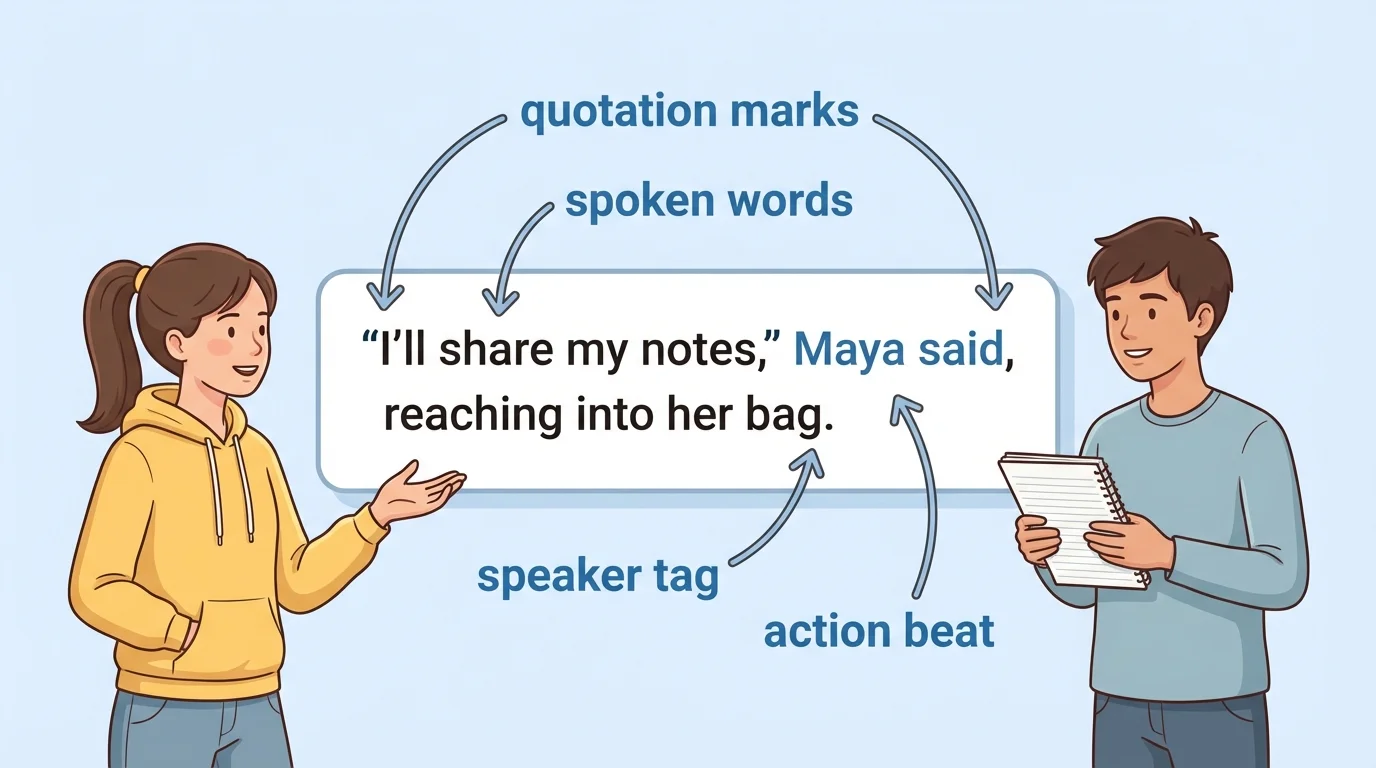
[Figure 2] Good dialogue sounds like a real person, but it is usually clearer and shorter than everyday conversation. In real life, people repeat themselves, pause, and wander off topic. In stories, dialogue should stay focused. It should match the character and fit the moment.
Characters should not all sound exactly the same. A shy character may speak softly and use fewer words. A confident character may speak quickly and directly. A younger child might say, "Wait for me!" while an older character might say, "Hold on. I'm coming." These differences help readers tell characters apart.
Dialogue can also show feelings without naming them. Compare these two lines: " 'I am angry with you,' Ben said." and " 'You promised,' Ben said, crossing his arms." The second line is stronger because it lets the reader notice the feeling through the words and action.
| Plain Dialogue | Stronger Dialogue |
|---|---|
| "I am scared," Ava said. | "Do we really have to go in there?" Ava asked, stepping back. |
| "I am excited," Luis said. | "No way! We made the team!" Luis shouted. |
| "I am upset," Nia said. | "That was my turn," Nia muttered. |
Table 1. This table compares plain dialogue that tells a feeling with stronger dialogue that shows the feeling.
Notice that the stronger lines sound more natural and reveal more about the characters. Later in a story, the same ideas from [Figure 1] still matter because clear punctuation, speaker clues, and actions keep the reader from getting confused.
Description gives readers a picture in their minds and can show how one setting may be described through several senses at once. Instead of piling on many random details, a writer chooses details that help the reader understand the place, action, or mood.
One helpful way to describe a scene is to use the senses. Ask: What can the character see, hear, smell, touch, or taste? Not every scene needs all five senses, but sensory details make writing more vivid. A hallway is not just "busy." It may echo with slamming lockers, smell like pencil shavings and lunch trays, and feel crowded as backpacks bump together.
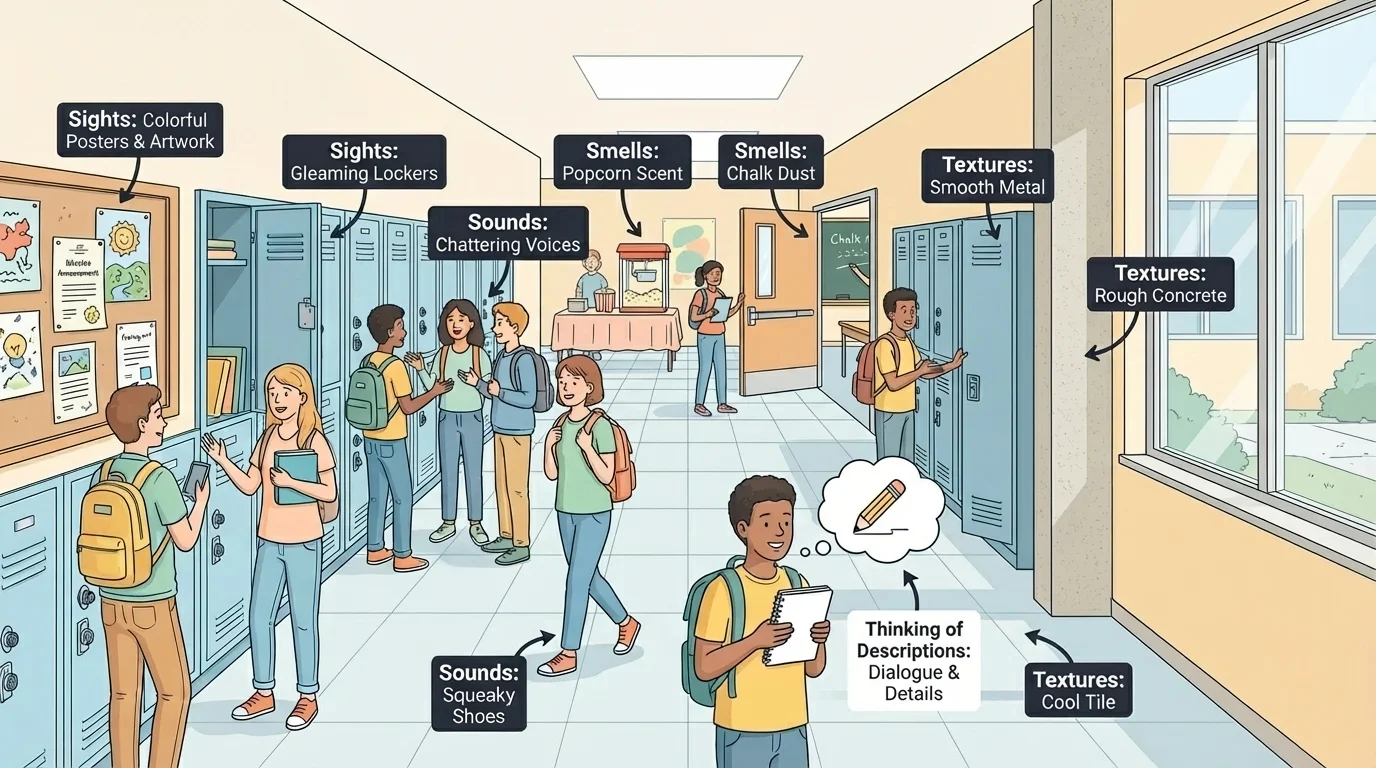
Strong description often uses specific words. Instead of saying "a bird," a writer might say "a bright red cardinal." Instead of "went," a writer might use "stomped," "tiptoed," "hurried," or "wandered." Precise words give readers a clearer picture.
Description can also create mood. Mood is the feeling a scene gives the reader. A sunny field with buzzing bees creates a different mood than a silent yard under gray clouds. The writer's details guide the reader's emotions.
Many favorite books feel exciting not because huge events happen on every page, but because small details make each scene vivid. A creaky stair, a flickering light, or a trembling hand can make an ordinary moment unforgettable.
[Figure 3] Here is a plain sentence: "The room was messy." Here is a stronger version: "Socks hung from the desk lamp, comic books covered the floor, and a half-built model spaceship leaned dangerously on the edge of the bed." The second sentence helps the reader see the room and also learn something about the character who lives there.
People do not all react the same way to a situation, and different reactions can appear on a character's face, in posture, in speech, and even in silence. In a narrative, showing these responses makes characters feel believable.
A response is how a character reacts to an event, problem, surprise, or change. Writers can show responses in several ways: through dialogue, actions, thoughts, and body language. A character who is nervous might bite a lip, look at the floor, or ask many questions. A character who is calm might stand tall, speak clearly, and take a slow breath.
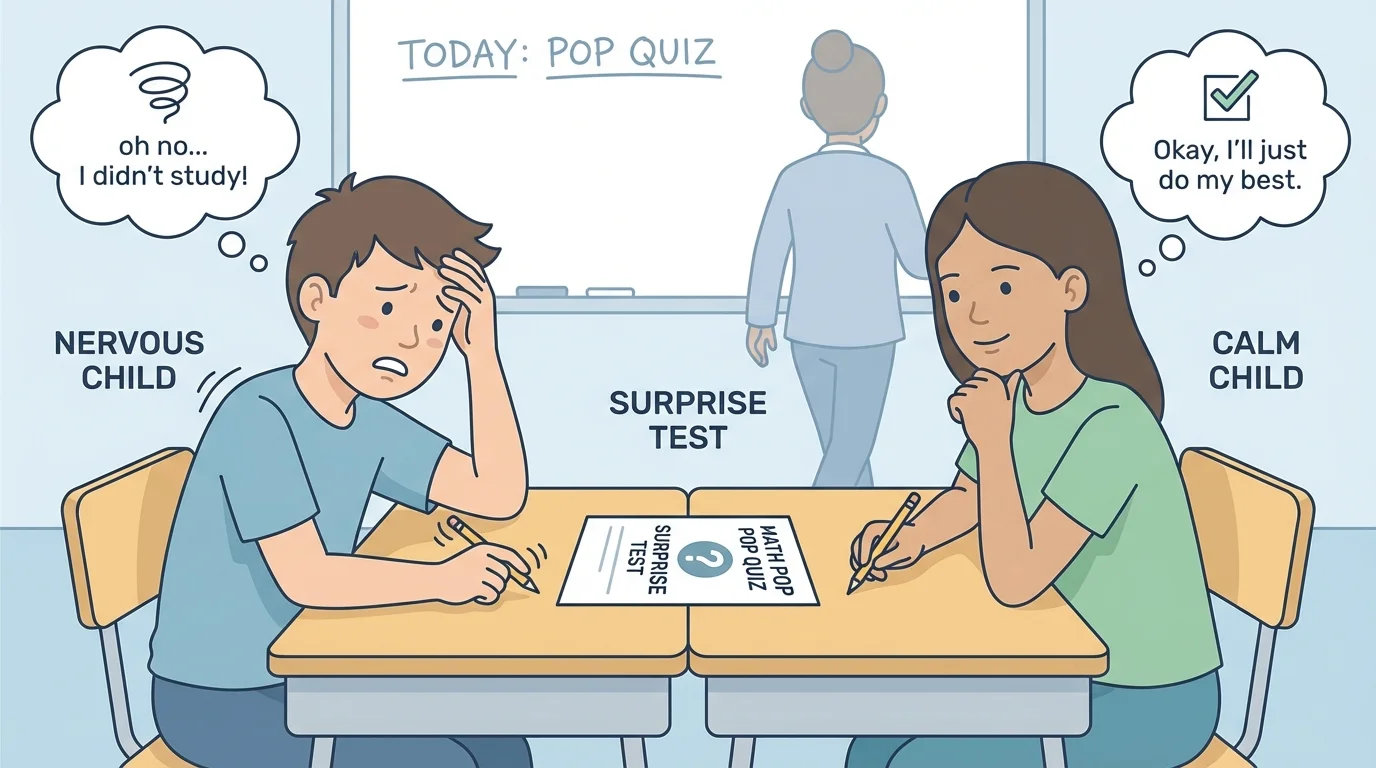
You do not always have to write the feeling word. Instead of saying, "Jamal was worried," you can show his response: "Jamal checked his pocket again, even though he had already felt the folded permission slip three times." The action helps the reader infer the feeling.
Thoughts are useful too. A writer might include a line such as, "What if I forget the words?" Maya thought. This helps readers understand a character's inner experience. Dialogue shows what the character says out loud. Thoughts show what the character keeps private.
Example: showing response in different ways
Situation: A student learns that the class pet is missing.
Step 1: Show the spoken response.
" 'What do you mean he's gone?' Tessa asked."
Step 2: Show the physical response.
"Her hands flew to the top of the cage, and the water bottle rattled."
Step 3: Show the inner response.
"He was here this morning, she thought. He had to be."
Together, these details help the reader understand Tessa's fear and surprise.
When writers combine these kinds of responses, characters seem more real. Just as the reactions in [Figure 3] differ even in the same situation, your characters should respond in ways that fit their personalities.
A strong narrative does not use dialogue and description randomly. It uses them to guide the reader through a sequence of related events. Usually, the story begins with a situation, moves through actions and reactions, and leads to some kind of change, problem, or solution.
Suppose a story is about a boy who enters the school spelling bee. The opening might describe the bright stage lights and the rows of chairs. Then dialogue might show a friend whispering encouragement. Next, the writer may describe the boy's sweaty hands and quick breathing before his turn. Each part moves the event forward while also deepening the experience.
Here is how a sequence can work: first, the writer sets the scene; next, characters speak and act; then, a problem or surprise appears; finally, the character reacts and the event continues. Description helps readers understand where and how the event is happening. Dialogue helps readers hear what the characters say during it.
Stories need a clear order of events. Words such as first, next, suddenly, after a moment, and finally help readers follow the sequence.
Writers should think about pacing. Pacing is the speed at which a story moves. A quick exchange of dialogue can speed up the action. A longer description can slow down an important moment so readers notice details. If a dog suddenly dashes across a picnic, fast dialogue may fit the excitement. If a character waits alone before a big decision, slower description may fit better.
One of the best ways to learn this skill is to compare simple writing with richer writing. The goal is not to make every sentence long. The goal is to make each sentence do useful work.
Example 1: adding dialogue
Weak version: "Kai lost his shoe in the river. He was upset."
Step 1: Add the exact words the character says.
" 'My shoe!' Kai yelled."
Step 2: Add a helpful action.
"He lunged toward the water, but the current spun the sneaker away."
Stronger version: " 'My shoe!' Kai yelled, lunging toward the water as the current spun the sneaker away."
This version lets the reader hear Kai and picture what is happening at the same time.
Example 2: adding description
Weak version: "The storm started, and Ella ran home."
Step 1: Describe what the character notices.
"Wind slapped the tree branches together, and cold drops tapped Ella's cheeks."
Step 2: Show the action more clearly.
"She clutched her backpack over her head and sprinted down the sidewalk."
Stronger version: "Wind slapped the tree branches together, and cold drops tapped Ella's cheeks. She clutched her backpack over her head and sprinted down the sidewalk."
The stronger version creates a scene instead of only reporting an event.
Example 3: showing a response
Weak version: "Noah was nervous about reading his poem."
Step 1: Replace the feeling word with body language.
"Noah rubbed his palms on his jeans and stared at the floor."
Step 2: Add a line of dialogue or thought.
" 'Maybe I should go after Lena,' he whispered."
Stronger version: "Noah rubbed his palms on his jeans and stared at the floor. 'Maybe I should go after Lena,' he whispered."
Notice how each stronger version helps the reader infer the feeling instead of only being told what it is.
One common mistake is using too much dialogue without enough description. If characters talk and talk, but the reader does not know where they are or what they are doing, the scene may feel like floating voices. Add small actions and setting details to anchor the conversation.
Another mistake is using too much description at once. If a writer lists every object in a room, the story can slow down too much. Pick the details that matter most. Ask which details help the reader understand the moment, character, or mood.
A third mistake is making the speaker unclear. If several characters are talking, the reader needs clues about who says each line. Use speaker tags or action beats when needed. The clear structure we saw earlier in [Figure 1] helps readers follow the conversation without stopping to guess.
Another mistake is telling feelings in a flat way when the moment would be stronger if it were shown. "She was sad" may be useful sometimes, but "She folded the birthday invitation and slid it into her desk without answering" gives the reader more to notice and think about.
Strong writers do not include every possible detail. They choose the sensory details and actions that matter most. If a story is about a tense basketball game, the squeak of shoes, the bouncing ball, and the final buzzer may be more important than the color of every seat in the gym.
The best details often do more than one job. A detail can show the setting and also reveal character. For example, "Rina lined up her pencils by size before the test started" describes an action, but it also suggests that Rina is careful and likes order.
As you write, think about what you want the reader to notice most. Is the moment exciting, funny, scary, or surprising? Is the character brave, impatient, shy, or determined? Choose dialogue and description that support that idea.
"Show the moment so clearly that the reader can step inside it."
When writers use dialogue and description with care, even small events can become memorable. A lost mitten, a missed bus, a secret note, or a backyard race can all feel important because readers can hear the voices, picture the scene, and understand how the characters respond.
