One small change in a word can completely change the picture in your mind. If a character is glad, that feels different from thrilled. If the weather is cool, that is not quite the same as freezing. Strong readers notice these differences. They do not just know what a word means; they understand how words connect to other words. That skill helps them read more carefully, write more clearly, and figure out unfamiliar vocabulary.
Words are connected in many ways. Some words have meanings that are almost alike. Some words have meanings that are opposite. When readers understand these relationships, they can make better sense of stories, articles, poems, and directions. They can also make smarter choices in their own speaking and writing.
Suppose you read the sentence, "The path was narrow, not wide enough for two bikes." Even if you are unsure about the word narrow, the phrase not wide helps you understand it. That is the power of word relationships. A reader can connect a new word to a known word and unlock meaning.
Synonyms are words with similar meanings.
Antonyms are words with opposite meanings.
These relationships help readers compare meanings, notice differences, and understand how carefully chosen words shape a sentence.
Knowing synonyms and antonyms is also useful when you speak or write. If you use the same word again and again, your writing can sound repetitive. But if you know related words, you can choose one that matches your exact idea. For example, instead of always saying said, a writer might choose whispered, shouted, or replied, depending on the situation.
A synonym is a word that has a meaning similar to another word. The word big has synonyms such as large, huge, and gigantic. These words all connect to the idea of size. They are not always perfectly interchangeable, but they point in a similar direction.
An antonym is a word that means the opposite of another word. The antonym of big might be small. The antonym of early is late. The antonym of noisy is quiet. Opposites help sharpen meaning because they show what something is not as well as what it is.
Readers often use both kinds of relationships at the same time. If a text says, "The tiny mouse hid beside the enormous pumpkin," you can understand enormous better because it is clearly very different from tiny. The opposite idea helps define the unknown word.
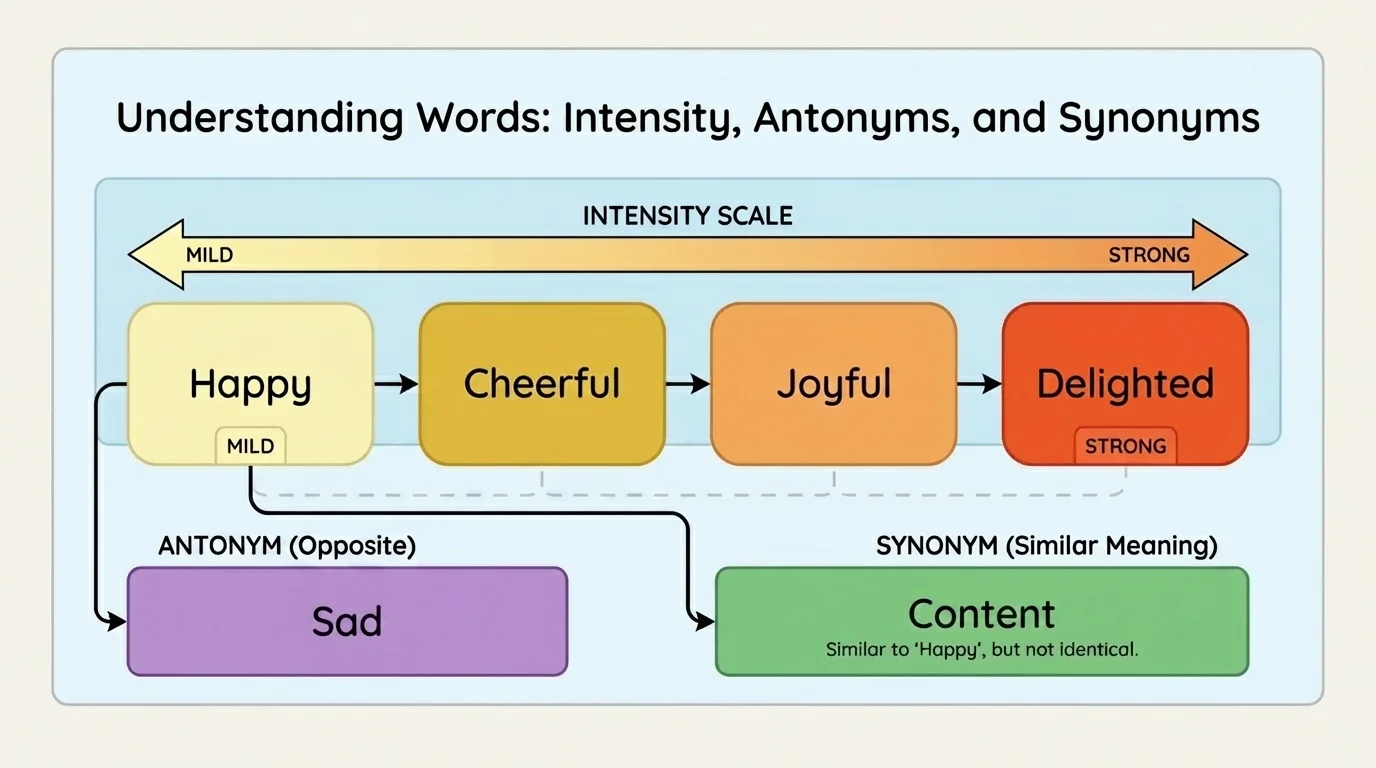
Many students think synonyms are words that mean exactly the same thing. In reality, most synonyms are shades of meaning. They are close in meaning, but not identical. As [Figure 1] shows, words that seem like synonyms can be arranged from weaker meaning to stronger meaning. This matters because a writer chooses words carefully.
Look at these words: happy, cheerful, joyful, and delighted. They all describe positive feelings, but they are not equal in strength. A person who feels happy may feel good. A person who feels delighted feels much more excited and pleased. If a writer wants to describe a birthday surprise, delighted may fit better than happy.
Synonyms can also differ in style. The words child and kid have similar meanings, but they sound different. Child is more formal. Kid is more casual. If you are writing a school report, child may be the better choice. If you are chatting with a friend, kid may sound more natural.
Sometimes synonyms differ in the picture they create. Compare walked, strolled, and marched. All involve moving on foot, but each gives a different feeling. Strolled sounds relaxed. Marched sounds strong and organized. That is why readers should not treat synonyms as simple replacements every time.
Example: noticing shades of meaning
Read this sentence: "After winning the championship, the team felt proud."
Step 1: Find a possible synonym.
A similar word for proud might be pleased.
Step 2: Compare the strength.
Pleased is a milder feeling. Proud suggests deeper satisfaction, often about an achievement.
Step 3: Choose the better fit.
Because winning a championship is a major accomplishment, proud fits better than pleased.
This shows that synonyms may be close in meaning, but one can match the situation more exactly.
Later, when you come across strong feeling words in stories, the scale in [Figure 1] helps you remember that not all similar words carry the same amount of emotion.
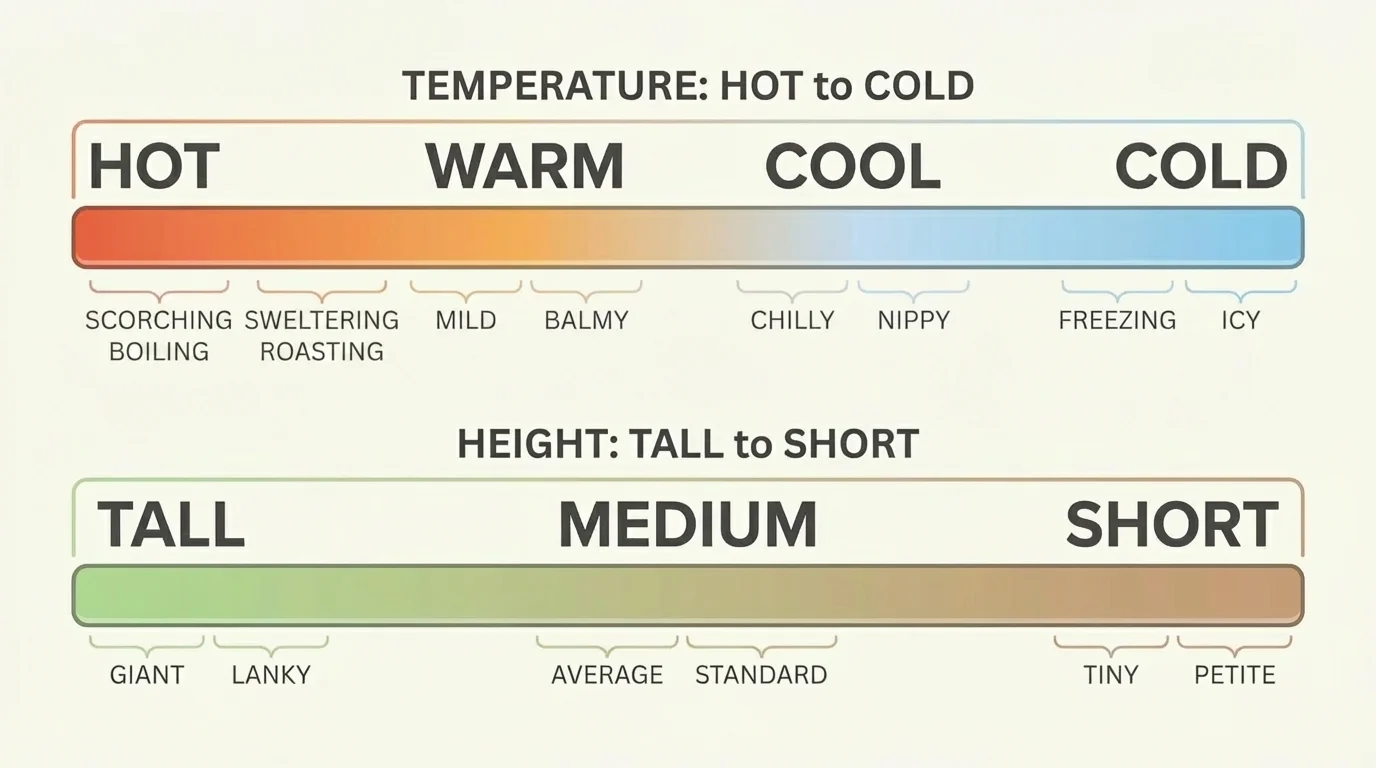
Antonyms are not always simple yes-or-no opposites. As [Figure 2] illustrates, some opposites sit on a scale, with middle steps between them. This is true for many describing words.
For example, hot and cold are antonyms, but there are middle words too: warm and cool. Tall and short are antonyms, but not everyone is one extreme or the other. These are called gradable antonyms because the meanings can move along a scale.
Other antonyms are more exact opposites. Alive and dead are usually treated as direct opposites. On and off are another pair. There is usually not a middle state in everyday use.
Some opposites depend on a relationship. Think about teacher and student, or buy and sell. These words are not opposites in the same way as hot and cold, but they show two connected sides of the same situation.
Antonyms help readers understand meaning by contrast. If a text says, "Unlike his restless brother, Marco was calm," the word unlike tells you to compare the brothers. Even if you do not know restless exactly, you can guess it means something like not calm, perhaps unable to sit still.
Opposites can be clues
Authors often place antonyms near each other on purpose. Signal words such as but, however, unlike, instead of, and in contrast often warn readers that an opposite idea is coming. These clue words help readers unlock meaning during reading.
When you look again at the scales in [Figure 2], you can see that some opposites are far apart, while others allow many words in between. That is an important part of understanding nuance.
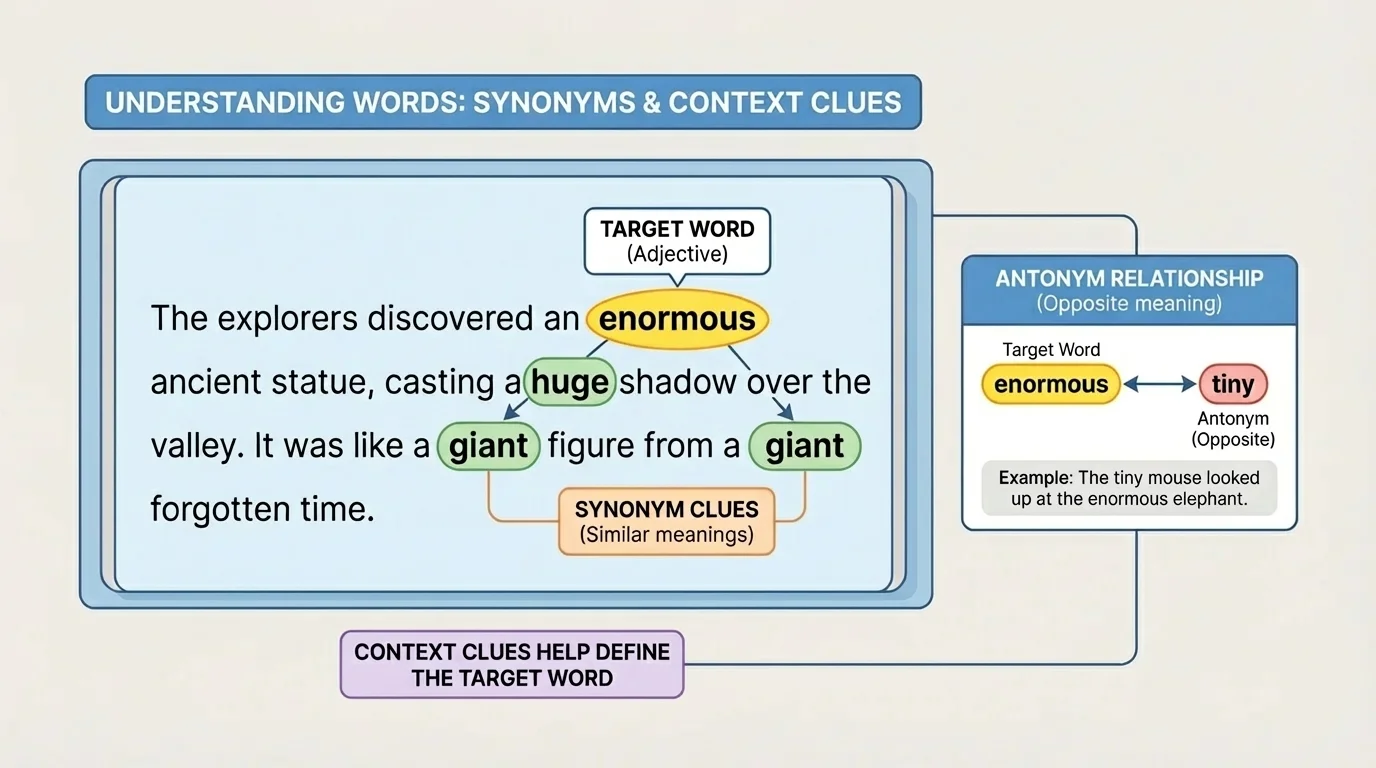
Readers do not usually stop after every unfamiliar word. They look around the word for clues. Nearby words, examples, explanations, and contrasts all help. As [Figure 3] shows, a sentence can surround an unknown word with hints that point toward a synonym or antonym.
Suppose you read: "The enormous bear looked huge beside the small tent." Even if context clues are the only help you have, the word huge acts like a synonym clue, and small tent adds a contrast. Together they suggest that enormous means very big.
Here are common kinds of context clues:
Strong readers ask themselves questions: Which known words are near the unknown word? Does the sentence compare or contrast ideas? Is there an example? Is there a definition hidden in the sentence? These questions make reading more active and more accurate.
Example: using context clues
Read this sentence: "The glass was fragile, so Mia carried it carefully to keep it from breaking."
Step 1: Notice the nearby clue.
The phrase to keep it from breaking explains something important about the glass.
Step 2: Connect to a known word.
If something breaks easily, it is delicate.
Step 3: Infer meaning.
Fragile means easy to break.
Here, the explanation in the sentence leads directly to the word's meaning.
The highlighted clue pattern in [Figure 3] reminds you that the unknown word is only one part of the sentence. The surrounding words often do the teaching.
Knowing many synonyms is useful, but choosing the best one is even more powerful. Good readers and writers think about exact meaning, strength, and tone. Nuance is the small difference that makes one word fit better than another.
Look at these words: look, glance, peek, and stare. They all connect to using your eyes, but they are not the same. A glance is quick. A peek may be secretive. A stare is long and fixed. If a story says a child looked at presents before the party, peeked may be the best choice because it suggests sneaking a look.
Tone also matters. The words skinny and slender can both describe a thin person, but they do not feel the same. Slender often sounds more positive. Skinny can sound negative or unkind. Word choice shapes how readers feel.
This matters in everyday life. In sports writing, saying a team edged out another team sounds different from saying it crushed the other team. In science writing, saying an animal is tiny may be less exact than saying it is microscopic if it can only be seen with magnification. Precise words make communication stronger.
Writers of dictionaries do not just list definitions. They also study how words are used in real books, articles, conversations, and online writing so they can explain the differences between similar words.
When readers pay attention to nuance, they understand characters, settings, and information more deeply. When writers pay attention to nuance, their sentences become clearer and more vivid.
Some words have more than one meaning, and that changes their synonyms and antonyms. As [Figure 4] shows, one word can branch into different meanings. To understand the right synonym or antonym, you must first know which meaning the sentence uses.
Take the word bright. In one sentence, "The bright lamp lit the room," bright means full of light. Synonyms might include shiny or vivid. In another sentence, "Amira is a bright student," bright means smart. Synonyms might include clever or intelligent.
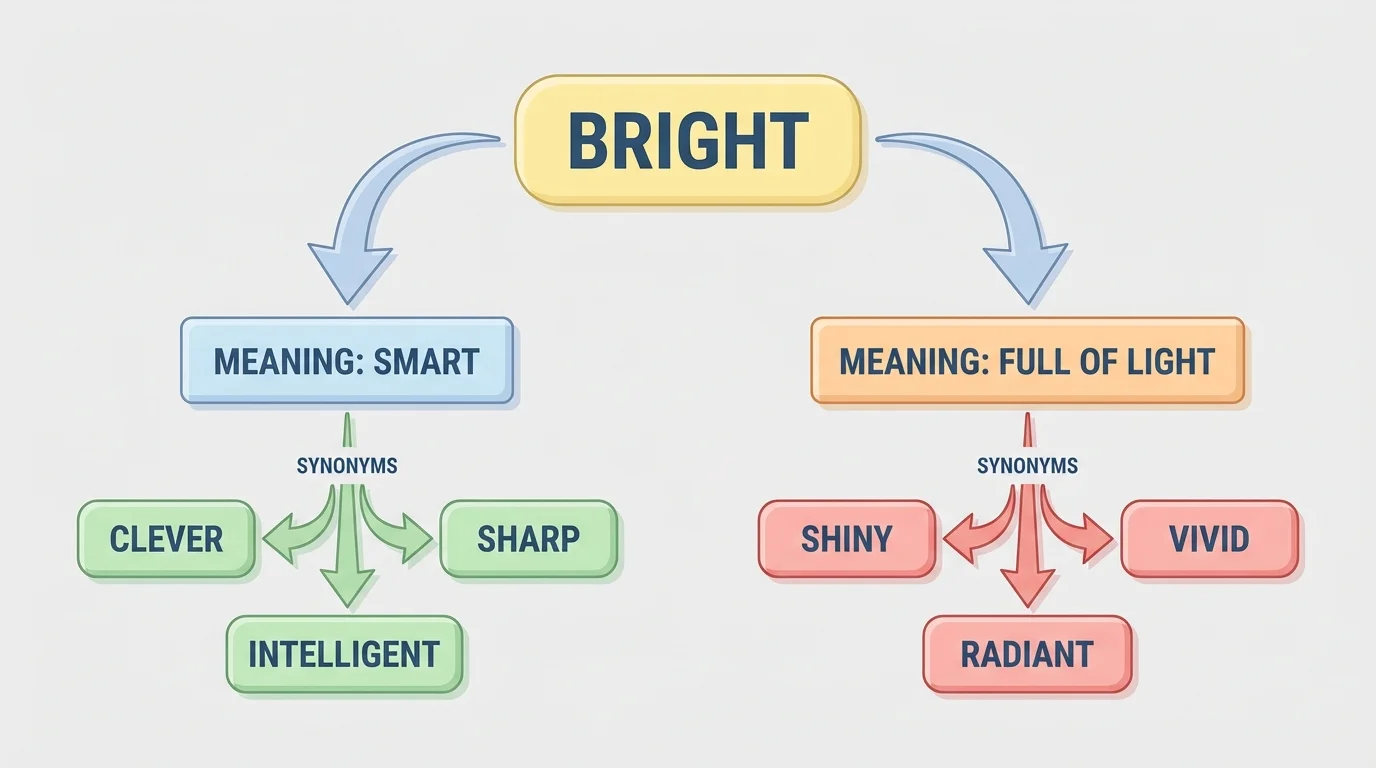
The antonyms also change. If bright means full of light, an antonym could be dim. If bright means smart, an antonym might be unwise or foolish. This is why context matters so much.
Another example is the word light. It can mean not heavy, or it can mean brightness. In "This box is light," an antonym is heavy. In "Turn on the light," the antonym might be darkness depending on how the word is used.
The branches in [Figure 4] make an important idea clear: before you search for a synonym or antonym, make sure you know which meaning of the word belongs in the sentence.
You build vocabulary best when you notice word relationships often, not just once in a while. Every time you read a story, article, or poem, you can watch for pairs and groups of related words. Notice when an author repeats an idea with a new word. Notice when a sentence uses contrast words such as but or however. These patterns teach meaning.
One useful habit is comparing words instead of memorizing them alone. Instead of learning only the word angry, connect it to mad, upset, furious, and calm. Ask: Which words are similar? Which are opposites? Which are stronger? Which sound formal or informal?
You may already know that prefixes and suffixes can help with meaning. Word relationships add another tool. If a word part does not fully help, a synonym or antonym in the sentence may finish the job.
A dictionary or thesaurus can help, but readers should still think carefully. A thesaurus lists synonyms, yet it does not guarantee that every listed word fits every sentence. You must check the exact meaning and tone. That is how thoughtful readers become thoughtful writers.
As you keep reading, you will notice that word knowledge works like a web. One new word connects to familiar words, opposite words, stronger words, softer words, and context clues. The more connections you make, the easier reading becomes.
