Have you ever read a sentence that sounded fine at first, but then something felt wrong? Maybe you read, "The puppy buried his bone in the flow bed," and suddenly realized that flow does not make sense there. Your brain is doing something powerful: it is checking the sentence, noticing a problem, and helping you fix it. Strong readers do this all the time. They do not just say words out loud. They pay attention to whether the words match the story or information.
Reading well is not about being perfect on the first try. It is about being an active thinker while you read. Good readers notice when a word seems wrong, use clues from the text, and reread when needed. This skill helps with stories, science articles, social studies texts, directions, and just about anything else you read.
When you read, your eyes see print, but your mind does much more than that. It connects letters and sounds, notices word parts, remembers what happened earlier, and predicts what might come next. This is why reading is both a word-reading job and a meaning-making job. If one of those parts breaks down, understanding can break down too.
A strong reader uses self-correction strategies. That means the reader notices a mistake and fixes it without someone else stepping in. For example, if a student reads, "The class went on a field track," the sentence sounds strange. The reader may look again and see that the word is trip. That quick fix helps the whole sentence make sense again.
Context means the words, sentences, and ideas around a word that help a reader understand it. Word recognition is being able to look at a printed word and read it correctly. Fluency is reading with accuracy, at a good pace, and with expression so the reader can understand the text.
Readers who check themselves understand more because they do not keep moving forward with a mistake. If a word is wrong, the meaning of the sentence may change. One small mistake can cause bigger confusion later. Self-checking helps stop that chain of confusion before it grows.
Context clues are hints in the text that help a reader figure out a word or confirm that the word they read is correct. These clues can come from the sentence itself, from nearby sentences, or from the whole paragraph.
[Figure 1] Look at this sentence: "Mila wore boots and a raincoat because the sidewalk was soaked." Even if you are unsure about the word soaked, the other words help. Boots, raincoat, and sidewalk suggest rain and wetness. That context helps you understand that soaked probably means very wet.
Context can help in two ways. First, it can help you figure out an unknown word. Second, it can help you check whether the word you just read fits the sentence. That second job is very important. Sometimes a reader says a real word, but it is the wrong word. Context helps catch that.
Some reading mistakes are tricky because the wrong word is still a real word. A reader might say horse instead of house. The letters look similar, so context becomes the clue that helps fix the mistake.
Suppose a reader says, "We sat on the porch of the horse." The word horse is a real word, but the sentence does not make sense. Context tells the reader to stop and check again. The correct word is probably house.
Strong readers often use three quick checks: Does it look right? Does it sound right? Does it make sense? These questions work together. One question alone may not be enough, but all three give a reader a strong way to confirm or fix a word.
Does it look right? This means checking the letters and spelling pattern. If the text says basket and the reader says blanket, the beginning letters do not match closely enough. Looking carefully at the word helps.
Does it sound right? This means checking whether the sentence sounds like normal language. If a reader says, "She put the milk in the chair," the sentence sounds odd, unless there is some silly reason in the story. A second look may show the word is cooler, depending on the text.
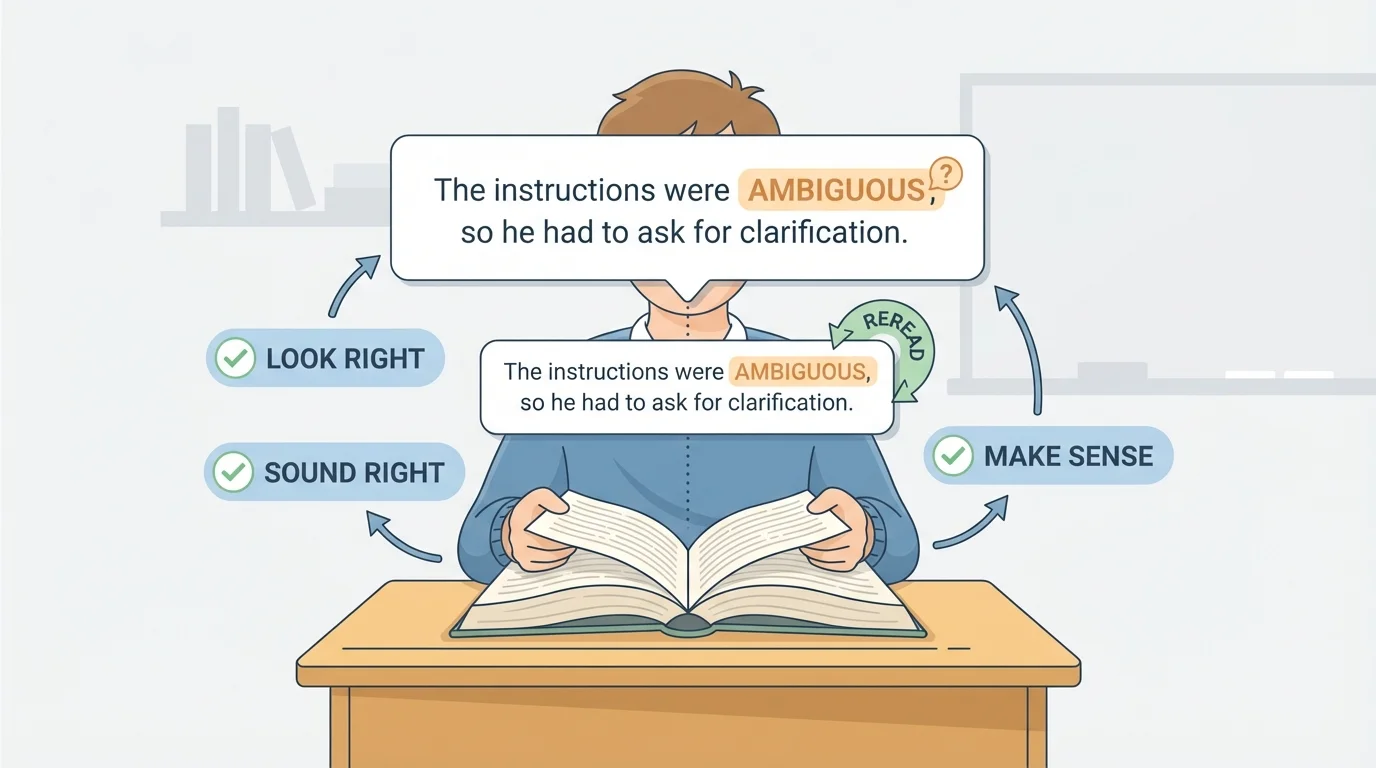
Does it make sense? This means checking the meaning. If the sentence is "The squirrel scampered up the tree," and the reader says stomped instead of scampered, the sentence still could make sense in a small way, but the careful reader notices that the exact action and word shape do not match well. Meaning and print both matter.
These three questions help with easy words and hard words. They also help in fiction and nonfiction. Later, when you meet a new word in an animal article or a chapter book, you can use the same check. As we saw in [Figure 1], strong readers do not guess wildly. They use clues from the print and from the sentence.
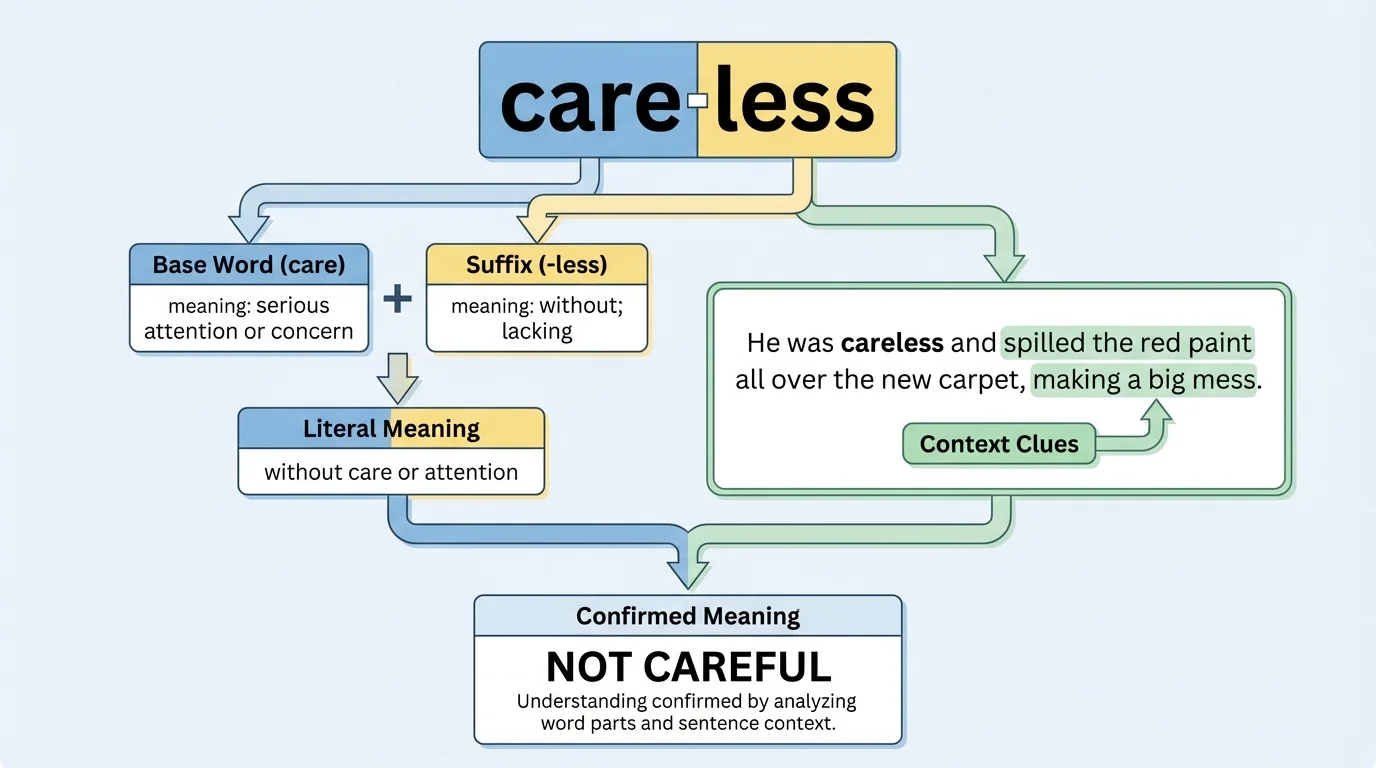
Sometimes a reader reaches a long word and feels stuck. This is where spelling patterns and word parts help. A multisyllable word has more than one syllable. Words such as careless, disagree, sunlight, and reusable can often be read by noticing chunks, and context helps confirm that the chunks lead to the right word, as shown in [Figure 2].
Readers can look for known parts inside a word. For example, in careless, a reader may notice care and the suffix -less. The suffix -less often means "without." So careless means "without care" or "not careful." If the sentence says, "A careless step splashed muddy water on the floor," the context supports that meaning.
This use of morphology helps with understanding. Morphology means studying meaningful word parts, such as prefixes, suffixes, and base words. For example, in replay, the prefix re- means "again." In unhappy, the prefix un- means "not." In hopeful, the suffix -ful means "full of."
Spelling patterns matter too. A reader may know that tion often appears at the end of words such as station or vacation. If the sentence is "Our family visited a science station at the museum," the reader can use the spelling pattern and the context to confirm the word.
Context is especially helpful when more than one word part seems possible at first. Suppose a student reads recover. In one sentence, "The team will recover after a good rest," it means "get better." In another, "The divers hope to recover the lost ring," it means "find and bring back." The same word can have different meanings, so readers must use context to choose the meaning that fits.
Context and word study work together
A reader should not rely on only one strategy. Looking at letters without thinking about meaning can lead to mistakes. Guessing from meaning without checking the letters can also lead to mistakes. The strongest reading happens when a reader uses print clues, word parts, and context at the same time.
This is why readers should avoid wild guessing. If you only glance at the first letter and make up the rest, you may read quickly but misunderstand the text. If you check the letters, the parts of the word, and the meaning of the sentence, you are much more likely to get it right.
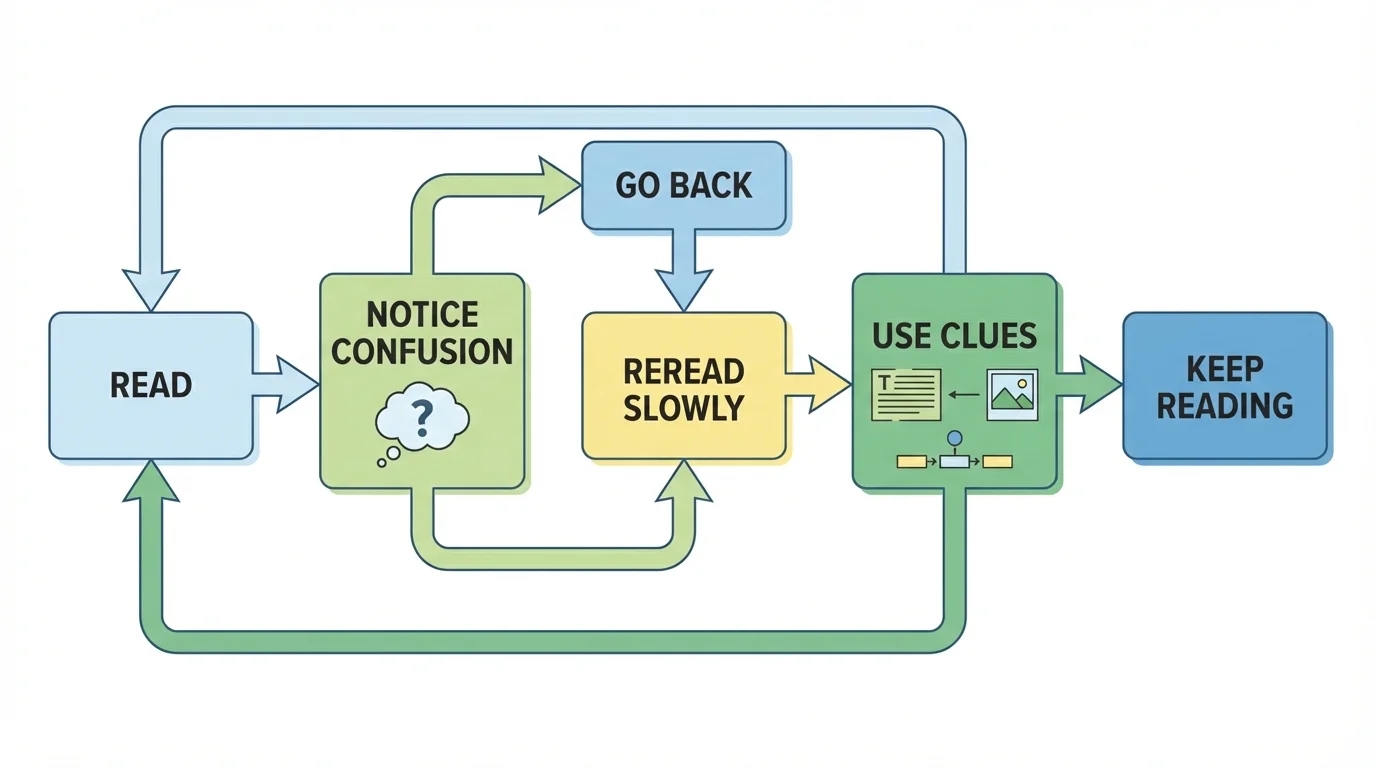
Sometimes the best reading move is simple: stop and go back. Rereading is a repair strategy that helps readers fix confusion through a step-by-step process. Rereading means reading a word, sentence, or section again to understand it better.
[Figure 3] You may need to reread when a sentence does not make sense, when your voice says something strange, when a new word appears, or when you realize you have read a whole paragraph and cannot explain what it said. That happens to all readers, even strong ones.
Rereading can be short and quick. You might go back just one line. You may slow down and look closely at a tricky word. You may read the next sentence too, because sometimes a clue comes after the unknown word. Reading before and after the word gives you a wider context.
For example, read this: "At dawn, the hikers began their ascent. The steep trail made the ascent difficult." If ascent is unfamiliar, the second sentence helps. The steep trail makes it likely that ascent means climbing upward. Rereading the two sentences together clears up the meaning.
Rereading also helps with longer sentences. Informational texts often contain many details. If a sentence has several commas, new vocabulary, or important facts, reading it again can help you connect the ideas. As shown earlier, good readers do not see going back as a failure. They see it as smart problem-solving.
Example: Using rereading to fix a mistake
Sentence: "The desert is a dry habitat with very little rainfall." A student first reads desert as dessert.
Step 1: Notice the problem.
The sentence about a habitat and rainfall does not make sense with dessert, which is food.
Step 2: Look again at the word.
The reader checks the spelling and sees one s in desert, not two as in dessert.
Step 3: Reread the whole sentence.
Now the sentence makes sense: a desert is a dry place with very little rainfall.
The reader uses both print and context to self-correct.
That kind of quick repair is a mark of growing independence. Instead of waiting for someone else to say, "Try again," the reader notices the mismatch and fixes it.
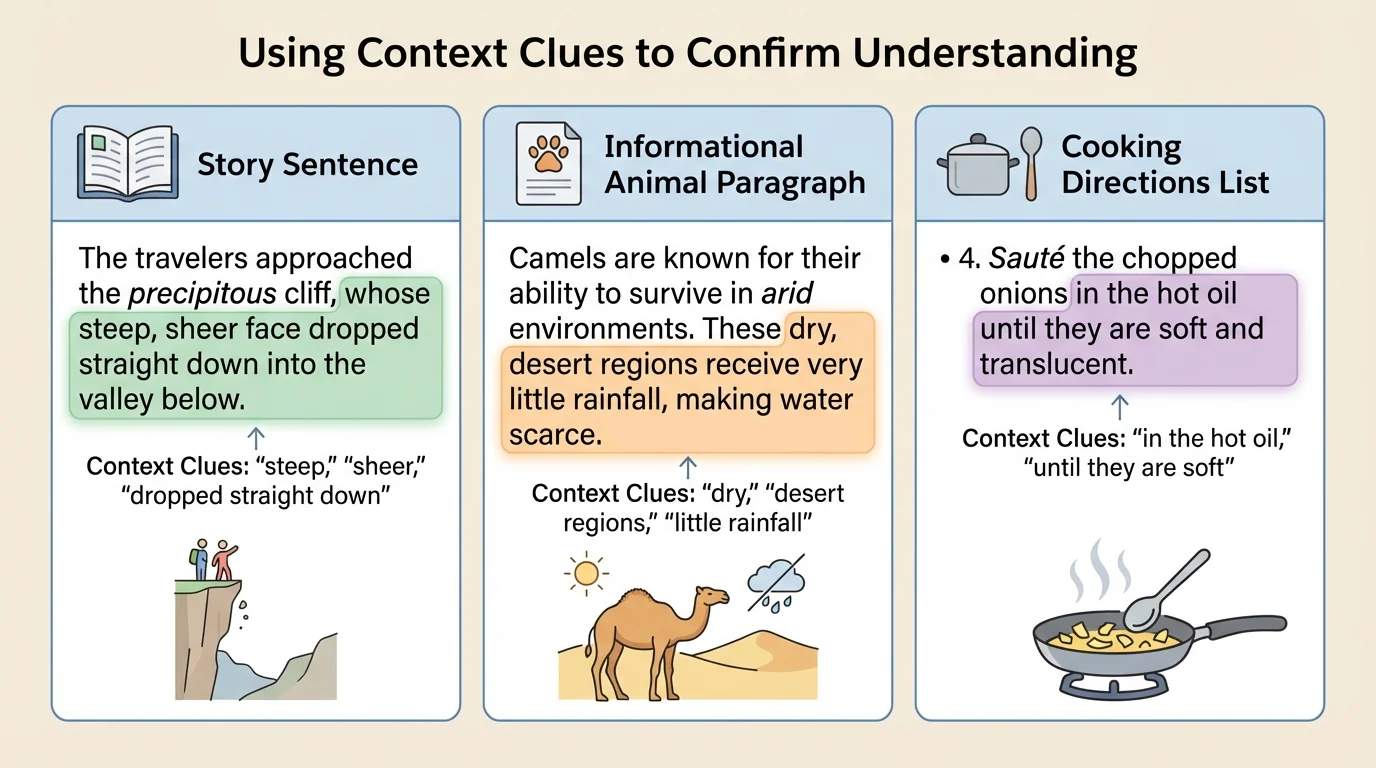
Context works in all kinds of reading, but the clues may look different in each one, as [Figure 4] illustrates. In a story, clues often come from characters, actions, and setting. In informational text, clues may come from definitions, examples, and facts. In directions, clues often come from sequence words and action verbs.
In a story, consider this sentence: "Lena tiptoed past the sleeping baby." Even if a reader is unsure about tiptoed, the sleeping baby gives a clue. Lena is probably moving quietly.
In informational text, the author may explain the word directly: "Nocturnal animals are active at night and rest during the day." The phrase active at night tells the meaning of nocturnal.
In directions, sequence words matter. "First, whisk the eggs. Next, pour the mixture into the pan." If a reader is unsure about mixture, the previous step gives a clue. It must be what was just whisked.
Good readers change their attention based on the text type. In a science article, they may look for definitions and labels. In a novel, they may pay attention to what a character feels or does. In both cases, they ask whether the word fits the meaning.
| Text type | Where clues often appear | Example of clue use |
|---|---|---|
| Story | Actions, dialogue, setting | A character whispers, so murmured likely means spoke softly. |
| Informational text | Definitions, examples, facts | An article says a mammal has hair and feeds its young with milk, helping explain the term. |
| Directions | Order words, action words, nearby steps | The word stir is understood by what the cook does before and after. |
Table 1. Common places where readers find context clues in different kinds of text.
Later, when you read a textbook page or a chapter book, remember the comparison in [Figure 4]. The kind of clue may change, but the habit of checking meaning stays the same.
Readers make different kinds of mistakes, often called miscues. A miscue is not always a disaster. It is information. It shows where the reader may need to slow down, check the print, or use the sentence more carefully.
One common mistake is using only the first letter. A reader sees bridge and says brown because both start with b. Another common mistake is skipping endings, reading jump for jumped. A reader may also swap a word for another word that means something similar, such as big for large. Sometimes that keeps the meaning close, but it still means the exact word was not read correctly.
Smart fixes include looking all the way through the word, checking suffixes and prefixes, rereading the sentence, and asking what would make sense here. If the sentence is "The leaves drifted gently to the ground," a reader who says dropped has the basic idea, but the exact word drifted gives a softer image. Accurate word reading helps deeper understanding.
Remember that reading is not just saying words fast. It is connecting the printed words to meaning. Accuracy comes before speed, and real fluency includes understanding.
Another smart fix is to read ahead a little, then come back. Suppose you read, "The cub stayed close to its mother in the den." If cub is unfamiliar, the words mother and den suggest a young animal. Reading the whole sentence helps confirm the idea.
Fluency means reading accurately, smoothly, and with expression. Sometimes students think fluency means reading as fast as possible. It does not. If you race through a paragraph and miss the meaning, that is not fluent reading.
Fluent readers usually recognize many words quickly, but they also stop when needed. They do not ignore confusion. They notice it and fix it. This actually supports fluency because understanding stays strong. A smooth reader is not one who never pauses; a smooth reader is one who reads in a way that supports meaning.
For example, if a reader slows down at the sentence "The enormous waves crashed against the rocks," that is a wise choice. The word enormous adds important meaning. Once the reader confirms it, the picture in the mind becomes clearer.
"Good readers pay attention to meaning every step of the way."
When you listen to skilled readers, you may notice that they group words into phrases, not one at a time. They may pause at commas, change their voice for dialogue, and slow down for tricky parts. All of that helps comprehension. Self-correcting and fluency work together.
Every time you read, you can train your brain to be more active. Look carefully at the word. Think about spelling patterns and word parts. Ask whether the sentence sounds right and makes sense. If not, go back and try again.
This habit is useful in every subject. In science, it helps you learn precise words such as habitat or erosion. In social studies, it helps you understand names, places, and events. In reading class, it helps you follow characters, settings, and important themes. The same reading habits travel with you from one book to another.
Over time, these strategies become more automatic. You may not say the three questions out loud anymore, but your mind will still check them. That is what skilled readers do. They stay alert, use context, and reread when necessary so their reading is both accurate and meaningful.
