Have you ever been in a class discussion where someone says something interesting, but then the conversation suddenly stops? A strong discussion is a little like playing catch. One person shares an idea, another person catches it, thinks about it, and throws back a related question or comment that keeps the conversation moving. When students know how to ask clear questions and make helpful comments, everyone learns more.
Talking and listening are both important parts of learning. In school, you discuss stories, science ideas, social studies topics, and classroom problems. Good discussions do not happen by accident. They happen when students listen carefully, ask thoughtful questions, and respond in ways that connect to what others say. These skills help you understand ideas better, explain your own thinking, and work well with many kinds of classmates.
A discussion is more than taking turns talking. A strong discussion helps people share information, compare ideas, and solve problems together. When one student asks a thoughtful question, it can help the whole group understand more. When another student adds a useful comment, the conversation becomes richer and more interesting.
Good discussions also help you become a better learner. Sometimes you think you understand something until you hear another person explain it in a different way. Sometimes a classmate asks a question you did not think of, and suddenly the topic becomes clearer. That is why strong speaking and listening skills matter in every subject.
Clarify means to make something easier to understand. Follow up means to ask or say something more after the first idea has been shared. A discussion is a shared conversation in which people listen, speak, and respond to each other.
These skills matter outside school too. People use them when they work on teams, play sports, make plans with friends, and solve everyday problems. Knowing how to ask, "Can you explain that part?" or "I want to add to what you said," makes communication stronger in many situations.
Before you can ask a good question or make a helpful comment, you need active listening. As [Figure 1] shows, active listening means giving your full attention to the speaker. It has visible signs: your eyes are on the speaker, your body is turned toward the group, and your mind is focused on the message.
Active listening also means thinking while you listen. You notice key details. You ask yourself, "What is this person's main idea?" "What examples did they give?" "What part is still unclear?" Instead of planning your own comment too early, you first try to understand what the speaker really means.
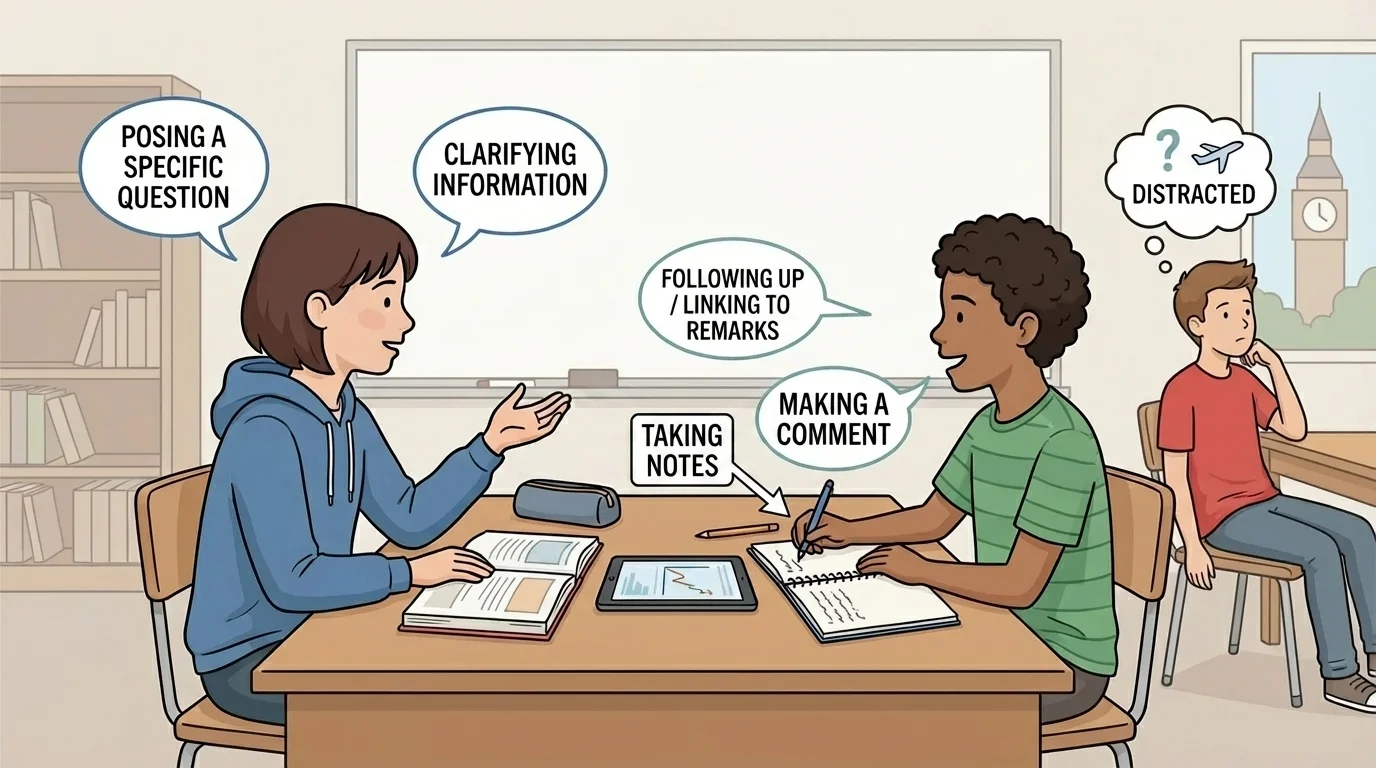
When students do not listen actively, their questions and comments often miss the point. For example, if Maya explains why recycling helps reduce waste, and another student responds with a random joke about lunch, the discussion breaks apart. But if the listener pays attention, the next remark can move the conversation forward.
Some habits show respectful listening: waiting until the speaker finishes, not interrupting, looking at the speaker, and keeping side conversations quiet. Taking a few notes can help too, especially when the topic has several important details. As we see in [Figure 1], listening is not passive. It is an active job your brain and body do together.
You may already know how to take turns and raise your hand. Those skills still matter here. Asking thoughtful questions and making linked comments builds on those earlier speaking and listening habits.
Once you have listened carefully, you are ready to respond in a way that helps everyone understand more.
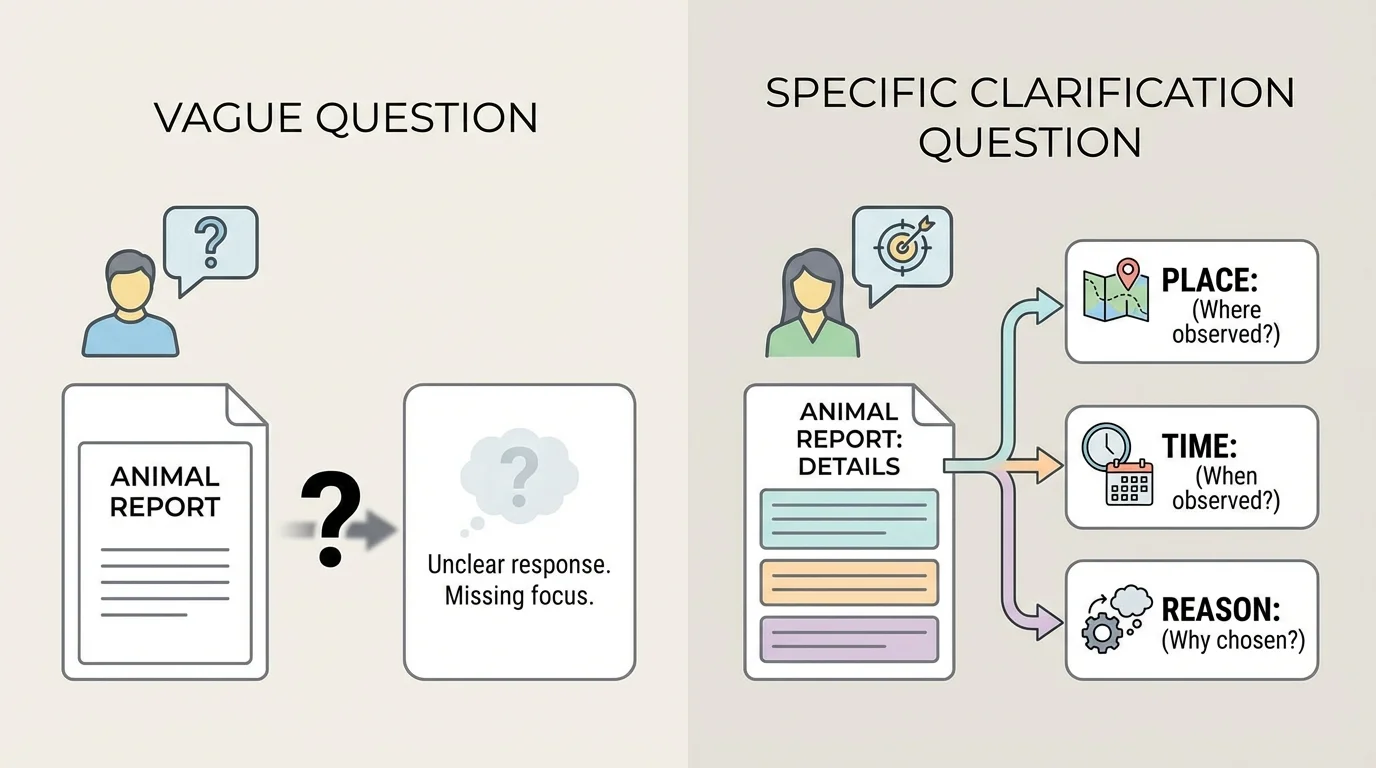
As [Figure 2] illustrates, a clarifying question asks for information that is missing, confusing, or not fully explained. Specific questions are stronger than vague ones. Instead of saying, "What?" you can ask exactly what you need to know.
Suppose a classmate says, "Bats are important animals." You might understand the main idea, but you may still need more information. A clarifying question could be, "How are bats important to the environment?" That question is specific. It tells the speaker what detail to explain.
Specific questions often begin with words such as who, what, when, where, why, and how. They can also begin with sentence starters such as "Can you explain...?" "What do you mean by...?" or "Can you give an example of...?"
Here are examples of weak and strong clarification questions:
| Less helpful question | More helpful question |
|---|---|
| "What?" | "What does 'habitat' mean in your report?" |
| "I don't get it." | "Can you explain how the character changed at the end of the story?" |
| "Why?" | "Why did the colonists protest that law?" |
| "Huh?" | "Which step comes first in the experiment?" |
Table 1. Comparison of vague questions and specific clarification questions.
Notice that the stronger questions point to one exact part of the speaker's message. That helps the speaker answer well. It also helps the group stay focused on the topic.
Example: Turning a vague question into a clear one
A student says, "The water cycle includes evaporation, condensation, and precipitation."
Step 1: Identify what is unclear.
You may not understand one of the stages.
Step 2: Ask about that exact part.
Instead of saying, "What are you talking about?" ask, "Can you explain what condensation means?"
Step 3: Listen to the answer and decide if you need more detail.
You might follow with, "Where do we see condensation in everyday life?"
The second version helps the discussion continue and gives the speaker a clear path to answer.
As shown earlier in [Figure 2], the best clarifying questions are focused, polite, and connected to the topic being discussed.
Sometimes you already understand the basic idea, but you want to learn more. That is when you ask a follow-up question. A follow-up question does not just clear up confusion. It pushes the conversation deeper.
For example, if a student says, "Our class should plant more trees at school," a clarifying question might be, "Where would the trees go?" But a follow-up question might be, "How would planting trees help the school over time?" That second question invites the speaker to think further and add more details.
Good follow-up questions often ask for reasons, examples, comparisons, or evidence. They may sound like this:
These questions show that you were listening and that you care about the speaker's idea. They also make discussions more interesting because they move beyond short answers.
Clarifying and following up are not the same. Clarifying questions help you understand something better when it is unclear. Follow-up questions help you explore an idea further after you understand the basics. Both types are important because discussions need both understanding and deeper thinking.
In a book discussion, for example, you might first ask, "What does the word 'determined' mean here?" That is clarification. Later, after understanding the word, you might ask, "How does the character's determination affect the ending?" That is a follow-up question.
Questions are important, but comments matter too. A useful comment adds something meaningful to the discussion. It might share an idea, give evidence, make a connection, or explain a different point of view. A strong comment helps the group think more clearly.
Comments that contribute often do one of these jobs:
Off-topic comments can interrupt learning. If the class is discussing a science experiment, a comment about your favorite video game does not contribute, even if it is exciting. A contributing comment stays connected to the speaker's idea and to the group's topic.
Strong discussions often sound more thoughtful not because students use longer sentences, but because they connect their sentences more carefully. A short, clear comment can be more powerful than a long, wandering one.
Before speaking, it helps to think, "Will my comment help the group understand more?" If the answer is yes, your comment probably contributes.
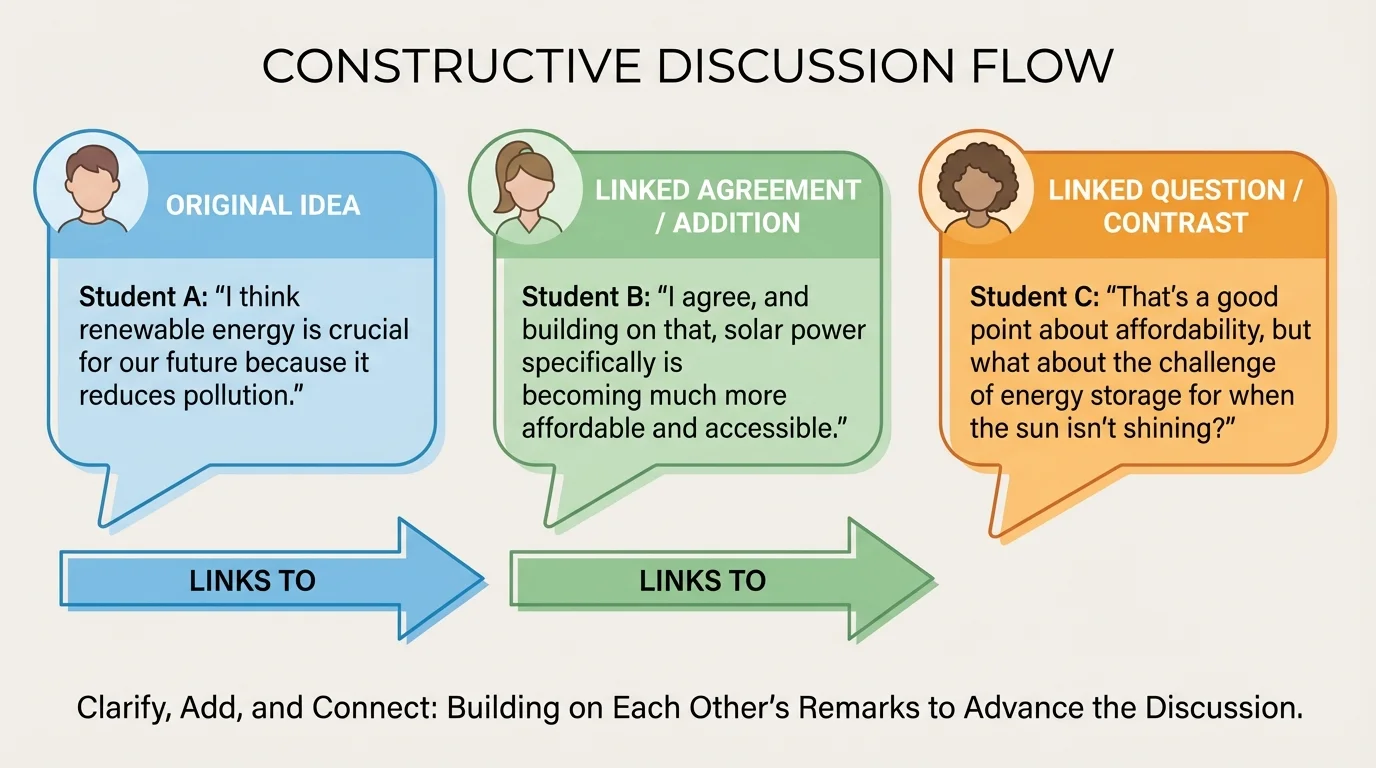
As [Figure 3] shows, a discussion is not a row of separate speeches. It is a chain of connected ideas. That chain becomes clear when students link their comments to earlier remarks. Instead of speaking as if no one else has talked, you connect your idea to another person's point.
This kind of response shows that you listened and that you respect the speaker. It also makes the discussion smoother. You are not just waiting for your turn; you are joining the shared thinking of the group.
Here are some useful sentence starters for linking your remarks:
Suppose Liam says, "The main character was brave." A linked response might be, "I agree with Liam because the character kept going even when the trip became dangerous." That response names the earlier idea and adds evidence. Another linked response could be, "I see it a little differently from Liam because I think the character acted more out of duty than bravery." That also connects clearly, even though it disagrees.
As [Figure 3] illustrates, a good discussion grows step by step. One idea leads to another. One question leads to a better answer. One comment leads to a new perspective.
Example: Linking comments in a discussion about protecting oceans
Student A says, "Plastic pollution hurts sea animals."
Step 1: Restate or mention the earlier idea.
"I want to add to what Student A said..."
Step 2: Add useful information.
"...because animals can mistake plastic for food."
Step 3: Push the discussion further if needed.
"What are some ways people can reduce plastic waste?"
This response both links to the earlier remark and moves the conversation ahead.
Linking does not mean you always agree. It means your response clearly connects to what someone else said.
As [Figure 4] shows, discussion skills are useful in different classroom situations, and each setting has its own rhythm. You may speak in a one-on-one conversation, a small group, or a teacher-led whole-class discussion. In each setting, you still listen actively, ask thoughtful questions, and make linked comments.
In a collaborative discussion with one partner, you usually have more chances to talk. That means you can ask more follow-up questions and respond quickly. It is important to balance speaking and listening so both partners have a voice.
In a small group, you need to notice several speakers, not just one. You may need to bring the group back to the topic by saying, "Let's return to the question," or "How does that connect to our article?" In a teacher-led discussion, you may need to wait longer for your turn and speak clearly enough for the whole class to follow.
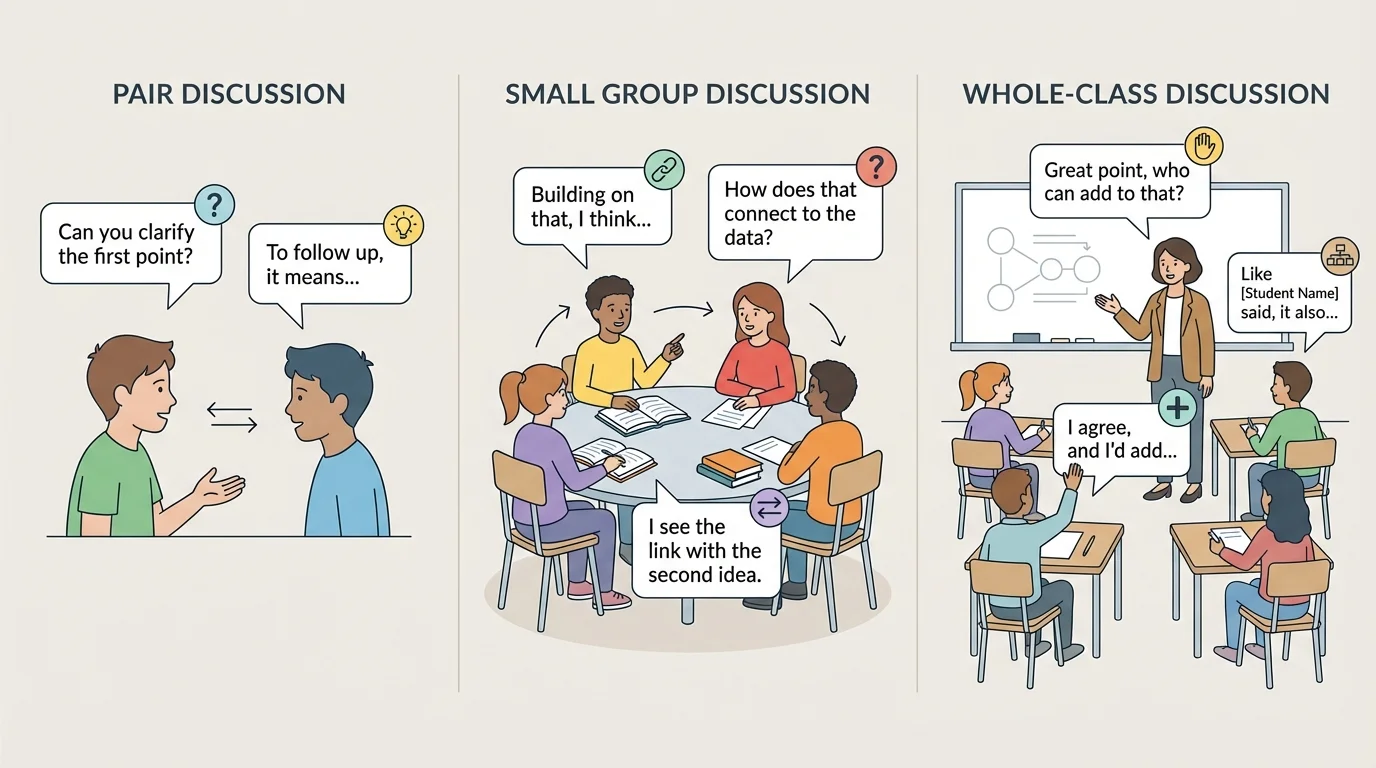
Each setting also changes how you enter the conversation. In a partner talk, you might jump in naturally after your classmate finishes. In a group, you may need to watch for pauses. In a whole-class discussion, you may raise your hand and then speak when called on. Even though the format changes, the goal stays the same: contribute something that helps the group think.
| Discussion setting | What to do well |
|---|---|
| One-on-one | Take turns fairly, ask follow-up questions, respond directly to your partner. |
| Small group | Listen to several people, stay on topic, build on group ideas. |
| Teacher-led | Wait respectfully, speak clearly, connect your remark to the class discussion. |
Table 2. Discussion skills used in different classroom settings.
Later, when you work in teams on projects, the comparison in [Figure 4] still matters. Different settings change the way you join in, but strong communication always depends on listening, clarity, and connection.
Sometimes discussions become even more powerful when people disagree respectfully. Respectful disagreement means sharing a different idea without being rude. You focus on the idea, not on attacking the person.
You can disagree politely by using phrases like these:
For example, if one student says, "Homework should be shorter," another might reply, "I see it differently because practice helps us remember what we learned." This response stays respectful and gives a reason. It does not insult the other student.
"Listen to understand, then speak to contribute."
Respectful disagreement is useful when groups solve problems. If your team is deciding how to present a project, one student might prefer a poster and another might prefer a slideshow. By asking follow-up questions and making linked comments, the group can compare ideas and choose the best plan.
Many discussion problems come from a few common mistakes. Knowing them can help you avoid them.
One mistake is asking questions that are too broad. "Can you explain everything again?" is less helpful than "Can you explain why the settlers moved west?" Another mistake is making comments that do not connect to the topic. A third mistake is repeating what someone said without adding anything new.
Sometimes students interrupt because they are excited. Excitement is good, but interrupting can make a speaker feel ignored. Waiting for a pause shows respect. Another mistake is disagreeing in a harsh way, such as saying, "That makes no sense." A better choice is, "I understand your idea, but I think the evidence points another way."
Better discussion choices help everyone. Specific questions make understanding easier. Linked comments keep the conversation organized. Respectful disagreement makes it safe for people to share ideas. When students use these habits together, discussions become more thoughtful and productive.
Good speakers are also good revisers of their own words. If you ask a question and realize it is unclear, you can try again. If your comment came out too short, you can add an example. Discussion skills improve with attention and practice.
Picture a class discussing a story about a child who starts a community garden. One student says, "The garden brought the neighborhood together." A strong clarifying question would be, "What events in the story show that people worked together?" A strong follow-up question would be, "Why do you think the garden changed the neighborhood so much?" A strong linked comment would be, "I want to add to that idea because the story also shows people sharing tools and food."
Now think about a science discussion. One student says, "Bees are important pollinators." Another student could ask, "Can you explain what pollinators do?" That clarifies. Then someone else could ask, "How would fewer bees affect farms and gardens?" That follows up. Another student might add, "I agree, and I think this connects to how plants depend on animals to reproduce." Each response helps the group understand more deeply.
Example: A strong discussion sequence
Topic: Should the school add more recess equipment?
Step 1: One student shares an idea.
"I think the school should add more equipment because more students could play at the same time."
Step 2: Another student asks a clarifying question.
"What kind of equipment do you think would help most?"
Step 3: A third student asks a follow-up question.
"How would that improve recess for younger and older students?"
Step 4: A fourth student links a comment.
"I want to add to that because more choices might also reduce long lines at the playground."
This sequence keeps the discussion focused, clear, and connected.
When you ask specific questions, make useful comments, and link your ideas to others, you help create a classroom where everyone can think together. That is what strong discussion sounds like: careful listening, clear speaking, respectful responses, and ideas that keep growing.
