Have you ever read a report that felt jumpy, like each sentence was standing all alone? Strong writers do not just collect facts. They connect them. When you write about a topic, your reader should be able to move from one idea to the next smoothly. Words such as another, also, for example, and because act like bridges between ideas. They help writing sound organized, clear, and easy to follow.
Informative writing teaches readers about a topic. That means the writing must be clear. If a writer lists fact after fact with no connection, the reader may understand each fact by itself, but not how the facts fit together. Linking words and phrases show relationships between ideas. They tell the reader, "This is one more detail," or "Here is an example," or "This happens for a reason."
When writers connect ideas well, their paragraphs feel complete. The reader can follow the information step by step. This matters in science reports, animal articles, history paragraphs, and even how-to explanations. A writer who uses linking words carefully helps the reader learn faster.
Linking words and phrases are words that connect one idea to another. They help show how ideas are related. Some linking words add information, some give examples, some explain reasons, and some compare or contrast ideas.
Think of informative writing like building with blocks. Facts are the blocks, but linking words help lock the blocks together so the whole structure stays strong.
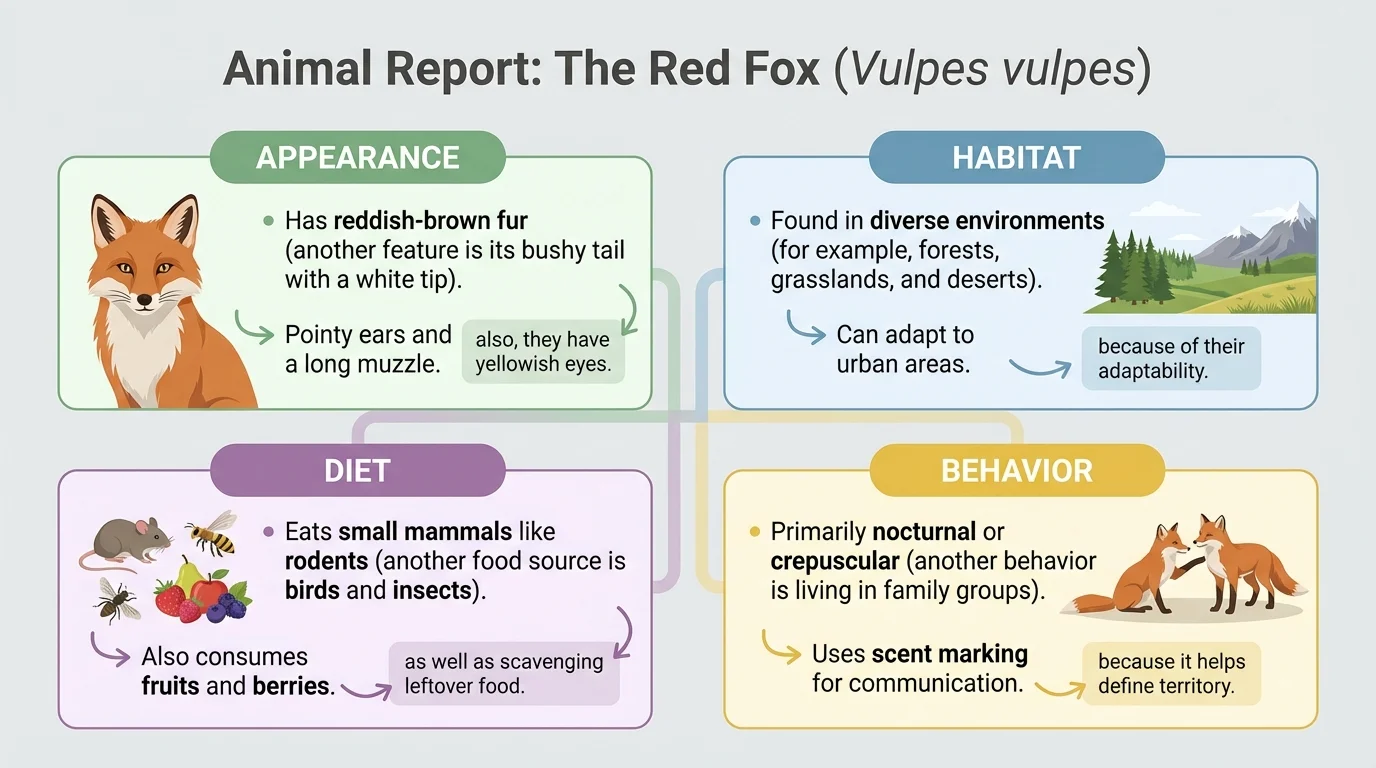
[Figure 1] In informative writing, a category is a group of details that belong together. When a writer is explaining a topic, the writer often sorts facts into categories so the information is easier to understand. For example, a report about dolphins might have categories such as appearance, habitat, diet, and behavior.
Each category focuses on one part of the topic. Inside that category, the writer needs to connect ideas that belong together. In a "diet" category, the sentences should all be about food. In a "habitat" category, the sentences should all be about where the animal lives. This keeps the writing organized and prevents confusing jumps.
Here is an example of categories for a plant report:
| Category | What It Might Include |
|---|---|
| Appearance | Color, size, shape of leaves |
| Habitat | Where the plant grows |
| Needs | Sunlight, water, soil |
| Uses | Food, medicine, decoration |
Table 1. Categories of information for a plant report.
Once the writer chooses a category, the next job is to connect the details inside it. Instead of writing separate facts in a flat list, the writer links them so the paragraph flows.
Later, when you move to a new category, you still need clear transitions. But first, the details within one category must make sense together. That is why organization and connection work as a team, just as we saw in [Figure 1].
[Figure 2] Different linking words do different jobs. A writer chooses the linking word or phrase that best matches the relationship between ideas. If you want to add another detail, you need one kind of word. If you want to explain a reason, you need a different one.
Here are some common linking words and phrases for grade 4 informative writing:
To add information: another, also, in addition, one more, besides
To give an example: for example, for instance, such as
To explain a reason: because, since, this happens when
To compare: also, similarly, both
To contrast: but, however, unlike, one difference
To show order: first, next, then, finally
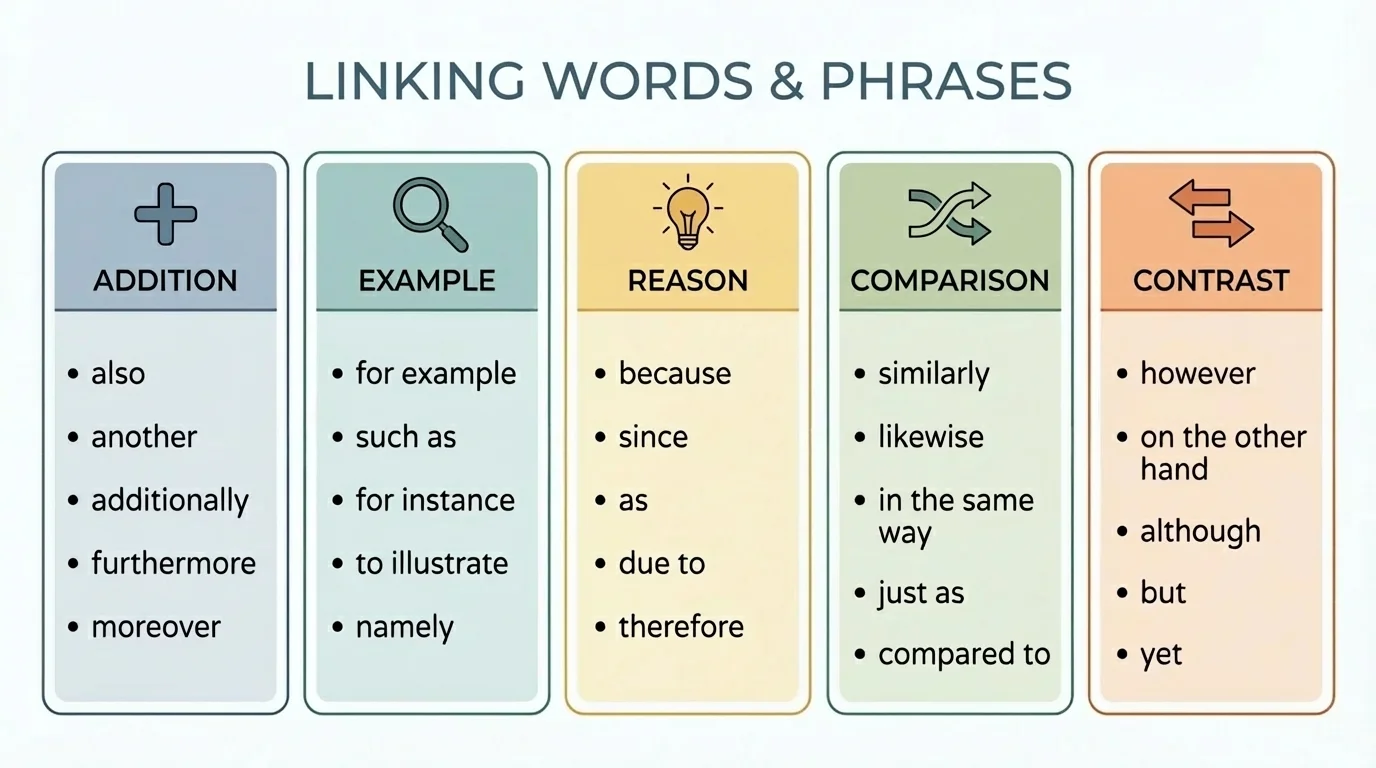
Notice that some words can work in more than one way. The word also often adds information, but it can also help compare two things. The writer must think about the sentence's job, not just grab any connector.
Connectors must match the relationship between ideas. If two sentences give more facts about the same category, use an adding word like also or another. If the second sentence explains why something is true, use because. If the second sentence gives proof or a specific case, use for example. Good writers choose the word that tells the reader exactly how the ideas fit together.
Read these examples:
The red-eyed tree frog has bright green skin. Also, it has red eyes and orange feet.
Owls are active at night because they hunt in the dark.
Some cacti store water in their stems. For example, the saguaro cactus can hold a large amount of water after rain.
The connectors make the relationships clear. Without them, the reader would need to guess how the ideas connect.
One important writing skill is choosing the right connector for the right purpose. If you use the wrong one, the sentence may sound strange or confusing. For example, "Penguins live in cold places, for example they have feathers" does not work well because feathers are not an example of a place. The connection is not logical.
Instead, the writer should think: Am I adding? Explaining? Giving an example? Comparing? Contrasting? Once the job is clear, the link word becomes easier to choose.
Look at these pairs:
Adding: Bees collect nectar. Another job of bees is carrying pollen from flower to flower.
Example: Many desert animals hide during the day. For example, the kit fox stays in a cool den when the sun is hot.
Reason: Sea turtles return to beaches to lay eggs because those places are suitable for nesting.
Contrast: Frogs begin life in water. However, many adult frogs live part of their lives on land.
Good informative writing does not use connectors as decorations. It uses them to show meaning.
Some of the shortest words in a paragraph can do some of the biggest jobs. A small word like because can completely change how a reader understands a fact by showing the reason behind it.
When you revise, ask yourself: does this connector truly fit the idea? If not, replace it with one that does.
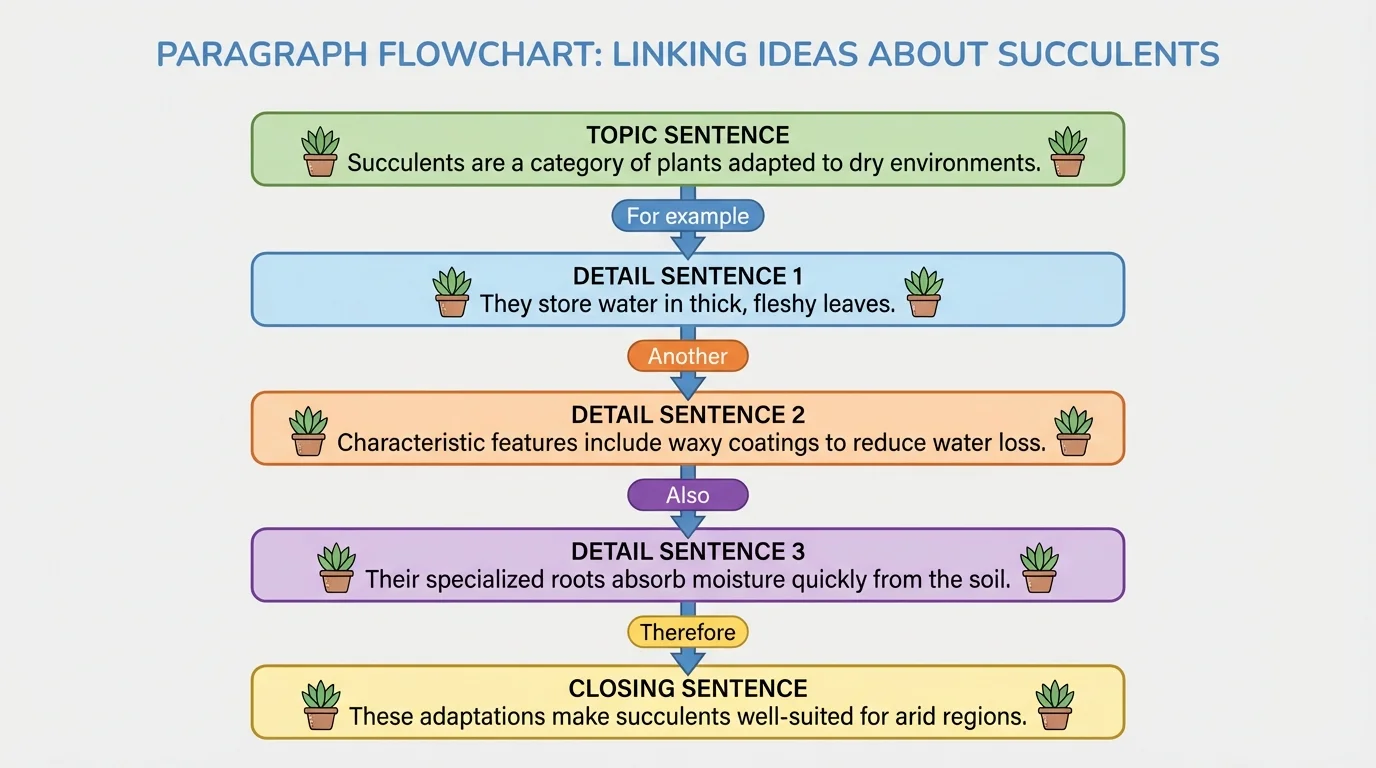
[Figure 3] A strong paragraph usually begins with a sentence that tells the main idea of the category. Then the writer adds supporting details and links them clearly. This keeps the reader focused on one category at a time.
Suppose the category is "habitat" in a report about polar bears. A topic sentence might be: "Polar bears live in very cold Arctic regions." The next sentences should stay focused on habitat and connect details smoothly.
Here is a model paragraph:
Polar bears live in the Arctic, where the weather is extremely cold. They also spend much of their time near sea ice. Sea ice is important because polar bears hunt seals there. For example, a polar bear may wait by a hole in the ice for a seal to come up for air. This habitat gives the animal the space and food it needs.
Notice how every sentence stays in the habitat category. The linking words help each detail connect to the one before it. The writer does not suddenly jump to fur color or cubs. That would belong in a different category.
Writers often use this pattern inside one category:
Topic sentence: names the category and its main idea.
Detail sentence 1: adds a fact.
Detail sentence 2: adds another fact, gives an example, or explains a reason.
Closing sentence: wraps up the category idea.
Example: linking details in one category
Topic: butterflies. Category: life cycle.
Step 1: Start with a topic sentence.
Butterflies go through several stages as they grow.
Step 2: Add a related detail.
First, a butterfly begins as an egg on a leaf.
Step 3: Link another detail.
Next, the egg hatches into a caterpillar.
Step 4: Explain with an example or reason.
The caterpillar eats many leaves because it needs energy to grow.
Step 5: Finish the category clearly.
Finally, it forms a chrysalis and later becomes an adult butterfly.
The paragraph stays focused on one category and uses link words to guide the reader.
As the paragraph structure in [Figure 3] makes clear, connected details help a paragraph grow in a logical order instead of sounding like random notes.
Writers connect ideas in two important ways. First, they link sentences within a category. Second, they link one category to the next. Both kinds of linking matter.
Inside a category, the links are usually close and direct. For example: "Komodo dragons are powerful predators. In addition, they can detect prey from far away." These two sentences belong in the same category, perhaps "hunting behavior."
Between categories, the writer may need a broader transition. For example: "Komodo dragons are skilled hunters. Another important part of their lives is reproduction." This tells the reader that the writing is moving to a new category.
Here is how a report might move through categories:
First, the writer explains appearance. Next, the writer shifts to habitat. Then, the writer explains diet. Finally, the writer describes behavior. These ordering words help the whole piece feel organized from beginning to end.
Good informative writing needs more than facts. It also needs a clear topic, strong organization, and details that match the purpose of the writing. Linking words help all of those parts work together.
If sentences are linked well but categories are mixed up, the writing can still become confusing. Organization tells where ideas belong. Linking tells how they fit together.
One common mistake is repeating the same connector too many times. A paragraph that begins every sentence with also may sound dull. Writers should vary their linking words when possible. Instead of "also, also, also," a writer might use another, in addition, or a sentence structure that flows naturally without repeating the same starter.
A second mistake is using a connector that does not match the relationship between ideas. If a sentence gives an example, use for example or for instance. If it gives a reason, use because. This may seem simple, but it is one of the most important choices in clear writing.
A third mistake is packing too many ideas into one sentence. Linking words are helpful, but they should not turn a sentence into a tangled chain. It is often better to write two clear linked sentences than one very long confusing one.
Look at these revisions:
Weak: Sharks live in oceans also some sharks live near coasts because they hunt there for example tiger sharks.
Better: Sharks live in oceans. Some sharks also live near coasts because they hunt there. For example, tiger sharks often swim in coastal waters.
The improved version uses connectors correctly and separates ideas into clear sentences.
Revision often means making ideas flow better. A first draft may have good facts, but the facts may not feel connected. By adding the right linking words and phrases, the writer turns a list into a real paragraph.
Read this basic version:
Fennec foxes live in the desert. They have large ears. They can hear well. They stay cool.
The facts are true, but the writing feels choppy. Now read the revised version:
Fennec foxes live in the desert. They also have large ears. These ears help them hear well and stay cool because they release body heat.
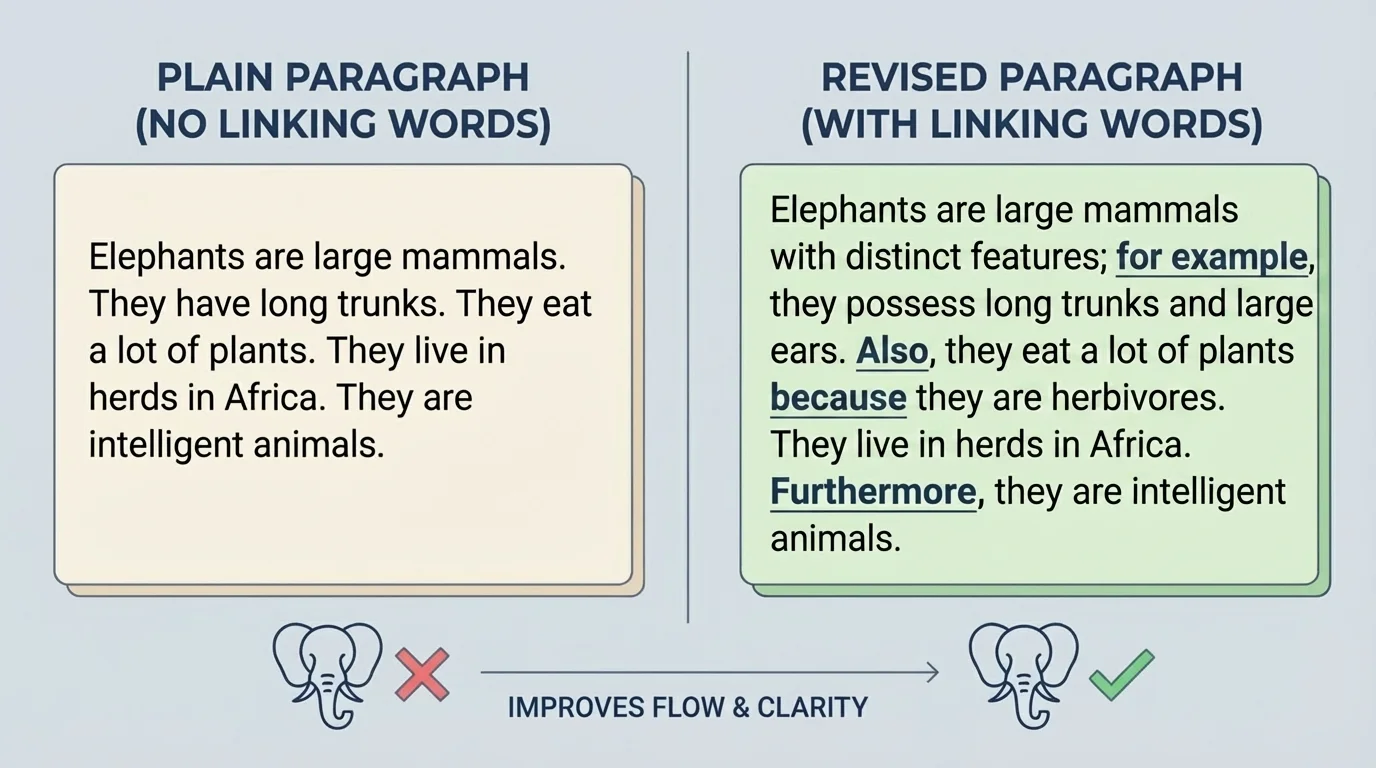
The revised paragraph is stronger because it shows how the ideas connect. The ears are not just another fact. They are linked to the fox's survival in its habitat.
Example: revising with stronger links
Plain draft: "A volcano can be dangerous. Hot ash comes out. Melted rock comes out. People move away."
Step 1: Choose the category.
This paragraph fits the category of dangers from volcanoes.
Step 2: Add a topic sentence.
Volcanoes can be dangerous to people and places nearby.
Step 3: Link supporting details.
Hot ash can spread through the air. In addition, melted rock called lava can flow down the sides of the volcano.
Step 4: Show reason or result.
People often move away because eruptions can destroy homes and roads.
The revised paragraph sounds more like informative writing because the details are connected and focused.
When you compare the before-and-after versions, as in [Figure 4], you can see that good revision is not only about fixing spelling. It is also about building better relationships between ideas.
Strong informative writing uses not only linking words, but also precise language. Precise language means choosing words that are exact and clear. Instead of saying an animal is "nice at hunting," a writer might say it is "skilled at hunting" or "a strong predator." Precise words help readers understand the topic more accurately.
Writers also use facts, definitions, concrete details, and sometimes domain-specific vocabulary. That means words that belong especially to one subject. In a weather report, words like forecast, precipitation, and temperature are domain-specific. In a plant report, words like stem, roots, and photosynthesis may appear.
Linking words help these details work together. For example:
Cacti have thick stems that store water. For example, the saguaro cactus can hold water after desert rain. This feature is helpful because rainfall is rare in the desert.
This short explanation includes a fact, an example, and a reason. The connecting words make the structure easy to follow.
"Facts teach best when they are organized and connected."
— Writing principle
When you write informative paragraphs, think of each category as a small section with its own job. Then choose the words and phrases that connect details inside that section clearly and naturally.
Clear connections help readers learn. They show that the writer understands not just the facts, but the relationships among the facts.
