Have you ever finished a class discussion and realized that two people heard the same words but understood them in different ways? That happens all the time. Good discussion skills are not just about talking. They are about listening carefully, noticing the most important ideas, and then explaining what you think in a way others can understand. When you can do that, conversations become more thoughtful, clearer, and more interesting.
In school, discussions help you learn from books, lessons, and from other people. A classmate may notice something you missed. Another student may explain an idea in a new way. When you review key ideas and share your own understanding, you show that you are not only hearing words—you are thinking about them.
A collaborative discussion is a conversation where people work together to understand a topic. In a strong discussion, students take turns, listen closely, ask questions, and connect ideas. The goal is not to win. The goal is to learn.
Discussions can happen in different ways. You might talk with one partner, work in a small group, or join a whole-class conversation led by the teacher. In each setting, you need the same basic skills: listen, think, respond, and speak clearly.
Key ideas are the most important thoughts or points someone expresses. Understanding means what you know, think, or realize after listening and thinking. When you explain your understanding, you tell how the discussion helped shape your thinking.
When students review key ideas, they show respect for the speaker and for the topic. They also make the discussion stronger because everyone can tell what has been learned so far.
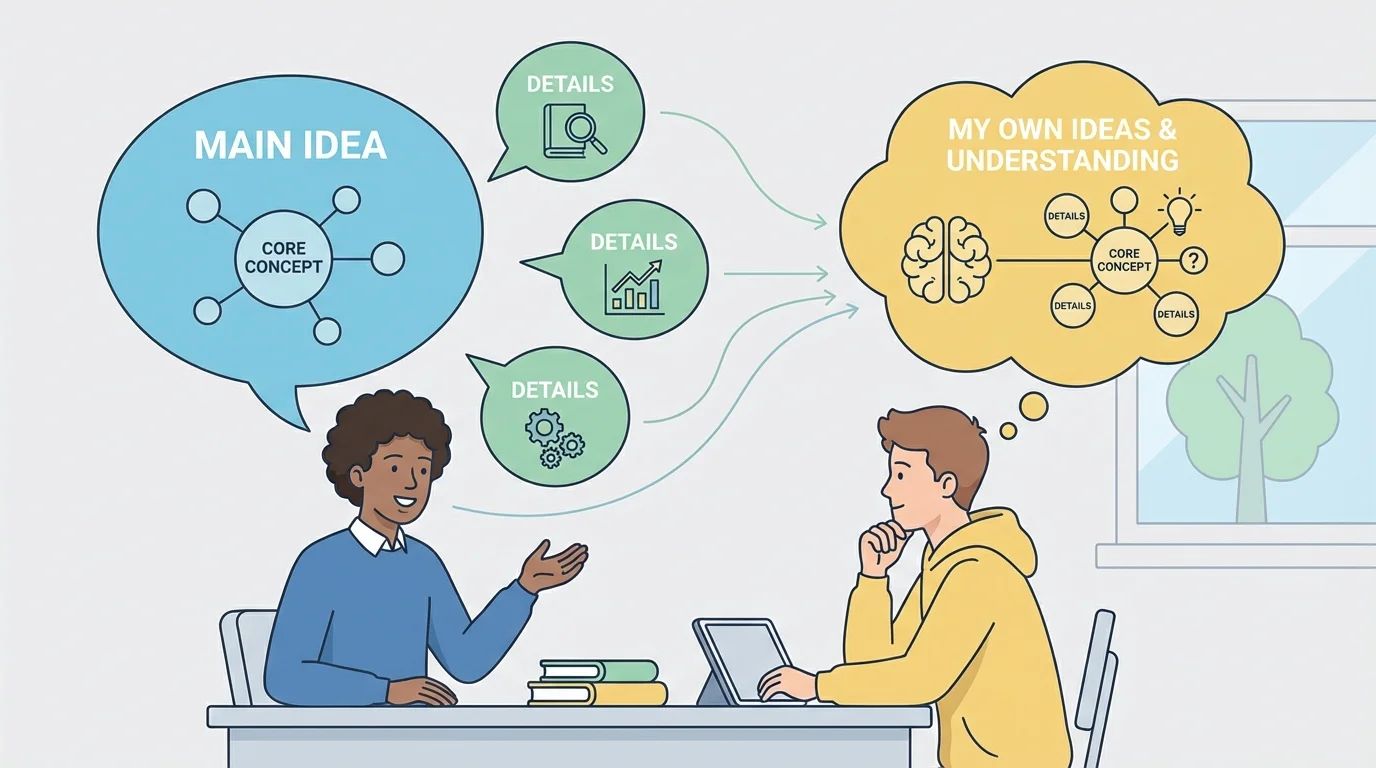
To review key ideas means to listen for the biggest points, not every tiny detail. A strong listener asks, "What is this person mostly saying?" and "Which details help explain that big idea?" That kind of thinking, as shown in [Figure 1], helps you organize what you hear instead of letting it all blur together.
For example, imagine a class discussion about saving water. One student says, "People waste water when they leave the sink on while brushing their teeth, take very long showers, and use sprinklers in the middle of the day." The key idea is that people waste water in everyday habits. The examples about sinks, showers, and sprinklers are supporting details.
When you review someone's ideas, you might say, "Your main point is that small daily choices can waste a lot of water." That response shows you understood the important message, not just one example.
Sometimes there is more than one key idea. In a longer discussion, a speaker may explain a problem, give causes, and suggest a solution. You can review that by putting the ideas in order: first the problem, then the reasons, then the solution.
Reviewing key ideas does not mean repeating someone's exact words. It means restating the important meaning in your own words. This helps everyone check for understanding. If your restatement is not quite right, the speaker can clarify.
Active listening means paying close attention with your mind and body. It includes looking at the speaker, staying focused, not interrupting, and thinking about the meaning of the words. These visible habits, shown in [Figure 2], help a discussion stay respectful and thoughtful.
Active listening also means noticing how ideas connect. If one student says that recess helps kids focus better, and another says movement wakes up the brain, you can hear that both ideas support each other. You are not just hearing separate comments. You are building understanding.
Another part of active listening is waiting. Sometimes students are so busy planning what they want to say next that they miss what another person is saying. Good listeners pause, think, and then respond.
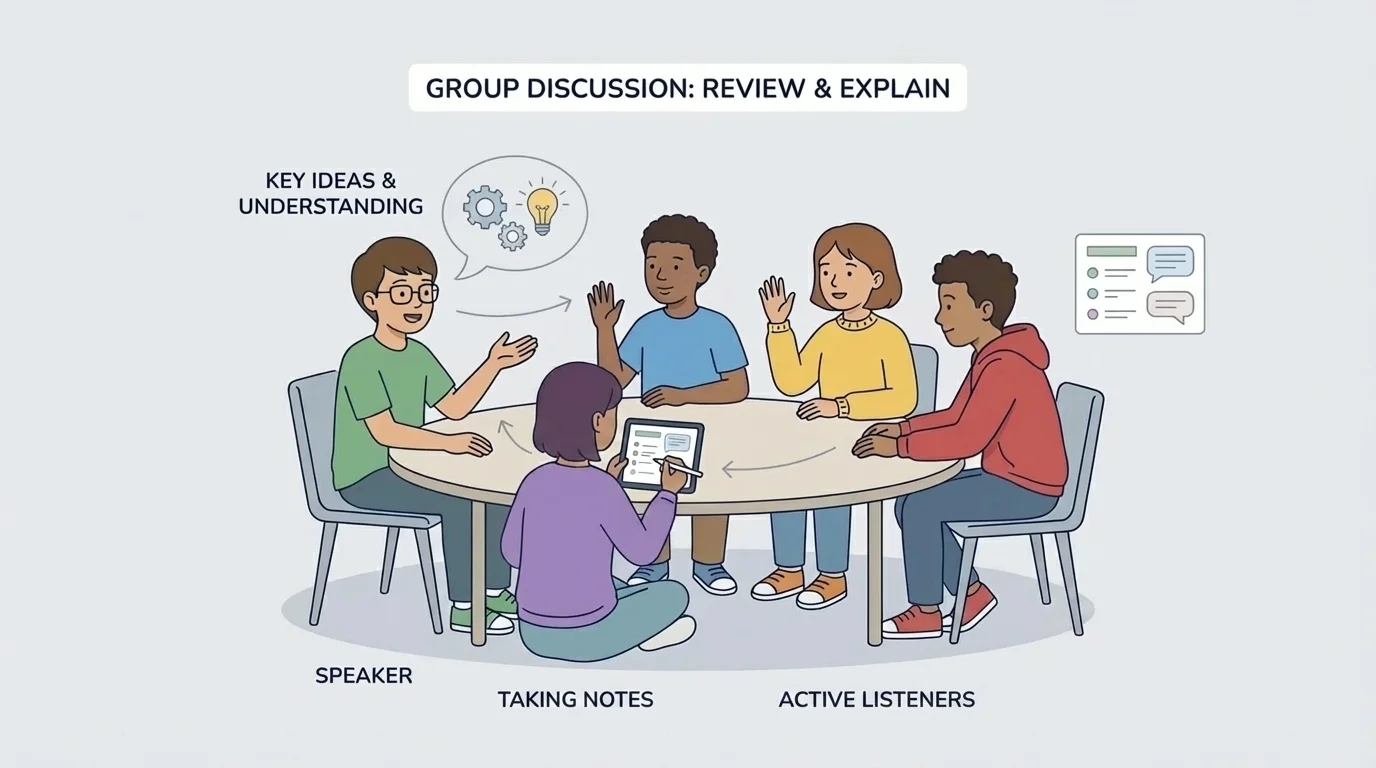
Taking simple notes can help. You do not need to write every word. You can jot down short phrases like "water waste at home," "animals need habitats," or "character feels lonely." Later, those notes help you review the discussion more clearly.
Remember that a conversation has both a speaker and a listener. If everyone only tries to speak, the discussion falls apart. Listening is half of good speaking because it gives you something meaningful to respond to.
Later in a discussion, the same listening habits still matter. When you compare two classmates' ideas, you need to remember who said what and how those ideas fit together.
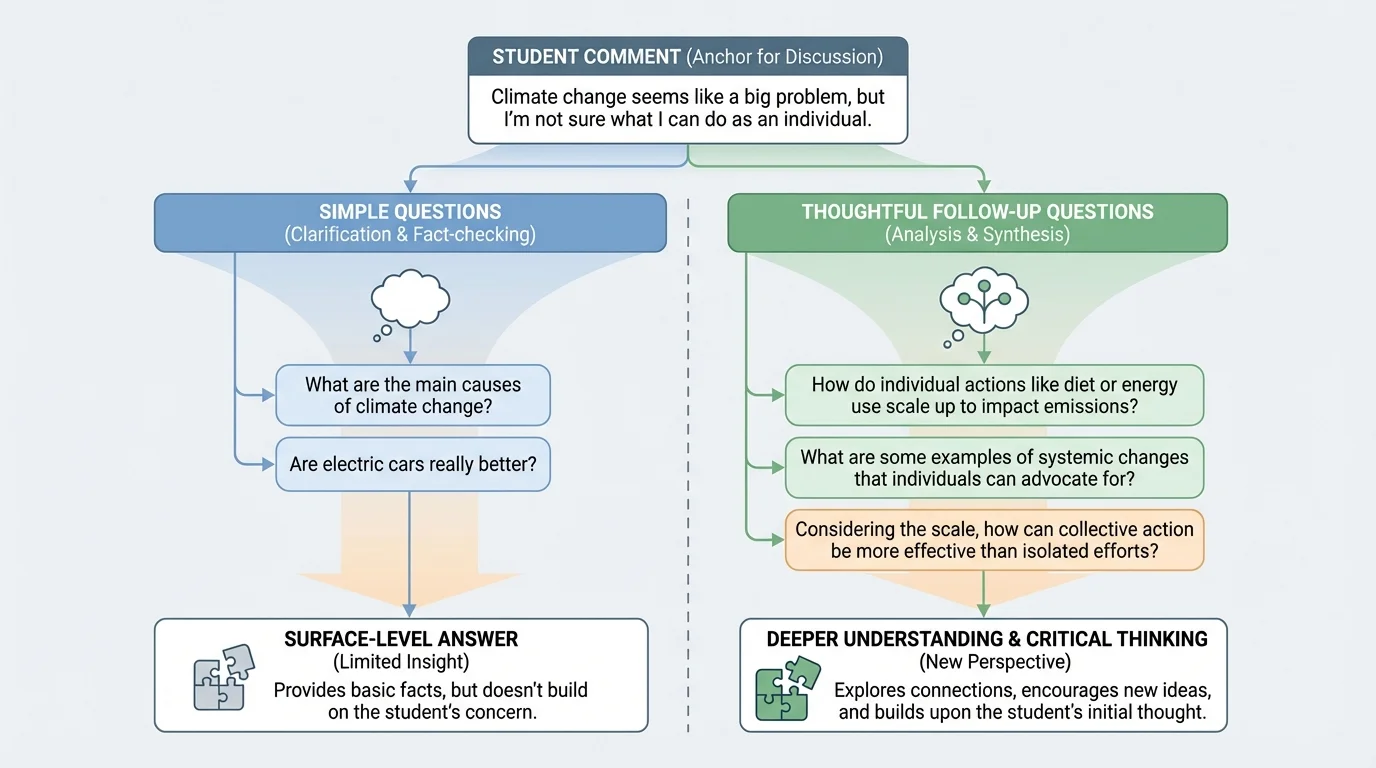
[Figure 3] A thoughtful question connects directly to what someone said and helps the discussion go deeper. It is not random. It is not asked just to fill silence. It helps people explain, clarify, compare, or think more carefully.
Here are some kinds of thoughtful questions:
Suppose a student says, "I think the main character made a bad choice." A weak response might be, "Why?" That question is very short and does not guide deeper thinking. A stronger response might be, "What part of the story makes you think the choice was bad?" That question asks for evidence and leads to a better answer.
Thoughtful questions also show respect. They tell the speaker, "I heard your idea, and I want to understand it better." That makes discussions more open and friendly.
Later, when you want to push a discussion further, you can return to the same idea. For example, after hearing several answers, you might ask, "Do we all agree that the problem started because of weather, or are there other causes?" That kind of question helps the group think together.
After listening to others, you need to explain your own ideas clearly. That means speaking so others can follow your thinking. It also means showing how your idea fits with the discussion.
You might agree, disagree politely, add on, or change your mind. All of these are useful. Good discussions are not just a line of separate opinions. They are connected responses.
How understanding can grow in a discussion
Your first idea is not always your final idea. Sometimes another person gives evidence, shares a new example, or explains something more clearly. When that happens, your understanding can deepen or change. Saying, "At first I thought one thing, but now I think something different because of what I heard," is a sign of strong thinking, not weakness.
Here are some clear ways to explain your understanding:
Notice that each response does more than give an opinion. It tells why. It connects to what was already said. That is what makes speaking clear and useful.
Discussion skills work in several settings, and each one feels a little different. [Figure 4] The three common settings are one-on-one discussions, small-group discussions, and teacher-led discussions.
In a one-on-one discussion, you usually get more time to speak and listen. You can ask follow-up questions more easily because there are only two people. This setting is great for careful back-and-forth thinking.
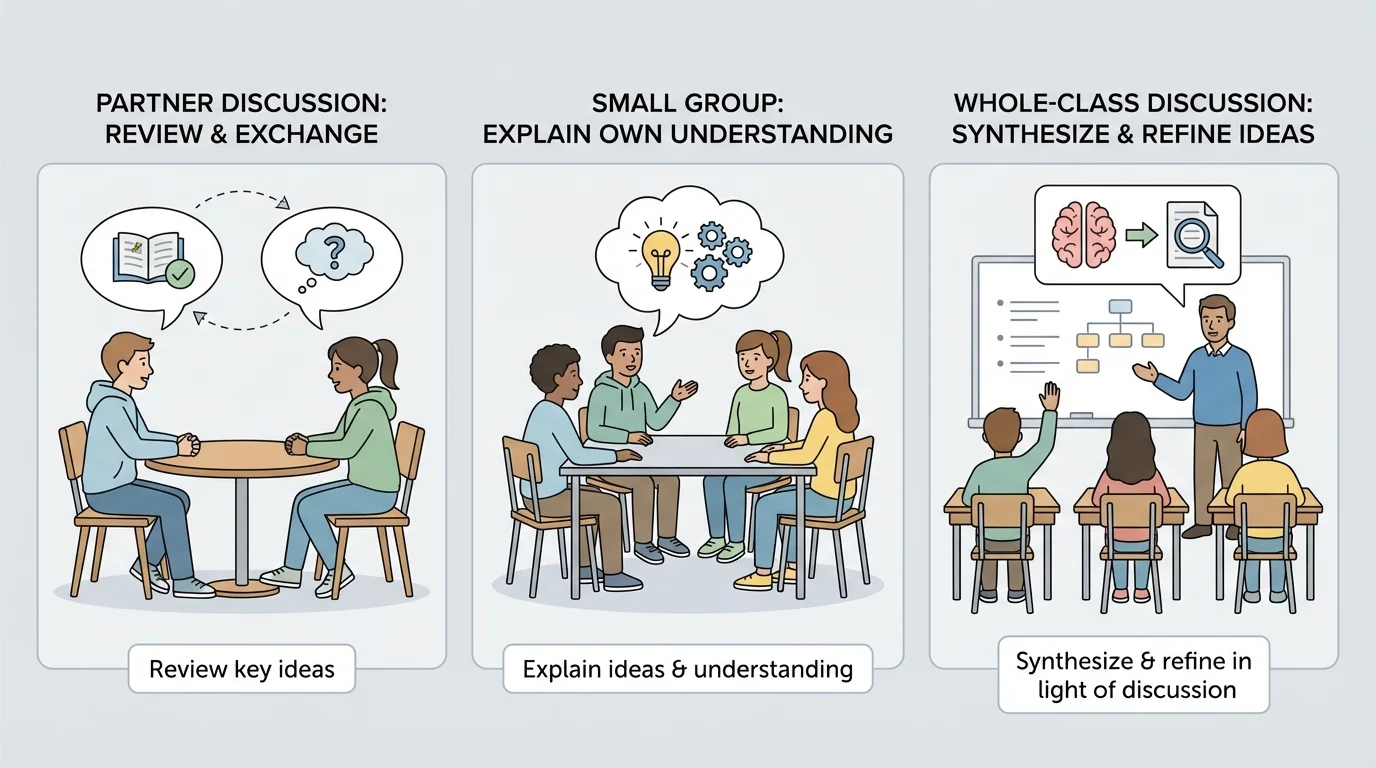
In a small-group discussion, students must share time fairly. You need to listen to several voices, remember different points, and decide when to join in. You may need to say, "I want to connect to what Ava said earlier," so others can follow your idea.
In a teacher-led discussion, the teacher may guide the topic, ask questions, or help students make connections. You may need to raise your hand, wait longer for your turn, and keep your response focused so the whole class can follow it.
Even though these settings differ, the same habits matter in all of them: listen actively, notice key ideas, ask thoughtful questions, and explain your understanding clearly. When you compare them, you can see that the size of the group changes, but the thinking skills stay important.
| Discussion setting | What helps most | Challenge |
|---|---|---|
| One-on-one | Careful follow-up questions | Keeping the conversation moving |
| Small group | Building on different ideas | Making sure everyone gets a turn |
| Teacher-led | Clear, focused speaking | Waiting and staying on topic |
Table 1. Comparison of important skills in three common discussion settings.
Sometimes students know what they think but are not sure how to begin. Sentence starters can help organize your words. They are like tools that help your ideas come out clearly.
Here are some helpful discussion moves:
These sentence starters do not make a discussion sound boring. They make it clear. They help other people follow your thinking, especially when the topic is complicated.
Skilled speakers often sound confident not because they never pause, but because they use simple sentence frames to organize their ideas. Clear speaking is usually planned speaking.
You do not need to memorize every sentence starter exactly. What matters is the purpose behind them: showing that you listened, connecting to the topic, and making your thinking easy to understand.
Sometimes discussions become confusing because students make common mistakes. The good news is that each mistake has a better choice.
One problem is interrupting. When you interrupt, you may stop someone from fully explaining an idea. A better choice is to wait and then say, "I want to respond to that point."
Another problem is repeating without adding. If you just say the same thing again, the discussion does not move forward. A better choice is to add a reason, an example, or a question.
A third problem is going off topic. A discussion about habitats should not turn into a random story about lunch. A better choice is to connect your comment to the current topic: "This reminds me that animals need safe places to live."
Another problem is speaking too vaguely. Saying, "I just think it's good," does not help much. A better choice is to be specific: "I think it is a good solution because it saves water and costs less."
Classroom example: improving a weak response
A student says, "The playground should have more shade." Another student answers weakly: "Yeah, me too." Here is how to improve that response.
Step 1: Review the key idea.
"Your main idea is that the playground needs more shade."
Step 2: Add your own thinking.
"I agree because students get too hot during recess."
Step 3: Extend the discussion with a question or suggestion.
"Do you think trees or shade structures would work better?"
The stronger response shows listening, opinion, and deeper thinking.
When students make these better choices, discussions become more helpful and more interesting for everyone.
Picture a class discussing whether zoos help animals. One student says zoos protect endangered animals. Another says animals may not have enough space. A third says some zoos teach people how to protect wildlife. A strong participant does not just jump in with a random opinion. Instead, the student listens for the main ideas: protection, space, and education.
Then the student might respond, "I hear three key ideas so far: zoos can protect endangered animals, they may limit space, and they can teach people. I think zoos are most helpful when they care for animals well and teach visitors how to help wildlife." That response reviews the discussion and adds a clear personal understanding.
Now imagine a book discussion. A student says the main character is selfish. Another says the character is actually scared. A good listener may ask a thoughtful question like the ones compared in [Figure 3]: "What action in the story makes you think the character is selfish instead of scared?" That question invites evidence and keeps the discussion focused.
As the conversation continues, someone might change their view. They could say, "At first I thought the character was selfish, but after hearing the example about the storm scene, I think the character was mostly afraid." That is exactly what strong discussion skills look like. The student listened, reviewed key ideas, and explained new understanding.
These same skills matter outside school too. When friends make plans, when teammates solve a problem, or when family members talk through a decision, people need to listen carefully, understand the main points, and respond clearly. Strong discussion skills help people learn together and work together.
"Listen to understand, then speak to be understood."
The more you practice reviewing ideas and explaining your thinking, the more confident and thoughtful you become. Good discussions are built one clear response at a time.
