Have you ever heard someone make a strong argument and then end with, "So, yeah... that's it"? It feels unfinished. A good opinion piece needs a strong ending for the same reason a movie needs a satisfying final scene. The ending helps the reader understand the writer's message and remember it.
When you write an opinion piece, you are trying to convince your reader to agree with you. You begin by telling your opinion, and then you support it with reasons and information. But you should not simply stop after your last reason. You need a strong ending that brings the whole piece together.
A concluding statement or concluding section is the part at the end of your writing that wraps up your ideas. It reminds the reader of your opinion and helps your writing feel complete. Without it, the piece can sound sudden or incomplete.
Think of the conclusion like tying a ribbon around a package. The opinion and reasons are the gift inside, but the ending helps present it neatly. The reader should finish your piece thinking, "Yes, I understand exactly what this writer believes."
Conclusion means the ending part of a piece of writing. In an opinion piece, the conclusion brings the writing to a close by connecting back to the writer's opinion and main reasons.
Restate means to say something again in a new way. Writers often restate their opinion in the conclusion instead of copying the exact same sentence from the introduction.
Strong writers know that the last part of a piece often stays in a reader's mind. That is why a careful ending matters so much.
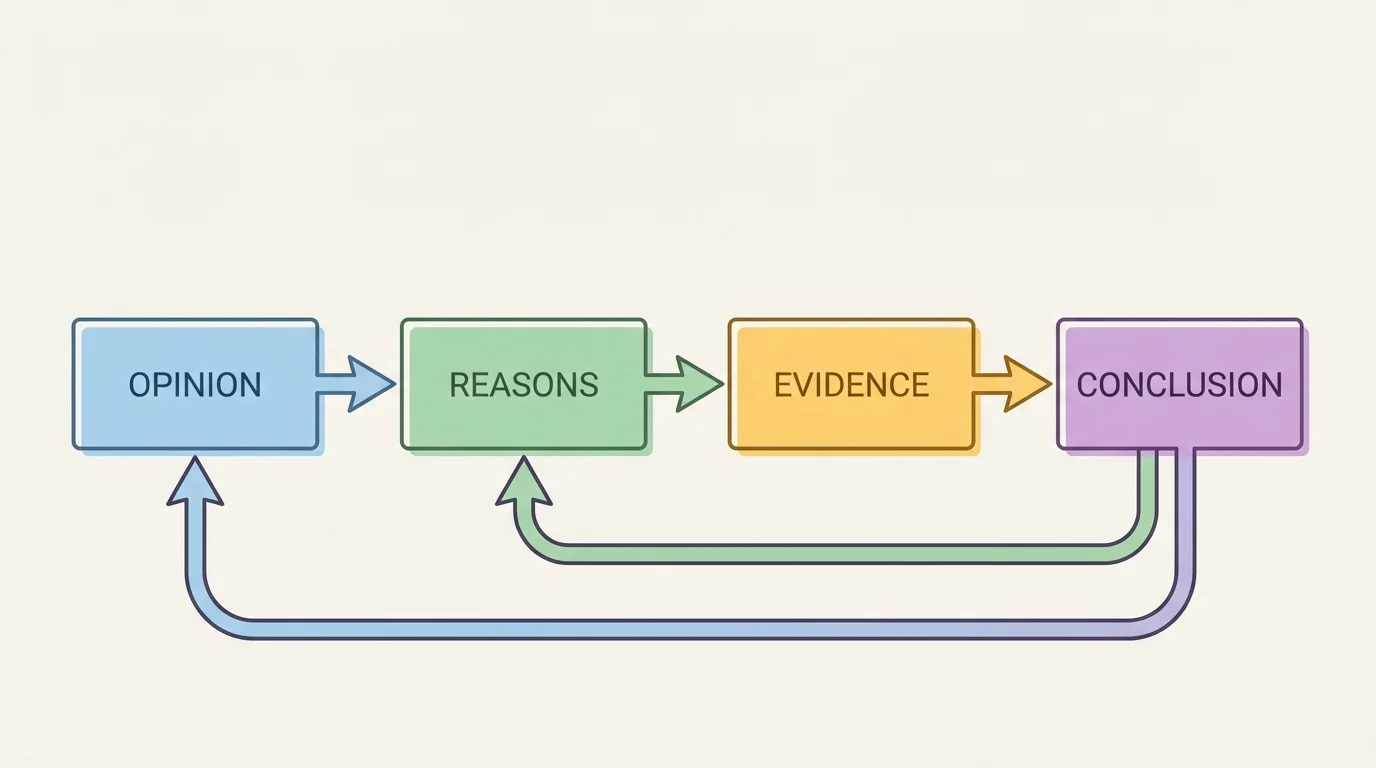
[Figure 1] A conclusion has an important job. It does not start a brand-new topic. Instead, it gathers the important ideas together and gives the reader a clear final thought.
A good conclusion usually does three things. First, it reminds the reader of the writer's opinion. Second, it brings back the main reasons without repeating every detail. Third, it gives the reader a feeling of closure, which means the writing feels finished.
You can think of closure as the feeling that all the parts fit together. The reader should not be surprised by a new idea at the very end. The ending should match what the rest of the piece has already said.
For example, suppose a writer's opinion is that school gardens should be added to every campus. The reasons might be that gardens help students learn science, encourage healthy eating, and make schools more beautiful. A conclusion could remind the reader of these ideas and end with a final statement such as, "For all of these reasons, school gardens are a smart addition to every school."
Notice that this ending does not introduce a new reason like saving money on lunches if that idea was never explained before. Instead, it stays connected to the reasons already given.
In opinion writing, the introduction tells what you believe, the body gives reasons and information, and the conclusion brings the piece to a close. Each part has a different job, and all three parts work together.
If the ending suddenly changes direction, the reader may feel confused. That is why the conclusion must be related to the opinion presented all the way through the piece.
[Figure 2] Not every strong conclusion sounds the same. Writers can choose different styles depending on their topic and purpose. The best choice depends on what you want your reader to think, feel, or do.
One common way is to restate the opinion. This means saying the opinion again in fresh words. If your opinion is "Pets should be allowed in some classrooms," you might end with, "Classroom pets can make learning more exciting and should be part of more schools."
Another way is a call to action. This asks the reader to do something or think about doing something. For example: "Schools should listen to student ideas and create more recycling programs now." This kind of ending works well when the topic involves change.
A third way is to end with a bigger idea. This type of conclusion shows why the opinion matters beyond one classroom or one school. For instance: "When communities plant more trees, they do more than improve the view—they help create a healthier future for everyone."
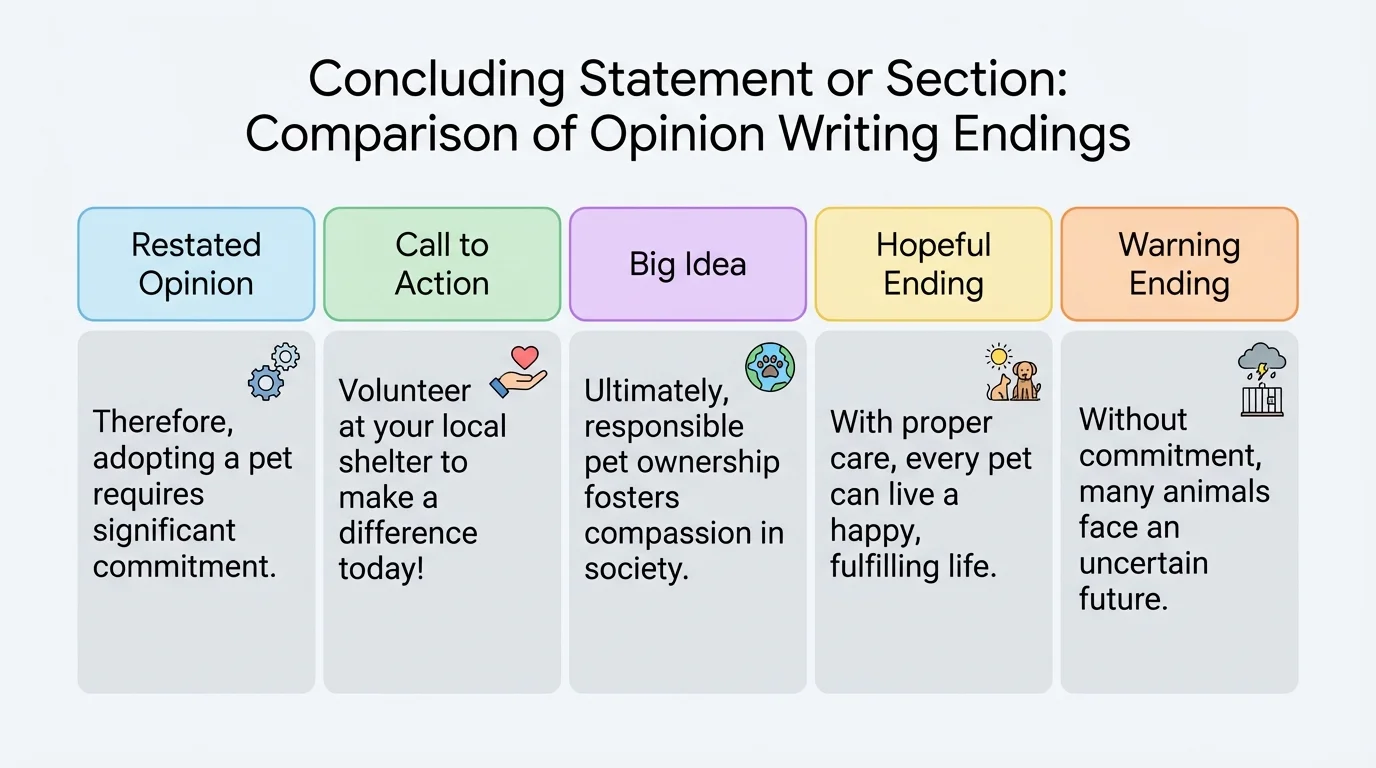
You can also use a hopeful ending. This kind of final sentence leaves the reader with a positive feeling. Example: "If schools add more reading time, more students may discover books they truly love."
Another possible style is a warning or caution. This shows what might happen if people ignore the opinion. Example: "If we keep wasting water, future families may not have enough when they need it most."
Even though these endings sound different, they all connect clearly to the opinion presented. That is the most important rule.
The final sentence of a piece of writing often has extra power because it is the last thing the reader sees. Many writers spend special time revising their ending so that it sounds clear and memorable.
When you look back at [Figure 2], you can see that each type of ending does the same main job in a different way: it brings the writing to a satisfying close.
A strong conclusion includes ideas the reader has already seen in the piece. It may restate the opinion, mention the main reasons, and add a thoughtful final sentence. It should sound confident and clear.
A weak conclusion often makes one of several mistakes. One mistake is introducing a completely new reason. For example, if your essay argues for longer recess because exercise helps focus and students need movement, you should not suddenly end by talking about recess helping students practice math facts unless that idea was explained earlier.
Another mistake is repeating the introduction word for word. Readers do not want to feel as if they are reading the exact same sentence again. Restating means using new wording.
A third mistake is ending too abruptly. A sentence such as "That is why I think this" sounds weak because it does not remind the reader of the opinion in a meaningful way. It also does not leave a clear final thought.
Writers should also avoid apologies in a conclusion. Sentences like "I may be wrong, but..." make the writing sound unsure. Opinion writing should sound respectful, but it should also sound confident.
| Strong Conclusion Choices | Weak Conclusion Choices |
|---|---|
| Restates the opinion in new words | Copies the introduction exactly |
| Refers to reasons already explained | Adds a brand-new reason |
| Ends with a clear final thought | Stops suddenly or sounds unfinished |
| Uses confident language | Uses unsure or apologetic language |
Table 1. This table compares features of strong and weak conclusions in opinion writing.
As with the structure shown earlier in [Figure 1], the conclusion should circle back to the opinion instead of wandering away from it.
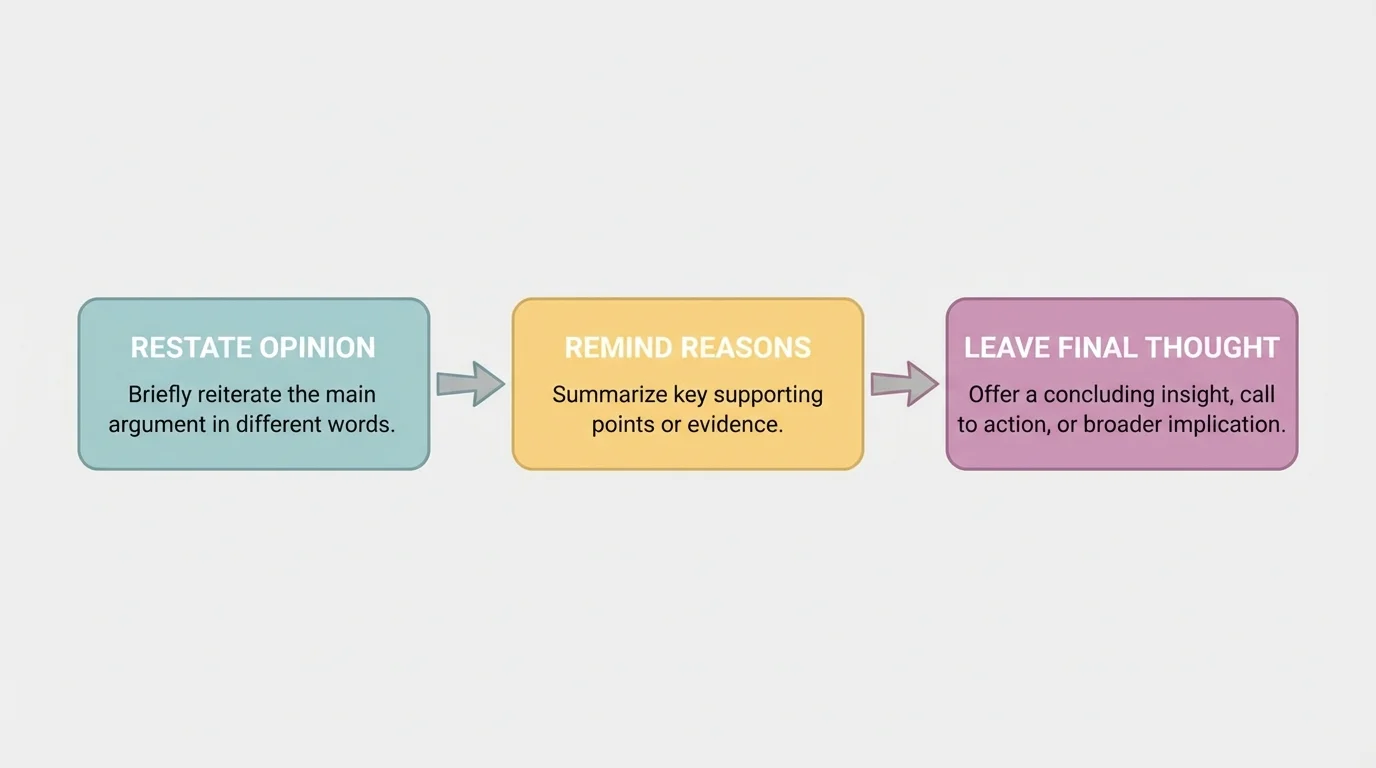
[Figure 3] Many students find conclusions easier when they use a simple pattern. This pattern follows a clear three-step sequence: restate the opinion, remind the reader of the reasons, and finish with a final thought. It works for many grade-level opinion pieces.
Step 1: Restate your opinion in a new way. Ask yourself, "How can I say my belief again without copying my first sentence?"
Step 2: Briefly remind the reader of your main reasons. Do not repeat every detail. Just bring back the most important points.
Step 3: End with a strong final thought. This could be a call to action, a hopeful statement, or a sentence that explains why the topic matters.
Here is a simple model:
Opinion topic: students should have more time for art.
Possible conclusion: "Students need more time for art because art builds creativity, reduces stress, and lets children express ideas in new ways. Schools should make room for art so every student can enjoy these important benefits."
This example follows the three steps. It restates the opinion, reminds the reader of the reasons, and ends with a clear final thought.
Building a conclusion from notes
Suppose your opinion is that biking to school is a good idea when it is safe to do so. Your reasons are that biking gives exercise, reduces traffic, and helps the environment.
Step 1: Restate the opinion.
Write: "When safe routes are available, biking to school is a smart choice for students."
Step 2: Bring back the reasons.
Add: "It helps children stay active, cuts down on traffic, and is better for the air."
Step 3: End with a final thought.
Finish: "For these reasons, communities should support safe biking for students."
Together, these steps create a complete conclusion that matches the opinion and supporting reasons.
When writers use this kind of structure, their endings sound organized and complete rather than rushed.
[Figure 4] Sometimes it is easiest to learn by comparing. This section highlights the difference between weak and strong endings so you can notice what makes one more effective than the other.
Topic: Recess should be longer.
Weak conclusion: "That is my opinion about recess. Also, longer recess would help students learn baseball better."
This ending is weak because it sounds flat, and it adds a new reason about baseball that may not have been explained earlier.
Stronger conclusion: "Longer recess would help students exercise, recharge their minds, and return to class more ready to learn. For these reasons, schools should give students more time to play and move."
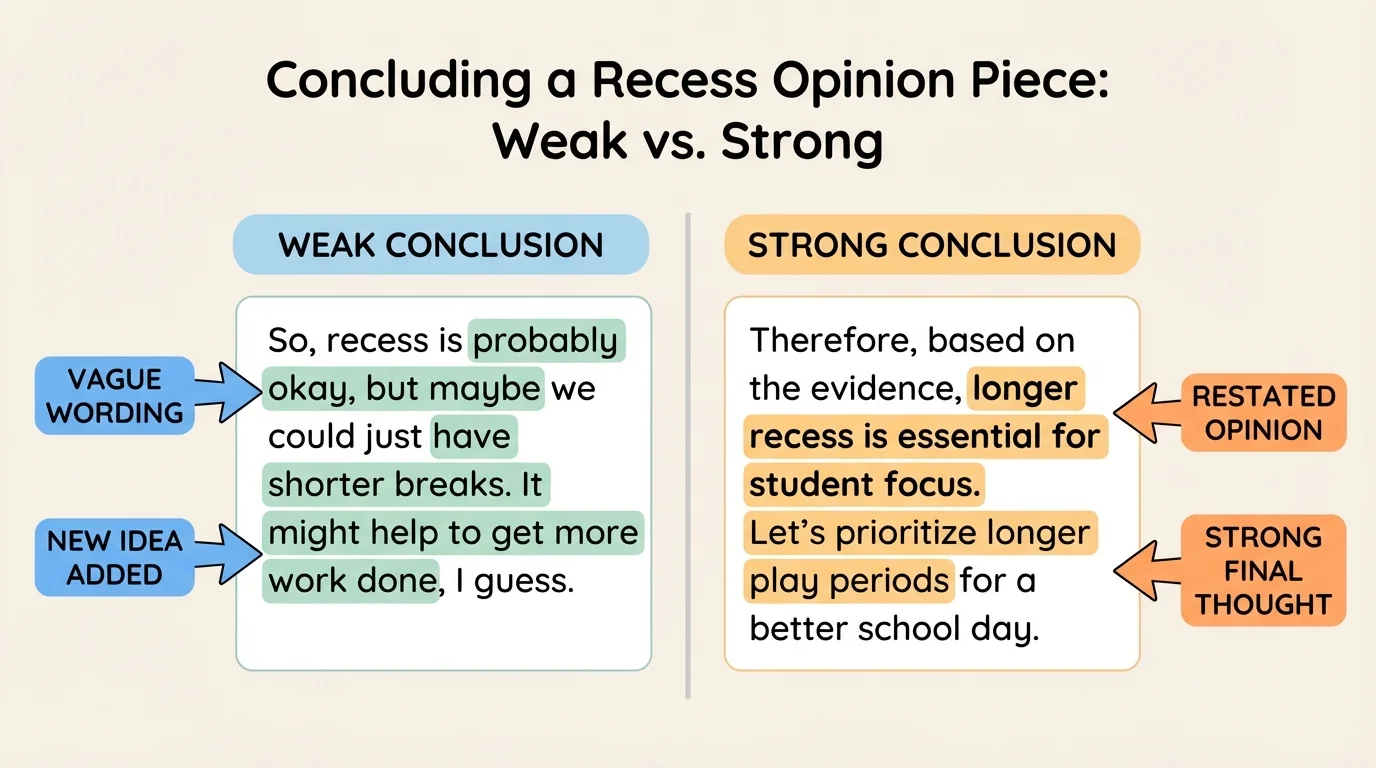
This stronger ending connects to the reasons and finishes with a clear point of view.
Here is another comparison.
Topic: Libraries should stay open longer after school.
Weak conclusion: "Libraries should stay open longer. Libraries should stay open longer."
This is weak because it only repeats the same sentence.
Stronger conclusion: "Libraries should stay open longer after school so students have a quiet place to read, study, and use helpful resources. Keeping them open later would support learning for many children."
The stronger example restates the opinion in new words and reminds the reader why the opinion matters.
Looking back at [Figure 4], you can see that stronger conclusions are specific, connected, and complete.
A conclusion should sound like it belongs to the rest of the writing. If the whole piece is serious, the ending should probably sound serious too. If the piece is encouraging and positive, the ending can keep that tone.
Tone is the feeling or attitude a piece of writing gives the reader. In opinion writing, the tone often sounds confident, thoughtful, or persuasive. A silly ending on a serious topic can feel out of place.
For example, imagine an opinion piece about protecting animals in local habitats. A fitting conclusion might say, "Protecting habitats helps animals survive and keeps nature healthy in our community." An unfitting conclusion might joke around in a way that does not match the topic.
The words you choose also matter. Strong words such as important, helpful, necessary, and valuable can support your opinion when they are used honestly and carefully.
The conclusion is connected, not separate. Some students think of the ending as an extra sentence tacked on at the end. Strong writers know it is part of the whole piece. The ending should grow naturally out of the opinion and reasons that came before it, so the reader feels a smooth finish instead of a sudden stop.
When your conclusion fits the whole piece, the writing feels unified. That means all the parts seem to belong together.
The last sentence is especially important because it is the reader's final impression. A good final sentence should sound clear and strong. It should not trail off or become too general.
Here are some useful patterns for final sentences:
These sentence starters are not magic formulas, but they can help you begin a strong ending. After that, your own ideas make the conclusion meaningful.
Compare these final sentences:
The second one clearly states the writer's position and gives a sense of completion.
"The end of your writing should sound finished, not forgotten."
Writers often revise their final sentence several times. Even a small change can make the ending more powerful.
Let's look at a short opinion paragraph and notice how the conclusion works with the rest of the writing.
"School field trips are an important part of learning. They let students see places and ideas in real life, which can make lessons easier to understand. Field trips also help students become more curious and excited about school. Because they make learning more real and engaging, schools should continue offering field trips whenever possible."
The final sentence is the conclusion. It restates the opinion and connects to the two reasons already mentioned: real-life learning and student excitement. It does not add a new reason, and it sounds complete.
Now look at this less effective version: "School field trips are an important part of learning. They let students see places and ideas in real life. Field trips also help students become more curious and excited about school. Also, buses are sometimes yellow."
The last sentence does not work as a conclusion because it does not connect to the opinion in a meaningful way. It feels random. A conclusion must relate to the opinion presented.
As you plan your own writing, remember the three-part pattern from [Figure 3]: restate the opinion, remind the reader of the reasons, and leave a strong final thought. That pattern helps many writers create endings that truly fit.
