One small word change can make a huge difference. If a writer says, "The animal was nice," the reader learns almost nothing. But if the writer says, "The red fox is a clever hunter that uses its sharp hearing to find mice under snow," the idea becomes much clearer. Informative writing works best when every word helps the reader learn. As [Figure 1] shows later, the same topic can sound blurry or sharp depending on the words a writer chooses.
When you write to inform or explain, your job is to teach the reader about a topic. That means your writing should be clear, accurate, and easy to follow. Strong informative writing does not use random words or guesses. It uses exact words that tell what something is, how it works, what it does, or why it matters.
If you write, "A volcano is a mountain that does stuff," your reader may feel confused. What kind of "stuff"? But if you write, "A volcano is an opening in Earth's crust that can release lava, ash, and gases," your reader gains real information. The second sentence is stronger because it uses exact nouns and details.
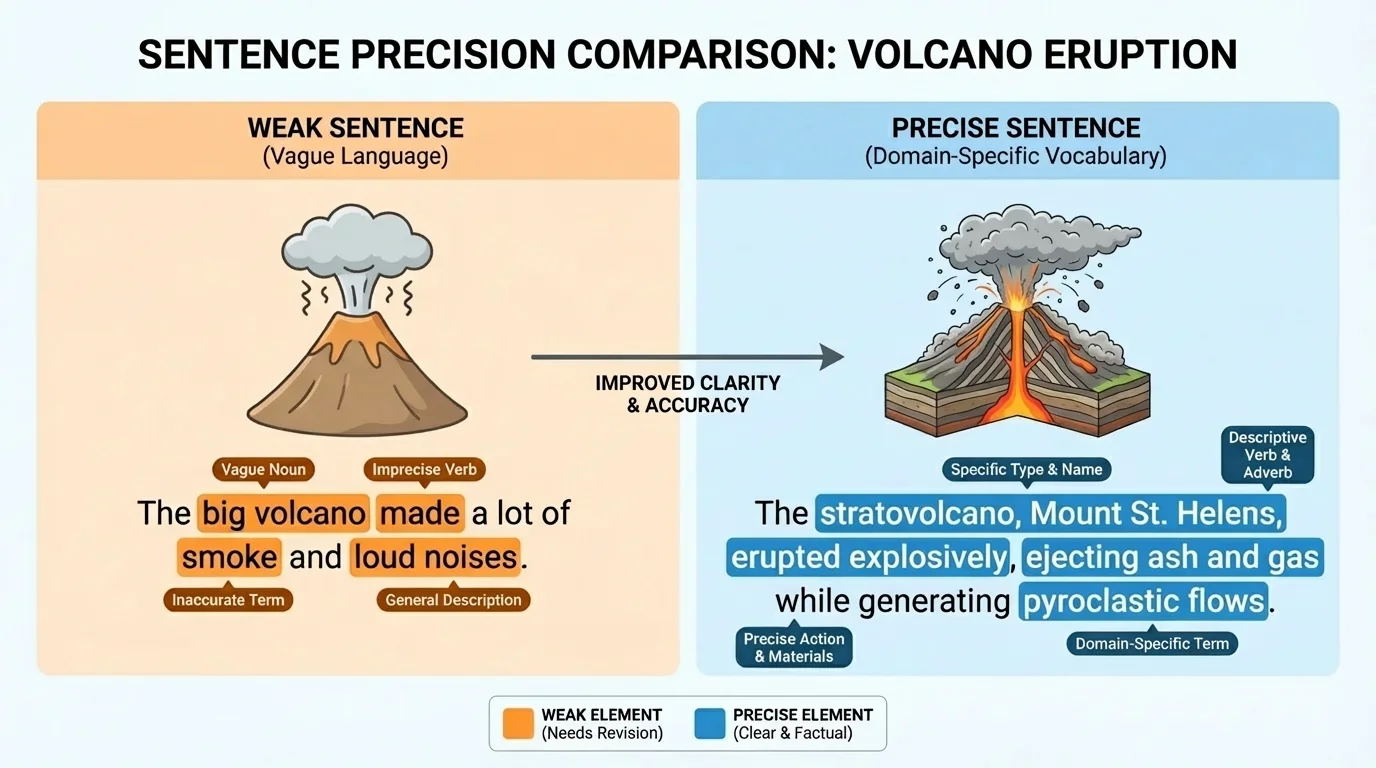
Precise language helps readers make a clear picture in their minds. It also helps them trust the writer. When a writer uses exact words, the writing sounds thoughtful and informed. When a writer uses vague words like stuff, things, nice, or a lot, the meaning can become weak.
Precise language means choosing exact words that clearly tell the reader what you mean. Domain-specific vocabulary means words that belong to a certain subject, such as science, geography, music, or sports.
Writers do not choose precise words just to sound smart. They choose them to help readers understand. That is the real goal of informative writing: not to impress, but to explain.
Precise language is language that is exact, specific, and accurate. It tells the reader more than a general word does. Compare these examples:
Weak: "The plant needs things to grow."
Strong: "The bean plant needs sunlight, water, air, and nutrients from the soil to grow."
Weak: "The dog moved fast."
Strong: "The dog sprinted across the field at high speed."
Weak: "The storm was bad."
Strong: "The thunderstorm brought heavy rain, strong winds, and frequent lightning."
In each stronger sentence, the writer replaces general words with exact ones. Instead of saying things, the writer names what the plant needs. Instead of saying moved fast, the writer chooses the stronger verb sprinted. Instead of saying bad, the writer describes what made the storm dangerous.
How precision helps a reader
Precise words answer questions in the reader's mind. They tell which one, what kind, how much, how it happens, or why it matters. The more clearly a writer answers those questions, the more informative the writing becomes.
Sometimes a single word can improve a sentence. The verb said may become explained, warned, or reported. The noun bird may become eagle, owl, or hummingbird. The adjective big may become gigantic, wide, tall, or massive, depending on the topic.
Good writers also pay attention to numbers, sizes, and names. "A river" is less exact than "the Mississippi River." "Many students" is less exact than "27 students." In informative writing, exact names and details often make the explanation stronger.
Every school subject has words that belong especially to it. This kind of language is called domain-specific vocabulary, and [Figure 2] shows how these words connect to different subjects. These words help writers explain ideas more exactly because they name things in the way that experts, teachers, and textbooks do.
In science, you might use words such as habitat, evaporation, and organism. In geography, you might use words such as region, climate, and border. In history, you might use words such as colony, government, and citizen. These are not just "fancy" words. They are the right words for those topics.
For example, if you are writing about weather, saying "water goes up into the sky" is understandable, but saying "water changes into vapor through evaporation" is more exact. The second sentence uses vocabulary that belongs to science and weather study.
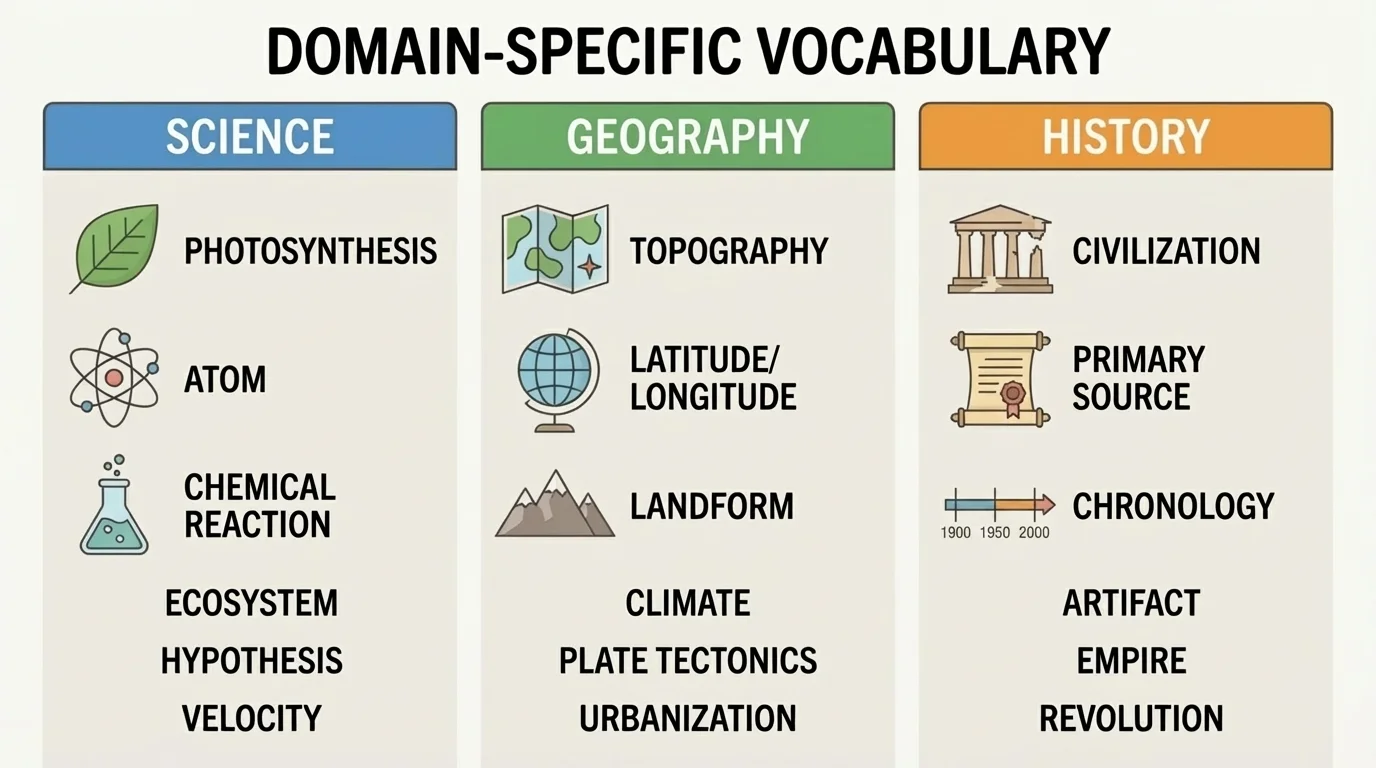
Using domain-specific vocabulary can make your writing more informed, but there is an important rule: your reader still needs to understand the terms. If a word may be unfamiliar, you should explain it with a definition or an example.
Example of defining a domain-specific word
Sentence: "A habitat is the natural home of an animal or plant."
Here, the writer uses the topic word habitat and then explains it clearly. This helps the reader learn the word and the idea at the same time.
Later, when you continue writing, you can use the term again without repeating the full definition every time. This keeps your writing both clear and efficient.
The best word choices depend on the topic you are explaining. If you are writing about basketball, words like dribble, rebound, and defense fit the topic. If you are writing about plants, words like roots, stem, leaves, and nutrients fit better. Good writers choose words that match the subject.
They also think about the audience. If you are writing for other fourth-grade students, your writing should be clear and not too complicated. You may use a domain-specific term, but you should explain it in a friendly, understandable way. For example, instead of writing only "condensation," you might write, "Condensation happens when water vapor cools and changes into tiny liquid drops."
This balance is important. Informative writing should be accurate, but it should also be readable. A writer who fills every sentence with difficult terms can confuse the reader. A writer who uses only simple and general words may leave out important meaning. The strongest writing mixes exact topic words with clear explanations.
Some of the most powerful writing changes are tiny. Replacing one weak verb like went with a stronger verb like traveled, raced, or migrated can quickly make a sentence more informative.
When you revise, ask yourself questions such as: "Can I name it more exactly?" "Can I use the real word for this topic?" "Will my reader know what this term means?" These questions guide better word choice.
A strong explanation is built in parts, as [Figure 3] shows with a paragraph moving from a topic sentence to details. Precise words are important, but they work best when they are supported by facts, definitions, and concrete details.
A fact is something true that can be checked. A definition explains what a word or idea means. Concrete details are specific pieces of information that readers can picture or understand clearly.
Suppose you are writing about sea turtles. A weak explanation might say, "Sea turtles are interesting animals." That opinion does not teach much. A stronger explanation might say, "Sea turtles are reptiles that breathe air, lay eggs on land, and spend most of their lives in the ocean." This sentence uses a definition and clear details.
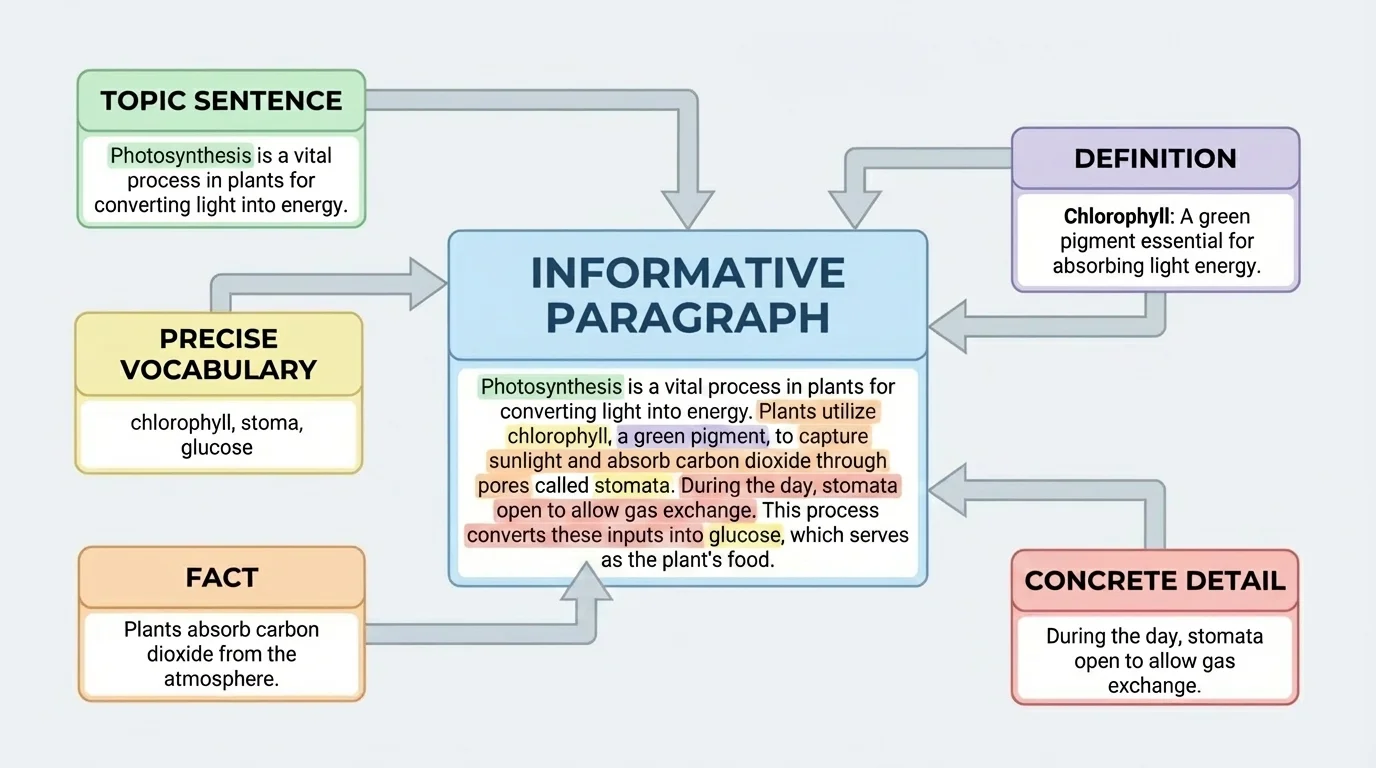
Here is another stronger explanation: "Loggerhead sea turtles use powerful flippers to swim long distances, and females return to sandy beaches to lay eggs." This sentence gives the reader actions, features, and topic vocabulary. It is easier to learn from because it is specific.
Building an informative paragraph about the water cycle
Step 1: Start with a clear topic sentence.
"The water cycle is the process that moves water through Earth's atmosphere and surface."
Step 2: Add domain-specific vocabulary with a definition.
"Evaporation happens when liquid water warms and changes into water vapor."
Step 3: Add another exact detail.
"Condensation forms when water vapor cools and turns into tiny droplets in clouds."
Step 4: Add a concrete result.
"Then precipitation, such as rain or snow, falls back to Earth."
This explanation works because each sentence adds accurate information with precise words.
Notice that strong informative writing does not pile up random details. It organizes them so the reader can learn one idea at a time.
It helps to compare weak writing and stronger writing. This shows how precise language improves a piece of writing.
| Weak version | Stronger version |
|---|---|
| The desert is a place with not much there. | The desert is a dry region that receives very little rainfall and supports specially adapted plants and animals. |
| Bats are weird and come out at night. | Bats are nocturnal mammals that use echolocation to find food in the dark. |
| The government makes rules. | The government creates laws and provides services to help a community function. |
| Plants need stuff from the ground. | Plants absorb water and nutrients through their roots. |
Table 1. Comparison of vague sentences and revised informative sentences.
The stronger versions use exact nouns, stronger verbs, and subject words. One sentence uses nocturnal, which is a domain-specific word in animal science. Another uses "region," which is more exact than "place." These changes make the writing more useful to a reader.
Informative writing answers questions like what is it, how does it work, and why is it important. Precise language helps answer those questions clearly.
You do not need every sentence to be long. In fact, short sentences can be very strong when the words are exact. "Frogs are amphibians." "They begin life in water." "As adults, many live on land and in water." These short sentences still teach because they are specific.
One common mistake is using words that are too general. Words like thing, stuff, good, and bad often need to be replaced with exact terms. Another mistake is repeating the same weak word over and over. Instead of writing "big" many times, choose a word that fits, such as wide, tall, deep, or massive.
A second mistake is using domain-specific words without explaining them. If you write, "The animal uses echolocation," some readers may not know what that means. You could improve the sentence by adding, "The animal uses echolocation, which means it sends out sounds and listens for echoes to locate objects."
A third mistake is choosing words that sound impressive but are not accurate. Informative writing should be clear first. If a simpler word is the correct word, use it. Precision is not about choosing the hardest word. It is about choosing the best word.
Precision is not the same as complexity
A precise sentence can be simple. "Mercury is the closest planet to the Sun" is both simple and exact. Writers do not need long or complicated sentences to be informative. They need truthful details and the right vocabulary.
Writers should also be careful with opinions. In informative writing, saying "Sharks are scary" tells how someone feels. Saying "Sharks have rows of teeth and highly developed senses" gives information the reader can learn from.
Precise language matters in every subject. In science, you might explain how a caterpillar changes during metamorphosis. In geography, you might describe a mountain range, a valley, or a coastal region. In history, you might explain how a colony was governed. In math, you might describe a pattern, a fraction, or a measurement using exact terms instead of unclear words.
For example, a weak science sentence might say, "The butterfly changes a lot." A stronger version says, "A butterfly goes through metamorphosis, changing from egg to larva, pupa, and adult." The second sentence teaches the stages clearly.
A weak geography sentence might say, "The area has different weather." A stronger version says, "The region has a dry climate in summer and receives more rainfall in winter." The word climate gives a more exact meaning than weather alone because it refers to usual conditions over time.
As we saw with the subject word groups in [Figure 2], each topic has words that fit it naturally. And just like the paragraph pattern in [Figure 3], those words are most helpful when they are placed into clear sentences with facts and details.
Revising one sentence across subjects
General sentence: "The place had animals and plants."
Science version: "The wetland habitat supports frogs, insects, reeds, and water lilies."
Geography version: "The coastal region includes marshes, shallow water, and muddy soil."
Informative writing improves when the writer chooses words that match the topic exactly.
Even outside school, precise words matter. A weather report, a recipe, a sports article, or instructions for a game all need exact language. If a recipe says "cook it for a while," that is not very helpful. If it says "bake for 20 minutes," the direction becomes clear. Exact language helps people understand what to do and what to know.
Clear writing is a gift to the reader. When writers choose exact words, use the real vocabulary of the subject, and explain terms with facts and details, they make learning easier. The goal is not to fill a page with difficult words. The goal is to say exactly what is true and important.
Think again about the difference between "The animal is cool" and "The emperor penguin survives Antarctic cold by huddling in groups and protecting its eggs on its feet." One sentence expresses an opinion. The other gives information. Informative writing becomes stronger when every important word earns its place.
