Have you ever heard someone say, "I had fun at the park," and thought, What happened there? Now compare that to this: "I raced across the wood chips, grabbed the warm metal bars, and slid down the twisting blue slide while my little brother laughed below." The second sentence makes a picture in your mind. That is the power of clear, specific writing.
When writers tell about real or imagined events, they want readers to feel almost as if they are inside the story. To do that, writers use exact words instead of fuzzy ones. They also add details that appeal to the senses. These choices help a narrative feel alive, interesting, and easy to understand.
Writing becomes stronger when it is precise. Precise writing tells exactly what happened, where it happened, and how it felt. Instead of saying something was "nice" or "bad," a careful writer chooses words that explain how it was nice or bad. Was the room bright, crowded, chilly, noisy, or silent?
Readers cannot see into a writer's mind. They depend on the words on the page. If the words are too general, the reader has to guess. If the words are specific, the reader can build a clear picture and follow the event more easily. This matters especially in narratives, where events happen in order and each moment should connect to the next.
Concrete words are words that name things people can sense, picture, or point to, such as apple, whistle, muddy boots, or icy wind.
Sensory details are details that describe what someone sees, hears, smells, tastes, or feels.
Precise language uses exact words that say clearly what happened instead of broad words that could mean many things.
A sentence like "The animal moved" is not very clear. Many animals can move in many ways. But "The squirrel darted up the oak tree" is much more exact. The reader now knows which animal, how it moved, and where it went.
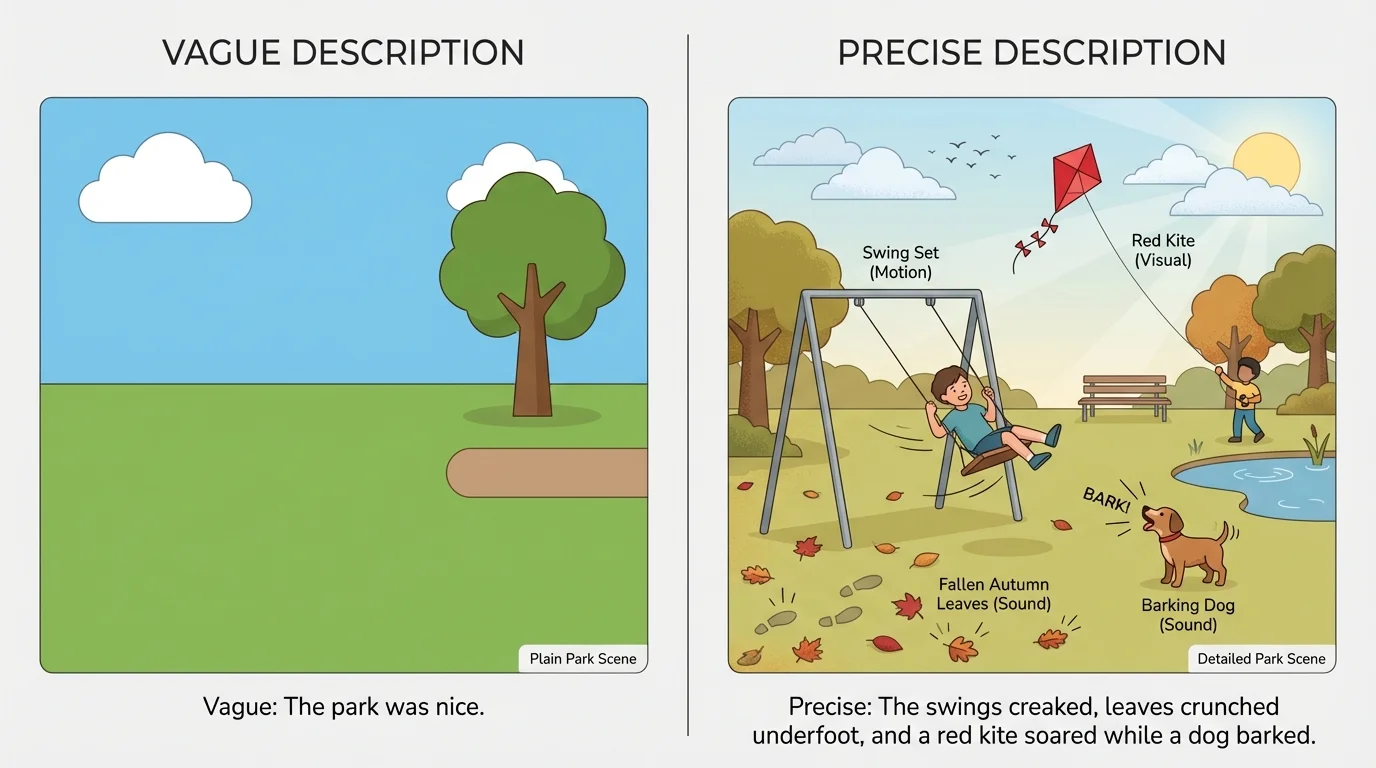
Concrete words help readers form strong mental pictures, as [Figure 1] shows through the difference between a plain scene and a detailed one. When a writer says "tree," readers picture a tree. When the writer says "a tall pine with sticky needles," the picture becomes sharper and more interesting.
General words are sometimes useful, but narratives usually need more than general words. Compare these pairs: bird and sparrow, food and buttery popcorn, shoes and mud-caked sneakers. The second word or phrase in each pair tells more.
Writers also choose details that matter. If a story is about a child walking into a spooky attic, the writer might describe the dusty floorboards, the dim bulb, and the smell of old paper. Those details support the mood and help the reader experience the event.
Strong writing does not mean adding random details. It means adding the right details. A writer should ask, "What does my reader need to see, hear, or feel to understand this moment?"
One of the best ways to make writing vivid is to use the sensory details that people notice in real life. Writers use sight, sound, smell, taste, and touch to help the reader step into the scene, as [Figure 2] illustrates with one event described through all five senses.
Sight includes color, shape, size, movement, and light. A writer might describe "silver rain," "crooked fence posts," or "sunlight flashing on the pond."
Sound includes voices, music, animal noises, weather sounds, and quiet sounds. Instead of saying "It was noisy," a writer could say, "Pots clanged in the kitchen, and the baby cried from the next room."
Smell can create a strong memory in the reader's mind. "The air smelled like wet grass" tells more than "It smelled good."
Taste is useful in scenes with food, drinks, weather, or surprise. "The lemonade tasted sour enough to make my eyes squint" is more exact than "The lemonade tasted funny."
Touch includes texture, temperature, and physical feeling. A writer might mention "the scratchy blanket," "the smooth stone," or "the sting of icy water around my ankles."
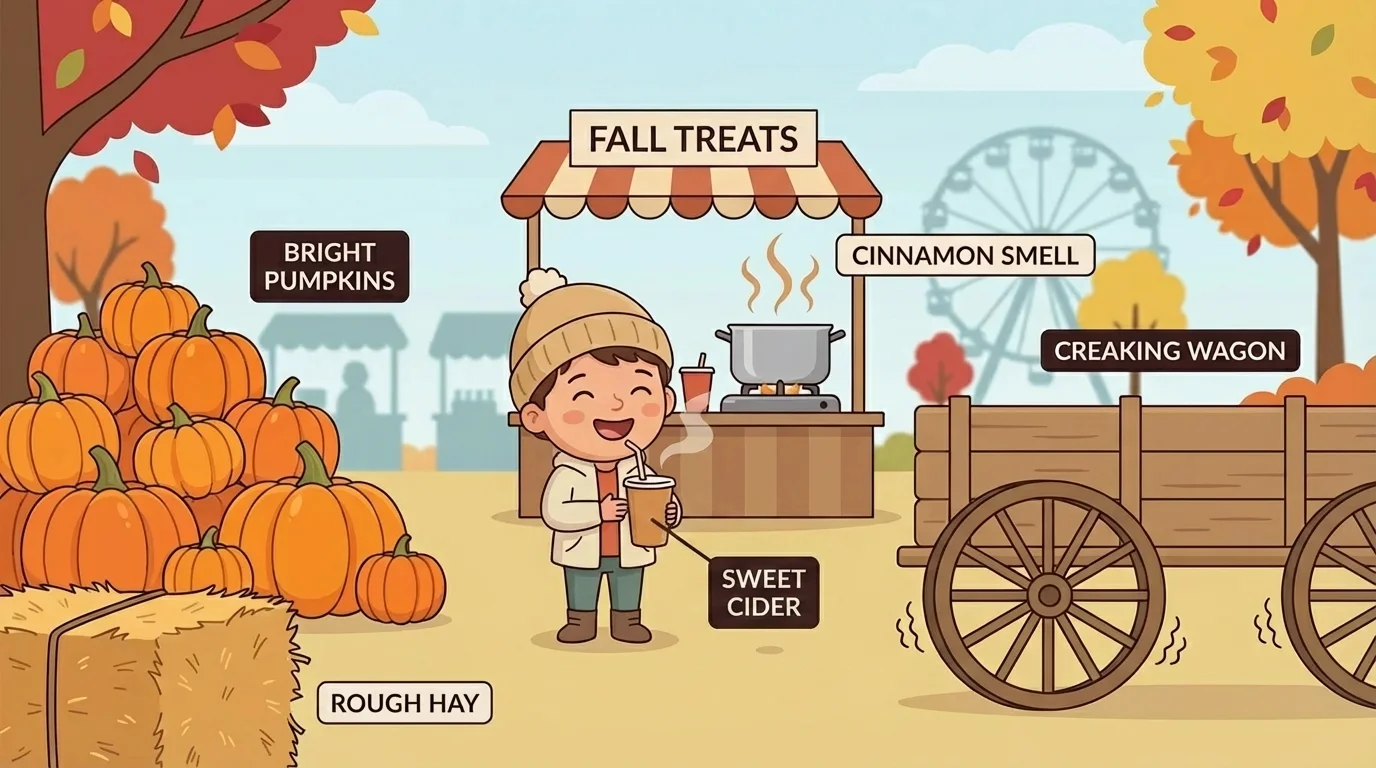
Not every sentence needs all five senses. Good writers choose the senses that fit the moment. In a bakery scene, smell and taste may matter most. In a thunderstorm scene, sound and touch may be more important.
Smell is closely connected to memory, so one strong smell in a story can help a reader remember the whole scene more clearly.
Consider this sentence: "We went to the beach." It tells a fact, but not much more. Now read this: "Warm sand slid into my sandals, gulls cried overhead, and salty wind whipped my hair across my face." The second version helps the reader experience the beach, not just know about it.
Concrete writing depends on smart word choice. A concrete word often begins with an exact noun. Instead of saying "thing," "stuff," or "animal," a writer can name the actual object or creature: flashlight, puzzle pieces, fox, helmet.
Verbs are especially important because they show action. Compare weak verbs with strong ones:
| General Verb | More Precise Verb |
|---|---|
| went | marched, tiptoed, hurried, stomped |
| looked | glanced, stared, peeked, squinted |
| said | whispered, shouted, muttered, called |
| ran | dashed, sprinted, raced, bolted |
Table 1. Examples of general verbs compared with more precise verbs.
Adjectives can also help, but they work best when they are specific. "Nice flower" is not very helpful. "Bright yellow daisy" is better. Even better might be "a bright yellow daisy drooping in the heat," because it gives both a clear picture and an action.
Writers should not pile on too many describing words. A sentence like "the beautiful amazing lovely big wonderful dog" sounds cluttered. A more effective choice is "the shaggy black dog" or "the enormous dog with muddy paws."
Why strong verbs matter
A strong verb often does the job of several weak words. "The boy went across the room quickly" can become "The boy dashed across the room." One precise verb makes the sentence shorter, clearer, and more exciting.
As writers revise, they can look for ordinary words and ask whether a better one exists. This does not mean choosing the fanciest word. It means choosing the clearest word.
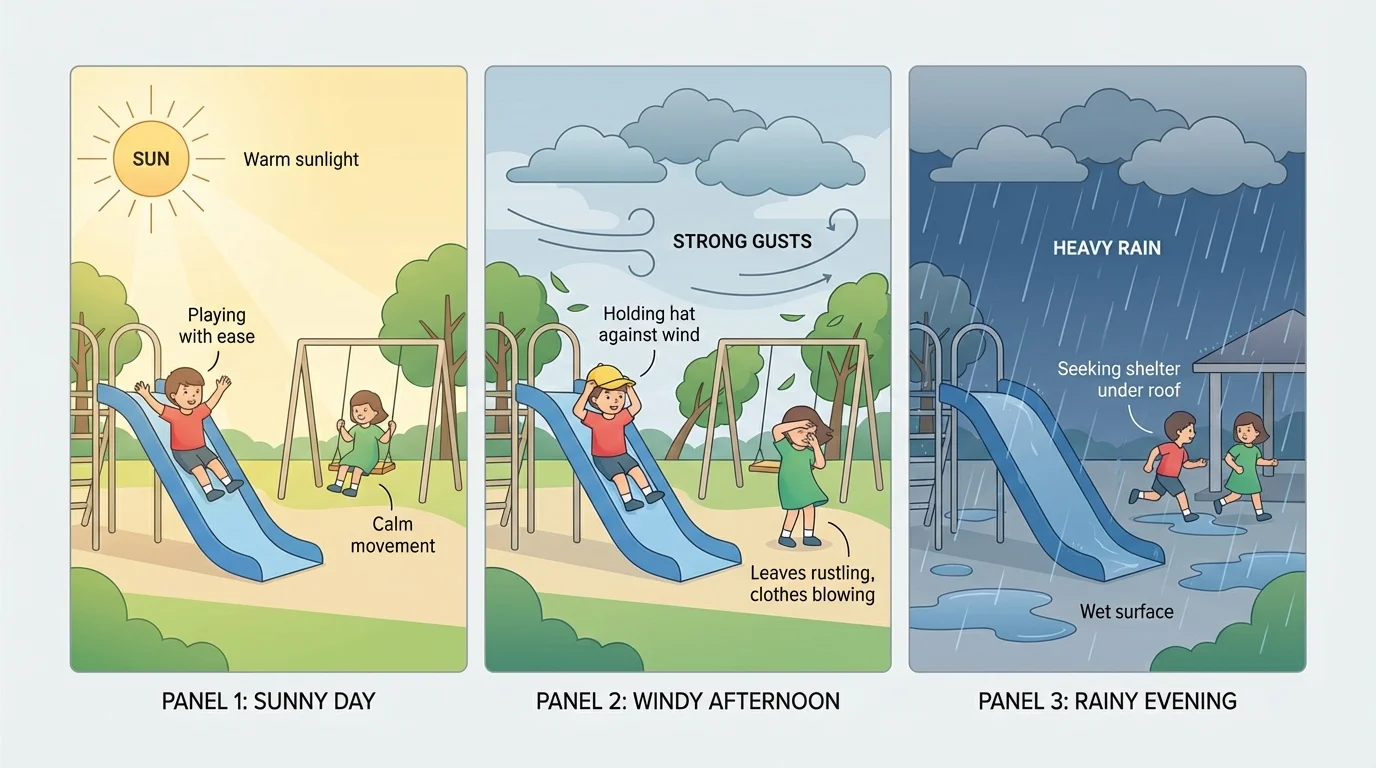
Narratives tell about events in an order. Readers need to know what happened first, next, and last. Descriptive details become even more powerful when they are attached to a clear sequence, as [Figure 3] demonstrates with one scene changing step by step.
Words and phrases such as first, then, a moment later, after that, and finally help connect related events. These sequence words guide the reader through the action.
Here is a plain sequence: "It got dark. It rained. We went inside." Now read this version: "Gray clouds swallowed the last bit of sunlight. A cold drop splashed on my arm, then another. When the rain began drumming on the slide, we grabbed our backpacks and ran inside." The second version gives the same order of events, but it feels much more real.
Example: building a sequence with detail
Read how a short event becomes clearer when the writer adds precise details.
Step 1: Start with a simple version.
"I opened the box. I saw a puppy. I was happy."
Step 2: Add concrete nouns and strong verbs.
"I lifted the cardboard lid. A tiny brown puppy popped up. I smiled."
Step 3: Add sensory details and feeling.
"I lifted the cardboard lid, and a tiny brown puppy popped up, its wet nose twitching. Its tail thumped against the box, and I laughed so hard my cheeks hurt."
The last version helps the reader follow the event and feel the surprise.
Notice that each action leads naturally to the next one. The box opens, the puppy appears, and the narrator reacts. Good narrative writing connects actions so the story does not feel jumpy or confusing.
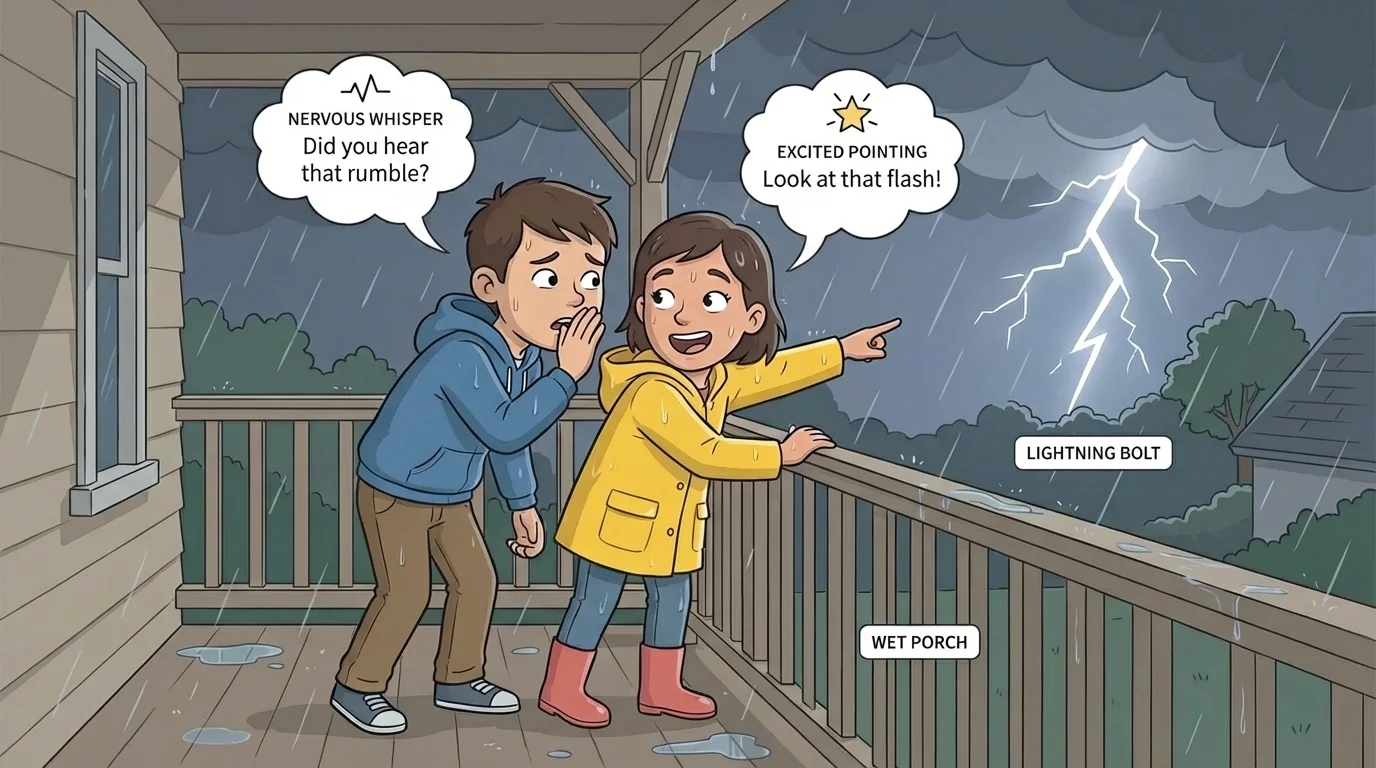
Dialogue is the spoken words of the characters in a story. Dialogue can reveal thoughts and feelings, but it is strongest when it works together with action and description, as [Figure 4] shows in a scene where body language and setting add meaning to the words.
Compare these two examples. First: " 'I'm scared,' Maya said." This tells the feeling, but only in a simple way. Now read: " 'Did you hear that?' Maya whispered, clutching the porch railing as thunder rolled across the sky." The second sentence combines dialogue, action, and sound to show fear more vividly.
Dialogue should sound natural, but it should also help the story move forward. It can show what a character notices, wants, remembers, or fears. Small actions around the dialogue help the reader picture the moment.
Here is another example: " 'Hurry up!' Ben yelled, waving both arms as the bus doors began to close." The verb yelled is more exact than said, and the action explains why he is yelling. The closing bus doors make the event urgent.
Example: plain dialogue and improved dialogue
Plain: " 'Come on,' Dad said."
Improved: " 'Come on, the pancakes are getting cold,' Dad called from the kitchen, and the smell of butter drifted up the stairs."
The improved version gives sound, smell, and a reason for the words.
Later in a story, a writer can return to the same kind of detail to build a stronger scene. For example, the mix of speech, weather, and body language we saw in [Figure 4] helps readers understand emotions without the writer needing to explain everything directly.
Sometimes young writers learn that details are good, so they try to describe everything. But too many details can slow a story down. The goal is not to list every object in a room. The goal is to choose the details that matter most.
If a character is sneaking into the kitchen at night, the writer may focus on the squeaky floorboard, the moonlight on the counter, and the cookie jar lid rattling. Those details support the event. Describing the color of every chair in the house would distract the reader.
Readers need enough description to picture the event, but they also need the story to keep moving. Good writers balance detail with action.
One useful question is: "Which details help the reader understand this moment?" Another helpful question is: "Which details match the feeling of the scene?" In an exciting chase, a writer may use quick, sharp details. In a peaceful morning scene, the writer may use softer, slower details.
As with the park contrast in [Figure 1], the best description is not the longest description. It is the description that gives the clearest picture.
Revision means improving writing by changing words, adding details, and making ideas clearer. Many strong paragraphs start out plain. Writers make them better by replacing general language with precise language.
Look at these revisions:
Vague: "The day was nice."
Revised: "Cool spring sunshine warmed the sidewalk, and a light breeze fluttered the tulips."
Vague: "She was mad."
Revised: "She slammed her notebook shut and glared at the spilled paint creeping across her poster."
Vague: "The soup tasted bad."
Revised: "The soup was so salty that I reached for my water after the first spoonful."
Example: revising a short paragraph
Before: "We went camping. It was fun. We heard stuff at night."
Step 1: Replace general words.
Change "went camping" to "pitched our tent beside the lake." Change "stuff" to exact sounds.
Step 2: Add sensory details.
Include what the campers saw, heard, or felt in the dark.
Step 3: Put the events in order.
"We pitched our tent beside the lake just before sunset. After the fire burned low, crickets chirped in the grass and an owl hooted from the trees. I pulled my sleeping bag to my chin, listening to the branches tap the tent in the wind."
The revision helps the reader picture the setting and follow what happens over time.
Revision is where many writers find their best ideas. A first draft tells what happened. A revision helps the reader experience what happened.
One common mistake is using too many weak words, such as nice, good, bad, fun, or thing. These words are not wrong, but they usually do not say enough. Readers need more exact information.
Another mistake is repeating the same detail again and again. If a writer keeps saying a forest is dark in every sentence, the description loses power. It is often better to show the darkness in different ways, such as "shadows covered the path" or "the trees blocked the last orange light."
A third mistake is adding details that do not fit the event. If the important action is a bike crash, the story should not stop for a long description of every cloud in the sky unless the clouds matter to the moment.
Writers should also be careful with unclear words like it, they, and there. In a scene with several people or objects, naming the correct person or object can make the writing much easier to follow.
"The right word may be just three letters long, but it can paint a whole picture."
Clear writing is not about using the biggest words. It is about choosing the truest words.
Now look at how many of these ideas can work together in one short narrative passage. The sequence of events, the concrete words, the sensory details, and the dialogue all help shape the scene. The changing action is easy to follow, much like the ordered events shown in [Figure 3].
"First, a gust of wind flipped the corner of my map against my wrist. I looked up and saw dark clouds sliding over the hills. 'We need to head back now,' Ava said, stuffing the granola wrappers into her pocket. By the time we crossed the bridge, rain had begun to prick my face like tiny needles. Our sneakers slapped the wet boards, and the river below churned brown and fast. When we finally reached the car, we tumbled inside, laughing and shivering while the windows fogged around us."
This passage works because the details are specific and connected to the event. The writer does not simply say it got stormy. The writer shows the map flipping, the dark clouds, the rain on the face, the wet bridge, and the foggy windows. Each detail helps the reader feel present in the scene.
That is the heart of strong narrative writing: choosing words that let readers see, hear, smell, taste, and feel what is happening while also guiding them through each related event in order.
