Why do stories told thousands of miles apart sometimes feel like cousins? A hero may fight a monster in one story, while in another a clever animal outsmarts danger, yet both stories can teach a lesson about bravery, goodness, or using intelligence wisely. People from many cultures have created stories for entertainment, teaching, remembering history, and passing on values. When we compare these stories, we notice something exciting: humans often care about similar big ideas, but they express them in different ways.
Stories, myths, and traditional literature come from many places and many times. Some were first told aloud and passed from person to person before being written down. Others were written long ago and are still read today. Even when the characters, settings, and creatures are different, the stories may share a similar theme, or main message, and a similar pattern of events, or the way important events happen in order.
People everywhere ask big questions. What is the right thing to do? What makes a person brave? Why do bad things happen? How can someone grow wiser? Because many cultures wonder about the same questions, their stories often explore the same topics.
At the same time, each culture tells stories in a way that reflects its own world. A fishing community may tell stories about the sea. A desert culture may tell stories about heat, travel, and survival. A community that values cooperation may praise helpers and teamwork, while another story may focus on individual courage. The ideas may be alike, but the details are shaped by place, history, and belief.
Theme is the deeper idea or message a story explores, such as kindness matters or evil does not win forever.
Topic is the subject a story is about, such as friendship, journeys, or family.
Myth is a traditional story that often explains nature, beliefs, gods, heroes, or the beginnings of things.
Traditional literature includes stories passed down over time, such as folktales, fairy tales, legends, myths, and fables.
When readers compare literature from different cultures, they look for both similarities and differences. Similarities help us see what people share. Differences help us respect what makes each culture special.
One of the most common ideas in literature is the struggle between good and evil. Different cultures picture this struggle in different ways, as [Figure 1] illustrates through two very different kinds of stories. In some tales, evil appears as a monster, witch, giant, or dragon. In others, evil appears as greed, selfishness, cruelty, or dishonesty inside an ordinary person.
For example, in many European fairy tales, a hero or heroine must face a clear enemy. In Hansel and Gretel, the witch is dangerous and wicked. In Sleeping Beauty, an evil fairy places a curse. The battle between good and evil is easy to spot because the good characters and the bad characters seem clearly separated.
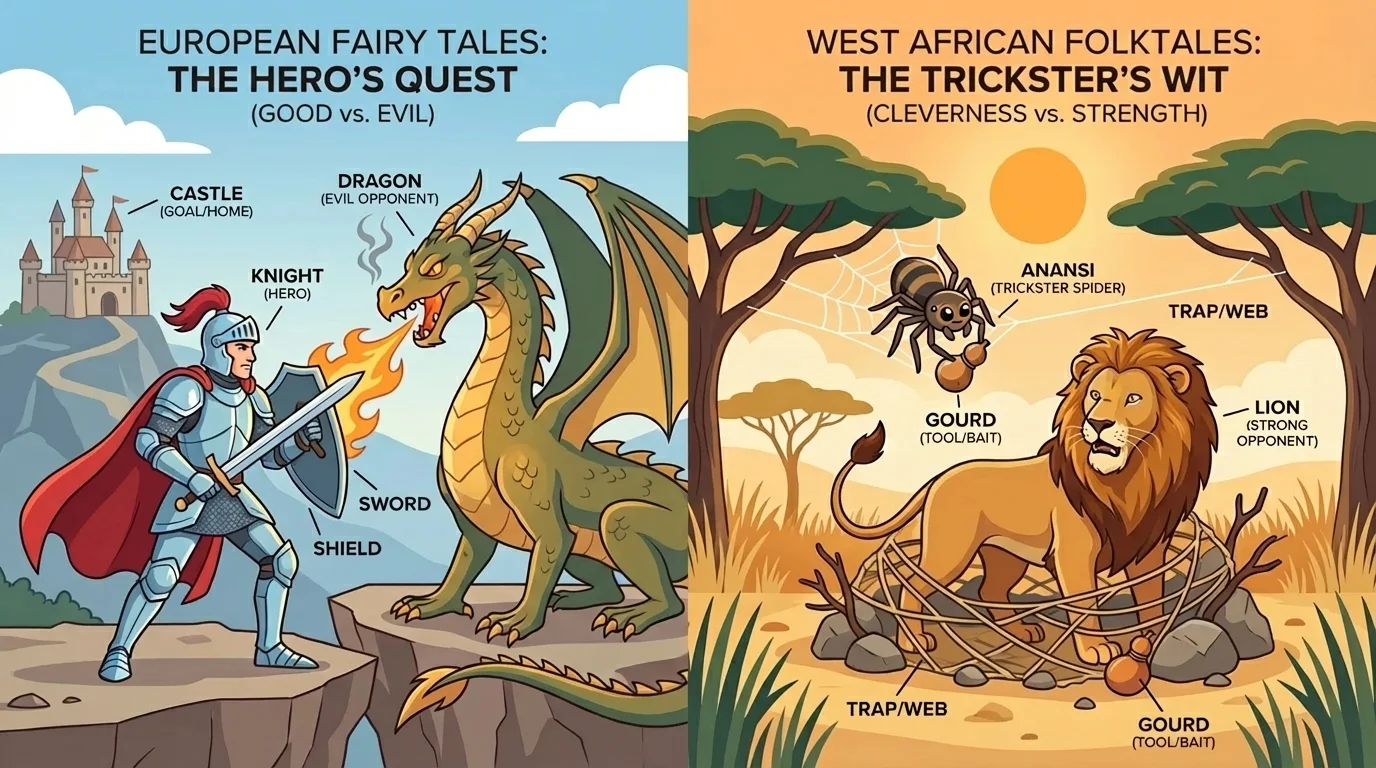
In some West African tales about Anansi the spider, the conflict is not always a huge battle. Sometimes the problem is trickery, pride, or unfairness. A smaller, weaker character may defeat a stronger one through clever thinking. In these stories, evil may be shown not just as physical danger but as foolishness, selfishness, or abuse of power.
In stories from ancient Greece, heroes often face monsters, but they also struggle with their own choices. In the story of Theseus and the Minotaur, evil is represented by a frightening creature and by the danger of a cruel system that sends young people into the labyrinth. Here, good and evil are connected to justice and bravery.
Many Native American traditional stories also show a struggle between helpful and harmful forces. In some tales, balance with nature matters. A harmful character may break that balance through greed or disrespect. This means that "evil" is not always just one villain. It can be a wrong action that harms the community or the natural world.
So, stories can share the same broad theme but treat it differently. One story may say good wins through strength. Another may show good winning through patience, wisdom, or teamwork. When we compare them, we ask: What counts as "good" in each story? What does each culture warn readers against?
Case study: comparing two treatments of good and evil
Step 1: In a European fairy tale, evil may appear as a dragon guarding a village.
The hero defeats the dragon, so goodness looks brave and strong.
Step 2: In a trickster tale, evil may appear as a proud ruler who uses power unfairly.
A clever character exposes the ruler, so goodness looks smart and resourceful.
Step 3: Compare the message.
Both stories oppose good and evil, but one honors physical courage while the other honors clever thinking.
Later, when we compare other story patterns, we can return to [Figure 1] and notice that even enemies who look different serve a similar purpose: they test what the hero values and reveal what kind of goodness the story admires.
Not every culture chooses the same kind of hero. Some stories praise the strong warrior. Others praise the gentle helper. Others celebrate the person who thinks carefully and solves problems. This means that stories may share a topic, like heroism, but define it differently.
Consider the Chinese ballad of Mulan and the European story of Cinderella. Both center on a young female character who faces hardship. But the treatment is different. Mulan is remembered for bravery, duty, and sacrifice. Cinderella is often remembered for patience, kindness, and hope. Both characters show strength, but not in exactly the same way.
In many animal fables, such as stories from India's Panchatantra, intelligence matters more than size. A small animal may survive because it understands others and plans ahead. That is a different kind of courage. It is quiet courage instead of loud courage.
Some story characters travel across cultures and change over time. A clever animal in one tradition may become a clever human in another, but the idea that brains can beat force stays the same.
When readers compare stories, they should notice what qualities are rewarded. Does the story praise honesty? Loyalty? Obedience? Imagination? Quick thinking? These choices help reveal the values of the culture that told the story.
Many stories from different cultures follow a quest pattern. A quest is a journey taken to reach a goal. The hero leaves home, faces tests, receives help, overcomes a major challenge, and returns changed in some way.
As [Figure 2] shows, this pattern appears in ancient myths, legends, and folktales. A hero may search for a magical object, rescue a person, discover truth, or prove worthiness. Even when the details differ, the pattern stays familiar: beginning, challenge, struggle, victory, and return.
Think about the Greek story of Odysseus. His quest is a long journey home after war. He meets monsters, storms, and temptations. In another tradition, a hero in a folktale may go into the forest to find a healing water or save a family member. The places and dangers change, but the event pattern is much the same.
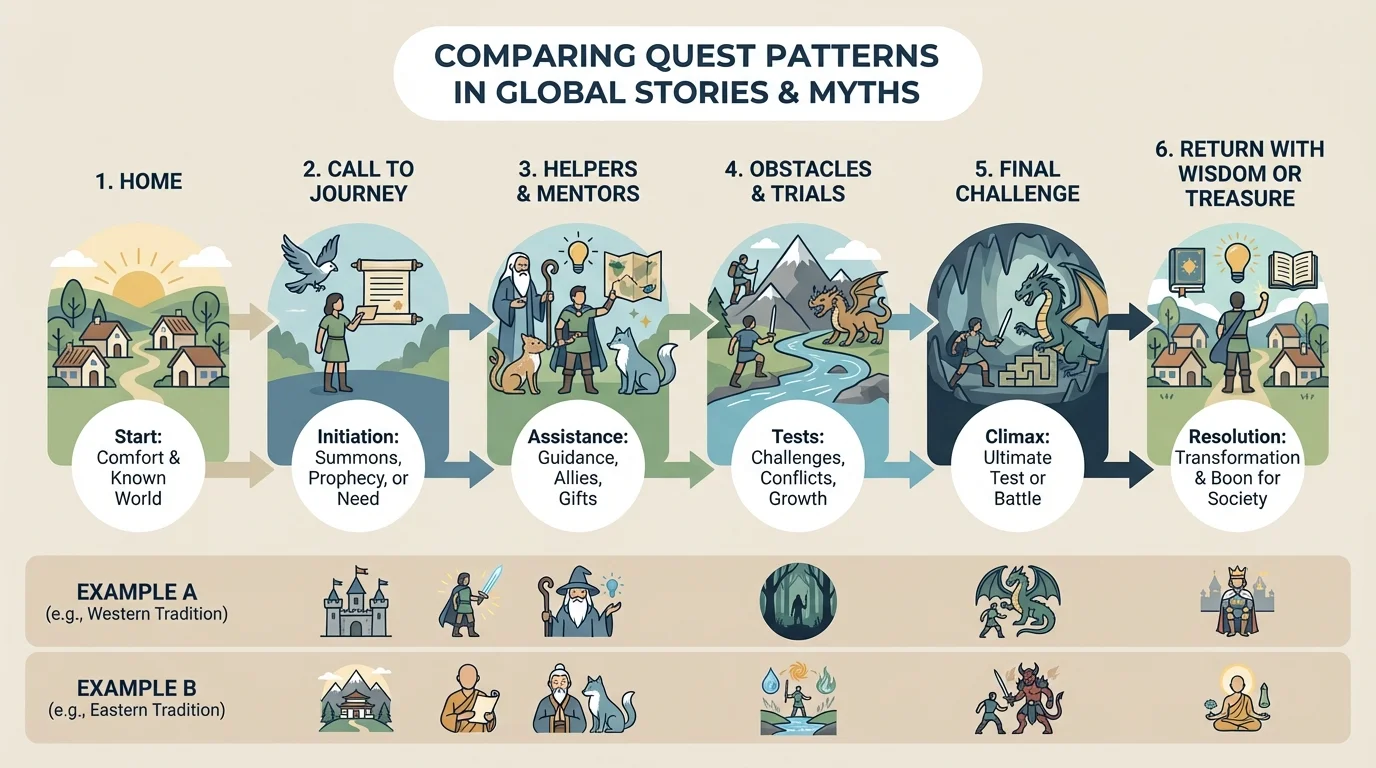
In some stories, the hero returns with treasure. In others, the hero returns with wisdom, peace, or a better understanding of self. That difference matters. A quest is not always about getting something physical. Sometimes it is about growing up, learning responsibility, or restoring harmony.
Quests can also vary in tone. One culture's quest may involve powerful gods and epic battles. Another may involve an ordinary child completing a small but meaningful task. Both are quests because the character moves through challenges toward a goal.
How a quest pattern works
A quest usually includes a call to action, a road of challenges, helpers or magical gifts, a final test, and a result that changes the hero. Readers compare quests by asking what the hero wants, what stands in the way, who helps, and what the hero learns by the end.
We can use [Figure 2] again to compare stories more carefully. Two heroes may both leave home and face obstacles, but one may be trying to help a whole kingdom while another is trying to help one family. The pattern is similar, yet the purpose and meaning can be different.
Another common pattern in traditional literature is the use of a trickster. A trickster is a character who uses cleverness, jokes, or deception. Tricksters may be funny, but they can also teach serious lessons. Anansi in West African stories, Coyote in many Native American stories, and Raven in some northern traditions all show how trickster characters can challenge rules, expose foolishness, or explain how something came to be.
Even when tricksters come from different cultures, readers can compare their roles. Does the trickster help people, hurt people, or do both? Does the trickster win because others are greedy or careless? These questions help us see deeper meaning.
Stories also often include transformation, or change. A frog becomes a prince, a selfish character becomes generous, or a frightened child becomes brave. Transformation can be magical, emotional, or both. This pattern appears in many traditions because people everywhere understand change and growth.
Tests are important too. Characters may be tested by riddles, hard journeys, temptations, or acts of kindness. The test reveals who the character truly is. In one culture, passing the test may require respect for elders. In another, it may require honesty or courage.
The land, climate, animals, and beliefs of a culture often shape its stories. This is why comparing stories is not just about finding matches. It is also about noticing why a culture tells a story in a certain way.
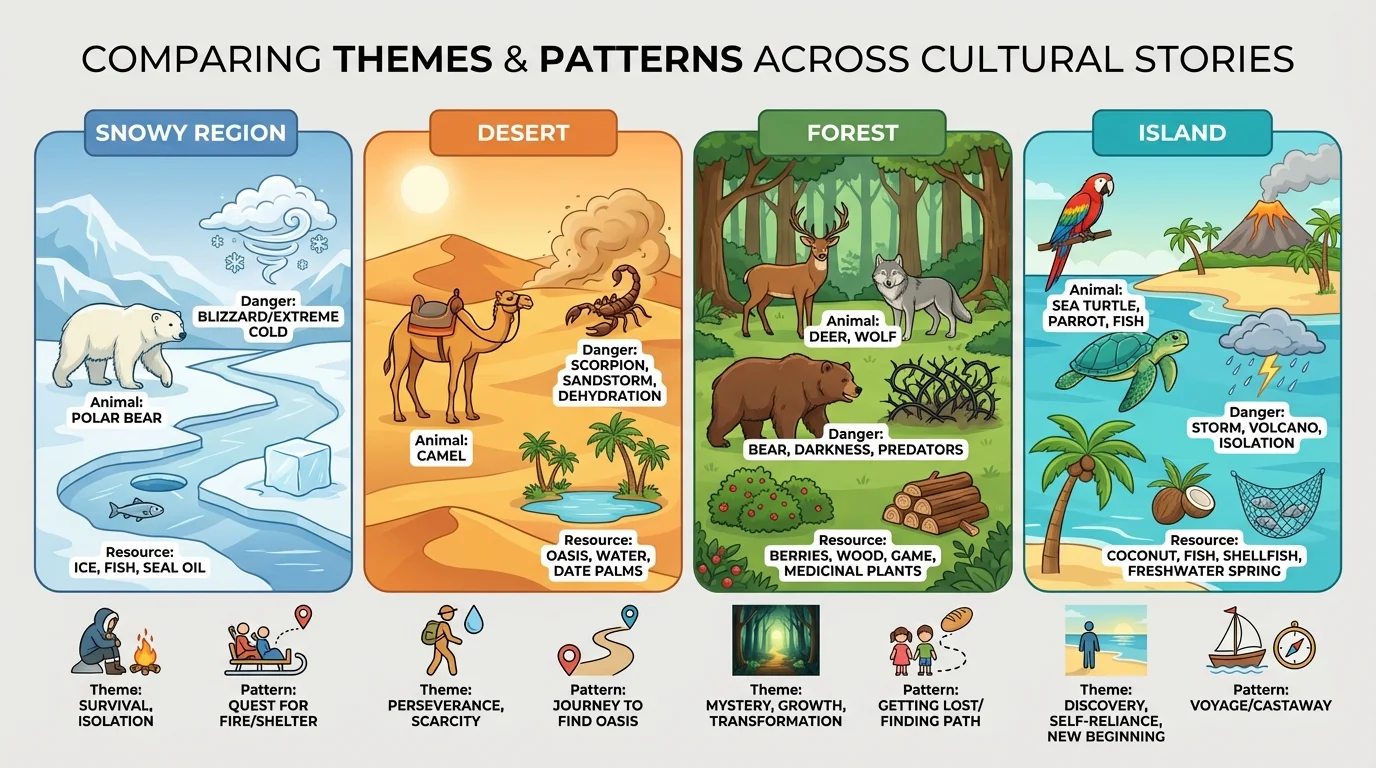
A story from a snowy region may include ice, darkness, and animal guides such as bears or ravens. A story from a tropical island may include storms, ocean travel, and sea creatures. A desert story may include long journeys, heat, and the value of water. The setting affects the dangers, helpers, symbols, and lessons.
As [Figure 3] makes clear, beliefs also matter. In some myths, gods or spirits guide human life closely. In others, ancestors, animals, or nature itself play a sacred role. These beliefs shape what counts as right, wrong, brave, or foolish.
For example, in Japanese folktales, respect, duty, and spirits of nature may be important. In many Norse myths, harsh weather, battle, and fate are powerful forces. In stories from India, wisdom, moral choices, and the consequences of actions are often central. Each culture's stories reflect the world people knew and the ideas they wanted to pass on.
When readers return to [Figure 3], they can see that setting is not just background. It helps create the whole story. The environment often influences the problem, the journey, and even the lesson.
When comparing texts, use details from both stories. A good comparison does not just say "they are different"; it explains how and why they are different.
Strong readers compare stories in organized ways. They can compare characters, themes, settings, problems, patterns of events, and lessons. They also support their ideas with evidence from the texts.
One useful way is to ask matching questions about both stories: Who is the hero? What problem begins the action? What tests appear? How is the conflict solved? What lesson does the story leave with the reader? Answering the same questions for both stories makes similarities and differences easier to see.
Another useful way is to notice whether the stories treat a topic in the same tone. One story about bravery may be serious and grand. Another may be playful and humorous. That difference changes how the reader experiences the same basic idea.
| What to Compare | Questions to Ask |
|---|---|
| Theme | What big idea or message does each story explore? |
| Characters | What traits are admired or criticized? |
| Conflict | What kind of problem must be solved? |
| Pattern of events | Does the story follow a quest, a trick, a test, or a transformation? |
| Setting | How do place and culture shape the story? |
| Ending | What changes by the end, and what does that show? |
Table 1. Questions readers can use to compare stories, myths, and traditional literature from different cultures.
When writing or speaking about a comparison, use words such as similarly, both, however, in contrast, and while. These signal words help show whether you are discussing likenesses or differences.
Let us compare several works briefly. In Cinderella, in the Chinese story of Mulan, and in some Native American hero tales, the main character faces difficulty and must prove inner worth. That is a similarity. But the way each character shows worth is different. Cinderella endures with kindness, Mulan acts with courage and duty, and a hero in a traditional tale from an Indigenous nation may prove worth by helping the people or honoring nature.
The Greek story of Odysseus, the West African stories of Anansi, and the Indian tales of the Panchatantra all include challenges and problem-solving. Yet Odysseus often solves problems during an adventurous journey, Anansi often uses tricks in shorter episodes, and the Panchatantra often teaches direct moral wisdom through animal characters.
Mini comparison across cultures
Step 1: Find the shared idea.
All three stories may show that intelligence helps characters survive.
Step 2: Notice the difference in treatment.
One story treats intelligence as heroic leadership, another as humorous trickery, and another as moral advice.
Step 3: State the comparison clearly.
The stories are alike because they value thinking, but they differ in tone, purpose, and cultural setting.
This kind of comparison helps readers avoid shallow answers. It is not enough to say "both stories have heroes." A stronger idea is "both stories have heroes, but one hero is praised for physical bravery while the other is praised for wisdom and self-control."
Comparing stories from different cultures helps readers become more thoughtful and more open-minded. It shows that people around the world may share fears, hopes, and dreams. It also shows that there are many ways to express those feelings.
These comparisons also make reading more interesting. A dragon, a spider, a raven, a prince, a village child, or a wandering sailor may all carry pieces of the same big human questions. By noticing themes and patterns, readers become better at understanding literature. By noticing cultural differences, readers become better at understanding people.
When students compare myths, folktales, and other traditional literature, they are doing more than finding matching parts. They are learning how stories carry values, explain the world, and connect communities across time. That is one reason literature from different cultures remains powerful today.
