Have you ever noticed that two books can teach about the same topic in completely different ways? One article about volcanoes might tell what happens first, next, and last. Another might explain what causes eruptions and what happens because of them. Good readers do more than gather facts. They also notice how the author organizes those facts.
When you understand a text's organization, reading becomes easier. You can predict what kind of information is coming next. You can connect ideas more clearly. You can also remember important details better because they are not just random facts anymore. They fit into a pattern.
Text structure is the way an author organizes information in a text. Some common structures are chronology, comparison, cause and effect, and problem and solution.
Informational texts in science, social studies, health, and even sports articles often use these patterns. A writer chooses a structure that matches the job the writing needs to do. If the writer wants to explain steps in a process, chronological order may work best. If the writer wants to show how two things are alike and different, comparison may be the better choice.
A text is easier to understand when you know its pattern. Suppose you are reading about how a hurricane forms. If the author uses time order, you expect the information to move step by step. If the author uses cause and effect, you expect reasons and results. Knowing that pattern helps your brain sort the details.
Text structure also helps when you read only part of a text. A whole chapter might mostly be organized one way, but one paragraph or section may switch to another pattern. Strong readers notice both the overall structure of the text and the structure of smaller parts.
Scientists, historians, and journalists all use text structures. Even when they study very different topics, they still need clear ways to organize information so readers can follow their thinking.
That means this skill is useful almost everywhere. If you can spot structure, you become better at reading textbooks, articles, directions, and reports.
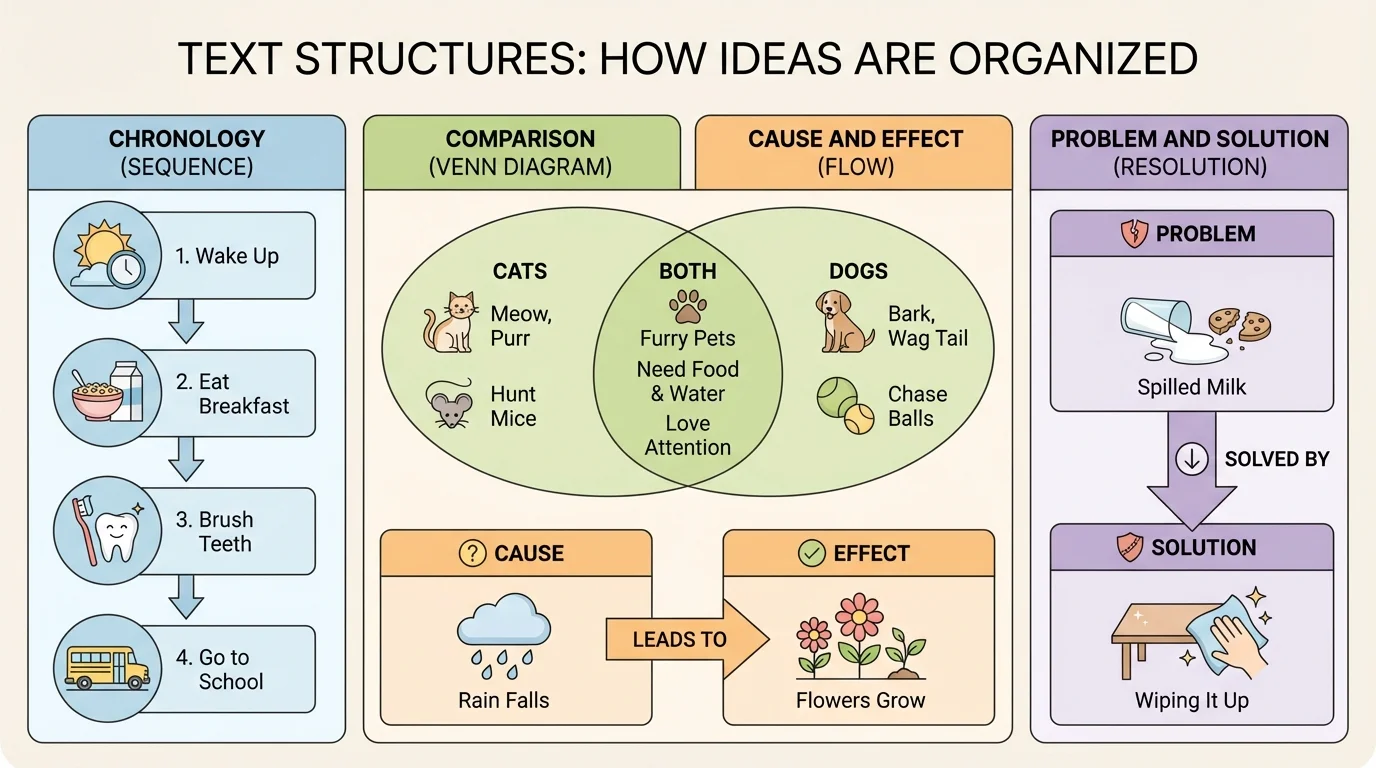
There are several ways authors organize information, but four structures appear again and again in upper elementary reading. The four main patterns are shown together in a simple overview: chronology, comparison, cause and effect, and problem and solution. Each one gives information a different shape.
[Figure 1] Chronology puts events or steps in time order. Comparison shows how things are alike and different. Cause and effect explains why something happens and what happens as a result. Problem and solution presents a challenge and then explains ways to fix it.
| Structure | Main Job | Questions It Answers |
|---|---|---|
| Chronology | Puts events or steps in order | What happened first, next, and last? |
| Comparison | Shows likenesses and differences | How are these things alike or different? |
| Cause and effect | Explains reasons and results | Why did this happen? What happened because of it? |
| Problem and solution | Presents a challenge and a fix | What is wrong, and how can it be solved? |
Table 1. The four common informational text structures and the questions they help readers answer.
As you read, asking these questions can help you identify the pattern quickly. You do not have to only memorize a list. You can think like a detective and search for clues in the way ideas connect.
When an author uses chronology, the information follows time order, as [Figure 2] shows with a growing plant moving from one stage to the next. This structure is also called sequence. It is common in articles about history, life cycles, experiments, recipes, and directions.
Signal words often help you notice chronology. Look for words such as first, next, then, later, before, after, and finally. These words act like road signs. They tell you that the writer is arranging details in order.
For example, read this short passage: "First, Maya filled a pot with soil. Next, she placed a bean seed in the dirt. After that, she watered it every day. Finally, a green sprout pushed through the soil." This part of the text is organized by chronology because it tells events in the order they happened.
Chronology is not only for stories about the past. A science book might explain the water cycle in steps. A social studies article might describe events leading to a holiday. A health article might list the order for washing hands correctly. In each case, the structure helps readers follow a process.
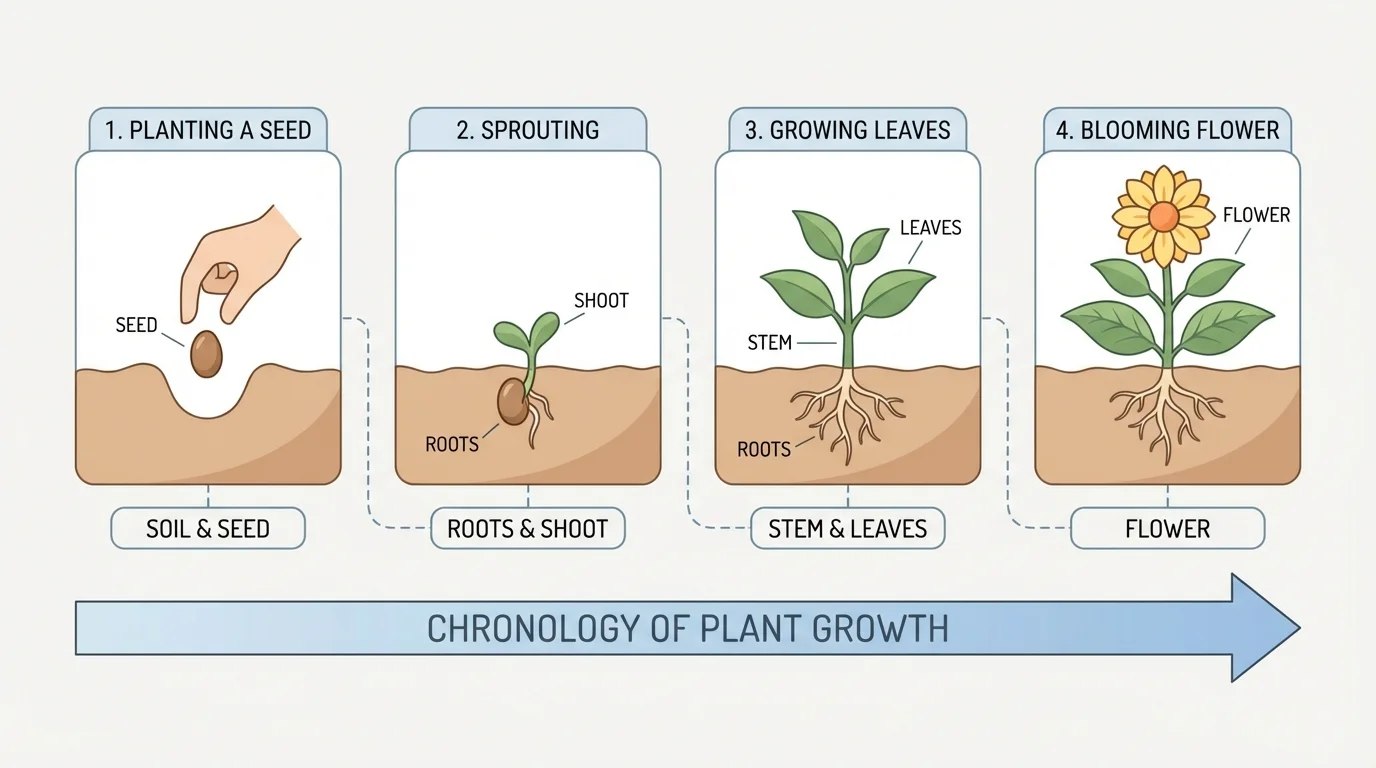
Later, if you return to [Figure 2], you can see why changing the order would confuse the meaning. A flower does not bloom before the seed sprouts. In chronology, order matters.
Example: Identifying chronology
Passage: "In the morning, the zookeepers cleaned the penguin area. Then they prepared buckets of fish. After lunch, they gave the penguins a health check."
Step 1: Look for signal words.
The words in the morning, then, and after lunch show time order.
Step 2: Ask what question the passage answers.
It answers, "What happened first, next, and later?"
Step 3: Name the structure.
The structure is chronology or sequence.
Some sequence texts use dates instead of words like next. A history article may say, "In 1969... In 1970... By 1972..." Dates can be clues that the author is organizing events over time.
A text uses comparison when it shows how two or more things are alike and different. Readers can line up details side by side, as [Figure 3] illustrates with two animals. This structure helps you understand each subject more clearly because you can see them together.
Signal words for comparison include both, alike, similar, different, however, instead, and on the other hand. Sometimes an author compares two places, two inventions, two kinds of weather, or two animals.
Here is an example: "Frogs and toads are both amphibians. Frogs usually have smooth, wet skin, while toads often have dry, bumpy skin. Frogs tend to make longer leaps, but toads often take shorter hops." This passage uses comparison because it explains similarities and differences.
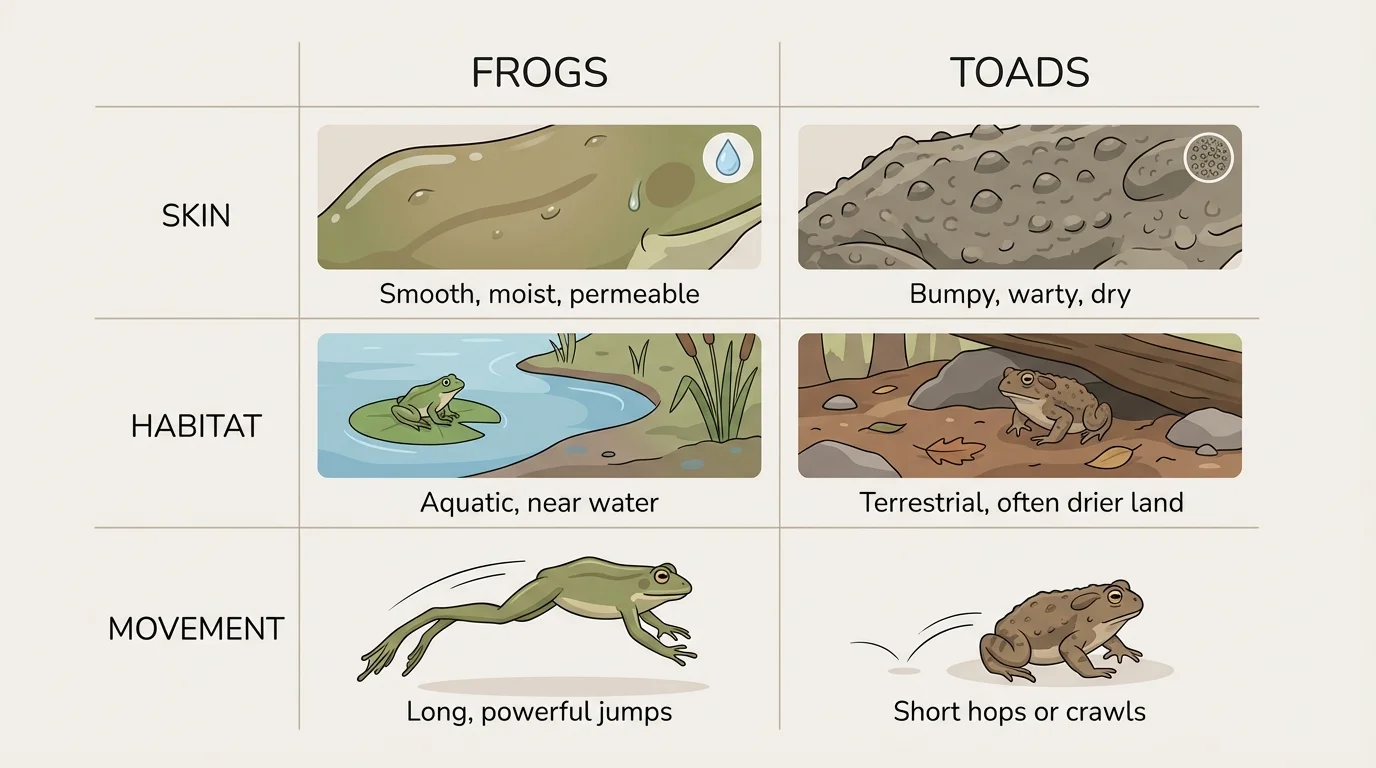
Comparison is useful in many school subjects. In science, you might compare rocks and minerals. In social studies, you might compare rural and urban communities. In reading, you might compare two biographies of important people. Looking back at [Figure 3] helps show how matching categories make the similarities and differences easier to spot.
Comparison is more than listing facts. In a comparison text, the details are connected by a shared idea. The author is not just saying random things about frogs and toads. The author is organizing those facts so readers can study the subjects together.
Sometimes a comparison text mostly focuses on differences. Other times it mostly focuses on similarities. It is still comparison as long as the author is organizing information by looking at two or more subjects side by side.
Cause and effect explains reasons and results. One event can lead to another, as [Figure 4] shows with heavy rain leading to several effects. The cause is why something happens. The effect is what happens because of it.
Signal words include because, since, so, therefore, as a result, and due to. These clues can help, but sometimes the author does not use clear signal words. Then you need to think carefully about which event led to another event.
For example: "A cold front moved into the area, so temperatures dropped quickly. As a result, schools delayed their start time." In this passage, the cold front is the cause. The falling temperatures and delayed school opening are effects.
This structure appears often in science and social studies. A science article may explain how a lack of rain causes drought. A history text may explain how unfair laws caused protests. A health article may explain how exercise affects the heart and muscles.
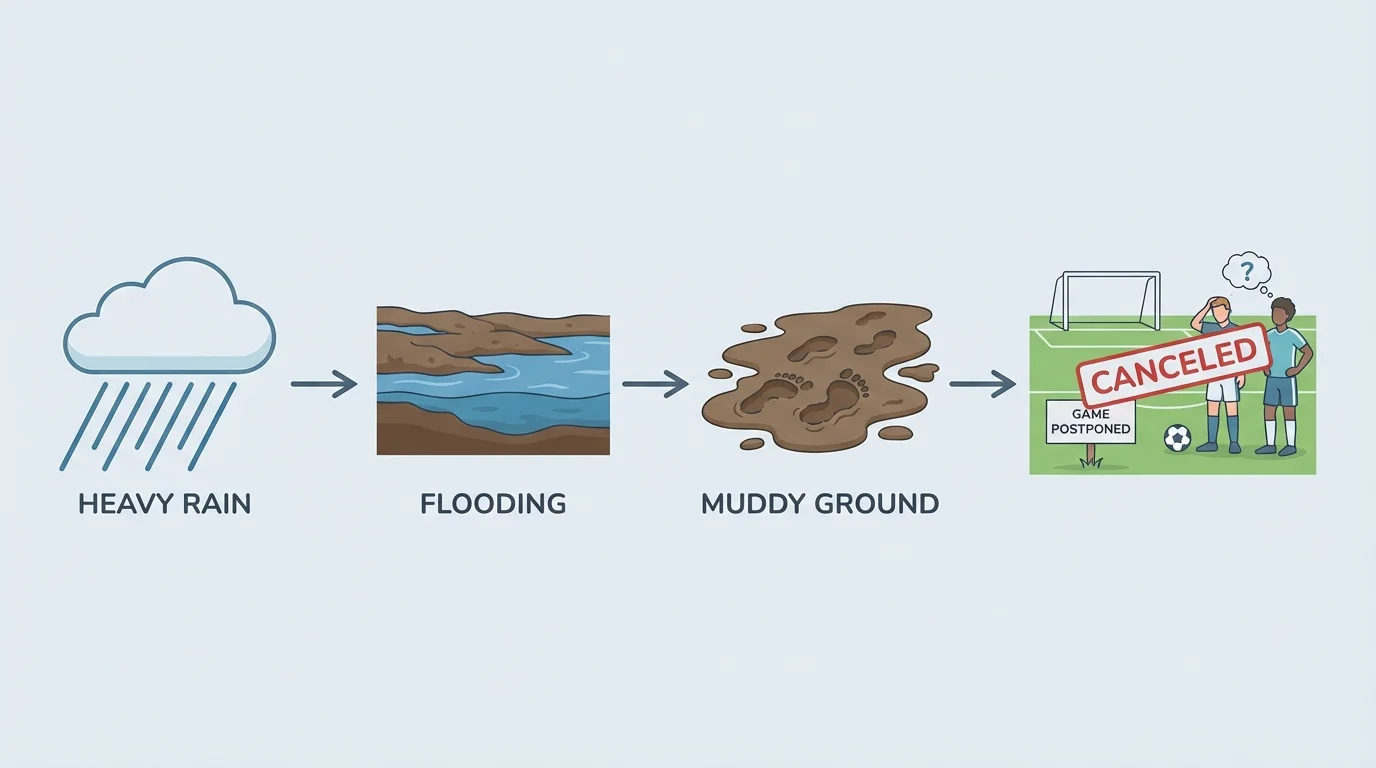
When you study a complicated topic, one cause can have many effects, and one effect can come from several causes. Looking again at [Figure 4] reminds us that ideas may branch out. Readers need to follow those branches carefully.
Example: Identifying cause and effect
Passage: "The class forgot to close the windows before the storm. Because rain blew inside, the papers on the bulletin board got wet."
Step 1: Find the reason.
The class forgot to close the windows before the storm.
Step 2: Find the result.
Rain blew inside, and the papers got wet.
Step 3: Name the structure.
The structure is cause and effect because the passage explains why the papers became wet.
Be careful: just because two things happen close together does not always mean one caused the other. Good readers look for real connections, not just events that happen one after another.
In a problem and solution structure, the author presents a challenge and then explains a way to solve it, as [Figure 5] shows with a park cleanup example. The problem may be something that is wrong, difficult, or needs to be fixed.
Signal words often include problem, solution, issue, solve, answer, and in order to fix this. Authors may give one solution or several possible solutions.
For example: "The school garden was drying out during summer break. To solve the problem, teachers made a watering schedule for families who lived nearby." This passage uses problem and solution because it tells what was wrong and how people tried to fix it.
This structure is common in articles about communities, the environment, inventions, and teamwork. A writer may describe plastic pollution as a problem and recycling programs as part of the solution. A writer may describe traffic as a problem and bike lanes or buses as possible solutions.
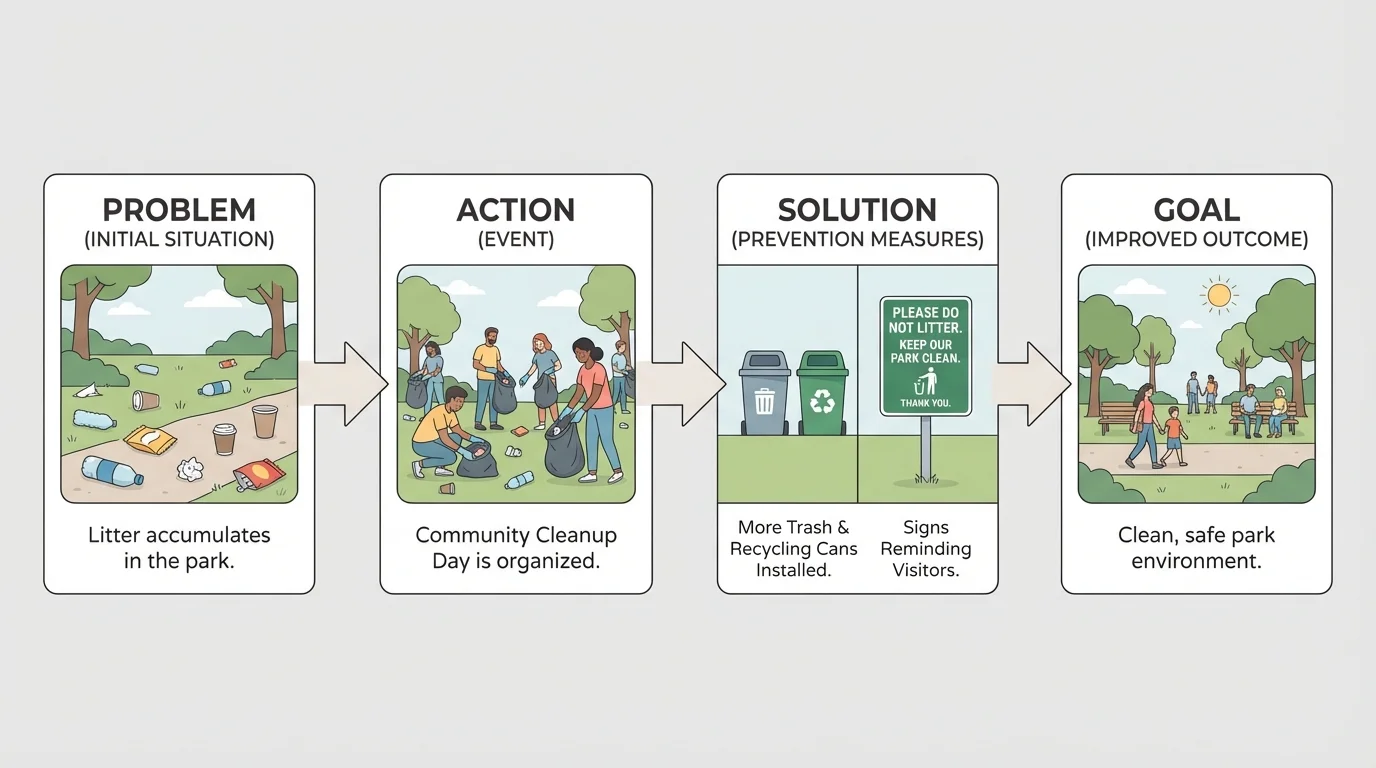
Later in your reading, [Figure 5] helps you remember that one problem can lead to more than one solution. Authors sometimes compare which solution works best, so one part of a text may shift from problem and solution to comparison.
Remember that a single paragraph may be short, but it can still have a clear structure. You do not need a whole chapter to identify chronology, comparison, cause and effect, or problem and solution.
Also, not every solution fully fixes a problem. Some texts present a problem and then explain attempts to solve it. That still fits this structure because the writing is organized around the challenge and the response.
Many informational texts are not organized in only one way from beginning to end. A chapter about wildfires might begin with cause and effect by explaining how fires start. Then it might switch to chronology to describe what firefighters do first, next, and last. Later, it might compare ground crews and air crews.
This is why readers should ask two different questions: What is the overall structure of the whole text? and What is the structure of this section or paragraph? The answer may be the same, but it may also be different.
Think about an article on recycling. The whole article might mostly be problem and solution because it explains too much trash and ways to reduce it. But one paragraph inside it may be chronological if it tells the steps for sorting materials at a recycling center. Another paragraph may use comparison if it compares paper recycling with plastic recycling.
Writers often mix structures on purpose. This helps them explain a topic fully instead of forcing every idea into the same pattern.
When you notice these shifts, you understand the text more deeply. You can tell not only what the author says, but also how the author builds the explanation.
Signal words are helpful, but they are not the only clues. Headings, repeated patterns, and the type of details included can also reveal structure. A heading like How Bees Make Honey may suggest sequence. A heading like City Life and Country Life may suggest comparison.
You can ask yourself simple questions while reading. Does the text move through time? Does it line up two subjects? Does it explain reasons and results? Does it name a problem and discuss solutions? These questions are powerful tools.
Another clue is what kind of details the author chooses. Dates and times often point to chronology. Paired details about two topics often point to comparison. Reasons and results point to cause and effect. Challenges and answers point to problem and solution.
| Structure | Common Signal Words | Reader Question |
|---|---|---|
| Chronology | first, next, then, finally | What order do the events or steps follow? |
| Comparison | both, similar, different, however | How are these subjects alike and different? |
| Cause and effect | because, so, as a result, therefore | What caused this, and what happened next? |
| Problem and solution | problem, solution, issue, solve | What needs fixing, and how is it fixed? |
Table 2. Signal words and guiding questions for identifying text structure.
Still, signal words can sometimes trick you if you depend on them too much. The word because often points to cause and effect, but you should still check the whole sentence to make sure the ideas truly show a reason and a result.
Here is a short passage: "Desert plants and rainforest plants both need water, but they survive in different ways. Cacti store water in thick stems. Many rainforest plants have wide leaves that help them collect sunlight under tall trees." This passage uses comparison because it studies two kinds of plants side by side.
Now look at another passage: "During winter, some roads become icy. As a result, trucks spread salt on the roads to make travel safer." This one may seem like problem and solution, and it does include a response. But the main relationship is that icy roads lead to salt spreading, so cause and effect is the stronger answer.
Here is another: "First, the robotics team sketched ideas. Next, they built a model. Finally, they tested the robot in a school competition." That pattern is sequence because the author tells the order of events.
Example: A text part can differ from the whole text
Suppose an article about community gardens mostly explains a problem and solution: neighborhoods need fresh food, so people create gardens. Inside that article, one paragraph says, "First, volunteers clear the land. Next, they build raised beds. Then they plant seeds."
Step 1: Look at the whole article.
The overall article is mostly problem and solution.
Step 2: Look at the paragraph only.
The paragraph is in chronology because it gives steps in order.
Step 3: Explain both clearly.
A whole text and one part of that text can use different structures.
This is an important reading skill. Teachers may ask about the structure of a passage, a paragraph, or an entire article. You must pay attention to the size of the text you are studying.
Authors do not pick structures randomly. They choose them because the structure helps teach the information clearly. If an author wants to explain a process, sequence works well. If the author wants readers to weigh two choices, comparison helps. If the author wants to explain why something happened, cause and effect fits. If the author wants to discuss a challenge and answer it, problem and solution is the natural choice.
Think about everyday examples. A recipe uses sequence. A product review may use comparison. A weather article may use cause and effect. A community news story about fixing playground equipment may use problem and solution. Text structure is everywhere once you start noticing it.
"Good readers do not only collect facts. They notice how the facts are connected."
When you understand these choices, you become a stronger reader and writer. You can read more thoughtfully, and you can also organize your own reports in clearer ways.
One of the best habits in reading is to pause and ask, "How is this text organized?" That single question can unlock meaning. It helps you sort information, follow the author's thinking, and remember what you learn.
As you read about animals, weather, inventions, explorers, sports training, or health, notice whether the author is moving through time, comparing subjects, showing causes and effects, or explaining a problem and its solution. Once you see the pattern, the text becomes easier to understand.
You do not need to guess wildly. Use clues from signal words, details, headings, and the relationships between ideas. Then decide which structure best matches the text or part of the text. Sometimes more than one pattern appears, but there is usually one main structure that organizes the ideas most strongly.
