Have you ever been reading a great story and suddenly come across a word you did not know? Strong readers do not always stop right away to ask someone or grab a dictionary. Instead, they act like detectives. They look in the words and sentences around the tricky word for clues. Those clues can help them unlock meaning and keep reading with confidence.
When authors write, they often give readers help without saying, "Here is the definition." They may explain a word, give examples, restate the idea in a simpler way, or use nearby details that point toward the meaning. This is called using context clues. Context clues matter because they help you understand what you read even when every word is not familiar.
Reading this way makes you a stronger, more independent reader. It also helps in every subject. In science, social studies, and even directions for a game or a recipe, you may meet new words. If you can use the text around the word, you can keep learning without getting stuck.
Context clues are hints in the words, phrases, sentences, or paragraphs around an unfamiliar word that help a reader figure out its meaning.
Unknown word means a word you do not know yet. A phrase is a small group of words that work together to express an idea.
Sometimes the clue is very clear. Other times, you have to think carefully and make a smart guess. A good reader does not guess wildly. A good reader uses evidence from the text.
Context means the words and ideas around a word. If you read only one word by itself, it can be hard to know what it means. But if you read the whole sentence and the sentences near it, the meaning often becomes clearer.
Look at this sentence: "The desert was arid, so dry that almost no plants could grow there." Even if you have never seen the word arid before, the words "so dry" tell you what it means. The sentence itself gives you the answer.
Context clues are not magic. They are signs that point you in the right direction. The more carefully you read, the more likely you are to notice them.
You already know that good readers reread when something does not make sense. Using context clues works best when you slow down, read before and after the unknown word, and ask, "What is this part mostly about?"
Sometimes one sentence gives enough information. Sometimes you need the whole paragraph. That is why readers should not focus only on the unknown word. They should zoom out and look at the larger idea.
Readers can find several clue types in nearby text. Learning to notice these patterns helps you identify what kind of help the author is giving.
As shown in [Figure 1], one common type is a definition clue. The author directly tells what the word means. Another is an example clue, where examples help you understand the word. A third type is a restatement, where the author says the same idea in a different way. Authors may also use a synonym, an antonym, or the general sense of the sentence.
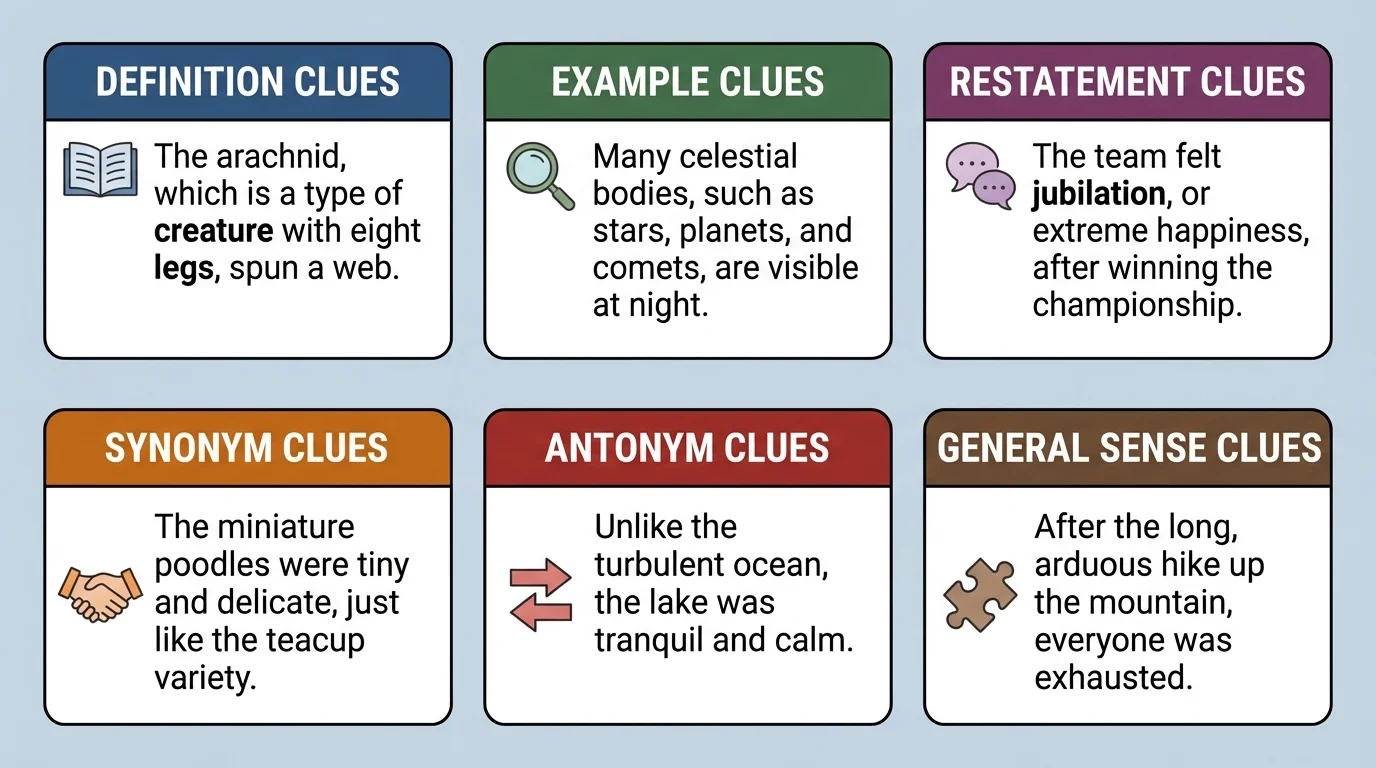
Here are the main types of context clues:
| Type of clue | How it helps | Example |
|---|---|---|
| Definition | The meaning is directly explained. | "A nocturnal animal is one that is active at night." |
| Example | Examples show what the word includes. | "Celestial objects, such as stars, planets, and moons, filled the sky." |
| Restatement | The idea is said again in a new way. | "Mila felt anxious, or worried, before the play began." |
| Synonym | A nearby word means almost the same thing. | "The path was narrow, a tight space between the rocks." |
| Antonym | A nearby word gives the opposite meaning. | "Unlike his timid sister, Ben was bold and fearless." |
| General sense | The whole sentence or paragraph suggests the meaning. | "After running for miles, Tasha felt exhausted and could barely speak." |
Table 1. Common types of context clues and how each one helps readers figure out meaning.
Notice that some sentences contain more than one clue. In the sentence about anxious, the words "or worried" are a restatement and also work like a definition. Authors often give readers more than one hint.
Many books for young readers are written so that hard words are surrounded by helpful clues. Authors know that readers can stretch their vocabulary when the text gives support.
As you keep reading, try asking, "Did the author define it, show examples, say it again, compare it, or give enough details for me to figure it out?"
Figuring out a word's meaning works best when you follow a clear process. Instead of panicking when you hit an unfamiliar word, move through the steps calmly.
As [Figure 2] illustrates, Step 1: Notice the unknown word or phrase.
Step 2: Read the whole sentence.
Step 3: Read the sentence before it and the sentence after it.
Step 4: Look for clues such as definitions, examples, or restatements.
Step 5: Make your best guess about the meaning and test it by putting it back into the sentence.
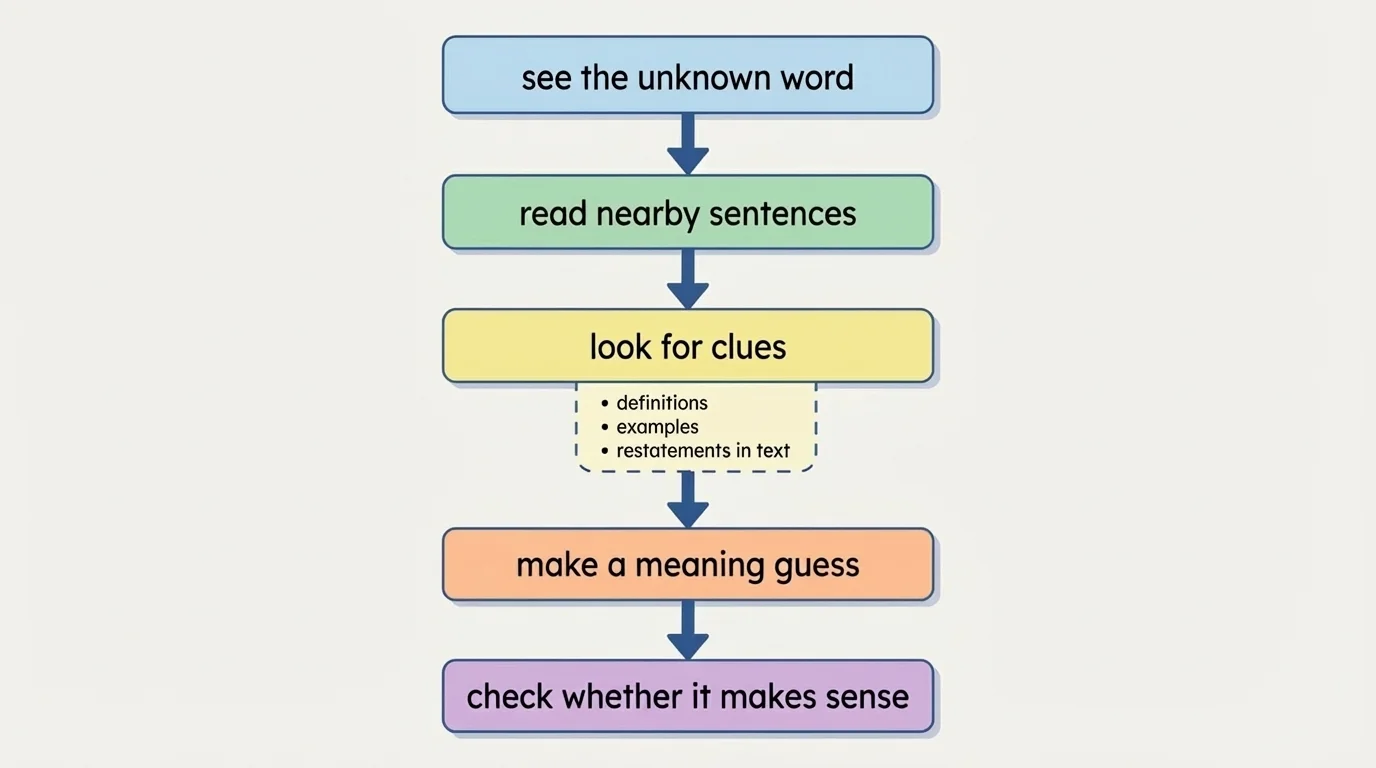
If your guessed meaning fits the sentence and the paragraph, it is probably close to correct. If it does not fit, try again. Good readers are willing to revise their thinking.
For example, read this sentence: "The puppy was reluctant to jump into the water; he backed away and hid behind the chair." The words "backed away" and "hid" suggest that the puppy did not want to jump in. So reluctant probably means unwilling or not eager.
Using context clues step by step
Sentence: "The glass vase was fragile, so Lena carried it with both hands and moved very slowly."
Step 1: Spot the unknown word.
The word is fragile.
Step 2: Read around it.
The sentence says Lena used both hands and moved very slowly.
Step 3: Find the clue.
People carry things carefully when they might break.
Step 4: Make a guess about the meaning.
Fragile probably means easy to break.
Step 5: Check the guess.
"The glass vase was easy to break" fits the sentence well.
The context clues lead to the meaning easy to break.
This process is useful in stories, articles, directions, and textbooks. The more you practice noticing clue words and sentence details, the faster your reading detective skills grow.
Now let us study each clue type more carefully. Seeing many examples helps you notice patterns during real reading.
Definition clue: "A habitat is the natural home of a plant or animal." The words after habitat directly define it. This is one of the easiest clue types to use.
Example clue: "During the storm, we needed provisions, such as water, crackers, canned soup, and batteries." The listed items help you infer that provisions are supplies.
Restatement clue: "The kitten was drowsy, or very sleepy, after playing all morning." The words "or very sleepy" restate the meaning in simpler language.
Synonym clue: "Jared was content with his score; he felt happy with how he had done." The phrase "felt happy" points to the meaning of content.
Antonym clue: "The first hike was easy, but the second one was strenuous and left us breathing hard." Because strenuous is compared with "easy," you can infer that it means hard or requiring a lot of effort.
General-sense clue: "The crowd began to murmur as the speaker took too long to begin, and a soft wave of whispering moved through the room." The details suggest a low, quiet kind of talking, even though there is no direct definition.
When you read longer passages, clues may be spread across several sentences. That is one reason careful rereading is so important. Earlier details and later details can work together.
Why the best clue is not always beside the word
Sometimes the strongest clue appears later in the paragraph, not right next to the unknown word. Skilled readers keep collecting information as they read, then return to the word and refine their guess about its meaning.
We saw earlier in [Figure 1] that clue types can be grouped into patterns. Knowing those patterns helps you notice whether the author is explaining, listing, comparing, or simply building a picture with details.
Some words are multiple-meaning words. That means the same word can have more than one meaning. Context helps you choose the right one.
As [Figure 3] shows, take the word bark. In one sentence, "The dog's bark woke the baby," the word means the sound a dog makes. In another sentence, "The bark of the tree felt rough," the word means the tree's outer covering. The letters are the same, but the surrounding words change the meaning.
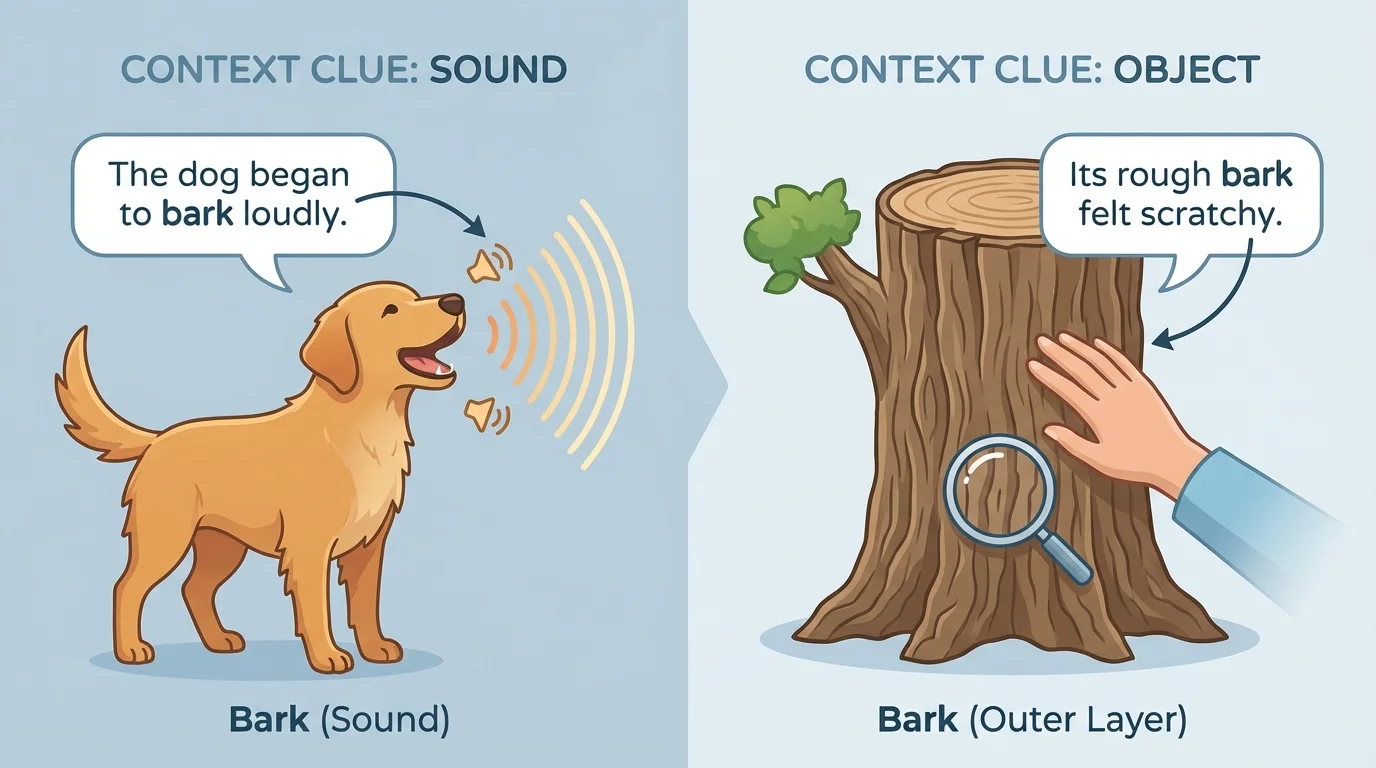
Look at another example with the word bat. "The bat flew out of the cave at dusk" means the flying animal. "Mia swung the bat and hit the ball" means the piece of sports equipment. The nearby words flew, cave, swung, and ball make the meaning clear.
Context also helps with phrases. If a story says, "After the long test, Jamal was all ears when the teacher said there would be extra recess," you know Jamal did not actually turn into ears. The phrase means he was listening very carefully.
Choosing the correct meaning of a multiple-meaning word
Sentence: "Please crane your neck so you can see over the fence."
Step 1: Think of possible meanings.
Crane can mean a bird or a machine, but it can also be used as an action word.
Step 2: Read the context.
The sentence mentions a neck and seeing over a fence.
Step 3: Match the meaning to the context.
Here, crane means to stretch or reach the neck forward.
The context tells which meaning fits.
When you meet a multiple-meaning word, do not stop at the first meaning you know. Ask yourself, "Does that meaning make sense here?" If not, look again at the context.
Sometimes context gives only a rough idea. You may understand that a word is positive or negative, or that it names a kind of object, but you may not know the exact meaning yet. That is normal.
When context is not enough, combine it with other strategies. Look at the word parts. A prefix, suffix, or base word may help. For example, in the word careless, the suffix -less means "without," so the word means "without care" or "not careful."
You can also reread, read farther, or use a dictionary after making a context-based guess. The key is that context gives you a strong starting point. It helps you think instead of giving up.
"The meaning of a word is often hiding in the company it keeps."
Readers use many strategies together. Context clues, word parts, and rereading are a team. If one strategy does not fully solve the problem, another can help.
Strong readers pay attention to signal words such as or, such as, for example, unlike, but, and that is. These words often introduce clues. For instance, such as often begins examples, and or may introduce a restatement.
They also stay flexible. Suppose you first think content means a book's topic because you know the word from "table of contents." But in the sentence about Jared feeling happy, that meaning does not fit. You revise your idea. Being willing to change your first guess is a sign of strong reading, not weak reading.
The contrast in [Figure 3] reminds us that one word form can lead to very different meanings. That is why the sentence, paragraph, and situation around the word matter so much.
As shown earlier in [Figure 2], the process works best when you slow down enough to test your best guess about the meaning. Readers who pause to check meaning understand more than readers who rush past confusing parts.
Over time, using context clues grows your vocabulary. Each time you figure out a word from reading, your brain stores new knowledge. Then, the next time you see that word, it feels more familiar.
