Have you ever read a sentence that made perfect sense until one tiny word stopped you? Maybe you saw the word crane. Was it a bird? A big machine? Or the action of stretching your neck? Strong readers do not guess forever. They use tools. Reference materials help readers unlock hard words, check pronunciation, and choose the exact meaning that fits the sentence.
When you read stories, articles, textbooks, or directions, you will meet words you do not know yet. Sometimes the word is completely new. Sometimes you have seen the word before, but it means something different in a new sentence. Reference materials give you a way to solve that problem carefully and accurately.
A good reader uses more than one strategy. You might look at the sentence around the word. You might break the word into parts. You might think about spelling patterns. Then, if you still need help or want to be precise, you can check a reference source. This helps you become more independent and more confident.
Reference materials are tools that help readers find information about words. They include dictionaries, glossaries, and thesauruses in both print and digital forms.
Pronunciation is the way a word is spoken aloud. A precise meaning is the exact meaning that fits the sentence or topic.
These tools are useful in every subject. In reading, they help with story words. In science, they explain special topic words. In social studies, they help with names, ideas, and phrases. In writing, they help you choose stronger and more accurate words.
A dictionary tells you what a word means and often shows how to say it. Many dictionaries also give the word's part of speech, such as noun, verb, or adjective. Some include example sentences.
A glossary is a list of important words and meanings, usually found in the back of a textbook or article collection. Glossaries are especially useful because they focus on the special words used in one subject. For example, a science glossary may explain words like evaporation or habitat.
A thesaurus helps you find words with similar meanings, called synonyms, and sometimes words with opposite meanings, called antonyms. A thesaurus is helpful when you want to understand small differences between words or improve your writing.
These tools can be printed in books or found online. A classroom dictionary, a textbook glossary, and a digital dictionary app are all examples of reference materials.
A dictionary entry has several important parts, and each part gives you a clue about the word. Learning to read all parts of the entry helps you do more than just pick the first definition you see.
[Figure 1] First, you find the headword, which is the main word listed in bold print. Near it, you may see the word divided into syllables. This can help you read longer words. You may also see a pronunciation guide. In a digital dictionary, you might see a speaker icon that lets you hear the word aloud.
Next, look for the part of speech. A word can act differently depending on how it is used. For example, play can be a verb in "We play outside," and a noun in "We watched a play." Then read the numbered definitions carefully. Dictionaries often list more than one meaning for the same word.
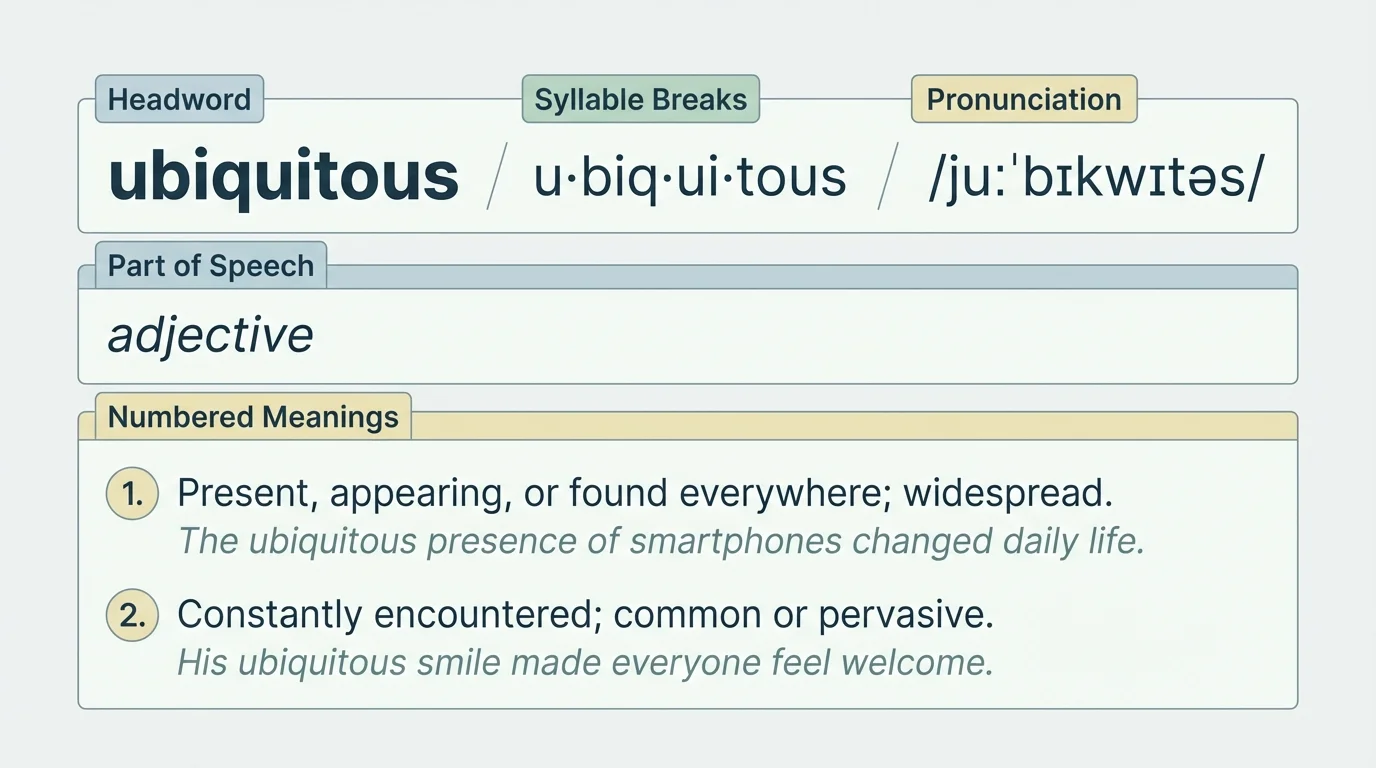
Guide words at the top of dictionary pages also help. They show the first and last word on the page. If you are looking for forest, and the guide words are fork and form, you know to keep looking because forest comes after form.
Alphabetical order matters when using print reference materials. To find a word, compare the letters one at a time. If two words begin with the same first letter, look at the second letter. If those match, look at the third letter, and so on. This is especially important for long words.
Reading a dictionary entry
Suppose you look up the word record.
Step 1: Read the pronunciation and part of speech.
You may notice that record is pronounced one way as a noun and another way as a verb.
Step 2: Read each definition.
One meaning may be "something stored so it can be remembered." Another may be "to write down or capture information."
Step 3: Match the sentence to the correct meaning.
In "Please record the score," the word is a verb. In "The swimmer broke the record," the word is a noun.
Reading the whole entry helps you choose the correct meaning and pronunciation.
The same careful reading matters later too. When you meet a word with several meanings, the labels and numbered definitions shown in the dictionary entry help you slow down and think instead of guessing.
Some words are multiple-meaning words, and context clues help you choose the right meaning. Context means the words and ideas around the word you are trying to understand.
[Figure 2] Look at these examples. In "The bat flew out of the cave at dusk," bat means an animal. In "She swung the bat and hit the ball," bat means sports equipment. The same spelling does not always mean the same thing.
Sometimes the topic helps too. In a science article, the word cell probably does not mean a tiny room in a jail. It probably means a small unit of life. In a math problem, the word table might mean a chart of information instead of a piece of furniture.
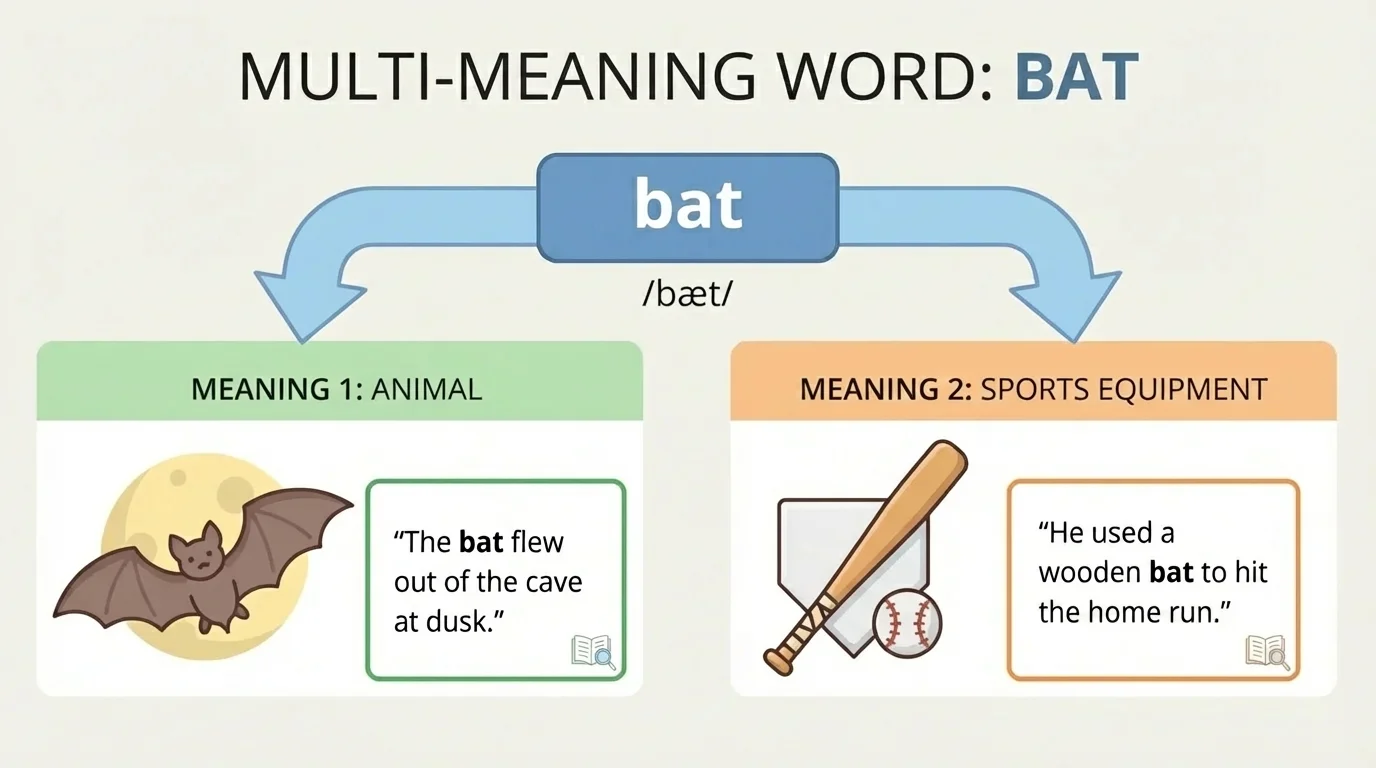
To find the right meaning, read the sentence before and after the unknown word. Ask yourself: What is happening? What subject is this text about? Which definition makes sense here? If one meaning sounds strange in the sentence, it is probably not the correct one.
Readers also use nearby clues such as pictures, headings, bold words, and examples. If an article is about weather and says "a cold front moved in," the word front does not mean the front of a line. The topic points to the weather meaning.
Choosing the best definition means combining two kinds of information: what the reference tool says and what the sentence says. A dictionary gives possible meanings, but the sentence tells you which one fits. Good readers use both.
This is why you should not automatically choose the first definition in the dictionary. You must compare the definitions to the sentence. The correct answer is the one that matches the context best.
A glossary is often the fastest tool when you are reading a textbook. It focuses on the words that are important for that subject. If you are reading about rocks, weather, or government, the glossary gives meanings that match that topic.
For example, a science book may define matter as anything that has mass and takes up space. In daily conversation, the word matter can also mean "something important." A glossary helps because it gives the special subject meaning you need right away.
Glossaries are useful for phrases too, not only single words. A social studies book might explain natural resources. A health book might define balanced diet. These exact phrases are easier to understand when you look them up in the place where they are used.
Many textbooks put glossary words in bold print the first time they appear. That small design choice helps readers notice important vocabulary and know that a definition is available.
Some digital textbooks let you tap or click a bold word to open the glossary meaning. That can save time and help you stay focused on the text.
A thesaurus is helpful when you want to compare words with similar meanings. For example, the word said may connect to words like whispered, shouted, or replied. These words are related, but they are not exactly the same.
This is important: synonyms are not always perfect substitutes. If a character whispered, that character is speaking softly. If a character shouted, that character is speaking loudly. Both are connected to speaking, but they create very different pictures in a reader's mind.
A thesaurus can also help you clarify meaning while reading. If you look up the word huge and see related words such as enormous and gigantic, you understand that the word describes something very large.
Using a thesaurus carefully
A student wants to replace the word happy in a sentence.
Step 1: Look up related words.
The thesaurus may list glad, cheerful, delighted, and pleased.
Step 2: Think about the strength of each word.
Delighted is stronger than glad. Cheerful describes a mood or attitude.
Step 3: Return to the sentence.
In "She felt happy after finding her lost dog," delighted may fit better than cheerful because the feeling is strong and joyful.
A thesaurus gives choices, but the sentence helps you choose wisely.
Good readers and writers use a thesaurus to compare shades of meaning, not to swap words without thinking.
Both print and digital references are useful in different ways, and knowing how to use both kinds makes you a more flexible reader.
[Figure 3] Print dictionaries and glossaries are excellent for learning alphabetical order and for seeing nearby words on a page. Sometimes looking at the words around your target word teaches you new vocabulary by accident. That is a helpful kind of discovery.
Digital tools are fast. You can type a word into a search bar, hear the pronunciation, and quickly compare definitions. Some digital dictionaries also include audio, sentence examples, word histories, or translation tools.
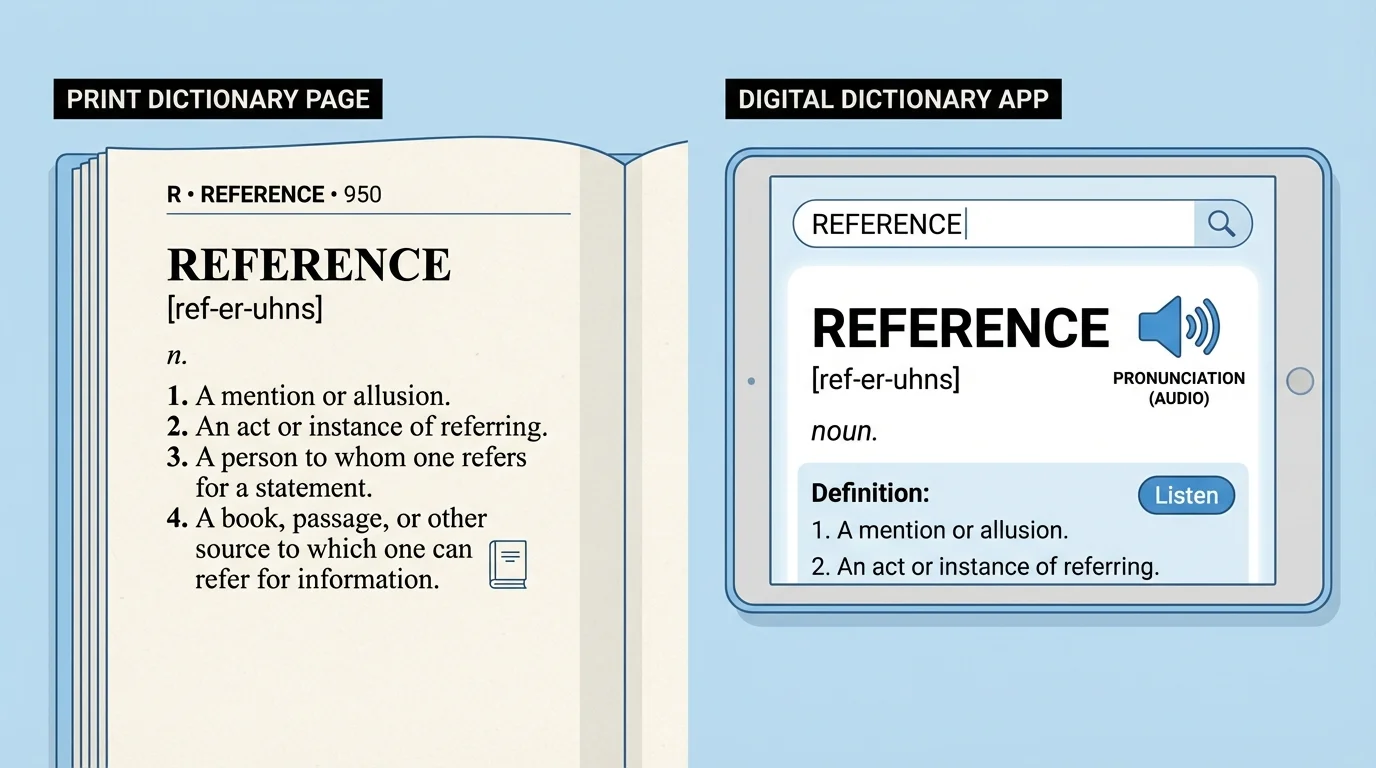
Even with digital tools, you should be careful. Make sure the source is trustworthy. A good dictionary site or school-approved app is better than a random website with unclear information.
Digital pronunciation tools are especially useful because they let you hear words spoken aloud. That helps with words whose spellings do not clearly show how they sound. When you later see those features again in print, you will better understand what the symbols and marks are trying to tell you.
| Tool | Best Use | Helpful Features |
|---|---|---|
| Dictionary | Find meaning and pronunciation | Definitions, syllables, part of speech, example sentences |
| Glossary | Learn subject-specific words | Topic meanings, textbook vocabulary, key phrases |
| Thesaurus | Compare similar words | Synonyms, antonyms, shades of meaning |
| Digital reference tool | Quick searching and audio support | Search bar, speaker icon, clickable entries |
Table 1. Comparison of common reference tools and the main job each one does.
Reference materials work even better when you also notice how words are built. Many long words can be understood by looking at prefixes, roots, and suffixes. A prefix is a word part added to the beginning of a word. A suffix is added to the end.
For example, in unhappy, the prefix un- means "not." In careful, the suffix -ful means "full of." If you read careless, the suffix -less means "without." These clues help you make a smart guess before checking a reference source.
You can also break multisyllable words into smaller parts. The word information can be read in chunks: in-for-ma-tion. This helps with decoding, which means reading the word correctly. Once you can say it, you may recognize it or be able to look it up more easily.
When you learned to read longer words, you used syllables and familiar spelling patterns to sound them out. Those same skills still matter now. Reference tools do not replace decoding; they work together with it.
Sometimes a word changes form. If you cannot find running in a print dictionary, try the base word run. If you cannot find happiest, try happy. Thinking about the base word makes searching easier.
Skilled readers choose strategies flexibly. That means they do not always use the same tool first. They think about the kind of problem they have.
If you do not know how to say a word, a dictionary is a strong choice. If you are reading a textbook and need a subject meaning, the glossary may be best. If you understand the basic meaning but want a more exact or stronger word, a thesaurus can help.
Here is a useful plan. First, read the sentence and the nearby sentences. Second, look for word parts and spelling clues. Third, decide which reference tool fits your need. Fourth, read carefully and check whether the meaning makes sense in the original sentence.
Flexible strategy in action
You read the sentence: "The desert plants can survive in arid conditions."
Step 1: Use context.
The sentence talks about desert plants, so the word likely describes the desert environment.
Step 2: Think about what kind of help you need.
You need the exact meaning of arid, so a dictionary or glossary is more useful than a thesaurus.
Step 3: Check the reference source.
You find that arid means very dry.
Step 4: Return to the sentence.
Now the sentence makes sense: desert plants can survive in very dry conditions.
This process turns confusion into understanding.
When a phrase is confusing, use the same idea. Look up the whole phrase if possible, especially in a glossary. Some meanings change when words are grouped together.
These skills are not only for language arts class. If you read game instructions, recipes, science articles, news for kids, or museum signs, you may need to check pronunciation or meaning. Accurate word knowledge helps you understand the whole text better.
Suppose you are reading about animals and find the word nocturnal. A dictionary helps you pronounce it. A glossary in a science book may tell you that it means active at night. Then, if the article says owls hunt after dark, the meaning fits perfectly.
Or maybe you are reading a story in which a character gives a stern look. A thesaurus can help you compare related words like serious, strict, and severe. That gives you a more precise picture of the character's face and mood.
"The right word can make understanding click into place."
Strong readers do not stop at a partial understanding of a word. They check pronunciation, compare meanings, and choose the exact one that fits. That careful habit makes reading clearer, writing stronger, and learning easier in every subject.
