Have you ever started a book and thought, "Uh-oh, now what will happen?" That feeling is one reason stories are so exciting. Authors do not just put random events on a page. They build a story step by step so that a problem begins, grows, becomes serious, and finally gets solved. When readers understand how that happens, they understand the story much better.
When we describe the development of plot, we explain how the story moves from the beginning problem to the ending solution. We pay attention to the central conflict, the important actions in the middle, the biggest moment, and the ending. Good readers notice not only what happens, but also why each event matters.
A plot is the sequence of events in a story. It is what happens and the order in which it happens. Stories often move through connected parts, as [Figure 1] shows, from the beginning of the problem to the ending of the story.
Plot is more than a list of events. The events must connect to one another. One action leads to the next. If a girl loses her library book, she may search her room, ask a friend for help, and rush to the library before it closes. Each event grows out of the one before it. That connection is what makes plot feel meaningful.
Many stories have a beginning, middle, and end. In the beginning, readers meet the characters and setting, and they often learn about a problem. In the middle, the problem grows and the character tries to deal with it. In the end, the problem is resolved in some way.
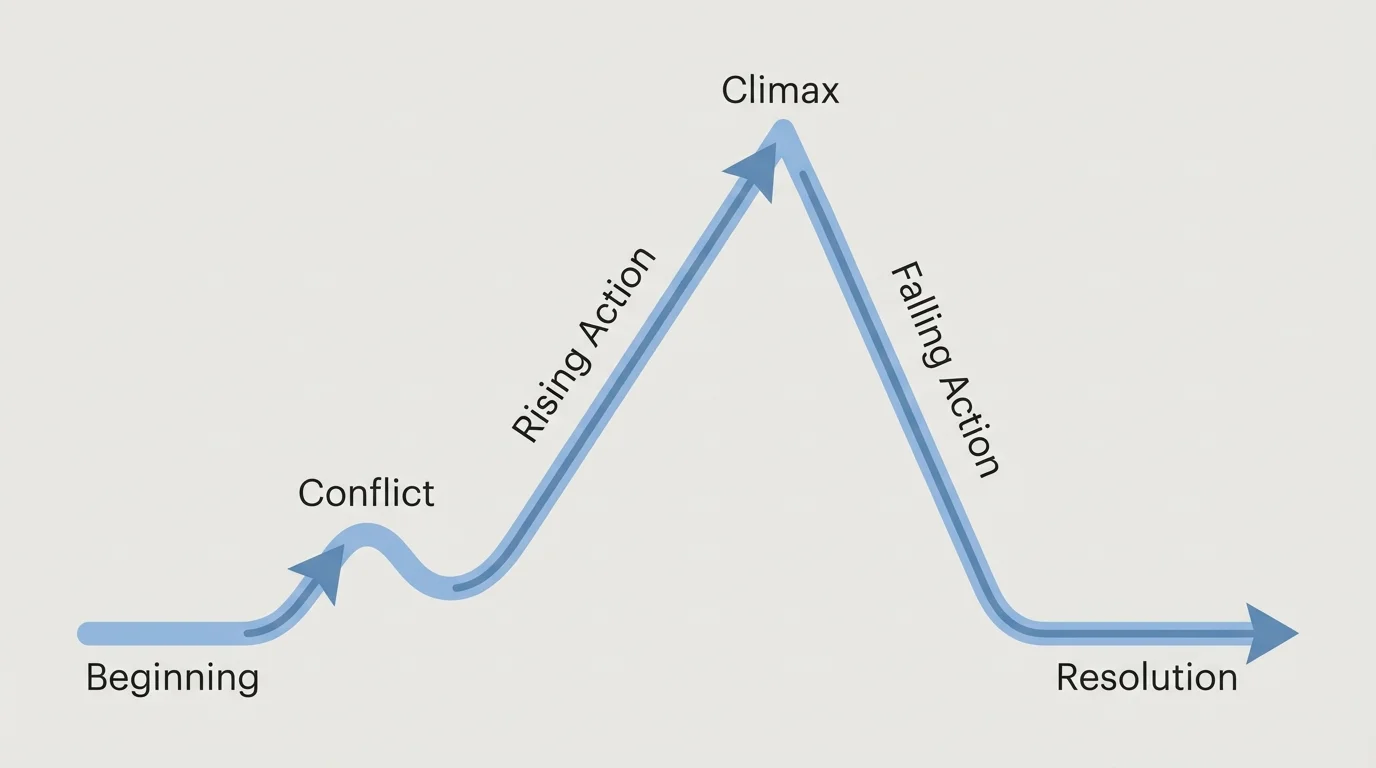
Readers sometimes use special words for parts of the plot. These include exposition, rising action, climax, and resolution. You do not always need to use every one of these words when talking about a story, but knowing them helps you explain plot clearly.
Central conflict is the main problem in a story. Rising action is the series of events that make the problem grow. Climax is the biggest, most intense moment in the story. Resolution is the part where the conflict is solved, settled, or brought to an end.
Think of plot like a trail on a hike. You start at one place, move through twists and turns, reach the highest point, and then come down at the end. If you skip the middle of the trail, you miss the adventure. The same is true when you skip important plot events while describing a story.
The conflict is the engine that pushes the story forward, and [Figure 2] illustrates how it begins when a character has a goal but meets a problem. The central conflict is the main problem the character faces.
The origin of the conflict means how the problem starts. Sometimes it begins because a character wants something. A boy may want to join the basketball team. A girl may want to protect a lost puppy. A family may want to get home before a storm. Then something stands in the way. That is the start of the conflict.
Conflict can begin in different ways. A character may struggle against another person, against nature, against a difficult situation, or even against his or her own fear. For fourth-grade readers, it is helpful to ask, "What does the character want?" and "What is stopping the character?" The answers often reveal the central conflict.
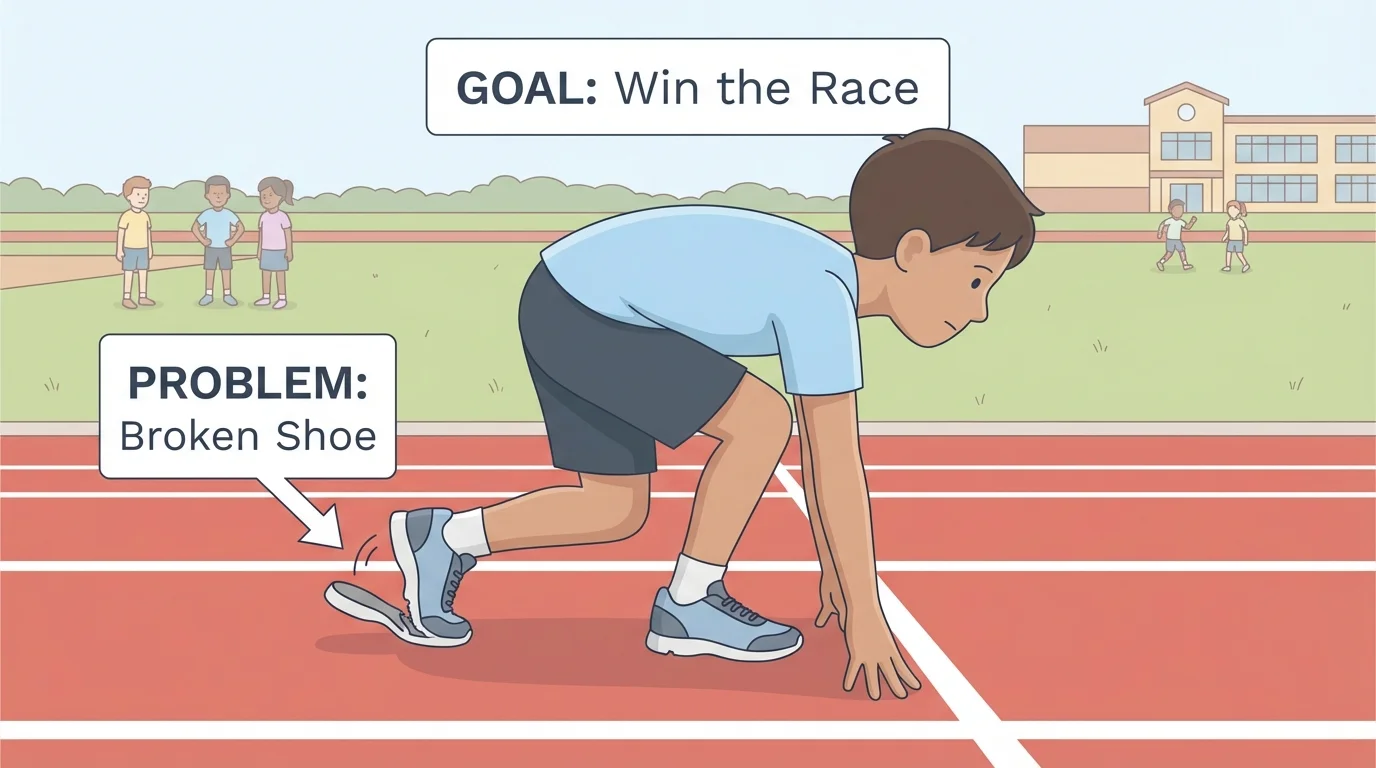
Here is a simple example. Luis wants to win the school race. On race morning, one of his shoes tears. Now he has a problem. The conflict begins because his goal and the obstacle come into conflict. Without the torn shoe, there might not be much of a story.
The setting can also help create the conflict. A problem in a snowy mountain village feels different from a problem in a busy city apartment. If a story takes place during a thunderstorm, at a crowded fair, or in the middle of a forest, the setting can make the conflict harder or more exciting.
How conflict gives a story direction
When readers know the main problem, they know what to watch for. Every important action can be connected back to that problem. If the story is about finding a missing cat, readers pay attention to clues, searches, mistakes, and discoveries. The conflict acts like a question: Will the character solve the problem? Readers keep going because they want the answer.
Not every small problem in a story is the central conflict. A character might spill juice, miss a bus, and forget a notebook, but if the main story is really about earning a friend's trust again, then that larger problem is the central conflict. Good readers look for the biggest problem, not just every tiny trouble.
After the conflict begins, the story moves into the action of the plot. This part is often called the rising action. These are the events that build the story and make the problem more challenging.
In rising action, characters make choices, face obstacles, and react to what happens. Each event should matter. If Ana is trying to win the spelling bee, the action might include studying after school, mixing up difficult words, getting nervous on stage, and hearing a surprise word in the final round. These events build suspense because readers wonder what will happen next.
Authors often use rising action to show suspense. Suspense is the feeling of waiting and wondering. It keeps readers interested. A story becomes exciting when events grow more difficult or important over time.
Not all action means running, shouting, or danger. In some stories, the action is quiet but still important. A character might read an old letter, overhear a conversation, or decide whether to tell the truth. Even a small choice can move the plot forward if it changes what happens next.
When you describe the action of the plot, include only the important events. You do not need every detail. If a story says that a character ate breakfast, tied a shoe, and looked out the window, those details may not matter unless they connect to the conflict. Focus on events that help the problem grow, change, or move toward a solution.
| Story Part | What It Does | Question to Ask |
|---|---|---|
| Beginning | Introduces characters, setting, and problem | Who is in the story, and what starts the trouble? |
| Rising action | Builds events around the conflict | What happens that makes the problem bigger? |
| Climax | Shows the biggest moment | What is the turning point? |
| Resolution | Shows how things end | How is the problem solved or settled? |
Table 1. Main parts of plot and the questions readers can ask about each part.
As you saw earlier in [Figure 1], the middle of a story usually stretches across the largest part of the plot. That is because stories need time to build tension. If a problem starts and ends too quickly, the story may feel flat.
At some point, the story reaches a turning point. This is the moment when the character must face the conflict directly. That biggest moment is called the climax.
The climax is often the most emotional or exciting part of a story. In an adventure story, it may be the moment the hero opens the hidden door. In a realistic story, it may be the moment a student stands up in front of the class and tells the truth. The climax does not have to be loud or dramatic. It simply has to be the moment that matters most to the conflict.
Readers can find the climax by asking, "When does the main problem come to its biggest point?" If the story is about whether Jalen will return a lost wallet, the climax may be when he finally decides what to do and acts on that decision. That moment changes everything that follows.
Some stories make the climax very close to the end, while others give more time after it. Authors choose this on purpose so the ending feels just right for the kind of story they are telling.
The climax matters because it connects all the earlier events to the ending. The choices, mistakes, clues, and struggles in the rising action lead to that one important point. If you miss the climax when describing plot, you miss the heart of the story.
After the climax, the story begins to settle. The main problem is solved, answered, or at least brought to an end. This part is called the resolution.
Sometimes the resolution is happy. The lost dog is found. The friends forgive each other. The team works together and wins. Sometimes the resolution is not exactly happy, but it still gives an answer. A character may not get what he wanted, but he may learn something important or change in a meaningful way.
When readers explain how the conflict is resolved, they should connect the ending to the earlier problem. For example, if the conflict began because Nia was afraid to perform in the school concert, the resolution should explain what happened with that fear. Did she sing anyway? Did she ask for help? Did she decide to play an instrument instead? The ending should answer the problem the story raised.
Some stories end with every question answered. Others leave a little mystery. But even when an ending is quiet or partly open, readers can still usually tell how the central conflict has changed.
When you retell a story, do not jump straight from the problem to the ending. Include the important events in between. Those middle events explain how the character reaches the resolution.
A weak plot explanation might say, "The girl had a problem, and then it was fixed." A strong explanation shows the sequence of events: "The girl discovered the garden was drying out, tried several ways to save it, asked neighbors for help, and finally built a watering schedule with her class." That version shows development.
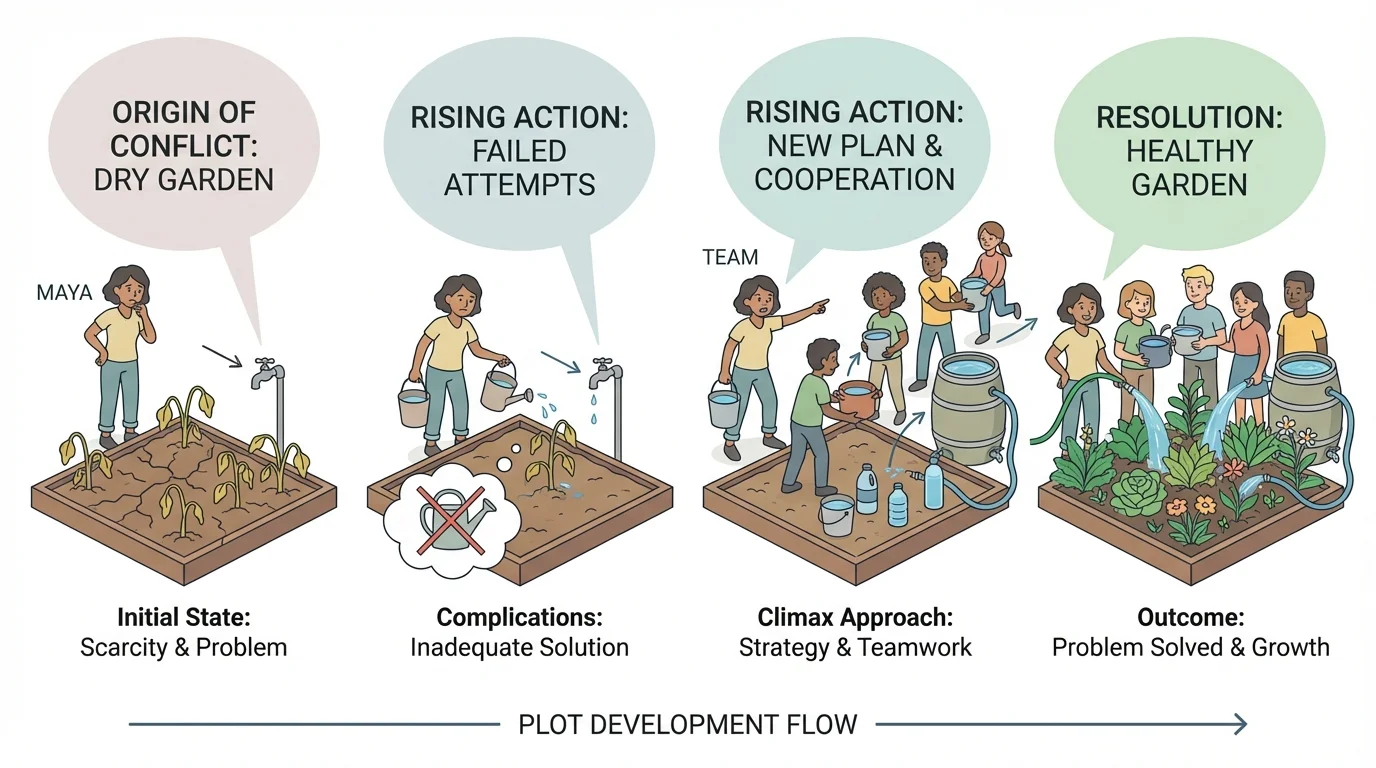
Let's trace the plot of an example story together. As [Figure 3] illustrates, readers can follow the conflict from its start through the important actions and into the ending. This makes it easier to describe plot clearly instead of giving a confusing retell.
In the story, Maya helps care for the school garden. One hot week, the garden begins to dry out because the hose is broken. This is the origin of the conflict. Maya wants to save the plants, but she does not have the water she needs.
Next comes the rising action. Maya carries small buckets of water, but that is too slow. She asks the custodian for tools, but the needed part has not arrived. She then notices that some classrooms pour leftover water from drink bottles into the sink. Maya gets an idea and asks her teacher if students can collect extra clean water in a large container.
The action keeps building. Some students forget. The container tips over one afternoon. Maya starts to worry the plants will die before the hose is fixed. Then she makes signs, explains the problem to other classes, and creates teams to help each day.
The climax happens when Maya presents her plan at a school assembly and asks everyone to help save the garden for one more week. This is the biggest moment because the success of her plan depends on whether the school joins in.
The resolution comes when students and teachers work together, the plants survive, and the hose is repaired a few days later. Maya's problem is resolved because the garden is saved. The ending also shows that Maya learned how teamwork can solve a hard problem.
Example: Describing the plot of Maya's garden story
Step 1: Name the central conflict.
Maya wants to save the school garden, but the hose is broken and the plants are drying out.
Step 2: Tell the important actions in order.
She carries buckets, asks for tools, notices wasted water, and creates a plan to collect clean leftover water.
Step 3: Identify the climax.
The biggest moment is when Maya asks the whole school to help.
Step 4: Explain the resolution.
The school works together, the garden survives, and the hose is later fixed.
This kind of explanation is clear because it focuses on the main problem, the key events, and the ending.
Later in the lesson, when you think again about the story sequence in [Figure 3], notice that every major event connects to the same central conflict. That is one sign of a strong plot.
When describing plot, use time-order words such as first, next, then, and finally. These words help your listener or reader follow the story in order.
It is also important to keep your explanation focused. Tell the most important events, not every small detail. If you include too much, the main plot can get buried. If you include too little, the story may not make sense.
A clear plot description often answers these questions: Who is the main character? What is the central conflict? How does the conflict begin? What important events happen next? What is the climax? How is the conflict resolved?
Here is the difference between weak and strong plot description. Weak: "Sam had a bad day at school." Strong: "Sam forgot his science project at home, tried to solve the problem before class, asked his brother to bring it, and finally gave his presentation just in time." The strong version shows the development of plot.
Why order matters
If you mix up events, the plot can sound confusing. Saying the ending before the main problem makes the story harder to understand. Readers describe plot best when they follow the story's order and show how each event causes the next one.
When authors use flashbacks or move in time, readers may need to work carefully to put events in order. Even then, the plot still develops from conflict to action to resolution. Strong readers can figure out the real order of important events.
Not all stories develop in exactly the same way. Some plots move quickly, with problems appearing almost at once. Others build slowly and spend more time showing characters and setting before the conflict begins.
Some stories have more than one problem, but one conflict is usually the most important. For example, a character might be training for a swim meet while also trying to repair a friendship. One of those may become the central conflict, while the other supports it.
Some resolutions are surprising. Others are predictable in a satisfying way. A mystery story may hide clues until the end. A family story may focus more on feelings and choices. Even though the style changes, readers can still ask the same key questions about conflict, action, climax, and resolution.
When you compare stories, you may notice that plot development shapes the mood. A fast-moving plot can feel urgent. A slower plot can feel thoughtful. The author chooses the pace to create a certain effect.
"Every story is a journey from a question to an answer."
That idea fits plot well. The question often begins with the conflict: Will the hero succeed? Will the truth come out? Will the friendship survive? The answer appears in the resolution.
Plot matters because it helps readers understand character growth. A character often changes because of the events in the story. The conflict tests the character, and the resolution reveals what the character has learned.
Plot also helps readers understand a story's message or theme. If a plot shows a character solving a problem by asking for help, the story may suggest that teamwork is powerful. If the plot shows a character finally telling the truth, the theme may involve honesty and courage.
When you study stories, you become a stronger reader by paying attention to how the plot develops. You notice how a problem starts, how the middle events build toward the most important moment, and how the ending connects back to the beginning. The simple shape shown earlier in [Figure 1] can help you remember that good plots grow in organized, meaningful ways.
