Have you ever heard someone read a story so well that the characters seemed to come alive? The words on the page do not change, but the voice makes a huge difference. A strong reader does more than say the words. A strong reader helps listeners hear the feeling, meaning, and action in the text. When you read a familiar text orally with fluency, accuracy, and prosody, you sound more like a storyteller than a robot.
Reading aloud is an important part of becoming a better reader. It helps you connect printed words to spoken language. It also helps you notice punctuation, sentence structure, and the way ideas flow together. When a text is familiar, you can spend less energy figuring out what the words say and more energy thinking about how the text should sound.
Oral reading also supports understanding. If you pause in the wrong place or read every sentence in the same flat voice, the meaning can get lost. But when you read smoothly and naturally, your voice can show excitement, surprise, sadness, humor, or seriousness. That helps both you and your listeners understand the text better.
Professional actors, news reporters, and audiobook narrators all practice oral reading. They do not just read words correctly. They study meaning so their voices match the message.
Even though oral reading is something we hear, it begins with thinking. Good readers pay attention to what the author is saying and how the author says it. They notice punctuation marks, repeated words, dialogue, and details that reveal mood. Then they use their voices to bring those clues to life.
Strong oral reading has three main parts, and [Figure 1] shows how they work together: fluency, accuracy, and prosody. These parts are connected. If one part is weak, the reading may be harder to understand.
Fluency means reading smoothly, at a natural pace, and with phrasing that makes sense. A fluent reader does not stop too often, rush wildly, or sound choppy.
Accuracy means reading the words correctly. An accurate reader says the right words, pays attention to endings such as -ed or -s, and notices when something does not sound right.
Prosody means reading with expression. It includes changes in voice, stress, pitch, and pauses. Prosody helps show feelings, meaning, and the shape of sentences.
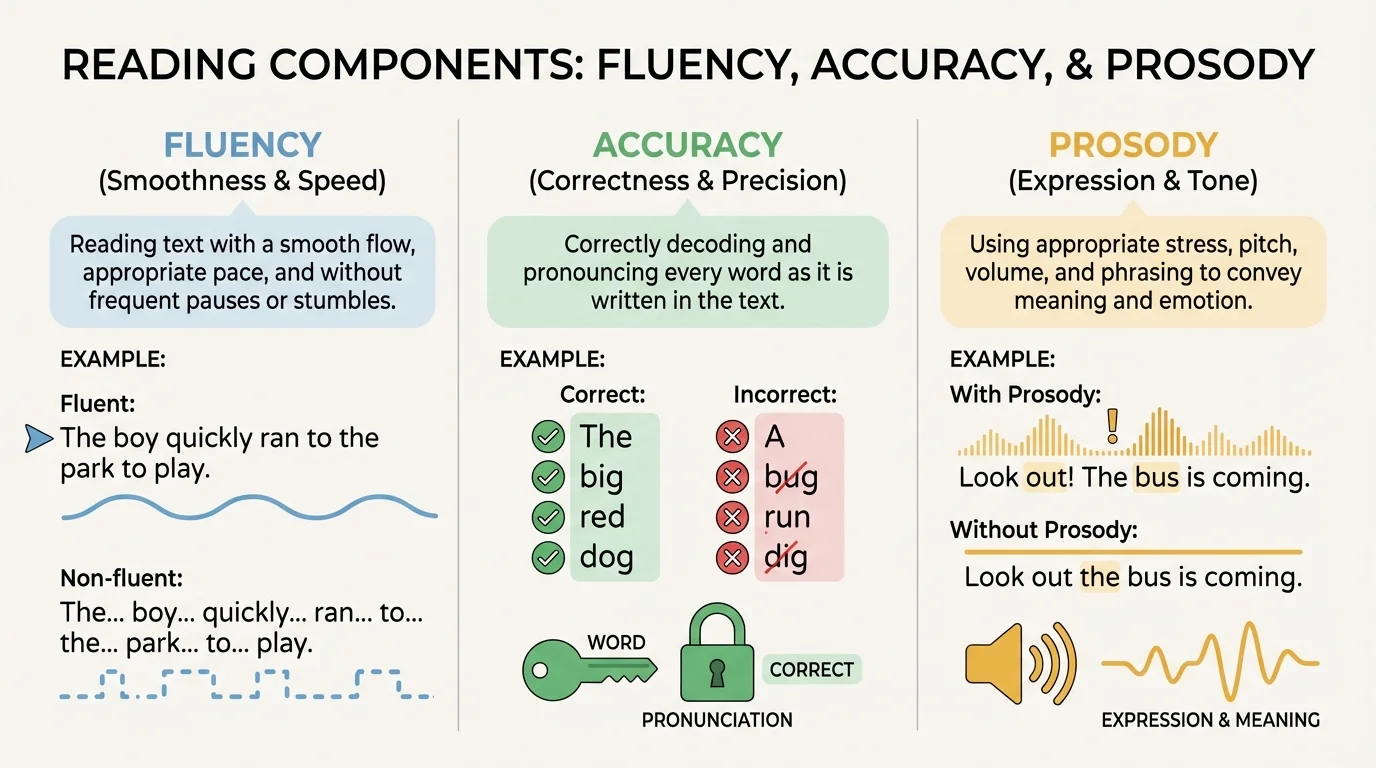
Think of oral reading like riding a bike. Accuracy is steering in the right direction. Fluency is moving steadily without wobbling. Prosody is riding with confidence and style. You need all three to make the ride work well.
Fluency is reading smoothly and at a natural pace. Accuracy is reading the words correctly. Prosody is reading with expression that matches the meaning of the text.
When these three parts work together, a reader sounds prepared and thoughtful. Later, when you think about how a story feels or what a character means, the same three parts still matter, as we saw in [Figure 1]. Smooth, correct, expressive reading supports comprehension because it reflects understanding.
Fluency is not the same as reading fast. Some students think fluency means racing through a passage. It does not. A fluent reader reads at a pace that sounds natural. If the text is exciting, the pace may move a bit faster. If the text is serious or full of important details, the pace may slow down. The goal is not speed alone. The goal is smooth meaning.
Fluent readers group words into phrases instead of reading one word at a time. Listen to the difference. A choppy reading might sound like this: "The / little / fox / ran / into / the / dark / woods." A fluent reading groups the words naturally: "The little fox / ran into the dark woods." The second version is easier to understand because the phrasing matches the meaning.
Punctuation helps with fluency. Periods tell readers to stop. Commas often signal a shorter pause. Question marks can change the sound of the voice. Exclamation points may add energy or surprise. Paying attention to punctuation helps a reader know when to pause and how long the pause should be.
Fluency also grows when a reader becomes familiar with the text. The first reading may include stops and hesitations. The second or third reading is often smoother because the reader already knows what is coming next. Familiarity frees the mind to focus on expression and meaning.
Example of choppy and fluent reading
Sentence: After the rain stopped, the birds began to sing in the bright morning light.
Step 1: A choppy reading breaks the sentence into too many small pieces.
It might sound like: After / the rain / stopped / the birds / began / to sing / in the bright / morning light.
Step 2: A fluent reading groups words by meaning.
It sounds more like: After the rain stopped, / the birds began to sing / in the bright morning light.
The fluent version is smoother because the phrases match the ideas in the sentence.
A reader can build fluency by noticing where ideas belong together. If several words describe one action or one picture, they often belong in the same spoken phrase. This skill becomes especially helpful when reading stories with longer sentences.
Accuracy means saying the words the author wrote. That may sound simple, but it takes careful attention. A reader must look closely at letters, word parts, and endings. Missing a small part of a word can change the meaning. For example, reading jump instead of jumped changes the time of the action. Reading horse instead of house changes the whole picture.
Accurate readers use what they know about spelling patterns, syllables, and word families. In familiar texts, many of the words are already known, so the reader can focus on reading them clearly and correctly. If a word does not sound right, strong readers often stop and self-correct.
Self-correction is an important reading habit. If a sentence says, "The kitten curled up on the warm blanket," but a reader says "The kitten called up on the warm blanket," the sentence may sound strange. A thoughtful reader notices the mistake, goes back, and fixes it. That is a sign of strength, not weakness.
Accuracy also includes little words. Sometimes readers skip words such as the, a, to, or of because they are small and common. But these words matter. They help sentences make sense. Careful eye tracking helps readers move across each line without leaving words out.
When you decode a word, you use letter sounds, chunks, syllables, and meaning clues to read it. Those same skills support accurate oral reading.
Accuracy supports fluency. If a reader keeps misreading words, the reading will not sound smooth. Accuracy also supports prosody. It is hard to read with expression if the words themselves are not correct.
Prosody gives oral reading its life. It includes the way your voice rises, falls, pauses, and stresses important words. Punctuation and dialogue give strong clues, and [Figure 2] illustrates how readers use those clues to decide whether a line sounds excited, calm, curious, worried, or dramatic.
When readers use prosody, they do not make every sentence sound the same. A question often has a different voice from a statement. A character whispering sounds different from a character shouting. A sad scene should not sound cheerful. The reader's voice should match the meaning and mood of the text.
Dialogue especially needs prosody. If a story says, "Run!" shouted Maya, your voice should sound urgent. If it says, "I am not sure," Liam whispered, your voice should become softer and more uncertain. Expression helps listeners understand what kind of moment is happening.
Readers also use stress to highlight important words. Compare these two ways of saying the same sentence: "I didn't say he stole the book." If you stress I, the meaning shifts. If you stress he, the meaning shifts again. Stress shows which idea matters most.
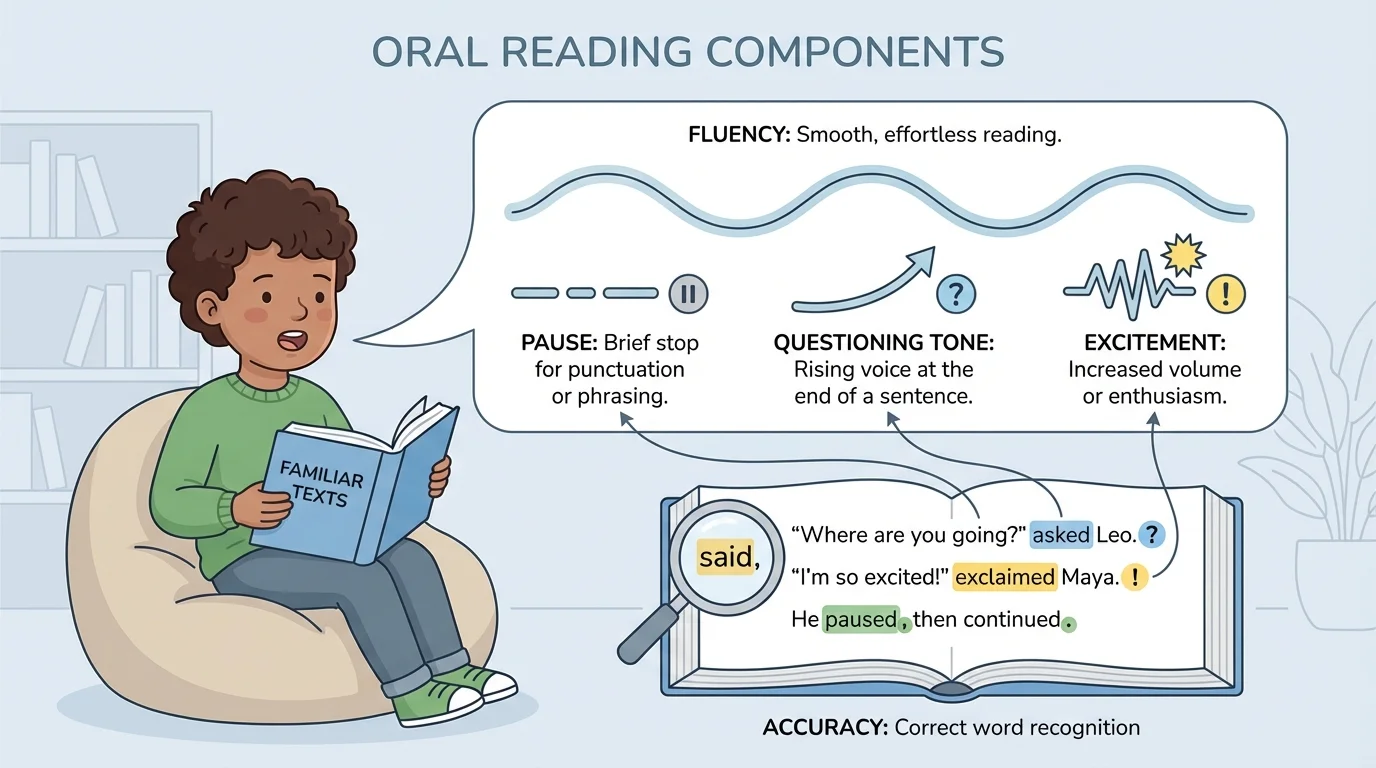
Prosody is not acting in a silly or exaggerated way. It is reading naturally so the voice fits the text. Good prosody sounds meaningful, not overdone. You do not need to perform wildly. You need to read thoughtfully.
Example of how punctuation changes the voice
Look at these three sentences with the same words:
Step 1: You are coming.
This sounds like a statement. The voice ends firmly.
Step 2: You are coming?
This sounds like a question. The voice shows uncertainty or surprise.
Step 3: You are coming!
This sounds excited or strongly emotional. The voice has more energy.
The words stay the same, but prosody changes the meaning listeners hear.
As we saw earlier in [Figure 2], punctuation marks are not just symbols on a page. They guide a reader's voice. They tell you when to stop, wonder, announce, or react.
Strong oral readers usually do some quiet thinking before they begin. They preview the text. They look at the title, the punctuation, and the way the lines are arranged. In a story, they may notice dialogue. In a poem, they may notice line breaks. In a play, they may notice who is speaking.
They also think about meaning. Who is talking? What is happening? Is the mood funny, serious, exciting, or mysterious? If a reader understands the text first, the oral reading becomes stronger. Expression grows from comprehension.
Another useful habit is to notice tricky parts ahead of time. Maybe there is a long name, a sentence with many commas, or a line of dialogue that changes emotion quickly. A prepared reader pays extra attention to those places. That makes the final reading smoother.
Some readers lightly mark their text when allowed. They may draw a slash where a pause belongs, underline a word to stress, or circle a difficult word. These marks are not decorations. They are reminders that help the voice match the meaning.
Preparation turns reading into interpretation. When a text is familiar, the reader can move beyond simply saying the words and begin showing what the text means. That is why preparation matters so much in literary reading. It helps the reader notice character feelings, mood, and important moments.
Preparation is especially helpful with literary texts because stories often contain feelings, character voices, and changes in mood. A calm beginning may lead to a tense middle and a joyful ending. A reader who notices these changes can shape the voice to fit each part.
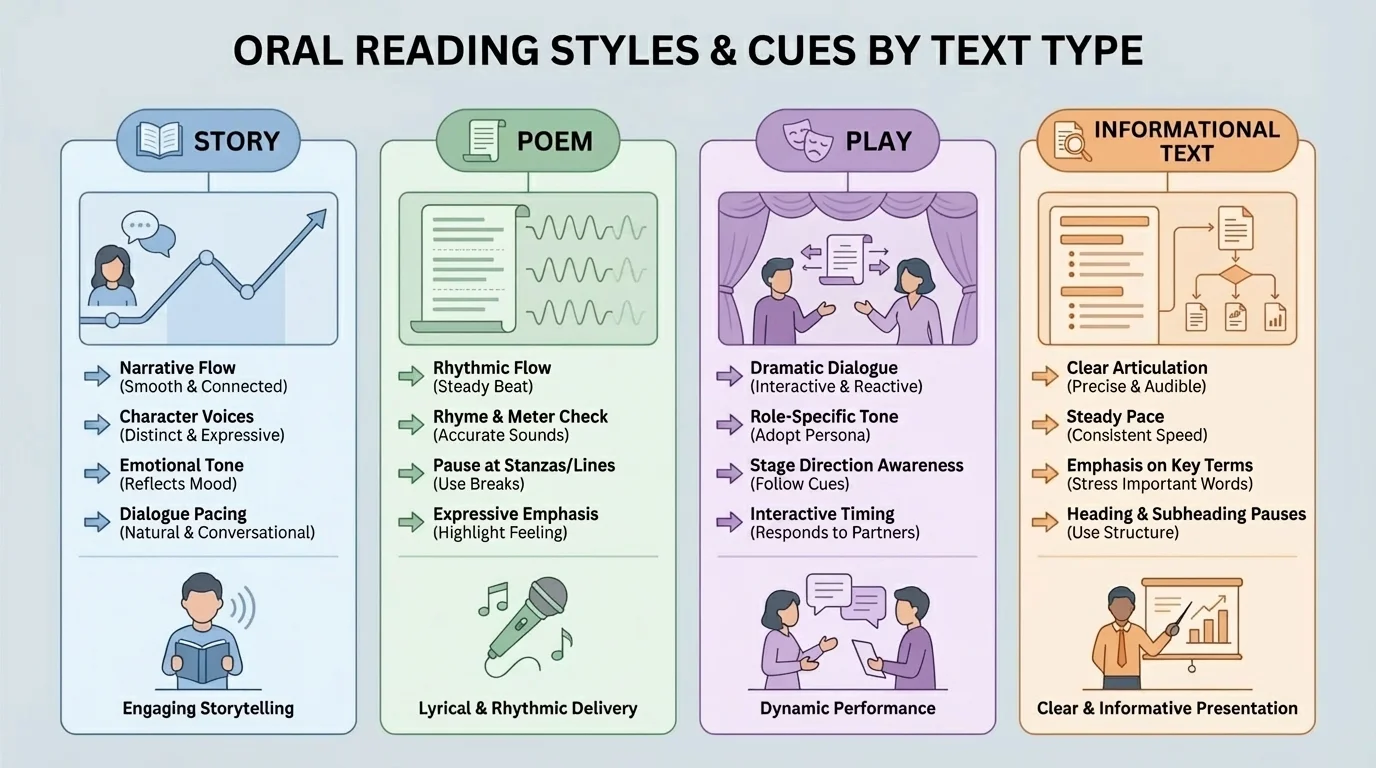
Not every text should sound the same. A story, a poem, a play, and an informational paragraph each call for slightly different choices in pace, phrasing, and expression.
[Figure 3] In a story, readers often change expression to match character feelings and events. If the hero is sneaking through a cave, the voice may become slower and quieter. If the hero escapes danger, the pace may quicken with excitement.
In a poem, readers pay attention to rhythm, repeated sounds, and line breaks. Poems often need careful pacing. Reading too quickly can hide their music. Reading too slowly can break the flow. The reader listens for the poem's beat and mood.
In a play, oral reading is especially important because plays are written to be spoken. A reader must notice who is speaking and how each character might sound. Different characters should not all sound exactly alike if the text gives clues that they feel different things.
In an informational text, the expression may be less dramatic, but it still matters. Important facts, headings, and details should sound clear and organized. The reader may pause after big ideas so listeners can understand the information.
| Text type | What the reader pays attention to | How the voice may sound |
|---|---|---|
| Story | Characters, events, mood | Expressive and changing with the action |
| Poem | Rhythm, line breaks, repeated sounds | Careful, musical, and paced |
| Play | Speaker, dialogue, emotion | Character-based and dramatic |
| Informational text | Main ideas, details, clear phrasing | Steady, clear, and organized |
Table 1. Different text types and the oral reading choices they encourage.
Later, when a reader interprets literary texts, these differences matter a lot. A poem asks for different oral choices than a scene from a play. As shown in [Figure 3], effective readers adjust their voices because the structure and purpose of the text are different.
Strong oral readers build helpful habits over time. They hold the text where they can see it easily. They sit or stand in a way that supports clear speaking. They keep their eyes moving forward through the sentence so they are ready for what comes next.
They also listen to themselves. If something sounds strange, they check it. If a sentence feels too fast, they slow down. If an important word needs emphasis, they try again with better stress. Good readers are not perfect on the first try every time. They are responsive and thoughtful.
Rereading is one of the strongest habits of all. A first reading helps with word recognition. A second reading often improves fluency. A third reading can deepen prosody because the reader now understands the meaning more fully. Familiarity supports confidence.
Many musicians practice the same piece again and again before a performance. Readers do something similar with oral reading. Repeated practice makes the final performance smoother and more expressive.
Another strong habit is paying attention to the audience. If listeners seem confused, the reader may need to speak more clearly, slow down, or increase expression. Oral reading is communication, not just saying words.
Reading familiar texts aloud is not only about sounding good. It is also about making meaning. When you read with fluency, the ideas flow together. When you read with accuracy, the author's words stay correct. When you read with prosody, the voice reflects feeling and purpose. These three parts help reveal what the text is saying.
This is especially important in literary texts. Stories, poems, and plays often depend on tone, character feeling, and mood. A flat voice can hide those things. An expressive voice can reveal them. For example, if a character says, "That is just great," the meaning changes depending on whether the voice sounds sincere or frustrated. Oral reading helps readers notice those differences.
Good oral reading also helps with interpretation. Interpretation means thinking about what a text means, not just what it says. If you pause dramatically before an important sentence, stress a repeated word, or soften your voice in a sad scene, you are showing your understanding of the text. You are making choices based on meaning.
"Readers use their voices to show what the words mean."
That is why familiar texts are valuable for oral reading practice. Because the words are already known, the reader can focus on bringing out the author's meaning. Oral reading becomes a bridge between decoding words and interpreting literature.
